QUALITÀ & PUREZZAMoligand™?Moligand™ — Aladdin's line of ligands and bioactive small molecules. Use for receptor, pathway, and binding studies needing defined small-molecule tools.≥96%
This compound belongs to the class of organic compounds known as 1,2-aminoalcohols. These are organic compounds containing an alkyl chain with an amine group bound to the C1 atom and an alcohol group bound to the C2 atom.
External Descriptors
Not available
1. Djoumbou Feunang Y, Eisner R, Knox C, Chepelev L, Hastings J, Owen G, Fahy E, Steinbeck C, Subramanian S, Bolton E, Greiner R, and Wishart DS. ClassyFire: Automated Chemical Classification With A Comprehensive, Computable Taxonomy. Journal of Cheminformatics, 2016, 8:61.
Determine the necessary mass, volume, or concentration for preparing a solution.
Dilution Calculator
Determine the dilution needed to prepare a stock solution.
Reconstitution Calculator
Recensioni
Recensioni dei clienti
Application Protocols
Not applicable. No validated bioassay, immunoassay, or analytical protocols are provided for this item. For synthetic applications, refer to the Reaction & Applications and Reaction Conditions sections for general guidance and adapt to your system.
Biological Roles
General biochemical context (literature; not item-specific)
L-Leucinol is the reduced alcohol analog of the essential amino acid L-leucine. While L-leucine is central to protein biosynthesis and branched-chain amino acid (BCAA) metabolism, L-leucinol itself is not a canonical metabolite.
As a primary amino alcohol, it can form salts and hydrogen-bonded complexes and has been employed as a chiral probe or derivatization agent in some biochemical analyses. Any observed biological interactions typically arise from its amine/basic character and hydrophobic isobutyl side chain.
Laboratory relevance
Useful for preparing chiral tagging reagents or ligands that can interrogate enzymes or transport processes in vitro; however, such uses are exploratory and system-dependent.
Important note
This product is for research use only (per Product Data). No clinical or diagnostic use is implied. Any biological effects should be characterized in the specific experimental system before drawing conclusions.
Buffer Applications
Not a dedicated buffering reagent.
L-Leucinol is a primary amine/alcohol and lacks a well-defined conjugate acid/base pair with a narrow pH range suitable for standardized buffering. While the protonated amine can contribute to solution basicity near pH ~9–10 (literature range for aliphatic amines), it is not used as a conventional buffer.
Practical note
If present in aqueous systems, expect pH drift upon CO2 uptake (carbamate formation) or acid/base additions. For controlled pH, use established buffers (e.g., phosphate, HEPES) and consider potential interactions (ion pairing, hydrogen bonding) with L-leucinol.
Green Alternatives
Intrinsic green aspects
Chiral-pool origin: Readily derived from the natural amino acid L-leucine via reduction, leveraging renewable bio-based feedstocks.
Atom economy in ligand generation: Formation of oxazaborolidines from amino alcohols occurs with minimal byproducts (H2), improving process mass intensity in asymmetric reductions.
Greener processing choices (literature guidance)
Solvent selection: Prefer water/EtOH/i-PrOH where feasible for salt formations, acylations, and simple condensations; for moisture-sensitive steps, 2-MeTHF or CPME can partially replace THF/Et2O in extractions and borane-mediated steps when compatible.
Protecting-group strategy: Boc protection via Boc2O in aqueous-organic biphasic media reduces reliance on chlorinated solvents and acid chlorides.
Workup optimization: Utilize CO2-free bases and aqueous crystallizations to minimize solvent volumes and amine loss.
Comparison snapshot (general)
THF vs 2-MeTHF: Similar polarity; 2-MeTHF often allows reduced peroxide formation and improved phase separation, but may alter enantioselectivity in catalyst formation—pilot trials advised.
DCM vs EtOAc/MTBE: EtOAc/MTBE provide lower toxicity; amine extractability is good under basic conditions.
Trade-offs
Aqueous ethanol may increase salt formation and complicate phase separation; balance green metrics with isolation efficiency and desired form (free base vs salt).
Pharmaceutical Uses
Formulation/excipient status
No pharmacopeial monograph is known for L-leucinol; it is not a standard excipient. It is primarily a research chemical and chiral building block.
Process chemistry context (literature; not item-specific)
Can serve as an intermediate toward chiral auxiliaries/ligands used in API synthesis (e.g., oxazaborolidines), or be transformed into urethanes/amides as chiral synthons.
Salt formation (e.g., hydrochloride, p-toluenesulfonate) can improve handling and crystallinity during process development.
Compliance note
For any cGMP or clinical manufacturing, full specification, impurity profiling, and residual solvent/metal controls are required. This catalog item is designated For research use only and is not supplied with clinical-use documentation.
Physical Properties
Item-specific specs
Appearance: Not specified for this item; refer to CoA/Spec Sheet.
Measured MP/BP/density/refractive index: Not specified for this item; refer to CoA/Spec Sheet.
Literature/general information (for reference; not item-specific)
Molecular formula: C6H15NO
Molecular weight: 117.19 g/mol
Physical state: Typically a low-melting solid or viscous liquid depending on salt form and hydration; forms hygroscopic salts with acids (literature, amino alcohols of this class)
Solubility: High in water and polar protic solvents (MeOH, EtOH); moderate in polar aprotic solvents (DMF, DMSO); low in nonpolar hydrocarbons (literature trends for aliphatic amino alcohols)
Acid–base behavior: Primary amine readily protonated; pKaH of analogous aliphatic primary amines typically ~9–10 (literature range). Exact pKa for L-leucinol should be confirmed experimentally.
Hydrogen bonding: Bifunctional H-bond donor/acceptor; tends to form intra/intermolecular H-bonds, impacting crystallinity and melting behavior.
Practical notes
Hygroscopicity and strong hydrogen bonding can complicate accurate Karl Fischer moisture and RI measurements; equilibrate samples under controlled humidity for analytical consistency.
Enantiomeric purity (ee) and salt form can significantly shift observed MP and solubility; consult the item’s CoA for definitive values.
Quality and Grades
Item-specific grade
Moligand™: Aladdin’s designation for materials suitable for ligand and catalyst development, chiral pool syntheses, and coordination/organometallic applications where functional group integrity and stereochemical fidelity are important.
What this typically implies (general; not item-specific guarantees)
Emphasis on defined stereochemistry and low levels of inorganic/organic residues that interfere with metal-catalyzed transformations.
Suitability for derivatization to chiral ligands (e.g., oxazaborolidines, oxazolines) and auxiliaries.
Not provided for this item (consult CoA/Spec Sheet)
Enantiomeric excess/optical rotation
Residual solvents and water content
Trace metals profile
UV–Vis background/LC baseline characteristics
Practical QA recommendations
Verify enantiopurity by chiral HPLC or derivatization (e.g., Marfey’s/mandelic esters) as required by your application.
For catalytic use, pre-screen with a metal-scavenging test or ICP-MS if metal sensitivity is critical.
Record optical rotation in your solvent system to establish an internal acceptance range for future lots.
Reaction and Applications
Representative uses (literature; not item-specific)
Chiral ligand/precatalyst precursor: Formation of oxazaborolidines (CBS-type) from amino alcohols for asymmetric carbonyl reductions and Diels–Alder reactions; leucinol-derived variants have been reported to induce asymmetry via the α-stereocenter.
Building block for chiral auxiliaries: Conversion to oxazolines/oxazolidines with carboxylic acids/aldehydes; application in enantioselective additions and resolutions.
Derivatization chemistry: Carbamate protection (Boc, Cbz), sulfonylation (Ts, Ms) of the alcohol, and subsequent SN2 displacement for chain elaboration with retention of α-stereochemistry when appropriately protected.
Amide/urethane formation: Coupling of the amine with activated acids (EDC/HATU) to furnish leucinol-derived amides; alcohol left as handle for further functionalization.
Immobilization/linkers: The primary alcohol enables attachment to solid supports (carbonate/ether linkages) for chiral phase preparation.
Practical notes
Protect amine (e.g., Boc) before selective alcohol transformations to avoid overacylation; alternatively, protect alcohol (TBS/TBDPS) for amide-first routes.
For oxazaborolidine formation, use borane sources (BH3·THF) under inert atmosphere at 0–25 °C; remove hydrogen safely.
Control stereointegrity: Avoid strong base at elevated temperatures that may induce racemization at the α-carbon; mild conditions (≤25–40 °C) preferred for enolizable intermediates.
Salt switches (HCl, p-toluenesulfonate) can aid isolation and ee maintenance by crystallization.
Reaction Conditions
General conditions for common transformations (literature; not item-specific)
Boc protection: Boc2O (1.1–1.5 eq), base (NaHCO3, Na2CO3, or Et3N), 0–25 °C, aqueous dioxane/THF/MeOH; 1–4 h, typically high yields.
Tosylation (alcohol): TsCl (1.1–1.5 eq), base (pyridine or Et3N), 0–25 °C, DCM/MeCN; monitor to minimize N-tosylation—prefer N-protection first.
Oxazaborolidine formation: Treat amino alcohol with BH3·THF (1–2 eq) at 0 °C to rt in dry THF/toluene under argon; remove H2 safely; subsequent activation with borane or borane–Lewis acid complexes; apply 1–10 mol% catalyst for ketone reductions at 0–25 °C.
Amide coupling: HATU or EDCI (1.1–1.2 eq), base (DIPEA), DMF/MeCN, 0–25 °C; 1–12 h.
Workup and purification
Utilize acid/base extraction to switch between free base (organic-soluble) and ammonium salt (aqueous-soluble) forms.
For chiral integrity, avoid prolonged exposure to strong base and elevated temperatures; verify ee by chiral HPLC.
Expected performance
Amino alcohol transformations of this class typically afford 70–95% yields under optimized conditions; actual results depend on substrate and protection strategy.
Safety and Handling
Item-specific hazard data
GHS classification, signal word, pictograms, H-statements: Not specified for this item; refer to SDS.
General safety considerations for aliphatic amino alcohols (literature/typical; not item-specific)
Hazards: May cause skin and eye irritation; ingestion/inhalation can be harmful. Amines can be corrosive to some metals via salt formation with acidic residues.
Incompatibilities: Strong oxidizers, acid chlorides/anhydrides, isocyanates (vigorous reactions); avoid mixing with nitrosating agents (risk of nitrosamine formation).
PPE: Safety glasses, lab coat, appropriate gloves (e.g., nitrile). Use in a fume hood to limit vapor/aerosol exposure during reactions or solvent removal.
First aid (overview): Eyes—rinse with water 15 min and seek medical advice; Skin—wash with soap/water; Inhalation—fresh air; Ingestion—rinse mouth, do not induce vomiting; seek medical attention.
Spill response: Absorb with inert material, avoid neutralizing with strong oxidants; wash area with water/detergent.
Storage guidance (per Product Data)
Store at room temperature, under argon (inert atmosphere) to minimize oxidative discoloration and moisture uptake.
Ship conditions: Normal (ambient). Always defer to the product’s SDS for authoritative safety and regulatory information.
Solvent Selection
Polarity and miscibility (general behavior for L-leucinol)
Highly polar, bifunctional (amine + alcohol); miscible with water and polar protic solvents (MeOH, EtOH, i-PrOH). Readily soluble in DMSO/DMF; limited solubility in ethers (THF) and poor in hydrocarbons (hexanes, heptane).
Choosing solvents by task
Reaction medium: For nucleophilic substitutions, condensations, and protective group operations, use EtOH/MeOH (protic) or DMF/DMSO (aprotic) depending on base/coupling system.
Workup/extraction: Partition into aqueous phase when protonated; basify to liberate free base and extract into moderately polar organics (EtOAc, i-BuOAc). Avoid chlorinated solvents for long contacts with free amine due to potential HCl formation upon degradation traces.
Crystallization/salt formation: Alcohols/ketones with controlled addition of acids (HCl in i-PrOH/Et2O) can provide crystalline salts for purification.
Comparison to alternatives (amino alcohols)
Versus valinol or alaninol: Leucinol is more hydrophobic (branched isobutyl), aiding extraction into organics but slightly reducing water solubility.
Practical tips
CO2 absorption can form carbamates in basic alcohols; keep under inert gas (argon) as per Product Data.
Keep under an argon atmosphere (argon charged) to limit oxidation, CO2 uptake (carbamate formation), and moisture absorption.
Shipped under normal ambient conditions.
Container and handling
Minimize headspace and reseal promptly under inert gas after each use. Use dry, clean tools to avoid introducing acids/oxidants.
Solution preparation (general guidance)
Readily dissolves in water, alcohols, and polar aprotic solvents. Prepare stock solutions in dry solvent when moisture-sensitive downstream steps are planned. Filter through 0.2 μm PTFE if particulate is observed.
For salt formation (e.g., HCl), gas dry HCl into anhydrous i-PrOH/Et2O at 0–5 °C and add to a cooled solution of the free base; isolate crystalline salt by filtration. Verify stoichiometry by titration or NMR.
Stability notes
Amines may discolor upon air exposure due to trace oxidation; inert storage as specified helps maintain appearance and purity.
No reconstitution requirements are specified for this item; refer to CoA/Spec Sheet for any lot-specific instructions.
Structure and Identity
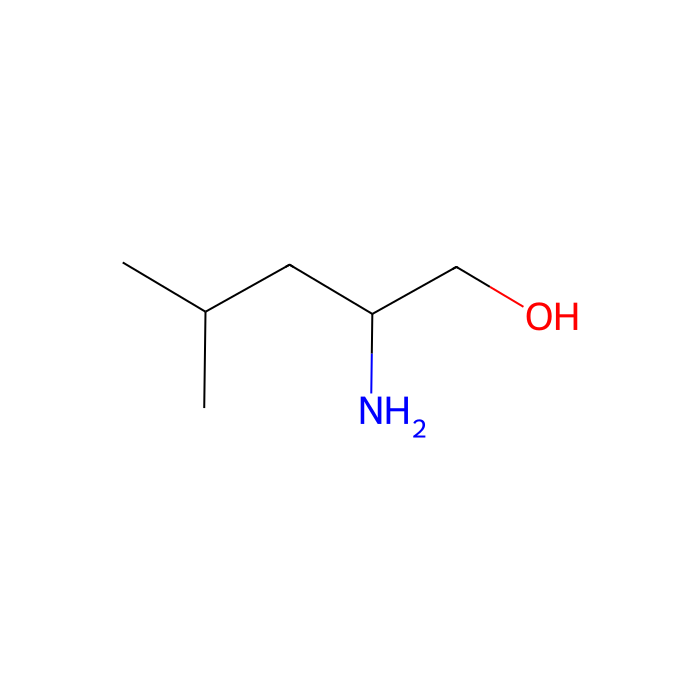
L-Leucinol is the amino alcohol obtained by reducing the carboxyl group of L-leucine to a primary alcohol, retaining the L (S) configuration at the α-carbon.
Item-specific (from Product Data)
CAS: 7533-40-6
SKU: L117136
Grade: Moligand™
InChIKey (as provided): 385195 (note: format appears nonstandard; verify against CoA/Spec Sheet)
SMILES: Not specified for this item; refer to CoA/Spec Sheet.
Literature identity details (for reference; not item-specific specs)
Common name: (S)-2-amino-4-methylpentan-1-ol (L-Leucinol)
Key functional groups: primary amine (–NH2), primary alcohol (–CH2OH), single stereocenter at the α-carbon (S)
Described 2D structure
A chiral backbone with the α-carbon bearing –NH2, –CH2OH, an isobutyl side chain –CH2–CH(CH3)2, and hydrogen. The molecule is an aliphatic, branched amino alcohol with one stereocenter (L configuration).
Alcohol: O-acylation (carbonates, esters), sulfonate activation (OTs/OMs) enabling SN2 substitution, oxidative transformations to aldehydes/acids under protected amine conditions.
Chiral derivatization
Oxazaborolidines (CBS-type): Generated by cyclization with borane; catalyze enantioselective reductions of ketones and imines.
Oxazolines/oxazolidines: Condensation with carboxylic acids or carbonyls provides chiral auxiliaries/ligands for asymmetric catalysis and resolution.
Retrosynthetic value
Serves as a branch point to access both N- and O-functionalized chiral intermediates from a single pool reagent. The isobutyl side chain confers hydrophobicity, facilitating phase manipulation and crystallization strategies.
Practical guidance
Orthogonal protection: Choose N-Boc/TBS-O or N-Cbz/benzylidene acetal motifs to enable stepwise functionalization without cross-reactivity.
Stereochemical integrity: Maintain mild temperatures and avoid strong bases near enolizable carbonyl intermediates to prevent racemization at the α-center.
Target Specificity
Not applicable. This product is a small-molecule amino alcohol, not an antibody, enzyme, or affinity reagent. No target-binding specificity data are provided for this item.
Domande frequenti
What is the purity of this product?
This product is supplied at ≥96% purity (chemical assay). Lot-specific values are stated on the Certificate of Analysis.
How should this product be stored?
Store at room temperature under argon. It is supplied under an argon blanket; reseal under inert gas after each use.
What is Moligand??
Moligand? is one of Aladdin Scientific's premium product lines, formulated for high-purity applications across multiple workflows. Compared to standard grades in the same workflow, Moligand? products typically offer tighter specifications, more rigorous QC, and stronger lot-to-lot consistency.
How is this product shipped?
This product ships under standard ambient conditions. No temperature-controlled packaging is required.
What are the CAS number, molecular formula and molecular weight?
The CAS Number is 7533-40-6, the molecular formula is C6H15NO, and the molecular weight is 117.19 g/mol. InChIKey VPSSPAXIFBTOHY-LURJTMIESA-N.
What documentation is provided?
Available product documentation, including Certificates of Analysis (COA), Safety Data Sheets (SDS), and specification sheets, is shown in the product document area. Document availability and access follow the current site policy.
La nostra guida alla selezione delle qualità copre purezza, stato dello stabilizzatore e idoneità all'applicazione per tutte le varianti del nostro catalogo.
Utilizziamo i cookie per garantire il corretto funzionamento del sito web e, ove consentito, per migliorare la tua esperienza. Puoi gestire le tue preferenze in qualsiasi momento nelle Impostazioni. Per saperne di più, consulta la nostra Cookie Policy.
Desidera che le inviamo un messaggio quando avremo sconti disponibili?
Ricordamelo più tardi
Grazie! Controlli la sua casella di posta per confermare.
Products are supplied to verified businesses, institutions, and qualified professionals for research and development use only. Not for use in humans, animals, diagnosis, or therapy.

 C1828173