GRADE & PURITYMoligand™?Moligand™ — Aladdin's line of ligands and bioactive small molecules. Use for receptor, pathway, and binding studies needing defined small-molecule tools.≥97%
Moligand™,≥97% Moligand™ for sensitive chromatographic and analytical workflows requiring minimal baseline interference.
🌡
Storage & shipping
Room temperature,Argon charged Ships Normal Check lot-specific COA for exact specifications.
📋
Quality documents
SDS, COA, datasheet, and spec sheet available for download. Lot-specific COA accessible via lot number lookup.
📚
Literature proof
Cited in 2 peer-reviewed publications across chromatography, organic synthesis, and cross-coupling reactions.
Panoramica
L-Lysine is an amino acid with a basic side chain and is amphipathic in nature. It has a protonated alkyl amino group and is fully protonated at physiological pH. L-lysine mainly participates in electrostatic interactions in proteins.
L-(+)Lysine Monohydrate is an amino acid essential to human nutrition, though not synthesized by the human body.Essential α-amino acid. Substrate for oxidation and glycation mechanism studies. Precursor to acetyl-CoA in vivo. Regulates calcium absorption,
Condizioni di conservazione di stoccaggio
Room temperature,Argon charged
Spedito in
Normal
Grado
Moligand™
Nota
Wherever possible, you should prepare and use solutions on the same day. However, if you need to make up stock solutions in advance, we recommend that you store the solution as aliquots in tightly sealed vials at -20°C. Generally, these will be useable for up to one month. Before use, and prior to opening the vial we recommend that you allow your product to equilibrate to room temperature for at least 1 hour. Need more advice on solubility, usage and handling? Please visit our frequently asked questions (FAQ) page for more details.
This compound belongs to the class of organic compounds known as l-alpha-amino acids. These are alpha amino acids which have the L-configuration of the alpha-carbon atom.
External Descriptors
Not available
1. Djoumbou Feunang Y, Eisner R, Knox C, Chepelev L, Hastings J, Owen G, Fahy E, Steinbeck C, Subramanian S, Bolton E, Greiner R, and Wishart DS. ClassyFire: Automated Chemical Classification With A Comprehensive, Computable Taxonomy. Journal of Cheminformatics, 2016, 8:61.
Determine the necessary mass, volume, or concentration for preparing a solution.
Dilution Calculator
Determine the dilution needed to prepare a stock solution.
Reconstitution Calculator
Recensioni
Recensioni dei clienti
Application Protocols
Item-specific tested applications and conditions are not provided in the Product Data; refer to CoA/Spec Sheet and SDS.
General starting points (literature; not product-validated):
Preparation of stock solutions
Dissolve L-lysine monohydrate in water to 0.1–1.0 M; adjust pH as required (e.g., pH 9.0–10.0 for amine availability). Filter sterilize through 0.22 μm if sterility is needed. Store refrigerated for short term; prepare fresh when possible.
EDC/NHS-mediated conjugation to carboxyls (surface or polymer)
Activate carboxyls in MES buffer (0.1 M, pH 5.5) with EDC (0.2 M) and NHS (0.1 M) for 10–20 min; rinse; couple with lysine solution (50 mM) in PBS pH 7.4 for 30–60 min; rinse thoroughly.
Reductive amination labeling (model reaction)
Mix substrate aldehyde (10 mM) with lysine (50 mM) in acetate buffer (pH 6.0), add NaBH3CN (50 mM), stir 2–4 h at RT; quench and purify.
These outlines are for research planning and should be adapted/validated for specific systems.
Biological Roles
General biochemistry (literature)
L-Lysine is an essential, basic α-amino acid incorporated into proteins by ribosomal translation. Its side-chain ε-amine imparts positive charge, influencing protein–DNA interactions, enzyme active sites, and protein solubility.
Post-translational modifications (PTMs) on lysine include acetylation, methylation, ubiquitination, SUMOylation, crotonylation, and glycation. These PTMs regulate chromatin structure, transcriptional activity, and protein turnover.
Metabolic context: In humans, lysine catabolism proceeds via the saccharopine pathway leading to acetyl-CoA and acetoacetate equivalents; it is strictly ketogenic. In microbes/plants, biosynthesis follows the diaminopimelate (DAP) pathway.
Chemical properties relevant to biology: High pKa of ε-amine (~10.5) means lysine residues are predominantly protonated at physiological pH, facilitating ionic interactions and salt-bridge formation.
Research implications
L-Lysine is used experimentally to modulate surface charge, enhance nucleic acid adsorption to matrices, and serve as a model nucleophile in studies of PTMs and Maillard chemistry.
As a free amino acid, it can act as an additive to stabilize proteins via preferential hydration and ionic interactions; effectiveness is system-dependent and should be empirically validated.
Note: All roles described are general biochemical properties of lysine and do not imply any medical or clinical use of this product. The item is designated For research use only.
Buffer Applications
Although not a classical Good’s buffer, L-lysine can function as a component of buffering systems in the alkaline range via its ε-amine.
Practical buffer use (literature/general)
Effective pH window: Approximately 9.0–10.5 (around the ε-NH3+ ↔ ε-NH2 transition). Above pH ~11, buffer capacity declines as deprotonation becomes complete.
Example formulations:
50–200 mM L-lysine base adjusted with HCl to pH 9.5–10.2 for amine-reactive conjugations (e.g., NHS ester quench/scavenging). Avoid using lysine buffers during active NHS-ester labeling, as it will compete; reserve for quench or as a blocking agent.
Mixed buffers: Lysine with carbonate/bicarbonate (pH 9–10) to tune ionic strength and buffering range.
Electrophoresis/capillary methods: Lysine-containing electrolytes are sometimes used to reduce EOF or interact with analytes via ion pairing.
Tips
Filter-sterilize (0.22 μm) and prepare fresh to avoid microbial growth.
Verify pH at the working temperature; the apparent pKa shifts slightly with ionic strength and temperature.
Be cautious in systems sensitive to primary amines (e.g., assays involving aldehydes, NHS esters); lysine will act as a nucleophile and can interfere.
Green Alternatives
While L-lysine monohydrate is itself bio-based and water-soluble, greener strategies focus on solvent choice and protecting-group minimization.
Greener considerations (general)
Use water as the primary solvent for couplings and conjugations whenever feasible; supplement minimally with DMF or DMSO.
Prefer enzymatic ligation (e.g., sortase, transglutaminase) or aqueous carbodiimide chemistry over highly activated reagents in strictly organic media.
Minimize protecting groups and employ orthogonal, removable protections that avoid hazardous deprotection reagents.
Comparison (literature-based, illustrative)
| Aspect | Conventional approach | Greener alternative | Trade-offs |
|---|---|---|---|
| Coupling solvent | DMF or NMP | Water or water/EtOH | Possible lower solubility for hydrophobic partners |
| Activators | HATU/HBTU (contains uronium/benzotriazole) | EDC/NHS in water or DMTMM | May require pH optimization; different byproducts |
| Protection strategy | Multiple protecting groups | Late-stage selective transformations or enzymatic methods | Selectivity challenges, scope limits |
| Surface amination | Organic priming, harsh silanization | EDC/NHS in water with lysine | Substrate-dependent adhesion |
Waste reduction tips
Use stoichiometric control to avoid over-acylation and rework.
Recover and reuse aqueous buffer salts when appropriate.
Choose benign quench/neutralization agents (e.g., bicarbonate) and avoid chlorinated solvents.
Pharmaceutical Uses
No clinical or therapeutic claims are made for this product. The following notes concern general formulation/manufacturing roles of lysine derivatives (literature) and do not represent item-specific suitability.
General excipient roles (literature)
Counterion/co-former: Lysine can form salts or co-crystals with acidic APIs, modifying solubility and stability.
Stabilizer/tonicity contributor: In some biopharmaceutical formulations, basic amino acids (lysine/arginine) are explored as stabilizers to suppress aggregation; suitability is case-specific.
pH modifier/buffer component: Operates in alkaline range where primary amine buffering is effective.
Compendial status
Various lysine forms (e.g., L-lysine, L-lysine hydrochloride) are described in pharmacopeias; specific compliance of this item is Not specified for this item; refer to CoA/Spec Sheet.
Manufacturing considerations
Free base lysine may react with activated esters and carbonyls; assess compatibility with excipients (e.g., reducing sugars) to avoid Maillard reactions.
Control bioburden/endotoxin for parenteral applications; this product is labeled For research use only.
For regulated uses, source a compendial/commercial-grade material with documented compliance and full excipient characterization.
Physical Properties
Item-specific specifications
Appearance: Not specified for this item; refer to CoA/Spec Sheet.
Molecular Formula: Not specified for this item; refer to CoA/Spec Sheet.
Molecular Weight: Not specified for this item; refer to CoA/Spec Sheet.
Molecular formula (literature): C6H14N2O2·H2O (sum C6H16N2O3)
Molecular weight (literature): ~164.21 g/mol
Acid–base properties (literature, 25 °C, water):
pKa1 (α-COOH) ≈ 2.1
pKa2 (α-NH3+) ≈ 8.9–9.1
pKa3 (ε-NH3+) ≈ 10.4–10.6
Isoelectric point (pI) ≈ 9.7–9.8
Solubility (literature): Highly soluble in water; sparingly soluble to insoluble in most organic solvents (e.g., alcohols, ethers) due to zwitterionic nature.
Hygroscopicity: Amino acid hydrates can absorb/desorb moisture; handle under dry conditions to preserve hydration state.
Thermal behavior (literature): Decomposes on heating; many amino acids darken and decompose >200 °C rather than exhibiting a sharp melt.
Partitioning (literature): Very low logP (strongly hydrophilic zwitterion).
Optical rotation (literature, for L-lysine base in H2O): typically positive; magnitude depends on concentration and wavelength; consult primary data if needed.
Note: The above literature values are provided for planning purposes only and are not product-specific specifications. Always consult the item’s CoA/Spec Sheet for definitive quality attributes.
Quality and Grades
Item-specific information
Grade/Purity: Moligand™ (as provided). No further assay, metal content, residual solvent, optical purity, or microbial limits are specified in the Product Data.
Stabilizers/additives: Not specified for this item; refer to CoA/Spec Sheet.
Interpretation and guidance
Moligand™ is a brand/grade designation used by the supplier; it is not a standardized pharmacopeial term. In the absence of explicit specifications (assay %, residual solvents, bioburden/endotoxin, ash/metals), treat the material as a research-grade reagent.
For sensitive applications (e.g., enzymology, cell culture, bioconjugation), request and review the Certificate of Analysis (CoA) for lot-specific parameters such as assay by titration/HPLC, optical rotation, microbial limits, and moisture content.
If low UV absorbance is needed (e.g., analytical use near 200–220 nm), verify UV cutoffs/absorbance with the CoA. If trace metals are critical (e.g., catalysis, chelation-sensitive assays), obtain a metals profile.
Chiral purity: L-Lysine should be optically pure (L); confirm enantiomeric purity (e.g., optical rotation or chiral HPLC) if chirality is critical. Absent explicit data, do not assume enantiopurity.
Practical recommendations
Perform incoming verification appropriate to your use case: melting/decomposition profile, water content (Karl Fischer), optical rotation, and HPLC assay.
If using for peptide synthesis, consider switching to protected derivatives (e.g., Fmoc-Lys(Boc)-OH) with defined peptide-grade specs for SPPS.
Reaction and Applications
Research uses (general/literature)
Building block in peptide chemistry: The ε-amine enables orthogonal protection strategies. L-lysine residues introduce positive charge and can serve as handles for post-assembly modifications.
Bioconjugation: The ε-amine reacts with activated esters (NHS, pNP), isothiocyanates, and aldehydes (reductive amination) for dye/hapten coupling or surface immobilization.
Materials/surface science: Commonly used to aminate surfaces (glass, graphene oxide, carboxylated polymers) via carbodiimide (EDC/NHS) coupling, enhancing adhesion and biofunctionality.
Chiral pool synthesis: L-lysine serves as a precursor to chiral heterocycles (e.g., pipecolic acid via intramolecular cyclization/reduction) and as a scaffold in organocatalyst/ligand design.
Reaction families and notes
Amide bond formation: EDC/HOBt or HATU-mediated couplings with carboxylic acids; selective α- vs ε-amine acylation achieved through pH control or protecting groups.
Reductive amination: Formation of secondary amines with aldehydes/ketones using NaBH3CN or NaBH(OAc)3 in aqueous/MeOH buffers; adjust pH 6–7 for imine formation, then reduce.
Alkylation/acylation: ε-Amine undergoes acylation with acyl chlorides/anhydrides; bis-acylation risks managed by stoichiometry and pH.
Urea/thiourea formation: Reaction with isocyanates/isothiocyanates yields (thio)ureas; useful for labeling with FITC.
Practical tips
Use orthogonal protection (e.g., Boc on ε-NH2 when coupling at α-NH2, or Fmoc for SPPS) to prevent side reactions.
Maintain low temperatures and mild bases during activation to limit racemization at the α-carbon.
For aqueous couplings, include NHS to stabilize O-acylisourea intermediates and improve yields.
Reaction Conditions
General guidance based on literature; adjust to your substrate/scope. These are not item-specific specifications.
Amide coupling (carboxyl of lysine → amide)
Solvent: Water, water/DMF (1:1), or DMF.
Reagents: EDC·HCl (1.1–1.5 eq) with NHS (1.1–1.5 eq); or DMTMM (1.1 eq) in water; or HATU/HBTU in DMF with DIPEA.
Conditions: pH 5.0–6.0 (EDC/NHS) for activation; then add amine nucleophile and adjust to pH 7.5–8.5. 0–25 °C, 1–4 h typical. Monitor by LC/MS or ninhydrin.
Selective ε-amine acylation
Strategy: Protect α-amine (Boc/CBz) first; acylate ε-NH2 with activated ester or acyl chloride.
Base: NEt3 or NaHCO3 in aqueous-organic mixtures; 0–25 °C. Control stoichiometry to avoid bis-acylation.
Reductive amination (on ε-amine)
Solvent: MeOH, EtOH, or water with small % acetonitrile; include buffer at pH 6–7.
Reagents: Aldehyde (1.0–1.2 eq), NaBH3CN (1.5–2.0 eq) or NaBH(OAc)3; 20–25 °C, 2–16 h. Quench with aqueous NH4Cl; purify by ion-exchange if needed.
Surface coupling (carboxylated surface → lysine)
Conditions: EDC (0.1–0.4 M) + NHS (0.05–0.1 M) in MES buffer pH 5.0–6.0 to activate; introduce lysine (10–100 mM) in PBS pH 7.4 for 15–60 min; rinse thoroughly. Optimize for each substrate.
Polymerization to poly(lysine) via NCA (derivative)
Generate NCA from protected lysine; ring-opening polymerization in anhydrous DMF/THF under inert gas, 0–25 °C, amine initiator; deprotect post-polymerization.
Yields and times are substrate-dependent; consult primary literature for detailed scope and optimization.
Safety and Handling
GHS and hazard statements (item-specific)
Signal Word: Not specified for this item; refer to SDS.
H-Statements: Not specified for this item; refer to SDS.
GHS Classification: Not specified for this item; refer to SDS.
Pictograms: Not specified for this item; refer to SDS.
General safety considerations (amino acids; literature/general guidance)
Expected hazards: Many amino acids are of low acute toxicity and frequently not classified as hazardous; however, classification depends on supplier SDS. Avoid creating dust; dust may cause mechanical irritation to eyes/respiratory tract.
PPE: Wear lab coat, safety glasses, and appropriate gloves (e.g., nitrile). Use dust mask or respirator if dust generation cannot be controlled.
Handling: Avoid inhalation of dust and contact with eyes. Use local exhaust ventilation when weighing/powder handling. Minimize exposure to ambient moisture to maintain defined hydration state.
Storage incompatibilities: Strong oxidizers may react with organic materials; avoid mixing with strong acids/bases when not intended. As a basic amino acid, it can interact with electrophiles (e.g., acid chlorides, activated esters); segregate accordingly.
First aid overview: If inhaled, move to fresh air. If in eyes, rinse cautiously with water for several minutes; remove contact lenses if present and easy. If on skin, wash with soap and water. If ingested, rinse mouth and seek medical advice if unwell. Always follow site SOPs.
Fire safety: Organic solid; may burn if involved in a fire. Use water spray, dry chemical, CO2, or foam as appropriate to surroundings. Combustion may produce nitrogen oxides and carbon oxides.
Always consult the product-specific SDS for authoritative safety, toxicological, and disposal information.
Solvent Selection
This product is a solid amino acid (not a solvent). Solvent selection is therefore typically about choosing appropriate media to dissolve or process L-lysine monohydrate.
General solubility guidance (literature)
Water: Highly soluble; dissolution is endothermic—gentle warming and stirring speed dissolution.
Alcohols (MeOH, EtOH): Poor to limited solubility due to zwitterionic nature.
Polar aprotics (DMSO, DMF): Moderate solubility may be achieved; however, aqueous systems are preferred for biochemistry.
Buffers: Readily dissolves in common biological buffers; pH ≥ pKa of amino groups increases solubility as cations form.
Mixed aqueous/organic: Conjugation with hydrophobic partners (use water-miscible co-solvents like DMF/DMSO at minimal percentages to maintain reagent compatibility).
Practical tips
Adjust pH to ~9–10 to maximize free ε-amine availability for conjugation to activated esters while maintaining solubility.
Filter sterilize solutions (0.22 μm) for bio-related workflows; avoid autoclaving if Maillard reactions with sugars are possible.
Avoid high-ionic-strength buffers when performing carbodiimide couplings to reduce side reactions.
Storage and Reconstitution
Item-specific storage/shipping
Storage Conditions: Room temperature, Argon charged (as provided). Keep container tightly closed to limit moisture exchange and preserve the defined hydration state.
Shipped In: Normal (ambient) conditions.
General guidance (literature/practice)
Protect from moisture excursions: Although a monohydrate, excessive humidity or desiccation may alter water of crystallization. Store in a dry place; reseal promptly after use. If maintaining the exact hydrate level is critical, consider storing in a desiccator and equilibrating before analytical use.
Light/heat: Store away from direct sunlight and heat sources. Avoid prolonged temperatures >40 °C.
Reconstitution: Readily dissolves in water. For concentrated stocks (0.5–1.0 M), warm gently and stir. Adjust pH depending on application (e.g., pH 9–10 for nucleophilic ε-amine availability; neutral pH for general biochemistry).
Sterile solutions: Prepare with sterile water and filter through 0.22 μm. Avoid repeated freeze–thaw; aliquot if freezing is necessary.
Stability: Aqueous solutions are generally stable for days at 2–8 °C; prepare fresh for sensitive applications to minimize bioburden and potential side reactions (e.g., with carbonyl-containing excipients).
Always consult the product’s CoA and SDS for lot-specific instructions and stability information.
Structure and Identity
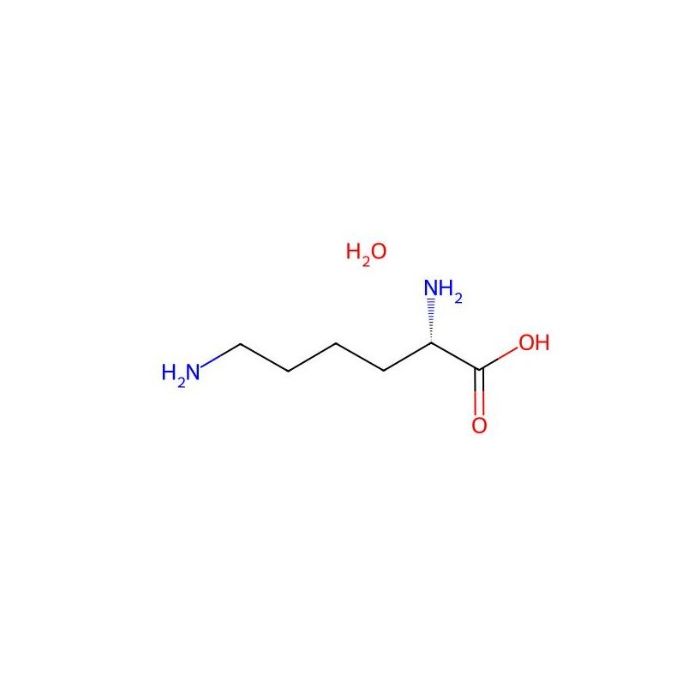
Brief description: L-Lysine monohydrate is the hydrated form of the basic, proteinogenic L-α-amino acid lysine, bearing a primary ε-amine side chain and an α-amino/carboxylate backbone.
Item-specific (from Product Data)
SKU: S133419
Product Name: L-Lysine monohydrate
CAS: 39665-12-8
InChIKey: 135250 (as provided)
SMILES: Not specified for this item; refer to CoA/Spec Sheet.
Grade/Purity: Moligand™
Literature/computed identifiers and descriptors (for reference only)
Common name: L-Lysine monohydrate
Molecular formula (literature): C6H14N2O2·H2O (sum formula C6H16N2O3)
Molecular weight (literature): ~164.21 g/mol
Stereochemistry: L-configuration at the α-carbon (S absolute configuration for lysine)
Representative InChIKey (literature, for L-lysine base): KDXKERNSBIXSRK-YFKPBYRVSA-N (monohydrate adds water of crystallization)
Structural features (general chemistry)
Functional groups: α-amino (–NH2), α-carboxyl (–CO2H), ω-primary amine on the side chain (ε-NH2), plus one equivalent of lattice water.
Zwitterionic character at neutral pH: protonated amines (NH3+) and deprotonated carboxylate (COO−).
2D description: A four-methylene chain (–CH2–CH2–CH2–CH2–) extends from the chiral α-carbon to a terminal primary amine; the α-carbon also bears the α-amino and carboxylate groups; one water molecule associates in the crystal lattice.
Synthetic Utility
Functional group handles
Carboxylic acid (α-CO2H): Amenable to esterification, amide formation, or activation (mixed anhydrides, NHS esters). Careful conditions minimize racemization at the α-stereocenter.
α-Amine and ε-amine: Two differentiated nucleophilic sites enable orthogonal strategies; chemoselectivity managed by protecting groups (Boc, Cbz, Fmoc, Alloc) or by pH control.
Applications in synthesis (literature)
Chiral pool precursor: Transformation to chiral piperidines/pipecolic acid, β-amino acids (via chain editing), and macrocycles through intramolecular cyclizations.
Ligand/catalyst scaffolds: Derivatized lysine backbones provide bidentate/tridentate ligation motifs for asymmetric catalysis.
Polymer/materials: Poly(lysine) via N-carboxyanhydride (NCA) polymerization; surface grafting and layer-by-layer assembly using ε-amine functionality.
Retrosynthetic value
The presence of two amines and one acid enables convergent assembly: attach the α-terminus to a growing peptide while reserving ε-NH2 for post-assembly diversification (e.g., pegylation, dye tags, handles for click-like chemistries after suitable conversion).
Practical notes
Racemization control: Avoid strong bases and prolonged activation near the α-carbon. Use coupling additives (e.g., HOAt/oxyma) and low temperatures.
Selectivity: Temporarily protect the more reactive site (often ε-NH2 with Boc) to direct α-amide formation; remove under mild acid later.
Solubility management: Employ aqueous media or minimal DMF/DMSO; convert to salts to modulate solubility/reactivity as needed.
Target Specificity
This product is a small-molecule amino acid, not an antibody, enzyme, or affinity reagent.
Item-specific application/target data: Not specified for this item; refer to CoA/Spec Sheet.
Target specificity is not typically applicable. For biochemical interactions, see Biological Roles and Reaction & Applications.
Utilizziamo i cookie per garantire il corretto funzionamento del sito web e, ove consentito, per migliorare la tua esperienza. Puoi gestire le tue preferenze in qualsiasi momento nelle Impostazioni. Per saperne di più, consulta la nostra Cookie Policy.
Desidera che le inviamo un messaggio quando avremo sconti disponibili?
Ricordamelo più tardi
Grazie! Controlli la sua casella di posta per confermare.
Products are supplied to verified businesses, institutions, and qualified professionals for research and development use only. Not for use in humans, animals, diagnosis, or therapy.

 D23031328