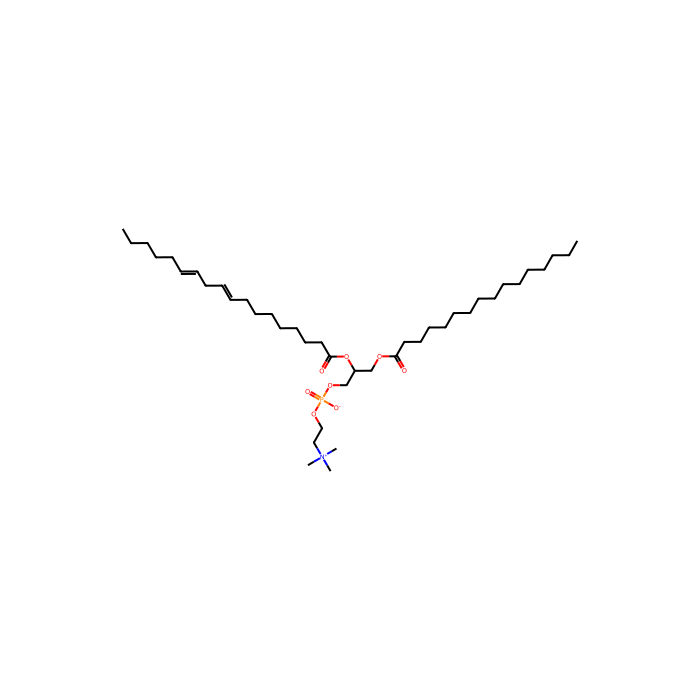
L-α-Phosphatidylcholine - ≥30%(enzymatic), from soybean, Type IV-S , CAS No.8002-43-5

CAS: 8002-43-5 Cat. No.: L434222 Formula: C42H80NO8P Peso molecolare: 758.06 Beilstein Registry Number: 5209585 Numero EC: 232-307-2
Disponibile su ordine
QUALITÀ & PUREZZA ≥30%(enzymatic) from soybean, Type IV-S
Synonyms
PC(16:0/18:2(9Z,12Z))|[(2R)-3-hexadecanoyloxy-2-[(9Z,12Z)-octadeca-9,12-dienoyl]oxypropyl] 2-(trimethylazaniumyl)ethyl phosphate|1-palmitoyl-2-linoleoyl-phosphatidylcholine|PALMITOYL-LINOLEOYL PHOSPHATIDYLCHOLINE|Soy PC, L-alpha-phosphatidylcholine (Soy), chloroform|Lecithin, Refined|1-16:0-2-18:2-phosphatidylcholine|16:0-18:2-PC|1-palmitoyl-2-linoleoyl-GPC|1-Palmitoyl-2-linoleoyl-sn-glycero-3-phosphocholine|PC(16:0/18:2)|Phosphatidylserine Powder|16:0-18:2 PC, 1-palmitoyl-2-linoleoyl-sn-glycero-3-phosphocholine, powder|L-alpha-1-Palmitoyl-2-linoleoylphosphatidylcholine|1-Palmitoyl-2-linoleoyl-3-sn-glycerophosphatidylcholine|(2R)-3-(hexadecanoyloxy)-2-[(9Z,12Z)-octadeca-9,12-dienoyloxy]propyl 2-(trimethylammonio)ethyl phosphate|16:0-18:2 PC, 1-palmitoyl-2-linoleoyl-sn-glycero-3-phosphocholine, chloroform|1,2-Diacyl-sn-glycero-3-phosphocholine|Phosphatidylcholine(16:0/18:2)|PC(16:0/18:2omega6)|Soybean phosphatide|SOYBEAN PHOSPHOLIPIDS|phosphatidylcholine 16:0/18:2(9Z,12Z)|Soybean lecithin|(2-{[3-(hexadecanoyloxy)-2-[octadeca-9.12-dienoyloxy]propyl phosphono]oxy}ethyl)trimethylazanium|1-palmitoyl-2-linoleoyl-GPC (16:0/18:2)|GPC(16:0/18:2)|LECITHIN|3,5,8-Trioxa-4-phosphahexacosa-17,20-dien-1-aminium, 4-hydroxy-N,N,N-trimethyl-9-oxo-7-(((1-oxohexadecyl)oxy)methyl)-, inner salt, 4-oxide, (7R,17Z,20Z)-|Soy PC, L-alpha-phosphatidylcholine (Soy), powder|PC(16:0/18:2n6)|Phosphatidylcholine(16:0/18:2w6)|GPCho(16:0/18:2omega6)|L-.ALPHA.-1-PALMITOYL-2-LINOLEOYLPHOSPHATIDYLCHOLINE|GPCho(16:0/18:2)|1-hexadecanoyl-2-(9Z,12Z-octadecadienoyl)-sn-glycero-3-phosphocholine|(2R)-3-(hexadecanoyloxy)-2-[(9Z,12Z)-octadeca-9,12-dienoyloxy]propyl 2-(trimethylazaniumyl)ethyl phosphate|Phosphatidylcholine(16:0/18:2omega6)|PC 34:2|1-Palmitoyl-2-linoleoyl-sn-glycerophosphatidylcholine|1-Palmitoyl-2-linoleoyl-sn-glycero-phosphatidylcholine|Soybean phospholipid
Storage
Store at -20°C
Shipped In
Ice chest + Ice pads
★
Dimensione
Germania (EU)
USA*
Prezzo
Qtà
25g
L434222-25g
—
2 Disponibile
74,54€
100g
L434222-100g
—
1 Disponibile
208,17€
500g
L434222-500g
—
2 Disponibile
728,81€
Enter a quantity for the sizes you want to add.

Panoramica

Application

L-α-Phosphatidylcholine is suitable for use: as a component of human erythroid massive amplification culture (HEMA def ) medium for clinical expansion of human erythroblasts in the chloride efflux assay to examine the chloride permeability of lipid vesicles conferred by soluble CLIC1 in an assay to measure solubilized wax synthase activity as a component of buffer A used for the resuspension of the cholate-solubilized catalytic unit of adenylate cyclase as a cryoprotectant for freezing ruminant sperm as a substrate for the estimation of phospholipase activity to make liposomes to assess their efficiency of recruitment of ARF (ADP ribosylation factor) and AP-1 (adaptor protein) in the preparation of the isolated catalytic unit of soluble adenylate cyclase

Specifiche

Sinonimi
PC(16:0/18:2(9Z,12Z)) | [(2R)-3-hexadecanoyloxy-2-[(9Z,12Z)-octadeca-9,12-dienoyl]oxypropyl] 2-(trimethylazaniumyl)ethyl phosphate | 1-palmitoyl-2-linoleoyl-phosphatidylcholine | PALMITOYL-LINOLEOYL PHOSPHATIDYLCHOLINE | Soy PC, L-alpha-phosphatidylcholine (Soy), chloroform | Lecithin, Refined | 1-16:0-2-18:2-phosphatidylcholine | 16:0-18 Mostra altro
Specifiche e purezza
≥30%(enzymatic), from soybean, Type IV-S
Meccanismi biochimici e fisiologici
Phosphatidylcholine is the major membrane phospholipid in eukaryotic cells, forming the structural component of these membranes. It also serves as a reservoir for several lipid messengers and a source for several bioactive lipids such as, lysophosphatidyl
Condizioni di conservazione di stoccaggio
Store at -20°C
Spedito in
Ice chest + Ice pads
Questo prodotto richiede spedizione a catena fredda. I servizi di terra e altri servizi economici non sono disponibili.
Purezza
≥30%(enzymatic)
Nomi e identificatori
Pubchem Sid
SMILES
[P](=O)([O-])(OC[C@H](OC(=O)CCCCCCC\C=C/C\C=C/CCCCC)COC(=O)CCCCCCCCCCCCCCC)OCC[N+](C)(C)C
IUPAC Name
[(2R)-3-hexadecanoyloxy-2-[(9Z,12Z)-octadeca-9,12-dienoyl]oxypropyl] 2-(trimethylazaniumyl)ethyl phosphate
InChIKey
JLPULHDHAOZNQI-ZTIMHPMXSA-N
InChI
1S/C42H80NO8P/c1-6-8-10-12-14-16-18-20-21-23-25-27-29-31-33-35-42(45)51-40(39-50-52(46,47)49-37-36-43(3,4)5)38-48-41(44)34-32-30-28-26-24-22-19-17-15-13-11-9-7-2/h14,16,20-21,40H,6-13,15,17-19,22-39H2,1-5H3/b16-14-,21-20-/t40-/m1/s1
Isomeri SMILES
CCCCCCCCCCCCCCCC(=O)OC[C@H](COP(=O)([O-])OCC[N+](C)(C)C)OC(=O)CCCCCCC/C=C\C/C=C\CCCCC
WGK Germania
1
RTECS
OG7565000
CAS alternativo
55128-59-1
Peso molecolare
758.06
Beilstein
5209585
Reaxys
11330961
Reaxys-RN_link_address
https://www.reaxys.com/reaxys/secured/hopinto.do?context=S&query=IDE.XRN=11330961&ln=

Dati avanzati

Taxonomic Classification

Taxonomy Tree

KingdomOrganic compounds
SuperclassLipids and lipid-like molecules
ClasseGlycerophospholipids
SubclassGlycerophosphocholines
Intermediate Tree Nodes Not available
Direct ParentPhosphatidylcholines
Alternative Parents Phosphocholines  Fatty acid esters  Dialkyl phosphates  Dicarboxylic acids and derivatives  Tetraalkylammonium salts  Carboxylic acid esters  Organopnictogen compounds  Organic salts  Organic oxides  Hydrocarbon derivatives  Carbonyl compounds  Amines  
Molecular FrameworkAliphatic acyclic compounds
Substituents Diacylglycero-3-phosphocholine - Phosphocholine - Fatty acid ester - Dialkyl phosphate - Dicarboxylic acid or derivatives - Organic phosphoric acid derivative - Phosphoric acid ester - Alkyl phosphate - Fatty acyl - Quaternary ammonium salt - Tetraalkylammonium salt - Carboxylic acid ester - Carboxylic acid derivative - Organic oxygen compound - Organic nitrogen compound - Carbonyl group - Organooxygen compound - Organonitrogen compound - Organic oxide - Organopnictogen compound - Amine - Organic salt - Hydrocarbon derivative - Aliphatic acyclic compound
DescrizioneThis compound belongs to the class of organic compounds known as phosphatidylcholines. These are glycerophosphocholines in which the two free -OH are attached to one fatty acid each through an ester linkage.
External Descriptors Diacylglycerophosphocholines
Certificati (CoA, COO, BSE/TSE e tabella di analisi)
C of A & Other Certificates(BSE/TSE, COO):
Analytical Chart:

Find and download the COA for your product by matching the lot number on the packaging.

8 results found

Lot NumberCertificate TypeDataOggetto
J2612067J2612067Certificate of AnalysisOct 16, 2026 L434222
E2621076E2621076Certificate of AnalysisJun 01, 2023 L434222
H2329611H2329611Certificate of AnalysisJun 01, 2023 L434222
H2329615H2329615Certificate of AnalysisJun 01, 2023 L434222
H2329638H2329638Certificate of AnalysisJun 01, 2023 L434222
H2329783H2329783Certificate of AnalysisJun 01, 2023 L434222
H2329819H2329819Certificate of AnalysisJun 01, 2023 L434222
H2329820H2329820Certificate of AnalysisJun 01, 2023 L434222
Proprietà chimiche e fisiche
Solubilitàchloroform: soluble 100mg/mL, clear to slightly hazy, yellow to orange
Peso molecolare758.1
XLogP312.900
Hydrogen Bond Donor Count0
Hydrogen Bond Acceptor Count8
Rotatable Bond Count40
Exact Mass757.562 Da
Monoisotopic Mass757.562 Da
Topological Polar Surface Area111.000 Ų
Heavy Atom Count52
Formal Charge0
Complexity940.000
Isotope Atom Count0
Defined Atom Stereocenter Count1
Undefined Atom Stereocenter Count0
Defined Bond Stereocenter Count2
Undefined Bond Stereocenter Count0
The total count of all stereochemical bonds2
Covalently-Bonded Unit Count1
Sicurezza e pericoli (GHS)
WGK Germania
1
RTECS
OG7565000
Reaxys
11330961
Reaxys-RN_link_address
https://www.reaxys.com/reaxys/secured/hopinto.do?context=S&query=IDE.XRN=11330961&ln=
Domande frequenti e articoli
Liposome Panorama Guide: Definition, Structural Mechanisms, Applications, and Selection Workflow (Including Products Table 1–Table 3)
Lecithin: Technical Characteristics, Preparation Processes, and Research Progress in Applications
Procyanidins: Structural Features and Key Points for Research and Application
Whey Protein: Composition Profile, Manufacturing Routes, and Key Product-Type Essentials
Functional Properties, Application Scenarios, and Manufacturing Processes of Maltotetraose (G4): A Review
Glutaraldehyde-mediated Microbial Inactivation: Chemical Mechanisms, Determinants, and Key Validation Considerations
Review of the Structural Characteristics, Biological Functions, and Application Advances of Lycopene
Functional Framework of Starch Metabolism-Related Enzymes in Food Science Research and Mechanistic Analysis of Quality Regulation
Mechanistic Analysis of Topical Glutathione in Skincare: Cellular Redox Regulation, Skin Delivery Challenges, and SLN-Based Delivery Strategies
Choline Metabolism and Detection Methods: Pathway Analysis of Choline, Phosphatidylcholine, Betaine, Acetylcholine, and TMAO
Antioxidant Mechanisms, Stability, and Delivery Strategies of Resveratrol in Skincare Research
Antioxidant Mechanisms of Ferulic Acid in Skincare, Vitamin C/E Synergy, and Stable Delivery Applications
Skin Anti-Aging Mechanisms of Carnosine and Decarboxy Carnosine: Active Carbonyl Scavenging, Oxidative-Stress Buffering, and Inhibition of Collagen Glycation Cross-Linking
The Moisturizing and Low-Moisture Protective Mechanisms of Trehalose: From Its α,α-1,1 Structure and Hydration Dynamics to In Vitro Skin Barrier Research
Protective and Potential Reparative Mechanisms of Prinsepia utilis Seed Oil on the Skin Barrier: Fatty Acid Composition, Epidermal Lipid Metabolism, and Research Evidence
UVA Absorption Mechanism of Avobenzone: Keto–Enol Tautomerism, Photochemical Instability, and Formulation Photostabilization Strategies
Mechanism of Action of Tranexamic Acid in Pigmentation Care: From the Plasmin System to Regulation of Inflammation-Driven Pro-Melanogenic Signaling
How Palmitoyl Pentapeptide-4 Acts on the Skin: From the KTTKS Sequence and Skin Delivery to Collagen Matrix Responses
How Cyclization Changes Peptide Behavior: Conformational Preorganization, Skin Delivery, and Integrin Binding, Using Cyclopeptide-5 as an Example
The Logic of Biomimetic Peptide Action in Skin: Sequence and Conformation, Skin Delivery, Stability, and Target Matching
How Does Collagen Tripeptide Act on the Skin: Stratum Corneum Delivery, Matrix Protection, and Regulation of Collagen Homeostasis
Potential Mechanisms of p-Cymene in Problem-Prone Skin: Membrane Perturbation, Inflammatory Signaling Modulation, and Localized Delivery
How Coenzyme Q10 Acts on the Skin: Mitochondrial Electron Transfer, Antioxidant Protection of Membrane Lipids, and Lipid-Carrier Delivery
The Combination Logic of Palmitoyl Tripeptide-1 and Palmitoyl Pentapeptide-4: Skin Delivery, Matrix Signaling, and Regulation of Collagen Homeostasis
How Arbutin Regulates Melanin Production: α/β Anomeric Configuration and Tyrosinase Action
Niacinamide Brightening Mechanisms and Formulation Design: Melanosome Transfer, pH Regulation, and Combination Strategies
Why Do Skincare Oligopeptides Have Different Effects? — Molecular Structure, Skin Delivery, and Mechanisms of Action
Citations of This Product
Calcolatori di soluzioni
Recensioni

Recensioni dei clienti

Desidera che le inviamo un messaggio quando avremo sconti disponibili?

Ricordamelo più tardi

Grazie! Controlli la sua casella di posta per confermare.

Ops! Le notifiche sono disabilitate.