L-Rhamnose is a part of plant cell wall polysaccharides, rhamnogalacturonan I and rhamnogalacturonan. It is also present in bacterial cell walland a major antigenic determinant contributing to its pathogenicity.L-rhamnose is non-absorbable in humans but is fermented by intestinal microbes. Supplementation of L-rhamnose slows down gastric emptying.L-rhamnose monosaccharide conjugated immunogens have applications in cancer immunotherapies. Intake of L-rhamnose elevates serum propionate levels
This compound belongs to the class of organic compounds known as hexoses. These are monosaccharides in which the sugar unit is a is a six-carbon containing moeity.
External Descriptors
Not available
1. Djoumbou Feunang Y, Eisner R, Knox C, Chepelev L, Hastings J, Owen G, Fahy E, Steinbeck C, Subramanian S, Bolton E, Greiner R, and Wishart DS. ClassyFire: Automated Chemical Classification With A Comprehensive, Computable Taxonomy. Journal of Cheminformatics, 2016, 8:61.
Determine the necessary mass, volume, or concentration for preparing a solution.
Dilution Calculator
Determine the dilution needed to prepare a stock solution.
Reconstitution Calculator
Recensioni
Recensioni dei clienti
Application Protocols
No assay-specific protocols are validated or provided for this item.
General research-use examples (non-validated; adapt to your system):
Inducer stock for rhamnose-regulated promoters: Dissolve to 20% w/v in sterile deionized water, filter-sterilize (0.22 μm), store refrigerated in aliquots. Typical working concentrations in microbial culture range from 0.0002% to 0.2% w/v depending on promoter strength and desired expression level (optimize empirically).
Carbohydrate standard for HPAEC-PAD: Prepare 1 mg/mL in water; perform serial dilutions to construct calibration curves across the expected concentration range. Store cold and use within several days to minimize degradation.
Starting material drying prior to derivatization: Co-evaporate with dry toluene or pyridine (3×) and keep under vacuum over P2O5 or molecular sieves before protection steps.
Note: The above are literature-style, general procedures intended for experienced researchers. Validate and adjust conditions for your specific application. For any regulated use, develop and qualify SOPs accordingly.
Biological Roles
Background (general biochemistry; no clinical claims):
Natural occurrence: L-Rhamnose is a common component of plant and microbial glycans, including rhamnogalacturonan I/II (pectic polysaccharides) in plants and O-antigen repeating units in Gram-negative bacterial lipopolysaccharides.
Metabolic pathways: Many bacteria catabolize L-rhamnose via the rhaBAD operon, converting it through L-rhamnulose to dihydroxyacetone phosphate and L-lactaldehyde. This operon underlies widely used rhamnose-inducible expression systems.
Recognition and binding: Rhamnose-specific lectins (e.g., from fish eggs, invertebrates, and some plants) exhibit selective binding to rhamnosyl residues, enabling affinity-based separation or targeting strategies in research.
Structural implications: As a 6-deoxy sugar, L-rhamnose influences glycan hydrophobicity and conformational preferences; rhamnosylation can modulate aglycone solubility, stability, and intermolecular interactions in natural products.
Enzymology: Rhamnosyltransferases catalyze transfer of rhamnose from activated donors (e.g., dTDP-L-rhamnose) to acceptors in polysaccharide and secondary-metabolite biosynthesis. Glycosidases (rhamnosidases) hydrolyze terminal rhamnose residues.
Research relevance:
Carbon source and selective pressure in microbial media; useful for tuning metabolic flux.
Ligand for probing lectin specificity and for constructing rhamnose-presenting surfaces in cell-adhesion and pathogen-interaction studies.
Note: Information above reflects general literature knowledge and is not item-specific.
Buffer Applications
This compound is not a buffering agent and does not form a conventional buffer system. However, practical notes for solution preparation in buffered systems (general guidance):
Dissolution: Readily dissolves in water; prepare concentrated stocks (e.g., 10–20% w/v) in your assay buffer of choice (commonly pH 6.0–8.0) to avoid osmolarity shocks upon addition.
Sterilization: Prefer 0.22 μm filtration over autoclaving to minimize thermal degradation (caramelization) and Maillard-type reactions in amino-containing buffers.
Compatibility: Compatible with common biological buffers (PBS, HEPES, MOPS) under ambient conditions. Avoid prolonged heating in phosphate buffers if browning is observed.
For true pH control, select an appropriate buffering agent; L-rhamnose serves only as a neutral carbohydrate component.
Green Alternatives
Perspective on L-rhamnose monohydrate in green chemistry (general guidance):
Renewable feedstock: L-Rhamnose is bio-based (commonly sourced from plant/biomass glycosides), aligning with renewable materials principles.
Benign solvent use: Many applications proceed in water—an inherently greener solvent—reducing reliance on chlorinated or high-toxicity media.
Opportunities to improve green metrics in rhamnose chemistry:
Solvent choice in protection/glycosylation:
Greener options: 2-MeTHF or CPME can sometimes replace dichloromethane or toluene for peracetylation or donor formation steps (literature-dependent). Ethyl acetate is another lower-toxicity option.
Aqueous catalysis: Enzymatic rhamnosylation or chemoenzymatic methods in buffered water can avoid protecting groups and hazardous promoters.
Energy efficiency: Many sugar transformations occur at ambient temperature; avoid unnecessary heating to limit energy consumption and decomposition.
Waste minimization: Employ catalytic promoters (e.g., catalytic TfOH alternatives, organocatalysts) and recyclable solvents where feasible.
DCM-based peracetylation: High EHS concern; facile workup but chlorinated waste.
2-MeTHF-based peracetylation: Lower toxicity, partially bio-based, good phase-separation; may require optimization of catalyst loading and drying.
Enzymatic glycosylation in water: Excellent EHS profile; potential for high selectivity; may have higher biocatalyst cost and narrower substrate scope.
Trade-offs: Greener solvents can change selectivity/kinetics. Validate on small scale before process adoption.
Pharmaceutical Uses
No pharmacopeial/excipient status is specified for this item; refer to CoA/Spec Sheet and relevant compendia.
General formulation-related context (literature/background; not a claim for this product):
Carbohydrates are sometimes employed as stabilizers, bulking agents, or cryo/lyoprotectants in biopharmaceutical formulations. While sucrose, trehalose, and mannitol are common, L-rhamnose may be explored in research formulations or as a reference sugar in analytical procedures.
In analytical pharmaceutics, monosaccharides can serve as process controls or standards for carbohydrate profiling of excipients or products.
Regulatory note: This product is sold for research use only and is not intended for use in humans or as an approved excipient without appropriate qualification. For GMP or compendial needs, source material with explicit pharmacopeial designation and full regulatory documentation.
Physical Properties
Item-specific specifications (this catalog item):
Appearance: Not specified for this item; refer to CoA/Spec Sheet.
Storage/Shipping (Product Data):
Storage: Room temperature
Shipped: Normal
Literature/Typical values for L-rhamnose monohydrate (reference only; not product specifications):
Physical state: White to off-white crystalline solid (literature)
Melting point: ~90–95 °C (monohydrate; literature, may vary with hydration and purity)
Solubility: Freely soluble in water; soluble in methanol and ethanol to a lesser extent; practically insoluble in nonpolar solvents (literature)
Optical rotation: Positive for L-form; magnitude depends on solvent, temperature, and anomeric composition (literature)
pKa: Multiple hydroxyls (pKa ~12–16 range for alcohols; not typically ionized under neutral conditions; literature)
Hygroscopicity: Carbohydrates can adsorb moisture; monohydrate contains bound water (literature)
Notes:
No boiling point is meaningful for saccharides; thermal decomposition occurs before boiling under ambient pressure (literature).
For method development, determine exact water content and anomer ratio experimentally for your lot.
If exact numeric specifications are required for your application, consult the item’s CoA/Spec Sheet.
Quality and Grades
Item-specific quality information for this SKU:
Grade/Purity: Not specified for this item; refer to CoA/Spec Sheet.
Stabilizers/Additives: Not specified for this item; refer to CoA/Spec Sheet.
How to interpret typical grades for saccharides (general guidance):
Reagent/ACS grade: Suitable for general laboratory use; limits on inorganic contaminants are defined but may not control trace organics/anomeric purity.
Biochemical grade: Emphasizes low bioburden/endotoxin; useful for cell-based assays and enzyme work.
HPLC/LC-MS grade (for solvents/solutions): Low UV background and low metal content; for sugar solids, “HPLC grade” may imply suitability as analytical standards (low non-volatile residue).
Enzyme/Cell culture suitability: Often specified via endotoxin and microbial limits on CoA.
Sugar-specific quality considerations (general):
Water content: Especially relevant for monohydrates; Karl Fischer moisture helps convert between mass and molar equivalents. Not specified for this item; refer to CoA/Spec Sheet.
Anomeric ratio/optical rotation: Can vary by lot and solvent; useful QC attributes for carbohydrate research.
Heavy metals/ash: Important for biochemical or catalytic applications; check CoA for limits.
Recommendation: For quantitative work (e.g., inducer dosing, glycosylation stoichiometry), obtain the lot-specific CoA to verify assay/purity, water content, microbial/endotoxin levels, and any stabilizers.
Reaction and Applications
Research applications (general; expand/guide use in the lab):
Microbial genetics/bioprocess: L-Rhamnose is a well-established carbon source and inducer for rhaBAD/rhaSR promoter systems in bacteria. It enables titratable gene expression; prepare sterile, filter-sterilized aqueous stocks for media supplementation.
Carbohydrate chemistry: Versatile starting material for L-rhamnosides. Common sequences include protection of hydroxyls (e.g., peracetylation), formation of glycosyl donors (trichloroacetimidates, thioglycosides, halides), and subsequent rhamnosylation of aglycones in natural product synthesis.
Analytical chemistry: Used as a monosaccharide standard in HPAEC-PAD, GC (after derivatization), and LC-MS (often requiring derivatization for sensitivity) to profile polysaccharide hydrolysates.
Materials/bioconjugation: Leverages lectin-mediated recognition (e.g., rhamnose-binding lectins) for surface functionalization and affinity separations.
Practical tips:
Drying: Prior to moisture-sensitive derivatizations, azeotropically dry (e.g., with toluene or pyridine) and store over desiccant. As a monohydrate, account for lattice water in stoichiometry.
Protection: Peracetylation with Ac2O/pyridine or Ac2O/catalytic DMAP affords the per-O-acetate, facilitating subsequent donor formation and improving organic solubility.
Donor formation: Convert peracetate to trichloroacetimidate (CCl3CN/base) or thioglycoside (RSH, Lewis acid) donors. Control α/β selectivity via protecting-group pattern and promoter.
Solvents: CH2Cl2, toluene, or 2-MeTHF; molecular sieves (3 Å/4 Å).
Temperature: −78 to 0 °C for selectivity; times: 0.5–12 h depending on donor/acceptor.
Notes: Neighboring-group participation at O-2 (e.g., acyl protection) can steer 1,2-trans selectivity.
Analytical derivatization for GC:
Convert to alditol acetates or trimethylsilyl ethers after reduction/acetylation or silylation.
These conditions are literature-style guidelines, not specifications for this product. Conduct small-scale trials and verify anomeric ratios and purity by NMR/HPLC.
Safety and Handling
Item-specific hazard information:
GHS classification, signal word, pictograms, and H-statements: Not specified for this item; refer to SDS.
General safe handling guidance for carbohydrates (literature/good practice; not a substitute for SDS):
Expected hazards: Low acute toxicity; dust may cause mechanical eye irritation and, if airborne, respiratory discomfort. Avoid creating dust clouds.
Personal protective equipment: Laboratory coat, safety glasses, and appropriate gloves (e.g., nitrile). Use dust mask/respirator if handling large quantities of powder or if airborne particulates are generated.
Engineering controls: Work in a well-ventilated area; local exhaust if dust generation is possible.
Incompatibilities: Strong oxidizers may react with organic materials; minimize contact. Avoid strong acids/bases at elevated temperature that could promote degradation (caramelization, dehydration).
Thermal stability: Carbohydrates decompose on strong heating; avoid overheating and open flames.
First aid (overview):
Inhalation: Move to fresh air; seek medical attention if symptoms persist.
Skin/eye contact: Rinse with water; remove contaminated clothing. Seek medical attention if irritation persists.
Ingestion: Rinse mouth with water. Seek medical advice if large amounts are ingested or if unwell.
Spills: Avoid dust formation; sweep up and collect for disposal. Wash spill area with water.
Always consult the product’s SDS for authoritative, lot-specific safety, handling, and regulatory information. For research use only.
Solvent Selection
Applicability: L-Rhamnose monohydrate is a highly polar, hydrogen-bonding solid best handled in aqueous or protic media.
Polarity and miscibility (literature/general):
Water: Freely soluble; ideal for biological assays, carbohydrate chemistry in water, and as inducer/carbon-source solutions.
Alcohols (MeOH, EtOH): Moderate to good solubility; may aid in drying/precipitation steps or preparative chromatography mobile phases.
Polar aprotic solvents (DMSO, DMF): Can dissolve at moderate concentrations; useful for stock solutions where water is undesired.
Nonpolar solvents (Et2O, hexanes, toluene): Practically insoluble; not recommended.
Selection tips:
For biological systems or enzyme assays: Use buffered aqueous media to maintain pH 6–8 and isotonicity as required by the system.
For glycosylation precursor preparation: Dissolve in minimal water or MeOH, then co-evaporate with toluene to remove residual moisture before protection reactions in anhydrous solvents.
For analytical work: Prepare standards in water or 50:50 water:acetonitrile; consider adding a small amount of base (e.g., ammonium hydroxide) for improved MS ionization when appropriate.
Comparison (general):
Water vs DMSO stocks: Water is greener and compatible with most biology; DMSO allows higher concentration and longer stability against microbial growth but may affect enzymes/cells.
Storage and Reconstitution
Item-specific (from Product Data):
Storage conditions (solid): Room temperature
Shipping: Normal
General guidance (for best practices; not item-specific specifications):
Container: Store tightly closed in a clean, dry container to limit moisture uptake and contamination. Protect from excessive humidity and prolonged exposure to elevated temperatures.
Hygroscopic considerations: As a monohydrate carbohydrate, it can adsorb surface moisture. Use a desiccator if your application is moisture-sensitive (e.g., donor preparation).
Reconstitution: Dissolve in high-purity water or appropriate buffer. For biological use, filter-sterilize through a 0.22 μm membrane. Avoid heat sterilization to minimize degradation.
Solution stability: Aqueous solutions are generally stable refrigerated (2–8 °C) for days to weeks; add preservative (e.g., 0.02% sodium azide) if compatible with downstream use to limit microbial growth. For long-term storage, prepare single-use aliquots and freeze; thaw gently and avoid repeated freeze–thaw cycles.
Stoichiometry: Account for the monohydrate water when calculating molar concentrations (MW ~182.17 g/mol for monohydrate; literature). Verify water content by KF if high precision is required.
Always refer to the product’s CoA and SDS for lot-specific instructions and safety information. For research use only.
Structure and Identity
L-Rhamnose monohydrate is a 6-deoxy L-hexose (L-mannose series) presented as its crystalline monohydrate. The predominant cyclic form in solution is the L-rhamnopyranose (six-membered pyranose ring) with multiple axial/equatorial hydroxyls typical of the L-manno configuration; the open-chain form is an aldose bearing an aldehyde at C1. The “monohydrate” indicates one molar equivalent of water of crystallization per sugar.
Item-specific (from Product Data):
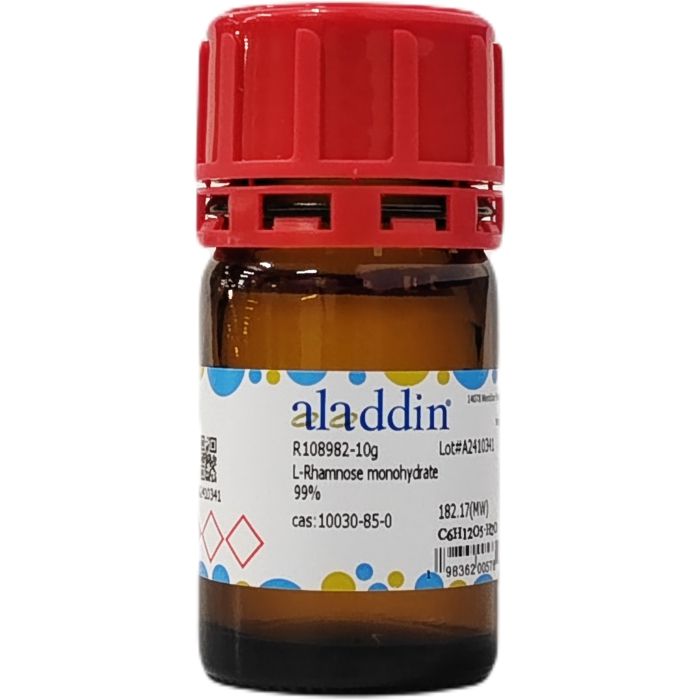
SKU: R108982
CAS: 10030-85-0
InChIKey: 39544 (as provided)
SMILES: Not specified for this item; refer to CoA/Spec Sheet.
Computed/Literature identifiers and descriptors (for reference only):
Common name: L-Rhamnose monohydrate (6-deoxy-L-mannose·H2O)
Six-membered pyranose ring with four hydroxyl groups (C1–C5), C6 is deoxy (methyl group) distinguishing it from hexoses like glucose.
Stereochemistry corresponds to the L-manno series; multiple chiral centers define L-configuration.
Exists as α/β anomers in aqueous equilibrium; hydrates via crystalline lattice water.
Synthetic Utility
Role in synthesis (general carbohydrate chemistry):
Chiral pool building block: Provides access to L-configured scaffolds. The 6-deoxy feature enables introduction of a terminal methyl group in target molecules.
Glycosyl donors/acceptors: L-Rhamnose is commonly converted to donors such as trichloroacetimidates, thioglycosides, or glycosyl halides after appropriate protection. These donors rhamnosylate phenols, alcohols, and amines to build natural product glycosides and oligosaccharides.
Protecting-group strategy: Peracetylation/perbenzoylation increases solubility in organic solvents and controls neighboring-group participation (e.g., at O-2) to influence α/β selectivity during glycosylation.
Derivatization handles: Selective oxidation (e.g., at C-6 is not applicable due to deoxy; alternative sites include C-1/C-2 chemistry), acylations, silylations, and formation of cyclic acetals enable further elaboration.
Linker chemistry: Reductive amination of the open-chain aldehyde (after equilibrium shift) allows attachment to amine-bearing linkers for conjugation to surfaces/polymers.
Strategic advantages:
Access to L-rhamnosyl motifs prevalent in antibiotics, saponins, and bacterial polysaccharides.
Defined stereochemistry simplifies downstream chiral integrity control compared to de novo asymmetric synthesis.
Note: Account for monohydrate water in stoichiometric calculations and perform thorough drying before water-sensitive steps.
Target Specificity
Not applicable. This product is a small-molecule carbohydrate, not an antibody, probe, or engineered affinity reagent. No target/epitope specificity is defined for this item.
Domande frequenti
What is the purity of this product?
This product is supplied at ≥99% purity (chemical assay). Lot-specific values are stated on the Certificate of Analysis.
How should this product be stored?
Store at room temperature.
How is this product shipped?
This product ships under standard ambient conditions. No temperature-controlled packaging is required.
What are the CAS number, molecular formula and molecular weight?
The CAS Number is 10030-85-0, the molecular formula is C6H12O5·H2O, and the molecular weight is 182.17 g/mol. InChIKey CBDCDOTZPYZPRO-DEZHIRTDSA-N.
What documentation is provided?
Available product documentation, including Certificates of Analysis (COA), Safety Data Sheets (SDS), and specification sheets, is shown in the product document area. Document availability and access follow the current site policy.
Utilizziamo i cookie per garantire il corretto funzionamento del sito web e, ove consentito, per migliorare la tua esperienza. Puoi gestire le tue preferenze in qualsiasi momento nelle Impostazioni. Per saperne di più, consulta la nostra Cookie Policy.
Desidera che le inviamo un messaggio quando avremo sconti disponibili?
Ricordamelo più tardi
Grazie! Controlli la sua casella di posta per confermare.
Products are supplied to verified businesses, institutions, and qualified professionals for research and development use only. Not for use in humans, animals, diagnosis, or therapy.

 J2614679