This compound belongs to the class of organic compounds known as alpha amino acid esters. These are ester derivatives of alpha amino acids.
External Descriptors
Not available
1. Djoumbou Feunang Y, Eisner R, Knox C, Chepelev L, Hastings J, Owen G, Fahy E, Steinbeck C, Subramanian S, Bolton E, Greiner R, and Wishart DS. ClassyFire: Automated Chemical Classification With A Comprehensive, Computable Taxonomy. Journal of Cheminformatics, 2016, 8:61.
Determine the necessary mass, volume, or concentration for preparing a solution.
Dilution Calculator
Determine the dilution needed to prepare a stock solution.
Reconstitution Calculator
Recensioni
Recensioni dei clienti
Application Protocols
Not applicable. No validated immunoassay or cellular protocols are provided for this small-molecule building block. For synthetic applications, refer to the Reaction Conditions and Synthetic Utility sections for general procedural guidance.
Biological Roles
Item-specific biological activity is not provided. This compound is a protected derivative intended for research and synthetic use.
Context (general/biochemistry):
L‑Tryptophan itself is an essential amino acid incorporated into proteins and is a biosynthetic precursor to serotonin, melatonin, and kynurenine pathway metabolites.
Conversion to the benzyl ester masks the α‑carboxylate, substantially changing physicochemical properties and biological handling. The ester is not a natural metabolite and typically serves only as a synthetic intermediate.
The indole ring can participate in π–stacking and H‑bonding interactions, which is exploited in medicinal chemistry and peptide design; however, the benzyl ester form is mainly used off‑biological pathway.
Practical implication:
Use in cell/biochemical systems is uncommon and generally not recommended without prior validation, given altered solubility and potential for non‑specific interactions.
No medical or clinical claims are made. For research use only, per Product Data.
Buffer Applications
This product is not a buffering reagent and is not typically used to prepare biological buffers or electrophoresis solutions.
If pH control is required during couplings or hydrogenolysis, use appropriate buffered aqueous phases (e.g., phosphate or bicarbonate) in biphasic workups, or select non-aqueous bases (e.g., DIPEA) for anhydrous couplings. These are general procedural notes, not uses of the compound itself as a buffer.
Green Alternatives
Green chemistry considerations focus on solvent choice, protecting-group strategy, and deprotection conditions.
Greener solvents (literature/general):
Prefer EtOAc or 2‑MeTHF over DCM/chloroform for couplings and workups.
Use EtOH or i‑PrOH where feasible for hydrogenolysis, potentially with water co‑solvent if substrate allows.
Protecting-group strategy:
Benzyl ester offers mild hydrogenolysis but requires Pd and hydrogen gas. Alternatives include:
t‑Bu ester: removable by dilute acid (TFA), avoiding Pd/H2 but generating isobutylene; acid-sensitive motifs may be impacted.
Methyl/ethyl esters: removed by saponification (base) or specific enzymes; avoids Pd/H2 but introduces aqueous base steps.
Comparison (general):
Deprotection energy profile and waste generation can be reduced by choosing solvent-efficient couplings (e.g., in EtOAc or 2‑MeTHF) and flow hydrogenation for safer H2 handling.
t‑Bu ester: Pros—no metals; Cons—acidic waste, may affect acid-labile groups.
Alkyl esters (Me/Et): Pros—simple reagents; Cons—aqueous base step, potential epimerization.
Note: Selection depends on the protecting-group constellation of the target. Item-specific environmental metrics are not specified; consult your process safety team for solvent and catalyst recovery options.
Pharmaceutical Uses
Item-specific pharmacopeial status or excipient role: Not specified for this item; refer to CoA/Spec Sheet.
General context (no therapeutic claims):
L‑Tryptophan benzyl ester is used as a synthetic intermediate in the preparation of peptide APIs, peptidomimetics, and small molecules that incorporate an L‑tryptophan motif. The benzyl ester facilitates C‑terminal protection during convergent fragment assembly and can be removed under mild hydrogenolysis.
In process chemistry, selection of benzyl vs. alternative esters balances downstream deprotection conditions, impurity profiles, and compatibility with other protecting groups (e.g., Boc on α‑amine, side-chain protections).
Manufacturing considerations (general):
Control of residual palladium following hydrogenolysis is often required (e.g., Pd scavengers, ICP‑MS limits) if used along GMP pathways.
Ensure chiral integrity through mild coupling methods and monitoring of D‑epimer content by chiral HPLC.
Residual solvent limits (ICH Q3C) and potential benzyl alcohol/toluene traces should be assessed in regulated settings.
This product is supplied for research and laboratory use only.
Physical Properties
Item-specific specifications are not provided in the Product Data. The following are general/literature values for context only; they are not product specifications.
Appearance: Not specified for this item; refer to CoA/Spec Sheet.
Molecular formula: Not specified for this item; refer to CoA/Spec Sheet. (Literature: C18H18N2O2)
Molecular weight: Not specified for this item; refer to CoA/Spec Sheet. (Literature: ~294.35 g/mol)
Melting point: Literature reports vary depending on polymorph and salt form; free-base benzyl esters of amino acids often are crystalline solids with mp in the ~70–120 °C range. Specific mp for this item: Not specified; refer to CoA/Spec Sheet.
Boiling point: Not typically distilled (decomposes before bp under ambient pressure). Specific bp: Not applicable.
Density: Not specified for this item; refer to CoA/Spec Sheet.
Solubility (qualitative, literature/general):
Organic: Good solubility in DCM, chloroform, EtOAc, MeOH, EtOH, and polar aprotic solvents (DMF, DMSO, NMP).
Aqueous: Low water solubility due to benzyl ester; may dissolve upon acid/base salt formation of the amine.
pKa (literature/general): α‑NH3+/NH2 ~9–10 (environment-dependent). Indole N is weakly acidic (~16–17 in DMSO).
LogP (literature/general expectation): Increased lipophilicity vs. L‑tryptophan due to benzyl ester; typical logP estimated in the 2–3 range, method-dependent.
Refractive index/UV cutoff: Not specified for this item; refer to CoA/Spec Sheet.
Note: Exact physical parameters can depend on salt form, solvate content, and polymorph; consult the item’s CoA/SDS for definitive data.
Quality and Grades
Item-specific quality information from Product Data:
Grade/Purity: Not specified for this item; refer to CoA/Spec Sheet.
Guidance for interpretation (general):
For building-blocks like L‑tryptophan benzyl ester, typical research grades specify purity by HPLC or NMR. If chromatographic use is intended (e.g., SPPS or LC standards), a higher grade (≥98% by HPLC) with tight controls on related substances is often preferred.
Key impurities to monitor (general): residual L‑tryptophan, oxidized indole species, over-acylated/byproducts from coupling reagents, and racemization products (D‑isomer). The benzyl ester is susceptible to trace toluene/benzyl alcohol residues depending on synthesis.
If stabilized or as a salt: Any stabilizer/salt form would be declared on the CoA. None is specified here; therefore, assume no added stabilizer unless noted on the label/CoA.
Documentation:
For critical applications, request or review: CoA (assay, identity by NMR/IR/MS, optical rotation, chiral purity); residual solvents per ICH Q3C (if relevant); and water content (KF) if handling under moisture-sensitive conditions.
Practical note:
For peptide coupling, ensuring low D‑epimer content and minimal peroxide in solvents (especially DMF/Et2O) helps maintain optical integrity of the L‑center. Item-specific numeric limits: Not specified for this item; refer to CoA/Spec Sheet.
Reaction and Applications
This benzyl-ester protected L‑tryptophan is primarily a building block for peptide and amide synthesis where the C‑terminus is masked as –CO2Bn.
Key applications (literature/general):
Peptide fragment synthesis: Serves as an L‑tryptophan unit with a protected C‑terminus, enabling selective coupling at the α‑NH2 to form amide bonds without undesired self-condensation.
Hydrogenolytic deprotection: The benzyl ester is cleanly removed using H2/Pd to regenerate the free acid post-coupling. Particularly useful when acid-sensitive protecting groups are present elsewhere.
Prodrug/intermediate synthesis: Used to install tryptophan motifs in small molecules and peptidomimetics, leveraging the indole for π–π and H‑bonding interactions.
Typical transformations:
Amide couplings with activated carboxylic acids (HATU, HBTU, TBTU, COMU) or carbodiimides (EDC/NHS, DIC/HOAt). Maintain low temperatures and bases such as DIPEA/TEA to minimize racemization.
N‑acylations/urea/thiourea formation via isocyanates or CDI activation at the α‑amine.
Side-chain functionalization on the indole (e.g., electrophilic substitution, metalation under carefully controlled conditions), though protection of the indole NH may be required (e.g., Boc or SEM on indole nitrogen) to control regioselectivity.
Practical tips:
Work under inert atmosphere if conducting prolonged steps; indole can oxidize.
Minimize exposure to strong acids/bases at elevated temperature to avoid racemization at the α‑center.
For hydrogenolysis, pre‑wet Pd/C with solvent, degas, and filter through celite to avoid catalyst carryover.
Reaction Conditions
General, literature-based guidance for typical operations involving L‑tryptophan benzyl ester. These are not product specifications.
Amide coupling at α‑amine:
Reagents: HATU (1.0–1.2 eq) or HBTU/COMU; base DIPEA (2–3 eq).
Solvent: DMF, DCM, or EtOAc; 0–25 °C.
Time: 1–4 h for small-molecule couplings; monitor by TLC/HPLC.
Notes: Pre-cool and add base last to minimize racemization; avoid prolonged exposure to strong base.
Carbodiimide coupling (alternative):
EDC·HCl (1.1–1.5 eq) with NHS or HOBt/HOAt additives; base DIPEA; DMF/DCM.
Control urea byproducts via stoichiometry and temperature.
Hydrogenolysis of benzyl ester:
Catalyst: Pd/C (5–10 wt% relative to substrate).
Solvent: EtOH, MeOH, EtOAc, or EtOH/EtOAc; optional small amount of AcOH to keep amine protonated and suppress catalyst poisoning.
Pressure: 1–3 bar H2 (balloon to Parr); Temperature: rt.
Time: 2–16 h, depending on load and stirring efficacy.
Workup: Filter through celite, wash thoroughly; check for residual Pd (if relevant) and remove with scavengers (e.g., silica‑thiol) as needed.
Indole protection (optional prior to harsh steps):
Boc protection: Boc2O, catalytic DMAP, base (Na2CO3 or DIPEA), DCM/MeCN, 0–25 °C.
Stability considerations:
Avoid strong oxidants and prolonged UV exposure (indole oxidation).
Limit heating with strong base to minimize epimerization at the α‑center.
Conditions vary by substrate and scale; optimize empirically.
Safety and Handling
Regulatory and hazard status (item-specific):
GHS classification: Not specified for this item; refer to SDS.
Signal word / H‑statements / pictograms: Not specified for this item; refer to SDS.
General laboratory hazards (literature/general):
May cause skin/eye/respiratory irritation. Dust can irritate mucosa.
Indole-containing compounds can be light- and air-sensitive, slowly discoloring; handle to minimize prolonged exposure to light and air.
Safe handling practices:
Use in a chemical fume hood; avoid dust formation and inhalation.
PPE: lab coat, safety glasses, and appropriate gloves (e.g., nitrile). Change gloves regularly when using DMF/DMSO.
Avoid contact with strong oxidizers; benzyl esters and indoles can be oxidatively sensitive.
First-aid overview (general):
Inhalation: Move to fresh air; seek medical advice if symptoms persist.
Skin/eye contact: Rinse with water for several minutes; remove contaminated clothing; seek medical attention if irritation continues.
Ingestion: Rinse mouth; do not induce vomiting; obtain medical attention.
Fire safety:
Organic solid; may burn to produce CO/CO2 and nitrogen oxides. Use CO2, dry powder, or foam extinguishers. Cool containers with water spray.
Spill/cleanup:
Avoid dust; collect mechanically. Wash area with suitable solvent/detergent while observing compatibility.
Always consult the SDS for authoritative, item-specific hazard, exposure limits, and emergency procedures.
Solvent Selection
L‑Tryptophan benzyl ester is a neutral, moderately lipophilic amino acid derivative; it dissolves well in many organic solvents used for coupling and hydrogenolysis.
Polarity and miscibility (literature/general):
Good solvents: DCM, chloroform, EtOAc, MeOH, EtOH, i‑PrOH, acetone, THF, CPME, MTBE; also polar aprotics (DMF, DMAc, DMSO, NMP).
Poor solvents: Water (unless protonated as a salt), aliphatic hydrocarbons (hexanes) may offer only limited solubility.
Selection guidance by operation:
Amide couplings: DMF, DCM, or EtOAc are common. For greener profiles, consider 2‑MeTHF or EtOAc with soluble coupling agents.
Hydrogenolysis (Bn deprotection): EtOH, MeOH, EtOAc, or mixed EtOH/EtOAc are widely used with Pd/C under H2; avoid strong bases that can promote indole oxidation.
Crystallization/trituration: EtOAc/hexanes or DCM/hexanes mixtures often enable purification due to differential solubility.
Comparison (general considerations):
DCM: fast kinetics and good solubility but environmental and safety drawbacks.
DMF/DMSO: excellent solvating power; challenging removal and health concerns.
2‑MeTHF/EtOAc: greener alternatives with manageable evaporation and good performance for many couplings.
Note: Verify solubility and stability empirically for your batch. Item-specific solubility parameters are not provided; refer to CoA/Spec Sheet if available.
Storage and Reconstitution
Storage (item-specific):
Storage conditions: Room temperature (per Product Data). Store tightly closed in a dry, well‑ventilated place.
Shipped: Normal (per Product Data).
General best practices (literature/general):
Protect from light and air to minimize indole oxidation; consider amber glass or foil wrap for long-term storage.
Maintain desiccation (e.g., desiccant pack) to avoid moisture ingress that can impact sensitive couplings.
If forming salts (e.g., HCl) for handling, record the exact form, as solubility and mp will change.
Reconstitution/dissolution (general):
For stock solutions, use dry DCM, DMF, DMSO, EtOAc, MeOH, or EtOH. Filter if particulates remain.
Prepare solutions freshly for coupling or store at 2–8 °C in amber vials for short periods; avoid repeated freeze–thaw of concentrated solutions in hygroscopic solvents.
Stability notes:
Avoid strong oxidizers and prolonged basic conditions at elevated temperatures to prevent degradation and racemization.
Refer to the product’s CoA/SDS for any additional, lot-specific storage instructions. Research use only, as noted in the Product Data.
Structure and Identity
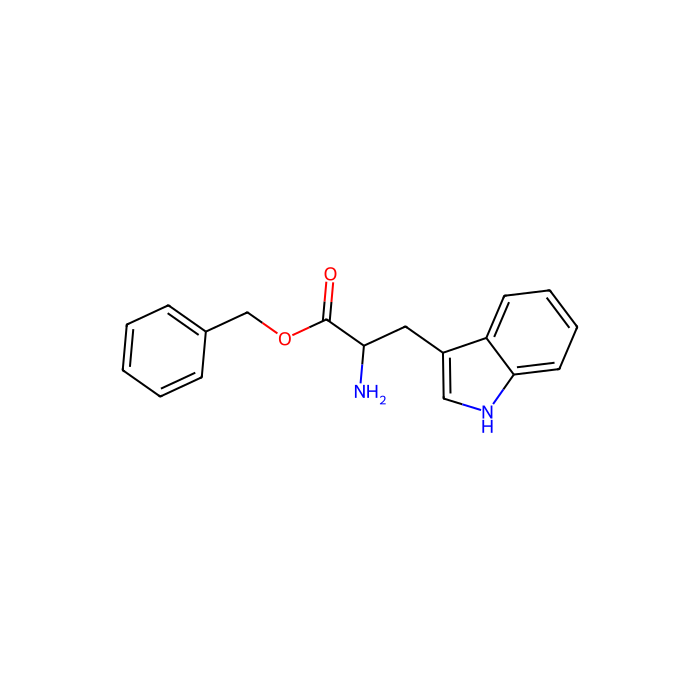
A benzyl-ester protected, L-configured aromatic amino acid derivative derived from L-tryptophan; useful as a C‑terminally protected building block.
Item-specific identifiers (from Product Data):
CAS: 4299-69-8
SKU: L334151
Category: Life Science (research use)
InChIKey (as provided): 353433
SMILES: Not specified for this item; refer to CoA/Spec Sheet.
Structure description (general/literature):
Core scaffold: Indole ring (fused benzene–pyrrole) attached at C-3 to a CH2–CH(NH2)–CO2Bn side chain.
Functional groups: Primary amine (α‑NH2), indole (N–H), and a benzyl ester (–CO2CH2Ph) protecting the α‑carboxyl of L‑tryptophan.
Stereochemistry: One stereocenter at the α‑carbon; configuration is L (S) as in natural L‑tryptophan.
Protecting-group logic: Benzyl (Bn) ester serves as an acid-stable, base-stable, and coupling-compatible C‑terminal protection removable by hydrogenolysis (H2/Pd).
Computed/literature identifiers (for context; not item-specific):
Typical molecular formula (literature): C18H18N2O2
2D depiction in words: The molecule contains an indole ring bearing a –CH2–CH(NH2)– moiety that terminates in a carbonyl linked via an oxygen to a benzyl group (–O–CH2–Ph), forming the benzyl ester of the α‑carboxylate.
Synthetic Utility
Functional elements and reactivity (general):
α‑Amine (NH2): Nucleophilic site for amide coupling, carbamate formation, and N‑acylation. Susceptible to racemization under strong base/heat.
Benzyl ester (–CO2Bn): Protects the α‑carboxylate; robust to most coupling conditions; cleavable by hydrogenolysis (H2/Pd).
Indole: Electrophilic substitution at C‑3 (native side chain attachment) and C‑2 under directed conditions; N‑protection may be employed (e.g., Boc, SEM) to modulate reactivity/solubility.
Retrosynthetic value:
Enables convergent assembly of peptides and peptidomimetics by preventing C‑terminal reactions until final deprotection. Often paired with Boc‑L‑Trp‑OH logic where N‑Boc protection is combined with a C‑terminal benzyl ester.
Named/standard transformations:
HATU/HBTU/COMU-mediated amide coupling at the α‑amine with minimal racemization using DIPEA at 0–25 °C.
EDC/NHS or DIC/HOAt couplings for carboxyl activation on the partner acid.
Hydrogenolysis: 5–10 wt% Pd/C, 1–3 bar H2, alcohol/ester solvent; quantitative removal of Bn to yield L‑tryptophan derivatives.
Purification strategies:
Silica gel chromatography using DCM/MeOH or EtOAc/hexanes gradients; protect the indole NH if streaking occurs.
Crystallization from EtOAc/hexanes can be effective for many benzyl esters.
Analytical control:
Monitor by HPLC/UPLC (UV 280 nm for indole), 1H/13C NMR, MS, and [α]D for enantiopurity where applicable.
Item-specific reactivity limits or impurities are not specified; consult the item’s CoA.
Target Specificity
Not applicable. This product is a small-molecule amino acid derivative, not an antibody, protein, or targeted biological reagent. No antigen/epitope or species reactivity data are relevant.
Domande frequenti
What is the purity of this product?
This product is supplied at ≥98% purity (chemical assay). Lot-specific values are stated on the Certificate of Analysis.
How should this product be stored?
Store at room temperature.
What are the CAS number, molecular formula and molecular weight?
The CAS Number is 4299-69-8, the molecular formula is C18H18N2O2, and the molecular weight is 294.35 g/mol. InChIKey TYQYRKDGHAPZRF-INIZCTEOSA-N.
Utilizziamo i cookie per garantire il corretto funzionamento del sito web e, ove consentito, per migliorare la tua esperienza. Puoi gestire le tue preferenze in qualsiasi momento nelle Impostazioni. Per saperne di più, consulta la nostra Cookie Policy.
Desidera che le inviamo un messaggio quando avremo sconti disponibili?
Ricordamelo più tardi
Grazie! Controlli la sua casella di posta per confermare.
Products are supplied to verified businesses, institutions, and qualified professionals for research and development use only. Not for use in humans, animals, diagnosis, or therapy.
 B2226631
