Determine the necessary mass, volume, or concentration for preparing a solution.
| Activity Type | Activity Value -log(M) | Mechanism of Action | Activity Reference | Publications (PubMed IDs) |
|---|

Information
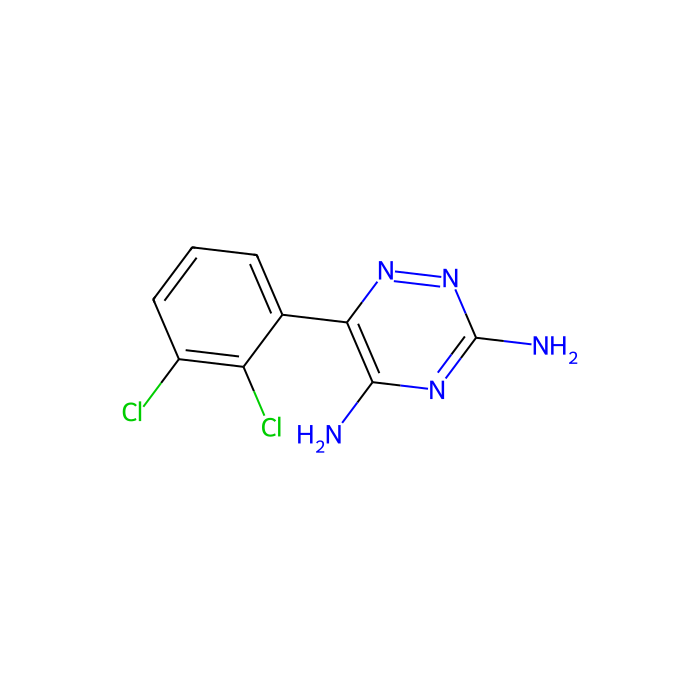
Lamotrigine Lamotrigine (BW-430C) is a novel anticonvulsant drug for inhibition of 5-HT with IC50 of 240 μM and 474 μM in human platelets and rat brain synaptosomes, and also is a sodium channel blocker.
In vitro
Lamotrigine stabilises presynaptic neuronal membranes by blockade of voltage-dependent sodium channels, thus preventing the release of excitatory neurotransmitters, particularly glutamate and aspartate. In rat cerebral cortex tissue incubated with veratrine 10 mg/L, lamotrigine is twice as potent in inhibiting the release of glutamate and aspartate (ED 50 = 5.38 mg/L for each) than the release of GABA (ED50 = 11.2 mg/L), and is much less potent in inhibiting acetylcholine release (ED50 = 25.6 mg/L) when cortical slices is exposed to veratrine 75 mg/L. Basal glutamate release is unaffected . Lamotrigine inhibits high-frequency sustained repetitive firing of sodium-dependent action potentials, indicating a direct effect on voltage-activated sodium channels. Lamotrigine does not induce PCP-like central nervous system (CNS) effects, does not act by direct inhibition at the NMDA receptor, and would be expected to be devoid of the undesirable effects associated with NMDA blockade.
In vivo
In mice and rats, lamotrigine prevents MES- and pentetrazol-induced hindlimb extension, suggesting an antiepileptic profile in animals. These effects peak 1 hour after lamotrigine administration and persist for more than 24 hours. Lamotrigine is active in the electrically evoked EEG after-discharge test, which is thought to indicate activity against both simple and complex partial seizures. After-discharge duration is reduced dose-dependently by lamotrigine in rats at intravenous doses >5 mg/kg.
Cell Data
cell lines:Murine cortical neurons and cerebellar granule cells
Concentrations:
Incubation Time:
Powder Purity:≥99%
| Activity Type | Activity Value -log(M) | Mechanism of Action | Activity Reference | Publications (PubMed IDs) |
|---|
| Punto di fusione (°C) | 216-218°C |
|---|
H301:Toxic if swallowed
P321:Specific treatment (see ... on this label).
P405:Store locked up.
P501:Dispose of contents/container to an approved waste disposal plant.
P264:Wash hands [and …] thoroughly after handling.
P270:Do not eat, drink or smoke when using this product.
P330:Rinse mouth.
P301+P316:IF SWALLOWED: Get emergency medical help immediately.
La nostra guida alla selezione delle qualità copre purezza, stato dello stabilizzatore e idoneità all'applicazione per tutte le varianti del nostro catalogo.
Visualizza la guida alle qualità Moligand™ →