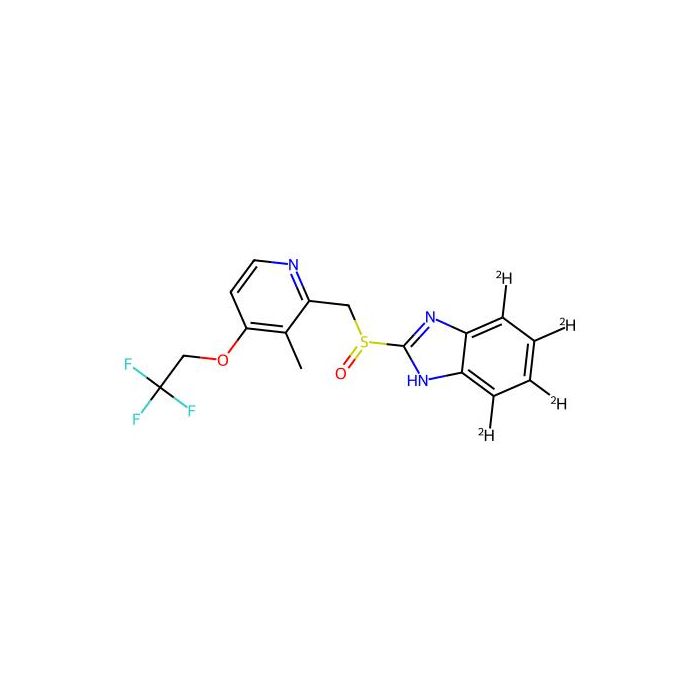
This compound belongs to the class of organic compounds known as sulfinylbenzimidazoles. These are polycyclic aromatic compounds containing a sulfinyl group attached at the position 2 of a benzimidazole moiety.
External Descriptors
Not available
1. Djoumbou Feunang Y, Eisner R, Knox C, Chepelev L, Hastings J, Owen G, Fahy E, Steinbeck C, Subramanian S, Bolton E, Greiner R, and Wishart DS. ClassyFire: Automated Chemical Classification With A Comprehensive, Computable Taxonomy. Journal of Cheminformatics, 2016, 8:61.
Determine the necessary mass, volume, or concentration for preparing a solution.
Dilution Calculator
Determine the dilution needed to prepare a stock solution.
Reconstitution Calculator
Recensioni
Recensioni dei clienti
Application Protocols
Validated applications, recommended dilutions, and positive controls: Not specified for this item; refer to CoA/Spec Sheet and internal SOPs.
Example workflow (general LC–MS/MS, for guidance only):
Prepare a 1–5 mg/mL stock solution in DMSO or ACN (amber vial). Store aliquots at −20 °C.
Working internal standard (IS) solution: dilute stock into ACN or 50:50 ACN:water with 0.1% formic acid to yield 10–100 ng/mL (concentration to suit sensitivity and matrix).
Sample spiking: add a fixed volume of IS to each calibration standard, QC, and unknown prior to extraction.
Extraction: precipitate proteins with 3–5× volume of ACN or MeOH, vortex, centrifuge, and transfer supernatant. Optionally perform SPE cleanup.
LC–MS/MS: monitor MRM transitions offset by +4 Da versus the analyte. Optimize collision energies to select fragments without isotopic overlap.
All parameters, including concentrations and transitions, must be optimized for the specific instrument and matrix. These are provided as general starting points only.
Lansoprazole is a benzimidazole sulfoxide pro-moiety that, under strongly acidic conditions, can convert to a reactive sulfenamide which covalently modifies luminal cysteine residues of the gastric H+/K+-ATPase. This chemistry underlies its selective reactivity in highly acidic environments.
The molecule contains basic heteroaromatics (pyridine, benzimidazole) that facilitate accumulation in low-pH compartments where activation can occur.
Relevance of d4 labeling (research use):
Deuteration does not materially alter target engagement pathways but provides a distinct mass signature for precise quantification of the parent analyte in biological matrices.
In metabolism studies, the d4 label supports discrimination of parent versus metabolites and correction for matrix effects during sample preparation.
Caveats:
Avoid interpreting analytical-standard performance as a measure of pharmacological activity; the d4 compound is intended for measurement support in research environments only.
Any assessment of biotransformation (e.g., sulfoxide reduction/oxidation, cleavage) should be verified experimentally under the specific assay conditions, as isotope effects on certain pathways can be subtle but nonzero.
No clinical or therapeutic claims are made. For research use only.
Buffer Applications
This product is not a buffering reagent and is not typically used to prepare biological buffers or electrophoresis running solutions.
Practical note:
If aqueous working solutions are required for spiking experiments, prepare organic stocks (e.g., in DMSO or ACN) and dilute into pre-made buffers (such as ammonium formate or phosphate buffers) immediately before use. Verify solubility and stability at the target pH, avoiding strongly acidic conditions due to acid lability (literature for unlabeled lansoprazole).
Green Alternatives
As an analytical standard, the principal environmental considerations relate to solvent choice and sample throughput rather than the compound itself.
Greener solvent choices (general guidance):
Prefer acetonitrile (ACN) or ethanol over chlorinated solvents (e.g., dichloromethane) for stock preparation and sample processing.
For LC mobile phases, use water/ACN with formic acid or ammonium formate (low concentration) instead of higher-toxicity modifiers when compatible with sensitivity.
Comparison (general, literature-based):
ACN vs MeOH in LC–MS:
ACN: lower viscosity, reduced system backpressure, often sharper peaks; higher cost and supply volatility.
MeOH: more sustainable sourcing potential, higher viscosity, sometimes inferior peak shape for benzimidazole–sulfoxides.
DMF: effective but more hazardous; avoid when DMSO suffices.
Operational practices to reduce footprint:
Use microvolume autosampler vials and low-flow LC (micro/UPLC) to reduce solvent consumption.
Consolidate calibration levels and apply bracketing standards to minimize injected volumes and waste.
Note: Performance and method suitability must be validated; prioritize greener choices when they meet analytical requirements.
Pharmaceutical Uses
No therapeutic or clinical use is implied. For research use only.
Role in pharmaceutical R&D and QC (general):
Stable-isotope internal standard for method development, validation, and routine QC testing of lansoprazole drug substance and drug products by LC–MS/MS or LC–UV.
Supports accuracy, precision, and robustness in bioanalytical assays (e.g., nonclinical PK, in vitro ADME), as well as release and stability-indicating methods when MS detection is employed.
Useful for recovery studies, matrix-matched calibration, and isotopic dilution experiments to mitigate matrix effects and instrumental variability.
Regulatory/quality notes:
Confirm isotopic enrichment, labeling positions, and impurity profile on the CoA to ensure suitability for validated methods and alignment with regulatory expectations.
Store and handle according to Good Laboratory Practices (GLP) or internal SOPs where applicable. Maintain traceability of reference standard lots used in regulated studies.
Physical Properties
Item-specific physicochemical specifications (BP, MP, density, UV cutoff, water/peroxide/metal limits, etc.): Not specified for this item; refer to CoA/Spec Sheet.
Literature/general data for unlabeled lansoprazole (for context only):
Appearance: off-white to pale yellow crystalline powder (literature).
Melting point: typically reported ~166–170 °C (literature, unlabeled).
LogP (octanol/water): reported ~3.0–3.3 (literature estimates for unlabeled parent).
pKa: benzimidazole/pyridine basic sites with reported pKa values in the range ~8–9 (conjugate acid) for the pyridine nitrogen; benzimidazole N is weaker (literature, method-dependent).
Solubility: sparingly soluble in water at neutral pH; increased solubility in polar aprotic solvents (DMSO, DMF, acetonitrile), and in alkaline aqueous media (literature for unlabeled parent). Deuteration typically does not materially alter solubility behavior.
Important notes:
Deuteration (+4 Da) minimally affects bulk physical properties versus the unlabeled compound but is critical for MS selectivity and accurate quantitation.
Actual measured values (including isotopic enrichment, residual solvents, water content) should be taken from the item’s CoA/SDS; do not substitute literature values for specifications.
Quality and Grades
Grade/Purity: Not specified for this item; refer to CoA/Spec Sheet for assay, isotopic enrichment, and impurity profile.
Context and expectations for deuterated analytical standards (general):
Isotopic enrichment: analytical internal standards are commonly supplied at ≥98 atom% D at labeled positions (literature/industry norm). Verify exact enrichment and labeling pattern on the CoA.
Chemical purity: typically reported by HPLC or LC–MS; verify acceptance criteria and reporting method on the CoA.
Residual solvents, water, inorganic content, and identity (NMR, MS): Not specified for this item; refer to CoA/Spec Sheet.
Stabilizers: Not specified for this item. Some acid-labile benzimidazoles are packaged under inert gas, in amber vials, and/or with desiccant to mitigate degradation; check label and CoA for any stabilizer or special packaging notes.
What this means for end-users:
For LC–MS quantitation, confirm both chemical purity and isotopic integrity to avoid interference from partially deuterated isotopologues (D3, D2) that may overlap with analyte isotopes.
Align acceptance criteria (e.g., mass fraction purity, atom% D, residual solvents) with your method validation plan and regulatory expectations where applicable.
Reaction and Applications
Primary use-case (research/analytical):
Stable-isotope internal standard for quantitative LC–MS(/MS) analysis of lansoprazole in complex matrices (plasma, microsomes, in vitro assays). The +4 Da mass shift enables selective MRM transitions with co-elution to correct for ionization suppression and recovery losses.
Additional applications (research):
Metabolic stability and DMPK studies as a tracer to track parent compound through microsomal/S9 incubations or chemical stability assays.
Isotope-dilution qNMR or LC–UV/fluorescence methods for calibrant cross-checks.
Matrix spike/recovery experiments, process control, and system suitability in bioanalytical methods.
Practical tips:
Prepare concentrated stock (e.g., 1–10 mg/mL) in DMSO or ACN; store small aliquots at −20 °C in amber vials to minimize freeze–thaw and photolysis. Item-specific stability: Not specified; verify with internal stability studies.
Avoid strong acids during sample preparation; lansoprazole scaffolds are acid-labile and can degrade via sulfenamide formation (literature for unlabeled parent).
For tandem MS, select precursor at [M+H]+ with +4 Da shift relative to analyte; ensure fragment transitions are free from isotopic cross-talk.
Not a general-purpose building block: due to complexity and labeling, this material is intended for analytical support rather than synthetic transformations.
Reaction Conditions
This product is not intended for use as a reagent in preparative organic reactions; typical “reaction conditions” are therefore not applicable.
Analytical method conditions (general guidance, literature-informed for unlabeled lansoprazole):
LC–MS/MS: ESI(+) mode commonly provides strong response. Mobile phases of water and acetonitrile with 0.05–0.1% formic acid or 2–10 mM ammonium formate are frequently used. Column temps 30–45 °C; gradients 2–8 min for UPLC methods.
Sample prep: protein precipitation with ACN or MeOH (3–5× volume), or SPE with mixed-mode sorbents to improve cleanliness. Spike the d4 internal standard prior to extraction for best accuracy.
Stability checks: assess bench-top (4–6 h), autosampler (4–24 h, 4–10 °C), freeze–thaw (≥3 cycles), and long-term (−20 °C) stability. Item-specific stability and acceptance criteria: Not specified for this item; define per method validation plan.
If employing chemical derivatization or stress testing, avoid strongly acidic conditions that can activate/degrade the benzimidazole–sulfoxide scaffold. Verify that no H/D back-exchange occurs under chosen conditions.
Safety and Handling
GHS classification, signal word, pictograms, and H-statements: Not specified for this item; consult the SDS for authoritative information.
General laboratory safety guidance (applicable to benzimidazole–sulfoxide small molecules; not a substitute for SDS):
PPE: wear lab coat, safety glasses, and appropriate chemically resistant gloves. Avoid inhalation of dusts and contact with skin/eyes.
Handling: work in a fume hood to minimize dust exposure. Lansoprazole analogues are light- and acid-sensitive; minimize exposure to strong acids and prolonged light. Use amber vials when possible.
Incompatibilities: strong acids (acid-labile), strong oxidizers or reductants that could affect the sulfoxide functionality; avoid moisture for accurate weighing and long-term stability.
First aid (overview): in case of eye/skin contact, rinse with plenty of water; if inhaled, move to fresh air; if ingested, rinse mouth. Seek medical attention according to SDS guidance.
Fire safety: treat as an organic combustible solid. Use CO2, dry chemical, or foam extinguishers. Thermal decomposition may produce irritating/toxic fumes.
Waste: dispose according to institutional and local regulations for organic laboratory chemicals.
Shipping and storage conditions (Product Data):
Shipped: Ice chest + ice pads.
Storage: Store at −20 °C. Keep container tightly closed, protected from light and moisture.
For research use only.
Solvent Selection
This compound is a neutral/weakly basic, moderately lipophilic benzimidazole–sulfoxide. For stock solutions and analytical workflows:
Preferred solvents (general/literature):
DMSO: excellent solubilizer; stable for concentrated stocks; protect from moisture and light.
Acetonitrile (ACN): LC–MS compatible; good solubility; mixes readily with aqueous mobile phases.
Methanol or ethanol: suitable for LC–MS; assess stability versus transesterification or acid impurities.
DMF: strong solvent; use when DMSO or ACN are insufficient; verify background in LC–MS.
Aqueous solubility: low near neutral pH; solubility increases under basic conditions but the compound is acid-labile. For bioanalytical sample prep, prepare organic stocks and dilute into buffered aqueous media immediately before use.
Miscibility profile: DMSO, ACN, MeOH are fully miscible with water and facilitate preparation of working solutions at low percent organic.
When to choose what:
DMSO for long-term frozen aliquots (−20 °C) and minimal volatility losses.
ACN for direct LC–MS infusion or when lower viscosity and faster evaporation are desired.
MeOH for protein precipitation workflows in bioanalysis.
Comparison note (general): ACN often provides lower background and better peak shape for benzimidazole–sulfoxides than MeOH in ESI(+), but MeOH can improve recoveries in some protein precipitation matrices. Validate empirically.
Storage and Reconstitution
Storage (Product Data):
Store at −20 °C.
Shipped in an ice chest with ice pads.
Handling and reconstitution (general recommendations for deuterated small-molecule standards):
Upon receipt, allow the sealed container to equilibrate to room temperature before opening to prevent moisture condensation. Open in a low-humidity environment.
Prepare concentrated stock solutions in dry DMSO or acetonitrile. Typical ranges are 1–10 mg/mL, depending on assay needs (item-specific solubility not specified; verify experimentally).
Aliquot into amber, low-bind microvials to minimize adsorption and freeze–thaw cycles. Flush headspace with inert gas if long-term storage is anticipated.
Protect from light and moisture. Avoid prolonged exposure to strong acids; the benzimidazole–sulfoxide scaffold is acid-labile (literature for unlabeled parent).
Frozen stability, solution stability, and allowable freeze–thaw cycles: Not specified for this item; establish in-house and consult the CoA/SDS.
For research use only.
Structure and Identity
Lansoprazole-d4 is an isotopically labeled analogue of lansoprazole in which four protium atoms are replaced with deuterium, enabling use as a stable-isotope internal standard and tracer in analytical workflows.
SKU: L648957
Product name: Lansoprazole-d4
CAS: 934294-22-1
PubChem CID: 45039648
InChIKey: 220637 (truncated in product data; full InChIKey not specified for this item)
SMILES: Not specified for this item; refer to CoA/Spec Sheet.
Molecular formula: Not specified for this item; refer to CoA/Spec Sheet.
Molecular weight: Not specified for this item; refer to CoA/Spec Sheet.
Structural features (general chemistry knowledge):
Core scaffold: a benzimidazole ring system linked via a sulfoxide (S=O) to a substituted pyridine ring (typical of the benzimidazole-sulfoxide class).
Functional groups: benzimidazole (weakly basic), pyridine (basic), sulfoxide (chiral at sulfur), trifluoro-substitution on the aromatic system (in unlabeled lansoprazole, literature).
Stereochemistry: the sulfoxide center is stereogenic; commercial materials may be racemic unless otherwise specified (literature for unlabeled parent).
Isotopic label: four deuterons (2H) incorporated at defined positions (not specified here); labeling is designed to be non-exchangeable under routine LC–MS conditions.
2D description (general): a benzimidazole ring bears a methoxy/alkoxy-substituted linkage to a sulfoxide, which connects to a substituted pyridine; deuterium labels replace four hydrogens on non-exchangeable carbon positions to maintain chromatographic co-elution with the unlabeled analyte.
Synthetic Utility
Lansoprazole-d4 is primarily an analytical standard rather than a synthetic building block. Nonetheless, understanding its functional motifs can inform handling and stability in method development.
Functional groups and reactivity (general, literature for unlabeled parent):
Sulfoxide (S=O): stereogenic center; susceptible to redox processes (reduction to sulfide, over-oxidation to sulfone). Strong acids can promote rearrangements and activation to sulfenamides.
Benzimidazole and pyridine nitrogens: weakly to moderately basic; prone to protonation under acidic conditions, affecting solubility and activation.
Trifluoroaryl substitution contributes to lipophilicity and MS response.
Implications for analytical chemistry:
Avoid strong acid in diluents; prefer mildly acidic mobile phases (e.g., 0.1% formic acid) that balance ionization efficiency and stability.
Light sensitivity: protect solutions during sample prep to minimize degradation or isomerization.
Use in synthesis: not typically employed due to cost and the need to preserve isotopic integrity. If used in tracer chemistry, maintain conditions that prevent H/D exchange at labeled positions (i.e., avoid strong base/acids and protic media at elevated temperatures).
Target Specificity
Antigen/epitope, species reactivity, clone, and related immunochemical details are not applicable to this small-molecule analytical standard.
Item-specific target information: Not specified for this item; refer to CoA/Spec Sheet if any assay-specific targeting guidance is provided.
General note (biochemical context): unlabeled lansoprazole targets the gastric H+/K+-ATPase after acid activation (literature). The d4 label preserves the same chemical scaffold for analytical co-elution, but this product is intended solely for research measurement purposes.
Domande frequenti
What is the purity of this product?
This product is supplied at ≥99% purity (chemical assay). Lot-specific values are stated on the Certificate of Analysis.
How should this product be stored?
Store at ?20 °C. Freezer storage is required to maintain the specified shelf life.
How is this product shipped?
This product ships in an insulated container with ice pads. Unpack on arrival and transfer it to the storage condition stated above.
What are the CAS number, molecular formula and molecular weight?
The CAS Number is 934294-22-1, the molecular formula is C16H10D4F3N3O2S, and the molecular weight is 373.39 g/mol. InChIKey MJIHNNLFOKEZEW-QFFDRWTDSA-N.
What documentation is provided?
Available product documentation, including Certificates of Analysis (COA), Safety Data Sheets (SDS), and specification sheets, is shown in the product document area. Document availability and access follow the current site policy.
Utilizziamo i cookie per garantire il corretto funzionamento del sito web e, ove consentito, per migliorare la tua esperienza. Puoi gestire le tue preferenze in qualsiasi momento nelle Impostazioni. Per saperne di più, consulta la nostra Cookie Policy.
Desidera che le inviamo un messaggio quando avremo sconti disponibili?
Ricordamelo più tardi
Grazie! Controlli la sua casella di posta per confermare.
Products are supplied to verified businesses, institutions, and qualified professionals for research and development use only. Not for use in humans, animals, diagnosis, or therapy.