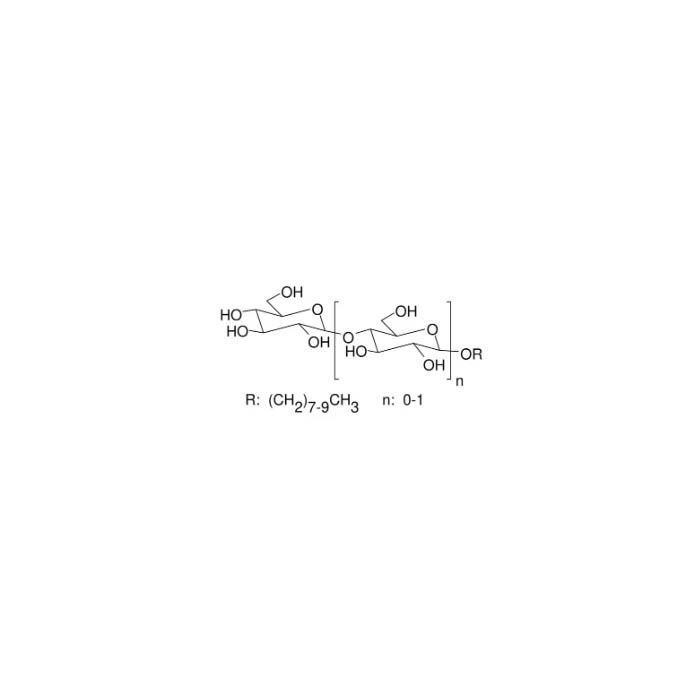
Lauryl glucoside - ≥40% , CAS No.110615-47-9

CAS: 110615-47-9 Cat. No.: L196324 Numero EC: 600-975-8
Disponibile su ordine
QUALITÀ & PUREZZA ≥40%
Synonyms
beta-D-GLUCOPYRANOSIDE, DODECYL|dodecyl d-glucopyranoside|(3R,4S,5S,6R)-2-dodecoxy-6-(hydroxymethyl)oxane-3,4,5-triol|Dodecyl D-glucoside|GLUCOSIDE, DODECYL, D-|lauryl glucoside|D-Glucopyranoside, dodecyl|CLAON ALL 4 CLEANSER|dodecyl--d-glucopyranoside|Alkyl-polyglucoside solution
Storage
Room temperature
Shipped In
Normal
★
Dimensione
Germania (EU)
USA*
Prezzo
Qtà
100ml
L196324-100ml
—
Disponibile ≥10
86,69€
500ml
L196324-500ml
1 Disponibile
1 Disponibile
260,23€
Enter a quantity for the sizes you want to add.

Specifiche

Sinonimi
beta-D-GLUCOPYRANOSIDE, DODECYL | dodecyl d-glucopyranoside | (3R,4S,5S,6R)-2-dodecoxy-6-(hydroxymethyl)oxane-3,4,5-triol | Dodecyl D-glucoside | GLUCOSIDE, DODECYL, D- | lauryl glucoside | D-Glucopyranoside, dodecyl | CLAON ALL 4 CLEANSER | dodecyl--d-glucopyranoside | Alkyl-polyglucoside solution
Specifiche e purezza
≥40%
Condizioni di conservazione di stoccaggio
Room temperature
Spedito in
Normal
Purezza
≥40%
Nomi e identificatori
Pubchem Sid
Pubchem Sid Url
https://pubchem.ncbi.nlm.nih.gov/substance/488196896
SMILES
CCCCCCCCCCCCOC1C(C(C(C(O1)CO)O)O)O
IUPAC Name
(3R,4S,5S,6R)-2-dodecoxy-6-(hydroxymethyl)oxane-3,4,5-triol
InChIKey
PYIDGJJWBIBVIA-IHAUNJBESA-N
InChI
1S/C18H36O6/c1-2-3-4-5-6-7-8-9-10-11-12-23-18-17(22)16(21)15(20)14(13-19)24-18/h14-22H,2-13H2,1H3/t14-,15-,16+,17-,18?/m1/s1
Isomeri SMILES
CCCCCCCCCCCCOC1[C@@H]([C@H]([C@@H]([C@H](O1)CO)O)O)O
Reaxys
8163724
Reaxys-RN_link_address
https://www.reaxys.com/reaxys/secured/hopinto.do?context=S&query=IDE.XRN=8163724&ln=

Dati avanzati

Taxonomic Classification

Taxonomy Tree

KingdomOrganic compounds
SuperclassLipids and lipid-like molecules
ClasseFatty Acyls
SubclassFatty acyl glycosides
Intermediate Tree Nodes Not available
Direct ParentFatty acyl glycosides of mono- and disaccharides
Alternative Parents Hexoses  Alkyl glycosides  O-glycosyl compounds  Oxanes  Secondary alcohols  Polyols  Oxacyclic compounds  Acetals  Primary alcohols  Hydrocarbon derivatives  
Molecular FrameworkAliphatic heteromonocyclic compounds
Substituents Fatty acyl glycoside of mono- or disaccharide - Alkyl glycoside - Hexose monosaccharide - Glycosyl compound - O-glycosyl compound - Monosaccharide - Oxane - Secondary alcohol - Acetal - Organoheterocyclic compound - Oxacycle - Polyol - Organooxygen compound - Primary alcohol - Hydrocarbon derivative - Organic oxygen compound - Alcohol - Aliphatic heteromonocyclic compound
DescrizioneThis compound belongs to the class of organic compounds known as fatty acyl glycosides of mono- and disaccharides. These are compounds composed of a mono- or disaccharide moiety linked to one hydroxyl group of a fatty alcohol or of a phosphorylated alcohol (phosphoprenols), a hydroxy fatty acid or to one carboxyl group of a fatty acid (ester linkage) or to an amino alcohol.
External Descriptors Not available
Struttura 3D
Modello di struttura chimica interattiva


Certificati (CoA, COO, BSE/TSE e tabella di analisi)
C of A & Other Certificates(BSE/TSE, COO):
Analytical Chart:

Find and download the COA for your product by matching the lot number on the packaging.

18 results found

Lot NumberCertificate TypeDataOggetto
J2217724J2217724Certificate of AnalysisAug 13, 2026 L196324
D2621675D2621675Certificate of AnalysisApr 16, 2026 L196324
D2621721D2621721Certificate of AnalysisApr 16, 2026 L196324
D2621722D2621722Certificate of AnalysisApr 16, 2026 L196324
K2510437K2510437Certificate of AnalysisOct 29, 2025 L196324
K2510359K2510359Certificate of AnalysisOct 29, 2025 L196324
F2524292F2524292Certificate of AnalysisJun 28, 2025 L196324
F2108156F2108156Certificate of AnalysisMar 04, 2025 L196324
A2408096A2408096Certificate of AnalysisSep 23, 2022 L196324
H2310018H2310018Certificate of AnalysisSep 23, 2022 L196324
H2415018H2415018Certificate of AnalysisSep 23, 2022 L196324
D2521014D2521014Certificate of AnalysisSep 23, 2022 L196324
J2217725J2217725Certificate of AnalysisSep 23, 2022 L196324
J2310182J2310182Certificate of AnalysisSep 23, 2022 L196324
E2315538E2315538Certificate of AnalysisJun 15, 2021 L196324
G2218035G2218035Certificate of AnalysisJun 15, 2021 L196324
D2315312D2315312Certificate of AnalysisJun 15, 2021 L196324
B2313064B2313064Certificate of AnalysisJun 15, 2021 L196324
Proprietà chimiche e fisiche
Peso molecolare348.5
XLogP33.500
Hydrogen Bond Donor Count4
Hydrogen Bond Acceptor Count6
Rotatable Bond Count13
Exact Mass348.251 Da
Monoisotopic Mass348.251 Da
Topological Polar Surface Area99.400 Ų
Heavy Atom Count24
Formal Charge0
Complexity301.000
Isotope Atom Count0
Defined Atom Stereocenter Count4
Undefined Atom Stereocenter Count1
Defined Bond Stereocenter Count0
Undefined Bond Stereocenter Count0
The total count of all stereochemical bonds0
Covalently-Bonded Unit Count1
Sicurezza e pericoli (GHS)
Pictogrammi
Segnale
Danger
Indicazioni di pericolo

H315:Causes skin irritation

H318:Causes serious eye damage

Precauzioni

P264:Wash hands [and …] thoroughly after handling.

P280:Wear protective gloves/protective clothing/eye protection/face protection.

P321:Specific treatment (see ... on this label).

P302+P352:IF ON SKIN: wash with plenty of water.

P362+P364:Take off contaminated clothing and wash it before reuse.

P264+P265:Wash hands [and …] thoroughly after handling. Do not touch eyes.

P305+P354+P338:IF IN EYES: Immediately rinse with water for several minutes. Remove contact lenses if present and easy to do. Continue rinsing.

P317:Get emergency medical help.

P332+P317:If skin irritation occurs: Get medical help.

Reaxys
8163724
Reaxys-RN_link_address
https://www.reaxys.com/reaxys/secured/hopinto.do?context=S&query=IDE.XRN=8163724&ln=
Domande frequenti e articoli
Bio-based Chemicals: From Platform Molecules to Application Scenarios — Trend Insights and Aladdin’s Product Portfolio
A Practical Guide to Fragrance Compositions: Turning a Black-Box Formula into an Engineerable System—Compatibility, Stability, Controlled Release, Traceability, and Selection
A Panoramic Guide to Surfactants: Definitions & Mechanisms, Key Metrics, Application Scenarios, and Selection Navigation (Tables 1–3)
Potassium Fatty Acid Soaps: Structure and Formulation Applications—Production Processes, Alkalinity, Foam Control, and Low-Foam Cleaning
Application of Fatty Acid Methyl Ester Sulfonate (MES) in Household Detergent and Cleaning Formulations: Detergency, Hard-Water Tolerance, and Selection Criteria
How Alkyl Polyglucosides (APG) Differ from Cocamidopropyl Betaine (CAPB): Structure, Foam Performance, and Applications in Personal Care and Household-Care Formulations
Solvents, Co-solvents, and Solubilization Systems in Home and Personal Care Formulations: Classification, Functions, and Selection Guide
K12 (Sodium Lauryl Sulfate/SLS) Is More Than a Foaming Agent: Structure, Properties, and Applications in Personal Care and Household Care Formulations
Thickening, Suspension, Auxiliary Stabilization, and Agglomeration Mechanisms of Xanthan Gum in Personal Care Formulations: From Molecular Structure to Processing Applications
Why Can 6501 (Cocamide DEA) Stabilize Foam and Build Viscosity? Structural Mechanism, 1:1/1:1.5 Differences, and Application Selection
Role of Alkyl Glucosides APG in Cleaning Formulations: Structural Features, Core Performance, and Selection Considerations
AES (Fatty Alcohol Polyoxyethylene Ether Sulfate) in Personal and Home-Care Cleansing Formulations: An Analysis of Structure, Performance, and Low-Temperature Flowability
Degreasing Agents from a Molecular-Structure Perspective: How AEO, APG, and Related Surfactants Can Replace Nonylphenol Ethoxylates (NPE)
Understanding CAPB from Its Structure: How Cocamidopropyl Betaine Improves Foam, Enhances Mildness, and Supports Thickening
Interfacial Mechanism and Formulation Applications of AEO-9 (Fatty Alcohol Polyoxyethylene Ether): An Analysis of Emulsification, Wetting, Oil Soil Removal, and Co-Formulation Compatibility
Wetting and Penetration Mechanisms of Penetrating Agents in Household and Personal Care Cleaning Systems: Representative Structural Analysis Using JFC, OEP-70, and DOSS as Examples
What Are the Differences Among Sodium Dodecylbenzenesulfonate/SDBS, LAS, and Sodium α-Olefin Sulfonate/AOS: A Comparative Overview of Synthesis, Structure, Mechanism of Action, and Formulation Selection
From Structure to Selection: Mechanisms and Application Assessment of Low-Foam Oil and Wax Removal with Fatty Acid Methyl Ester Ethoxylates (FMEE)
Analysis of the Foaming Performance Differences Between K12 and AOS: Structure, Acid–Base Stability, and Formulation Selection
Structural Characteristics, Low-Temperature Flowability, and Home-Care Cleaning Applications of Palm-Derived Isomeric Alcohol Polyoxyethylene Ether PLE-S9
The Structural Logic of Amphoteric Surfactants: Representative Ingredients, Performance Mechanisms, and Formulation Applications in Personal Care and Home Care
Structural Logic of Nonionic Surfactants: Mechanisms of Action, Classification Features, and Selection Principles
Why Are Daily Chemical Products Prone to Viscosity Thinning in Summer? Core Mechanisms, Troubleshooting Methods, and Solutions
Understanding the Four Classes of Surfactants Through Molecular Charge: Application Logic of Anionic, Cationic, Amphoteric and Zwitterionic, and Nonionic Surfactants in Personal Care and Home Care
Citations of This Product
Calcolatori di soluzioni
Recensioni

Recensioni dei clienti

Desidera che le inviamo un messaggio quando avremo sconti disponibili?

Ricordamelo più tardi

Grazie! Controlli la sua casella di posta per confermare.

Ops! Le notifiche sono disabilitate.