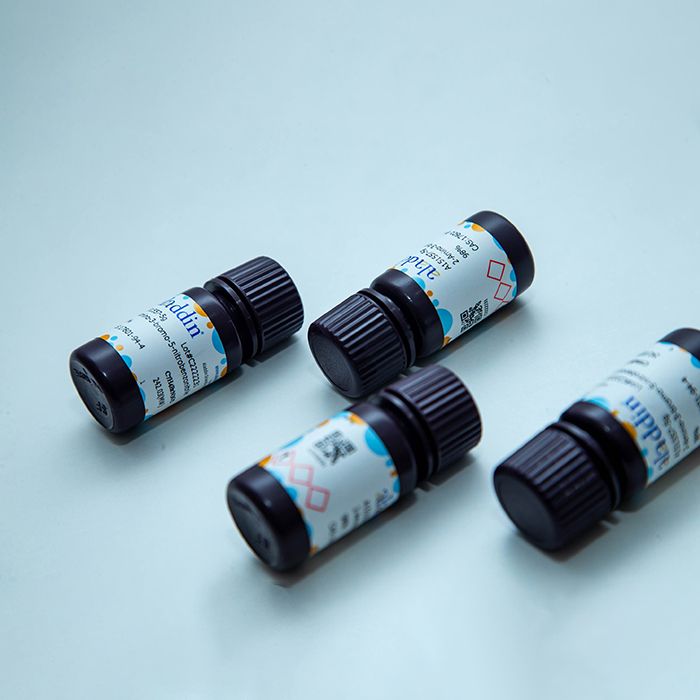
LCMV gp33-41 (TFA), the carboxyl-extended 11-aa-long peptide, is an lymphocytic choriomeningitis virus sequence restricted by MHC class I H-2Db molecules and presented to cytotoxic T lymphocytes.
Biological Activity:LCMV gp33-41 (TFA), the carboxyl-extended 11-aa-long peptide, is an lymphocytic choriomeningitis virus sequence restricted by MHC class I H-2Db molecules and presented to cytotoxic T lymphocytes.
Specifiche
Specifiche e purezza
10mM in DMSO
Condizioni di conservazione di stoccaggio
Desiccated,Store at -80°C
Spedito in
Dry ice packs + Cold packs
Questo prodotto richiede spedizione a catena fredda. I servizi di terra e altri servizi economici non sono disponibili.
Nomi e identificatori
Peso molecolare
1158.24
Dati avanzati
Certificati (CoA, COO, BSE/TSE e tabella di analisi)
C of A & Other Certificates(BSE/TSE, COO):
Analytical Chart:
Calcolatori di soluzioni
Molarity Calculator
Determine the necessary mass, volume, or concentration for preparing a solution.
Dilution Calculator
Determine the dilution needed to prepare a stock solution.
Reconstitution Calculator
Recensioni
Recensioni dei clienti
Application Protocols
Item-specific tested applications
Not specified for this item; refer to CoA/Spec Sheet.
General example workflows (informational; adapt to your SOPs)
Peptide stock preparation:
Warm to room temperature in a desiccator. Briefly spin down. Add DMSO to achieve 10 mM (or as solubility allows). Vortex/sonicate until clear. Aliquot and store at −80°C.
APC pulsing for T cell assays:
Resuspend APCs in serum-free medium at 1–5×10^6 cells/mL. Add peptide to 0.01–10 μM. Incubate 30–60 min at 37°C (or 4°C for surface loading), wash 2–3×, then co-culture with T cells.
ELISpot/ICS setup:
Add peptide to effector cells at titrated concentrations; include negative (vehicle) and positive controls (e.g., PMA/ionomycin). Incubate per assay requirements and proceed with detection.
Tetramer staining (with appropriate MHC):
Follow supplier guidance for tetramer staining; peptide is not used directly here unless refolding custom MHC, which requires specialized protocols.
These procedures are general references and not validated for this specific lot. Optimize conditions for your system.
Biological Roles
General literature context (verify relevance to your system)
Origin: The LCMV gp33–41 peptide is derived from the LCMV glycoprotein (residues 33–41) and is a canonical CD8+ T cell epitope in C57BL/6 mice (H-2Db MHC class I restriction).
Immunological role: Widely used as a model epitope for studying T cell activation, tolerance, memory formation, TCR affinity/avidity, and antigen processing/presentation. The P14 TCR transgenic line is specific for this epitope (literature).
Variants: Altered peptide ligands (APLs) at position 9 (e.g., C→M) or other sites are employed to fine-tune TCR signaling strength in mechanistic studies.
Cell biology: Peptide-pulsed antigen-presenting cells (APCs) present gp33–41 on H-2Db to prime or restimulate specific CD8+ T cells, enabling readouts such as IFN-γ production, degranulation (CD107a), and cytotoxicity.
Cross-reactivity considerations: TCR cross-recognition of gp33–41 variants and related viral sequences is documented; assay-specific conditions (MHC type, peptide concentration) strongly influence outcomes.
Note: The above are literature-based general roles for the gp33–41 epitope. This product listing does not specify sequence, modifications, or host applicability—consult the CoA/Spec Sheet to confirm compatibility with your experimental model. No clinical or diagnostic use is implied; for research use only.
Buffer Applications
This peptide is not a buffer reagent. However, appropriate buffer systems are critical for preparing working solutions for biological assays.
General preparation guidance (informational; not item-specific)
Stock solutions: Prepare at 1–10 mM in DMSO or sterile water, depending on solubility. Filter-sterilize (0.22 μm) if solutions are used for cell culture. Record the exact solvent fraction for downstream dilutions.
Working dilutions: Common assay buffers include PBS (pH 7.2–7.4), RPMI-1640 or DMEM complete media for cell stimulation, or HEPES-buffered saline when CO2 control is limited.
pH control: TFA salts can reduce pH upon dilution. Ensure adequate buffering capacity (e.g., 10–25 mM HEPES or PBS) to maintain physiological pH during cell exposure.
Adsorption minimization: For low-nanomolar to micromolar working ranges, include 0.1% carrier protein (e.g., BSA, fatty-acid free) to reduce peptide adsorption to plastics; confirm that carrier does not confound readouts.
Stability in buffer: Limit time at ambient temperature; keep on ice during setup. For extended incubations, consider adding antioxidants if the sequence contains oxidation-sensitive residues (e.g., Cys, Met), balancing against potential biological effects.
Always adapt buffer composition and peptide concentration to your specific biological system and validate empirically.
Green Alternatives
While the core material is a peptide (not readily substitutable), greener choices can be made in handling and formulation:
Counterion choice (general): TFA is widely used but persistent; acetate or hydrochloride counterions may be preferable for downstream biological applications. Counterion exchange can reduce residual TFA (literature), though not part of this product’s specification.
Solvent selection:
Prefer aqueous buffers where solubility allows; this minimizes reliance on high-toxicity or high-impact dipolar aprotic solvents.
If an organic cosolvent is necessary, limit DMSO to the lowest effective final percentage (commonly ≤0.1–0.5% v/v in cell assays).
Packaging and use:
Prepare concentrated stocks to reduce container waste and repeated thaw cycles.
Use inert, low-binding plastics or glass to minimize adsorption and loss, avoiding repeated re-preps.
Comparison (general considerations)
TFA salt vs acetate salt: TFA offers robust peptide handling during purification but can acidify media and contribute fluorinated waste; acetate is more biocompatible but may slightly alter solubility and stability profiles.
DMSO vs water/buffer: DMSO provides reliable dissolution but has higher environmental and health burdens; water/buffer is preferred when feasible.
These are general sustainability considerations; they do not modify the specifications of this item.
Pharmaceutical Uses
This product is supplied strictly for research use only and is not intended for human or veterinary use, diagnostic procedures, or as a drug substance.
Excipient/formulation role: Not applicable.
Pharmacopeial status: Not established for this item.
Manufacturing context: Synthetic peptides similar to this material are used in research-scale process development (e.g., analytical standards, method qualification for peptide mapping) but such uses require defined specifications (purity, identity, residual solvents, counterions) that are not provided here.
For any regulated application or GMP-adjacent work, request documentation (full CoA, impurity profile, residual solvent/counterion data) and assess suitability per your quality system.
Physical Properties
Item-specific (from Product Data)
Appearance: Not specified for this item; refer to CoA/Spec Sheet.
Molecular weight: Not specified for this item; refer to CoA/Spec Sheet.
Literature/general properties for LCMV gp33–41 peptide salts (informational; verify for this lot)
Physical state: Typically a white to off-white amorphous lyophilized solid when provided as a TFA salt.
Solubility: Peptides of this size are generally soluble in DMSO, DMF, or aqueous buffers depending on sequence and terminal protections. Stepwise dissolution (small volume DMSO then dilute with aqueous buffer) often improves clarity. Exact solubility is sequence- and lot-dependent.
pH behavior: TFA counterions can acidify aqueous solutions; neutralization/dilution into buffered media (e.g., PBS, HEPES) is commonly used.
Hygroscopicity: Peptide TFA salts can be hygroscopic; handle quickly at ambient humidity and store desiccated.
Optical rotation/UV: Aromatic residues (Tyr/Phe) give UV absorbance at 257–280 nm; precise ε values depend on sequence and environment (literature).
Stability: Lyophilized peptide is generally stable at −20 to −80°C for extended periods when protected from moisture and light; solutions are less stable and often aliquoted and stored frozen to minimize freeze–thaw (general peptide handling practice).
Note: Any specific numeric values (exact MW, extinction coefficient, water content) are lot-dependent and must be taken from the CoA/Spec Sheet for this item.
Quality and Grades
Item-specific
Grade/purity: Not specified for this item; refer to CoA/Spec Sheet.
General guidance on peptide quality
Typical peptide grades: Crude (unspecified), Desalted, >70–80% (screening grade), >90% (standard research grade), >95–98% (high purity), and ≥99% (analytical/reference). Higher purities reduce off-target biological responses in immunological assays.
Characterization methods: HPLC purity (area %), MS (MALDI-TOF/ESI) for identity, and sometimes amino acid analysis or elemental analysis to estimate counterion content and residual solvents.
Counterion considerations: TFA is commonly retained after cleavage and HPLC purification; residual TFA can affect cell-based assays by acidifying media. If counterion load matters, request acetate or perform counterion exchange (literature practice).
Endotoxin/bioburden: Not routinely guaranteed for synthetic peptides unless specified; if critical, verify endotoxin level on CoA or request additional QC.
Sequence verification: For epitope peptides, confirm exact sequence, N-/C-terminal modifications (e.g., acetylation/amidation), and cysteine state (free vs. capped) on the CoA to ensure compatibility with your assay design.
For this specific catalog item, consult the CoA/Spec Sheet for the definitive purity grade, analytical traces, and any stabilizers or residual solvent levels.
Reaction and Applications
This catalog item is a synthetic peptide epitope rather than a general chemical reagent; it is not typically used as a substrate or catalyst in organic transformations.
Not typically applicable for classical synthetic reaction families (e.g., Grignard, cross-coupling). If chemical derivatization is required (biotinylation, dye labeling, cyclization), standard peptide coupling chemistries may be employed on a custom basis (general practice; not specific to this item).
Practical laboratory applications (research use only; literature-based):
Antigen-specific stimulation of murine CD8+ T cells in vitro (e.g., restimulation of splenocytes or T cell lines) where the gp33–41 epitope is relevant.
Functional readouts: cytokine ELISpot/ICS, tetramer staining (with MHC class I H-2Db reagents), cytotoxicity assays, and TCR sensitivity studies.
For this specific SKU, no manufacturer application details are provided beyond research-use-only. Verify sequence/identity on the CoA to ensure compatibility with your biological system before use.
Reaction Conditions
Classical reaction condition guidance is not applicable to this product, as it is a finished synthetic peptide rather than a reagent for organic transformations.
General handling conditions for peptide use (informational)
Dissolution: Start with DMSO or water depending on sequence; gentle vortexing and brief sonication can aid dissolution. Avoid elevated temperatures that may induce degradation.
Working concentrations: Literature use in cell-based assays often spans 10 pM to 10 μM, optimized empirically for the specific TCR/MHC system and readout. Establish titration curves for your assay.
Incubation: For T cell stimulation, 30 min to several hours for pulsing APCs at 4–37°C are common ranges; wash to remove excess peptide prior to co-culture (general practice).
Compatibility: Maintain isotonicity and physiological pH; limit DMSO ≤0.1–0.5% v/v in sensitive cell systems.
These are general laboratory practices and are not item-specific specifications. Always refer to your validated SOPs and the product CoA/SDS.
Safety and Handling
Item-specific hazard data
GHS classification, pictograms, signal word, and H-statements: Not specified for this item; refer to SDS.
General laboratory safety for synthetic peptides and TFA salts (informational; consult SDS for authoritative guidance)
PPE: Laboratory coat, safety glasses, and appropriate gloves (e.g., nitrile). Use a dust mask or work in a fume hood to avoid inhalation of powders/aerosols during aliquoting.
Handling: Avoid generating dust. Peptide TFA salts may cause irritation to skin/eyes/respiratory tract. DMSO stock solutions facilitate dermal absorption of solutes—avoid skin contact.
Storage incompatibilities: Store away from strong bases and oxidizers. TFA-containing materials are acidic; avoid contact with reactive metals/carbonates that release CO2.
First aid (general): If inhaled—move to fresh air; if on skin—wash with soap/water; if in eyes—rinse cautiously with water for several minutes; if ingested—rinse mouth. Seek medical attention if symptoms occur.
Spill response: Avoid dust formation; collect by gentle sweeping or HEPA vacuum; dispose of in accordance with institutional and local regulations.
Special risks: Moisture uptake can degrade peptide quality; repeated freeze–thaw cycles of solutions can promote aggregation/degradation. Use aliquots and maintain cold chain as recommended.
Always defer to the product’s SDS for definitive hazard classification and response measures.
Solvent Selection
Item-specific
Solvent recommendations: Not specified for this item; refer to CoA/Spec Sheet.
General solvent guidance for LCMV gp33–41 peptides (informational)
Primary solvents: DMSO and DMF are broadly effective for initial dissolution of hydrophobic or mixed-character nonapeptides. For more polar sequences, sterile water or aqueous buffer may suffice.
Stepwise dissolution: Wet the peptide with a minimal volume of DMSO (e.g., 5–20 mg/mL), vortex/sonicate, then dilute with buffer (PBS, HBSS, HEPES) to the desired working concentration to minimize precipitation.
pH effects: TFA salt acidity may lower solution pH. Adjust with buffer capacity rather than strong base additions to avoid localized high pH that could induce deamidation (Asn) or thiolate formation (Cys).
Filtration: If particulate persists, pass through a 0.22 μm low-protein-binding filter (PTFE for DMSO-rich, PES/RC for aqueous) to clarify before cell assays.
Avoid: High-peroxide solvents; oxidants can modify cysteine and methionine residues. Minimize exposure to strong acids/bases and prolonged room-temperature heating.
DMSO: Excellent solvency; facilitates dermal absorption; limit final v/v% in biological assays (commonly ≤0.1–0.5%).
DMF: Strong solvency like DMSO; more challenging toxicological profile; typically avoided in live-cell contexts.
Storage and Reconstitution
Item-specific (from Product Data)
Storage conditions: Desiccated, store at −80°C.
Shipping: On dry ice packs + cold packs to maintain low temperature during transit.
General reconstitution guidance (informational; adjust to your requirements)
Equilibration: Before opening, allow the vial to reach room temperature in a desiccator to prevent moisture condensation.
Reconstitution:
Initial solvent: Add sterile DMSO or water to create a concentrated stock (e.g., 5–10 mM), based on solubility. If using water and solubility is limited, add a small DMSO fraction or buffer with mild sonication.
Clarification: If needed, centrifuge briefly and/or filter through a 0.22 μm low-binding filter.
Aliquoting: Dispense single-use aliquots in low-protein-binding tubes to avoid repeated freeze–thaw cycles.
Storage of solutions: Store aliquots at −80°C. Minimize freeze–thaw; thaw on ice and keep cold during handling. Typical stability in solution is limited (days to weeks, sequence-dependent); verify empirically.
Light and moisture protection: Protect from light if aromatic residues are present; always keep desiccated when lyophilized.
For definitive stability, concentration limits, and solvent compatibility of this lot, consult the CoA/Spec Sheet and SDS.
Structure and Identity
Item-specific (from Product Data)
Product name: LCMV gp33-41 TFA (SKU: L661665)
Category: Small molecules and compound libraries (小分子和化合物库)
Molecular formula: Not specified for this item; refer to CoA/Spec Sheet.
Molecular weight: Not specified for this item; refer to CoA/Spec Sheet.
SMILES: Not specified for this item; refer to CoA/Spec Sheet.
InChIKey: Not specified for this item; refer to CoA/Spec Sheet.
Literature/general information (verify against CoA for this lot)
Identity/context: LCMV gp33–41 denotes a nonapeptide epitope derived from the lymphocytic choriomeningitis virus (LCMV) glycoprotein, residues 33–41, commonly supplied as a trifluoroacetate (TFA) salt following Fmoc solid-phase peptide synthesis and TFA cleavage.
Typical sequence reported in the literature: “KAVYNFATC” (H-2Db–restricted CD8+ T-cell epitope); sequence can vary for analogs/variants. Always verify the exact sequence and any modifications on the product CoA.
Structural features (general for this class): linear peptide, 9 amino acids, backbone of repeating amide bonds; side chains include aliphatic (Ala, Val), polar/uncharged (Asn, Tyr), aromatic (Tyr, Phe), sulfur-containing (Cys), and small nonpolar (Ala). N- and C-termini may be free unless acetylated/amidated (check CoA).
Counterion: Trifluoroacetate (TFA) is commonly associated with peptide lyophilizates from TFA cleavage/deprotection; exact counterion content should be verified by CoA.
2D description (general)
A linear chain of 9 amino acid residues connected by peptide bonds with pendant side chains; no ring closure unless sequence contains disulfide/cyclization (not implied here). Stereocenters at each L-amino acid α-carbon (typical L-configuration unless otherwise specified).
Synthetic Utility
As a defined peptide epitope, this material is not typically used as a synthetic building block in organic chemistry. Nevertheless, some general considerations apply if derivatization is contemplated (general information):
Functional handles: N-terminus (amine), C-terminus (carboxylate), and side chains (e.g., Lys ε-amine if present; Cys thiol) provide conjugation sites for dyes, biotin, or linkers via NHS ester coupling, maleimide-thiol chemistry, or click reactions (azide/alkyne if introduced synthetically).
Protection/capping: For site-selective modifications, orthogonal protecting groups may be required; these are typically addressed during custom synthesis rather than post-synthetic modification of the final peptide.
Immobilization: Peptides can be tethered to solid supports (e.g., NHS-activated sepharose, streptavidin via biotin) for pull-downs or ELISA coating, with attention to orientation to preserve epitope presentation.
Stability concerns: Avoid harsh conditions (strong acid/base, oxidative reagents) that can cause deamidation, oxidation, or backbone cleavage. Work at low temperature and neutral pH when feasible.
For this specific SKU, no synthetic utility claims are made beyond research use as a peptide epitope; consult the CoA to confirm sequence and functional residues before planning conjugation.
Target Specificity
Item-specific
Target, epitope, species reactivity, clone/isotype: Not specified for this item; refer to CoA/Spec Sheet.
General literature context
The LCMV gp33–41 peptide is widely used as an H-2Db–restricted CD8+ T cell epitope in murine models and is recognized by the P14 TCR (literature). Specificity in your system depends on MHC allele expression and exact peptide sequence/modifications.
No antibody clone or biologic target attributes are provided for this SKU; verify compatibility with your experimental model before use.
Domande frequenti
How should this product be stored?
Store at ?80 °C, desiccated. Keep the container tightly closed with desiccant — the material is moisture-sensitive.
How is this product shipped?
This product ships frozen with dry ice and cold packs. Unpack on arrival and transfer it to the storage condition stated above; handle dry ice with insulated gloves in a ventilated area.
What are the CAS number, molecular formula and molecular weight?
The CAS Number is L661665(DMSO), the molecular formula is C50H74N11F3015S, and the molecular weight is 1158.24 g/mol.
What documentation is provided?
Available product documentation, including Certificates of Analysis (COA), Safety Data Sheets (SDS), and specification sheets, is shown in the product document area. Document availability and access follow the current site policy.
Utilizziamo i cookie per garantire il corretto funzionamento del sito web e, ove consentito, per migliorare la tua esperienza. Puoi gestire le tue preferenze in qualsiasi momento nelle Impostazioni. Per saperne di più, consulta la nostra Cookie Policy.
Desidera che le inviamo un messaggio quando avremo sconti disponibili?
Ricordamelo più tardi
Grazie! Controlli la sua casella di posta per confermare.
Products are supplied to verified businesses, institutions, and qualified professionals for research and development use only. Not for use in humans, animals, diagnosis, or therapy.