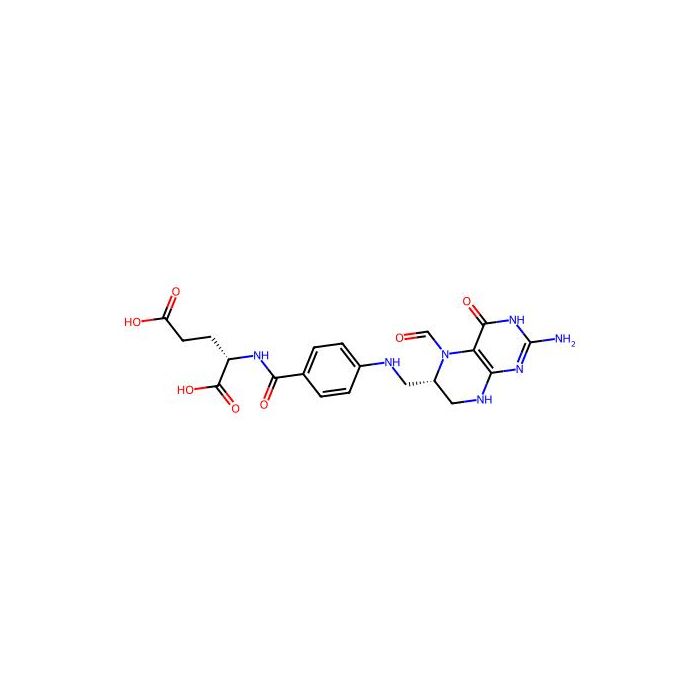
This compound belongs to the class of organic compounds known as tetrahydrofolic acids. These are heterocyclic compounds based on the 5,6,7,8-tetrahydropteroic acid skeleton conjugated with at least one L-glutamic acid unit.
External Descriptors
5-formyltetrahydrofolic acid
1. Djoumbou Feunang Y, Eisner R, Knox C, Chepelev L, Hastings J, Owen G, Fahy E, Steinbeck C, Subramanian S, Bolton E, Greiner R, and Wishart DS. ClassyFire: Automated Chemical Classification With A Comprehensive, Computable Taxonomy. Journal of Cheminformatics, 2016, 8:61.
Certificati (CoA, COO, BSE/TSE e tabella di analisi)
C of A & Other Certificates(BSE/TSE, COO):
Analytical Chart:
Proprietà chimiche e fisiche
Peso molecolare
473.400 g/mol
XLogP3
-1.200
Hydrogen Bond Donor Count
7
Hydrogen Bond Acceptor Count
10
Rotatable Bond Count
9
Exact Mass
473.166 Da
Monoisotopic Mass
473.166 Da
Topological Polar Surface Area
216.000 Ų
Heavy Atom Count
34
Formal Charge
0
Complexity
911.000
Isotope Atom Count
0
Defined Atom Stereocenter Count
2
Undefined Atom Stereocenter Count
0
Defined Bond Stereocenter Count
0
Undefined Bond Stereocenter Count
0
The total count of all stereochemical bonds
0
Covalently-Bonded Unit Count
1
Calcolatori di soluzioni
Molarity Calculator
Determine the necessary mass, volume, or concentration for preparing a solution.
Dilution Calculator
Determine the dilution needed to prepare a stock solution.
Reconstitution Calculator
Recensioni
Recensioni dei clienti
Application Protocols
The following example workflows provide general, literature-based guidance for research use of levoleucovorin. Adjust to your experimental needs and verify with small-scale pilots.
Preparation of aqueous stock (1–10 mM):
Chill oxygen-reduced water or buffer (e.g., 10–50 mM HEPES or phosphate, pH 7.4).
Add levoleucovorin to ~80% of final volume, swirl gently to dissolve. If needed, adjust pH slightly (≤8.0) to aid dissolution.
Optional: add 0.5 mM ascorbate and 0.5 mM EDTA if compatible.
Bring to volume, filter sterilize (0.22 μm) into amber vials, aliquot, inert‑gas blanket, and store at −20 °C.
Enzyme assay supplementation (example range):
Working concentrations often fall between 10–500 μM depending on the enzyme and assay design. Include appropriate blanks and controls to account for background absorbance/fluorescence of folates.
EDC/NHS coupling to amines (aqueous):
Dissolve levoleucovorin in 50 mM MES, pH 6.0 (2–10 mM).
Add NHS (1.5 equiv) then EDC (1.5 equiv) at 0–4 °C; incubate 15–30 min protected from light.
Add the amine partner (1–5 equiv), adjust pH to 7.5, react 1–4 h at 4–25 °C.
Quench excess EDC/NHS; purify by desalting or chromatography. Verify product by LC-MS under low-light conditions.
LC/LC‑MS standard preparation:
Prepare fresh dilutions in aqueous mobile phase containing volatile buffer (e.g., 5–10 mM ammonium acetate, pH ~5.5). Keep vials ambered at 4–8 °C; analyze promptly to limit oxidation.
Note: Concentrations and times are general literature ranges, not item-specific specifications.
Biological Roles
General function (literature): Levoleucovorin is the L‑isomer of folinic acid (L‑5‑formyl‑THF), a reduced folate that participates in the cellular one‑carbon network. It interconverts enzymatically to 5,10‑methylene‑THF and 5‑methyl‑THF, which donate one‑carbon units for thymidylate synthesis, methionine regeneration, and de novo purine biosynthesis.
Pathways and enzymes:
Serine hydroxymethyltransferase (SHMT): interconverts serine/glycine while producing 5,10‑methylene‑THF from THF; levoleucovorin can be metabolized to THF and then to 5,10‑methylene‑THF.
Thymidylate synthase (TYMS): uses 5,10‑methylene‑THF as a one‑carbon donor and reducing agent for dUMP→dTMP conversion; folate cofactor binding underpins mechanistic and structural studies.
Methionine synthase (MTR) and methylenetetrahydrofolate reductase (MTHFR): govern the 5‑methyl‑THF pool for homocysteine→methionine.
Purine biosynthesis (GART, ATIC): requires 10‑formyl‑THF as a one‑carbon donor, accessed via folate cycle interconversion from 5‑formyl‑THF.
Stereochemistry: Only the L‑(6S) configuration is efficiently recognized by folate transporters and enzymes; the D‑isomer is largely inactive biologically. Hence, levoleucovorin provides defined cofactor input in stereospecific systems.
Transport and cellular handling: Reduced folates are transported via the reduced folate carrier (RFC) and proton‑coupled folate transporter (PCFT) and can be polyglutamylated intracellularly to modulate retention and enzyme affinity (general folate biology).
Experimental considerations:
Oxidation state: Maintain reducing conditions to preserve the tetrahydrofolate core.
Matrix effects: Divalent cations and pH affect solubility and binding; control ionic strength and pH during assays.
Note: This tab describes general biochemical roles; it does not imply any medical or clinical use.
Buffer Applications
While not a buffer component per se, levoleucovorin is commonly prepared and used in aqueous buffers for biochemical assays.
Preparation guidance (literature/general):
Solvent: Use oxygen‑reduced, chilled ultrapure water or buffer (e.g., 10–50 mM phosphate, HEPES, or PBS) adjusted to pH 7.0–8.0. Slightly basic pH improves dissolution of the free acid; salt forms often dissolve directly at neutral pH.
Concentration ranges: Stock solutions of 1–50 mM are typical for enzymatic studies; choose the lowest practical concentration to minimize oxidation during storage.
Filtration: 0.22 μm sterile filtration into amber vials for sterile applications; avoid strong light during processing.
Stabilization: Consider adding 0.1–1 mM ascorbate and 0.1–1 mM EDTA if compatible with the assay to mitigate oxidative/metal-catalyzed degradation. Degas buffers and blanket vials with inert gas (N2/Ar).
Compatibility notes:
Avoid high pH (>8.5) and strong acids; both promote degradation.
Avoid oxidizing agents and transition metal contaminants.
Keep ionic strength consistent across controls and test conditions, as folate–protein interactions can be ionic-strength dependent.
Storage of solutions:
Aliquot and store at −20 °C protected from light. Minimize freeze–thaw cycles. For short-term work, 2–8 °C for up to a working day is common if protected from light and air.
These are general practices; verify exact solubility, counterion, and potency for this item on the CoA/Spec Sheet before preparing quantitative stocks.
Green Alternatives
This product is a specialized biochemical (reduced folate) rather than a commodity solvent or reagent where greener drop‑in replacements are typical. Nonetheless, greener practices can be applied to its use and handling.
Applicability of green alternatives: limited for the molecule itself; the active stereochemistry and functional groups are integral to its role in one‑carbon metabolism. Substituting a different compound generally changes the biology.
Greener practice suggestions (literature/general):
Solvent choices: prioritize water-based buffers over organic cosolvents; avoid high DMSO percentages. When organic handling is necessary (e.g., for conjugation), use ethanol or isopropanol over chlorinated solvents, and minimize volumes.
Process minimization: prepare concentrated stocks to reduce packaging and cold-chain burden; aliquot to avoid waste from repeated freeze–thaw degradation.
Energy and stability: store at −20 °C as specified; avoid unnecessary ultra‑low temperature storage. Protect from light to prevent waste via degradation.
Analytical workflows: adopt LC methods with aqueous mobile phases and volatile, low-toxicity modifiers (e.g., ammonium formate/acetate) where compatible.
Comparison to related materials (general):
Racemic leucovorin vs levoleucovorin: using the active enantiomer can reduce the mass required to achieve a given biochemical effect in stereospecific systems, thereby potentially lowering material and waste, though at higher unit cost.
Overall, green chemistry levers here focus on solvent selection, right‑sizing, and stability management rather than on substituting the molecule itself.
Pharmaceutical Uses
This product is supplied strictly for research use. No medical, diagnostic, or therapeutic uses are intended or implied.
Context (literature/general): Levoleucovorin (the L‑isomer of folinic acid) is known industrially as a regulated active pharmaceutical ingredient (API) in certain markets. In research and development, it may be employed as a reference standard, for method development/validation, and for formulation feasibility studies in preclinical laboratories.
Research/formulation roles:
Analytical standard: for calibration of chromatographic or mass spectrometric assays of reduced folates; important for stability‑indicating methods.
Excipient status: Not typically used as an excipient; it is an active entity. Any use in formulations within a research setting should treat it as an API with appropriate containment and documentation.
Salt/solid form screening: Investigations into polymorphs, hydrates, and salt forms (e.g., mineral salts) for process research can inform future manufacturing strategies; confirm the exact form of this item on the CoA.
Considerations for pharmaceutical R&D labs:
Control light, oxygen, and pH during sample prep and stability studies.
Use validated potency corrections (anhydrous basis) when preparing solutions.
Observe cold‑chain storage and handling to maintain integrity.
For any regulated or clinical work, source material conforming to pharmacopeial specifications and follow applicable quality systems; this catalog item is for research use only.
Physical Properties
Item-specific property data: Not specified for this item; refer to CoA/Spec Sheet.
Storage (from Product Data): Store at −20 °C. Shipped in ice chest with ice pads.
Literature/general (typical behavior of levoleucovorin/folinate materials; not a specification for this item):
Physical state/appearance: typically an off-white to yellowish amorphous or microcrystalline solid; sensitive to light and air oxidation due to the reduced folate core.
Solubility: highly polar. Free acids have limited solubility in pure water near neutral pH but dissolve upon pH adjustment; salt forms (e.g., calcium) and sodium salts are readily water-soluble. Often soluble in aqueous buffers; limited solubility in most nonpolar organics; sparingly to moderately soluble in DMSO.
Acid–base behavior: multiple titratable centers (pteridine nitrogen(s) and the glutamate α- and γ-carboxylates). Solutions are commonly prepared in slightly basic aqueous media (pH 7–8.5) to enhance solubility while limiting base-catalyzed degradation.
Thermal behavior: folates generally decompose on melting; exact melting/decomposition temperature varies with salt/solvate content.
Stability: susceptible to oxidation (especially to dihydro- and fully oxidized folate forms) and to photodegradation. Stability improves under inert atmosphere, low temperature, reduced light exposure, and with antioxidants (e.g., ascorbate) in aqueous solutions.
Spectroscopy: reduced folates exhibit characteristic UV absorbance bands (pterin chromophore); absolute ε/λmax values depend on pH and redox state. Verify spectral details experimentally for the specific batch.
Always confirm exact numerical values and the salt/solvate form on the item’s CoA/Spec Sheet before use in quantitative applications.
Quality and Grades
Item-specific grade/purity: Not specified for this item; refer to CoA/Spec Sheet.
What to verify on the CoA for levoleucovorin materials:
Identity: chiral purity (enantiomeric excess for the L- (6S) isomer), assay (%), and confirmation of the exact chemical form (free acid vs specific salt; hydration/solvation state).
Impurities: limits for oxidized folate species (e.g., dihydrofolate/folate), residual solvents, inorganic counterions, and any process-related impurities.
Potency on an anhydrous basis: particularly important when salts or hydrates are supplied; provides correction factors for solution preparation.
Appearance and color: reduced folates can yellow upon mild oxidation; acceptance criteria typically account for slight coloration.
Water content (Karl Fischer) and residual inorganic content (as applicable to salts): ensure appropriate correction for accurate molarity.
Chromatographic suitability: if intended for bioassays, low UV background and clean HPLC profile are desirable. For LC-MS applications, verify additive/metal content if provided.
Discussion of common grades (general guidance):
Research/Biochemical grade: intended for enzymology and cell-free assays; typically controlled for identity/assay and key impurities. May include stabilizers—confirm on CoA.
USP/EP/API grades: tighter controls on assay, impurities, and chiral purity; sometimes supplied for process development and analytics. This product is for research use only; confirm compliance needs before regulated use.
Stabilizers: Some folate materials are formulated with antioxidants or presented as lyophilized solids to enhance stability. Presence/absence and type of stabilizer are item-specific—verify on the Spec Sheet.
Reaction and Applications
This compound is primarily a biochemical cofactor analog for research, rather than a general-purpose synthetic reagent. Typical laboratory applications center on one‑carbon metabolism, enzyme reconstitution, and biochemical assays.
Enzyme studies: substrate/cofactor surrogate for enzymes interacting with reduced folates (e.g., thymidylate synthase via conversion to 5,10‑methylene‑THF; serine hydroxymethyltransferase; methionine synthase after folate cycle interconversion). Used to probe kinetics and mechanism in one‑carbon pathways.
Cell-free systems: supplementation in enzymatic cascades that require reduced folate pools; provides a stable reservoir convertible to active cofactors.
Calibration/controls: reference standard for chromatographic or spectrometric quantification of reduced folate species after suitable derivatization or stabilization.
Chemical modification and conjugation (general synthetic manipulations):
The γ‑carboxylate of the glutamate residue can be selectively activated (e.g., EDC/NHS coupling) to install reporter tags, affinity handles, or linkers, enabling immobilization or probe synthesis. Protecting-group strategies may be required to control regioselectivity over the α‑carboxylate.
The N5‑formyl group is labile to interconversion under enzymatic or controlled chemical conditions, enabling generation of 5,10‑methylene‑THF in situ for mechanistic studies.
Practical tips:
Maintain solutions cold, deoxygenated, and shielded from light. Include antioxidants and chelators if compatible.
Validate the exact chemical form (free acid vs salt; hydration) to correctly calculate molarity and coupling stoichiometry.
For LC/LC-MS assays, minimize exposure to air and use freshly prepared standards to limit artifactual oxidation.
Note: No medical or clinical claims are implied; all uses are for research in chemical/biochemical systems.
Reaction Conditions
Because levoleucovorin is used mainly in biochemical and conjugation contexts, typical “reaction conditions” relate to aqueous coupling and handling rather than classical organic synthesis. The following are general, literature-based guidelines; adjust to your system and verify experimentally.
Solvent/buffer: 25–100 mM MES or phosphate buffer, pH 5.5–6.5 (to favor O‑acylisourea/NHS ester formation while limiting hydrolysis).
Reagents: EDC (1.2–2.0 equiv per target carboxylate) and NHS or sulfo‑NHS (1.2–2.0 equiv). For water solubility, sulfo‑NHS is often preferred.
Temperature/time: 0–25 °C under low light, 15–60 min for activation; then add amine nucleophile and react 1–4 h.
Notes: Maintain inert atmosphere if possible; include 0.1–1 mM EDTA to reduce metal‑catalyzed side reactions. Monitor by LC or HPLC.
Preparation of biochemical stocks:
Dissolve in chilled, deoxygenated buffer at pH 7.0–8.0 to the desired concentration (often 1–50 mM for stocks). Filter (0.22 μm), aliquot, and store at −20 °C protected from light.
Stability: Working solutions at 2–8 °C are typically used within the day; frozen aliquots within days to weeks depending on conditions (verify empirically).
Analytical method development:
LC/LC-MS: Use aqueous mobile phases (e.g., ammonium formate/acetate, pH ~3.5–6.5). Keep autosampler at 4–8 °C, use amber glassware, and minimize oxygen exposure. Include antioxidant in diluent if compatible.
These conditions are representative and should be optimized for your specific substrate, counterion form, and application.
Safety and Handling
Regulatory status: For research use only (Product Data). Not for human or veterinary use.
GHS information (Product Data):
Signal Word: Not specified for this item; refer to SDS.
H-Statements: Not specified for this item; refer to SDS.
GHS Classification: Not specified for this item; refer to SDS.
Pictograms: Not specified for this item; refer to SDS.
General laboratory safety guidance (literature/general; defer to SDS for authoritative details):
Hazards: Reduced folates are generally considered low acute hazard, but dust may cause irritation. The material is light- and air-sensitive; degradation can generate different folate species—avoid unnecessary exposure and contamination.
PPE: laboratory coat, safety glasses, and appropriate gloves (e.g., nitrile). Use in a clean environment; handle powders in a fume hood or ventilated enclosure to minimize inhalation and light exposure.
Handling: Protect from light; minimize exposure to air. Use amber containers or foil wrap. Prepare solutions with oxygen-reduced, chilled buffers when feasible. Avoid strong oxidizers and strong acids/bases that can degrade the reduced folate core.
Incompatibilities: strong oxidizing agents; prolonged exposure to alkaline pH; metal ions that may catalyze oxidation (consider chelators if compatible with your system).
First aid (overview): If inhaled, move to fresh air. On skin/eye contact, rinse with water for several minutes. If ingested, rinse mouth. Seek medical attention as per institutional policy. Bring the SDS to medical personnel.
Spill/leak: Avoid dust generation; collect with minimal disturbance, using damp disposable wipes or HEPA vacuum. Dispose according to local regulations.
Storage: Store at −20 °C, protected from light and moisture. Keep container tightly closed. Avoid repeated freeze–thaw of solutions by aliquoting.
Solvent Selection
Levoleucovorin is a highly polar, multifunctional molecule with multiple ionizable groups. Solvent choice is driven by the required concentration, pH, stability, and downstream assay compatibility.
Polarity/miscibility (literature/general):
Aqueous buffers: primary medium. Good solubility at neutral to slightly basic pH (depending on salt/form). Adjust pH to 7.0–8.5 to increase dissolution while limiting base-catalyzed degradation.
Water-miscible organics: limited solubility in methanol/ethanol; DMSO can dissolve modest concentrations, but aqueous vehicles are preferred for biological assays.
Nonpolar solvents: not suitable.
Practical recommendations:
For stock solutions: prepare in oxygen-reduced, chilled water or buffer (e.g., 10–100 mM phosphate or HEPES, pH 7.2–7.8). Filter-sterilize through 0.22 μm if sterility is required.
To enhance stability: include low levels of antioxidant (e.g., 0.1–1 mM ascorbate) and protect from light. Avoid prolonged exposure to pH >8.5.
Compatibility: avoid strong acids/bases and oxidants. Metal chelators (e.g., 0.1–1 mM EDTA) may reduce metal-catalyzed oxidation, if compatible with the assay.
When to choose alternatives:
If organic reaction media are essential, folate derivatives with protecting groups or pro-moieties may be more soluble. For purely synthetic manipulation, consider protected folate building blocks rather than the fully functional levoleucovorin.
Small comparison (general):
Water/Buffer: best solubility and biological relevance; requires light/oxygen protection.
DMSO: can aid dissolution for high-concentration stocks; may affect some enzymes/cells; dilute promptly into buffer.
Alcohols: limited utility; can promote degradation on storage—use only for brief handling.
Item-specific appearance, stabilizer, and solvent of reconstitution: Not specified for this item; refer to CoA/Spec Sheet.
General reconstitution guidance (literature/general):
Solvent: Prefer chilled, oxygen-reduced water or buffer (pH 7.0–8.0). If using the free acid and dissolution is slow, adjust pH slightly upward (≤8.0). Salt forms often dissolve readily at neutral pH.
Concentration: Prepare concentrated stocks (e.g., 1–50 mM) to minimize headspace and exposure. Use amber vials; minimize light.
Stabilization: Consider adding low concentrations of antioxidant (0.1–1 mM ascorbate) and chelator (0.1–1 mM EDTA) if compatible with downstream assays.
Filtration: 0.22 μm sterile filtration for aseptic applications.
Storage of solutions:
Aliquot immediately after preparation to avoid repeated freeze–thaw cycles. Store frozen at −20 °C protected from light. Avoid frost-free freezers that cycle warm air.
Thawing: Thaw on ice, mix gently, and keep shielded from light. Do not heat. Use thawed aliquots promptly; refreezing is generally discouraged.
Short-term stability: At 2–8 °C and protected from light/air, working solutions are typically used within the same day; verify empirically for your system.
Disposal: Dispose of unused solutions and materials in accordance with institutional and local regulations for nonhazardous organic chemicals.
Always consult the product’s CoA/Spec Sheet and SDS for definitive, item-specific instructions on form, concentration calculations, and safety.
Structure and Identity
Briefly: Levoleucovorin is the biologically active L-isomer of folinic acid (L-5-formyl-5,6,7,8-tetrahydrofolate), a reduced folate cofactor analog widely used in biochemical research.
Item-specific (from Product Data):
SKU: L1073694
Product Name: Levoleucovorin
CAS: 68538-85-2
CID: 135398559
InChIKey: 389375
SMILES: Not specified for this item; refer to CoA/Spec Sheet.
Molecular Formula: Not specified for this item; refer to CoA/Spec Sheet.
Molecular Weight: Not specified for this item; refer to CoA/Spec Sheet.
Category Path: 全部 / 可售 / 化学和生化试剂
Literature/general identity (for context; not item specification):
Common names: L-folinic acid; L-5-formyl-THF; (6S)-leucovorin; levo-folinic acid. Materials may be supplied as the free acid or as mineral salts (e.g., calcium); confirm the exact form on the CoA.
Core scaffold: pteridine-like reduced folate system (tetrahydropterin fused to p-aminobenzoate) conjugated to an L-glutamate via an amide linkage; the N5 position bears a formyl substituent (5-formyl-THF).
Stereochemistry: One defined stereocenter at the C-6 (folate numbering; corresponds to L-configuration at the glutamate-bearing center), giving the biologically active (6S) enantiomer. The glutamate is L-configured; additional conformational flexibility resides in the p-aminobenzoate–glutamate linker.
Functional groups: tertiary amine (reduced pterin), anilide/amide linkage, para-aminobenzoate, α-amino acid (L-glutamate) with α-carboxylate and γ-carboxylate, and an N5-formyl group capable of one‑carbon transfer chemistry in enzymatic contexts.
2D structure description: a bicyclic reduced pterin ring connected via a methylene to a para‑aminobenzoate ring, which is amide-linked to L-glutamate; the N5 on the reduced pterin carries a formyl substituent.
Synthetic Utility
Although primarily a biochemical reagent, levoleucovorin offers functional handles that can be leveraged in chemical biology and conjugation chemistry (literature/general guidance):
Functional groups and reactivity:
Carboxylates (α and γ on the glutamate): amenable to carbodiimide-mediated coupling (e.g., EDC/NHS) to install amide-linked tags or surfaces. Regioselectivity can be directed by transient protection or pH control (γ‑selective activation is often targeted).
Aromatic amine (p‑aminobenzoate): can be diazotized or acylated; however, modifications may impair biological recognition.
N5‑formyl group: participates in one‑carbon transformations; chemical interconversion to other folate oxidation states is possible under controlled conditions but is more commonly enzyme-catalyzed.
Applications:
Affinity probes: conjugation to resins or fluorophores to study folate‑binding proteins and transporters, leveraging the native binding specificity of the reduced folate core.
Surface immobilization: creation of folate-decorated surfaces or nanoparticles for binding studies (non-clinical), using γ‑carboxylate coupling to preserve recognition elements.
Probing enzyme mechanisms: isotopic labeling of the formyl carbon (e.g., 13C) in levoleucovorin analogs for kinetic isotope effect or tracing experiments (requires isotopically labeled starting materials).
Practical notes:
Carefully control pH (typically 5.5–6.5 for EDC/NHS activation in aqueous MES buffer) and minimize exposure to oxidants/light during coupling.
Account for counterions/hydration in stoichiometry.
Characterize products with LC-MS under low-light, oxygen‑reduced conditions to limit artifactual oxidation.
These transformations support chemical biology workflows rather than bulk synthetic routes.
Target Specificity
Not applicable. This product is a small-molecule biochemical (reduced folate) and not a biological targeting reagent such as an antibody, peptide ligand, or nucleic acid probe. There are no antigen/epitope, clone, isotype, or species-reactivity attributes associated with this catalog item.
For binding studies (literature/general): Levoleucovorin can interact with folate-binding proteins, enzymes of the one-carbon cycle, and folate transporters. However, such interactions are context-dependent and are not provided as item-specific specifications. Consult primary literature and design appropriate controls for any binding assays.
We use cookies to ensure the website functions properly and, where permitted, to improve your experience. You can manage your preferences at any time in Settings. Learn more in our Cookie Policy.
Shall we send you a message when we have discounts available?
Remind me later
Thank you! Please check your email inbox to confirm.
Products are supplied to verified businesses, institutions, and qualified professionals for research and development use only. Not for use in humans, animals, diagnosis, or therapy.