GRADE & PURITYMoligand™?Moligand™ — Aladdin's line of ligands and bioactive small molecules. Use for receptor, pathway, and binding studies needing defined small-molecule tools.10mM in DMSO
Determine the necessary mass, volume, or concentration for preparing a solution.
Dilution Calculator
Determine the dilution needed to prepare a stock solution.
Reconstitution Calculator
Recensioni
Recensioni dei clienti
Application Protocols
Item-specific validated applications and recommended conditions: Not specified for this item; refer to CoA/Spec Sheet.
General laboratory usage examples (for guidance only)
Preparation of 10 mM DMSO stock: Weigh required mass in a dry vial, add DMSO to volume, vortex until clear. Aliquot and store at −80 °C. Thaw once, dilute into assay buffer keeping final DMSO ≤1% v/v.
Aqueous working solution via in situ salt formation: Dissolve compound in minimal ethanol, add equimolar HCl, then dilute with buffer (e.g., 25 mM acetate, pH 4.5) to target concentration. Filter sterilize (0.22 µm) if sterility is required.
LC–MS reference standard: Prepare 1 mg/mL stock in MeOH or ACN with 0.1% formic acid; dilute to calibration levels (1–1000 ng/mL) in 50:50 water:organic with 0.1% formic acid. Store aliquots at −20 to −80 °C.
These examples are illustrative and should be optimized for the user’s instruments and assay formats.
Biological Roles
Literature overview (for scientific context; not a medical or clinical claim)
Primary molecular pharmacology: Lidocaine is a state- and use-dependent blocker of voltage-gated sodium (NaV) channels, stabilizing the inactivated state and reducing excitability in excitable tissues (literature). Affinity varies among NaV isoforms and with membrane potential and frequency of depolarization.
Secondary interactions: At higher concentrations, interactions with other ion channels/receptors (e.g., certain K+ channels, NMDA receptors) and membrane effects have been reported (literature), typically weaker than NaV blockade.
Ionization state: With pKa ~7.9 (tertiary amine), the fraction protonated at physiological pH affects membrane permeation and intracellular accumulation. The neutral base more readily traverses lipid bilayers; the cationic form exhibits higher aqueous solubility.
Research implications
Useful as a reference inhibitor in electrophysiological assays (patch clamp, automated platforms) to validate NaV currents and assay robustness.
Employed in structure–activity relationship studies of anilide local anesthetics, exploring roles of aromatic substitution, amide resonance, and amine basicity on channel binding (literature).
Serves as a benchmark compound in ADME profiling (permeability, microsomal stability, plasma protein binding) and in transporter interaction screens for basic, lipophilic drugs.
Caution
For research use only. Do not use in humans or for diagnostic/therapeutic applications.
Buffer Applications
Lidocaine is not a buffering reagent and does not constitute a conventional biological buffer system. It lacks acid/base pairs with suitable pKa spacing to maintain pH over a practical range.
Practical guidance
If aqueous solutions are required, acidify the medium (e.g., with HCl or acetate buffer) to protonate the tertiary amine, improving water solubility; this is a solubilization tactic, not buffering.
For experiments requiring tight pH control, select an appropriate buffer (e.g., phosphate pH 6–8, acetate pH 3.6–5.6, HEPES pH 6.8–8.2) and then dissolve lidocaine in a compatible co-solvent or as its salt.
Summary
Not typically applicable as a buffer. See Solvent Selection and Storage & Reconstitution for practical solution preparation.
Green Alternatives
Because lidocaine is a specific bioactive small molecule (not a solvent or general-purpose reagent), “green alternative” considerations focus on handling, formulation, and waste minimization rather than replacing the compound itself.
Formulation strategies to reduce organic solvent use (general)
Use aqueous, mildly acidic buffers to protonate the amine, enabling water-based formulations and lowering DMSO/MeOH content.
Prefer the hydrochloride salt for high-aqueous systems to minimize organic cosolvents.
Process and waste reduction
Prepare concentrated DMSO stocks to minimize solvent volume in assays (e.g., add ≤1% v/v DMSO to final wells).
Opt for volatile, MS-friendly acids (formic/acetic) for LC methods to simplify solvent recovery and reduce salt waste.
Small comparison (general context)
DMSO vs ethanol: DMSO offers superior solubility and stability but is less “green” in persistence; ethanol is more renewable/benign but may limit solubility and has higher flammability.
ACN vs MeOH for analytics: MeOH often preferred by several green metrics (renewability, toxicity) relative to ACN, when chromatographically acceptable.
Packaging and storage practices
Aliquot at high concentration to reduce repeated thawing, extending shelf life and reducing material waste.
Employ sealed, low-permeation vials to prevent solvent loss and reduce need for re-preparation.
Pharmaceutical Uses
Important note: For research use only. No medical or clinical claims are made. The following refers to non-clinical, laboratory, and quality-control contexts.
Laboratory/formulation roles (general)
Reference standard: Widely used as an analytical standard for system suitability, retention-time locking, and calibration in HPLC/UPLC/LC–MS methods targeting basic, amide-containing APIs (literature context).
Preformulation studies: Model compound to evaluate salt screening (e.g., HCl, HBr, sulfate) and excipient compatibility for tertiary amines and anilide APIs.
Permeability/solubility benchmarking: Employed to probe the impact of ionization and lipophilicity on dissolution, supersaturation, and membrane transport in in vitro models.
Excipient status
Lidocaine is an active pharmaceutical ingredient (API) rather than an excipient; therefore it is not used as a formulation aid in the conventional sense. Any pharmacopeial monographs, where present, are for the API/salt forms and are relevant for QC reference only in a research setting.
Practical considerations in lab settings
Confirm base vs. salt form on CoA to ensure accurate dosing in solution prep and in vitro studies.
For MS-based assays, prepare standards in volatile buffers with low non-volatile salt content to preserve ionization efficiency.
Physical Properties
Item-specific values from Product Data
Appearance: Not specified for this item; refer to CoA/Spec Sheet.
Molecular formula: Not specified for this item; refer to CoA/Spec Sheet.
Molecular weight: Not specified for this item; refer to CoA/Spec Sheet.
Literature/Reference physicochemical data (for context; not item specifications)
Physical state: Solid, typically crystalline (base form) (literature)
Color: White to off-white (literature)
Melting point (base): ~66–69 °C (literature)
Boiling point: High; decomposes before boiling at 760 mmHg (reported ~350 °C, literature; decomposition likely)
pKa (conjugate acid of tertiary amine): ~7.8–7.9 at 25 °C (literature)
Aqueous solubility: Base is sparingly soluble in water; freely soluble in organic solvents (ethanol, methanol, chloroform, DMSO). Corresponding hydrochloride salt is freely water soluble (literature)
Density (solid): Not reliably established; typically ~1.0–1.1 g/cm³ reported (literature, method-dependent)
Refractive index: Not applicable for a solid; not commonly reported
Practical implications (general)
The basic tertiary amine enables facile formation of water-soluble salts (e.g., HCl) for aqueous workup or biological assays.
The lipophilic anilide and 2,6-dimethyl substitution contribute to membrane permeability and moderate to high logP, affecting formulation and assay partitioning.
Quality and Grades
Item-specific details
Grade: Moligand™ (as listed). No additional specifications (assay, residual solvents, stereochemical purity, water/peroxide/metal content, UV cutoff) are provided in the product data for this item.
Therefore, where a specific numeric specification is required: Not specified for this item; refer to CoA/Spec Sheet.
What Moligand™ implies (general description)
Moligand™ designations are typically used for small-molecule library members curated for screening, binding, or profiling workflows. Emphasis is often on identity confirmation (e.g., NMR/HRMS), practical solubility in screening solvents (DMSO), and archival stability under low-temperature storage.
Compared with “analytical reagent” or “HPLC grade” (terms usually reserved for solvents/reagents), a Moligand™ library compound prioritizes structural fidelity and suitability for bioassay stock preparation rather than low-UV background or trace-metal specifications.
Quality considerations for this item (practical notes)
Identity/assay: Verify by CoA (e.g., 1H NMR, LC/MS, purity by HPLC/UPLC); request spectra where needed.
Form: Base vs. salt form affects solubility and mass assay; confirm on CoA.
Counterions/residuals: If provided as a salt or with residual solvents, confirm levels on CoA as they can influence assay response.
For analytical applications (e.g., LC-MS reference), ensure the CoA purity and counterion state meet your method requirements.
Reaction and Applications
This product is supplied as a screening-library small molecule rather than a reagent; hence it is not commonly used as a solvent or a generic synthetic auxiliary. Still, lidocaine’s functional groups and properties enable several research applications.
Applications in research collections (general)
Reference compound in electrophysiology, ion-channel, and analgesic target panels (as a known voltage-gated sodium channel blocker; literature context only; research use only).
Analytical benchmarking for basic, moderately lipophilic analytes in LC/UPLC method development (retention of cationic amines on C18, impact of mobile-phase pH, ion-pairing vs MS-friendly modifiers).
QSAR/ADME model compound to probe permeability vs solubility trade-offs (pKa ~7.9, logP ~3.3; literature).
Functional-group reactivity (general chemical context)
Tertiary amide: Resistant to nucleophilic acyl substitution; hydrolysis requires forcing acidic/basic conditions or enzymatic catalysis.
Tertiary amine: Readily forms salts and quaternary ammonium derivatives; can undergo alkylation (e.g., MeI) to give quaternary salts for structure–activity studies or analytical derivatization.
Practical tips (general)
Prepare DMSO stocks (10–50 mM), filter (0.22 µm) if needed, and aliquot to avoid freeze–thaw cycles.
For aqueous assays, titrate with HCl to form the hydrochloride in situ, improving solubility; verify final pH to maintain assay integrity.
For LC-MS, use volatile acids (formic acid) or modifiers (ammonium formate) to ensure MS compatibility and sharp peaks for basic analytes.
Reaction Conditions
This section provides general laboratory guidance for preparing and using lidocaine solutions and for representative chemical transformations, based on literature; these are not item-specific specifications.
Stock solutions for assays (general)
DMSO: 10–50 mM typical; dissolve with gentle warming (≤40 °C) and vortexing/sonication. Filter (0.22 µm) if needed. Aliquot and store at ≤−20 °C to −80 °C to limit freeze–thaw.
Aqueous acidic media: Prepare 1–10 mM by dissolving in water containing 0.1–1% v/v HCl or 10–50 mM acetate/citrate buffer (pH 3–5). Verify final pH after dilution into assay buffer.
Forming hydrochloride in situ (literature practice)
Add ~1.0–1.2 equivalents of HCl (e.g., 1 N HCl in ethanol or ether–HCl) to a solution of the base; isolate the salt by precipitation (from ether) or use in solution for biological assays. Dry under vacuum to constant mass if isolating the solid.
Representative reactions (for method development)
Quaternization: Lidocaine + MeI (1.1–1.5 eq) in MeCN/acetone at RT to 50 °C, 1–24 h → quaternary iodide salt (yields commonly high; literature-dependent).
Reductive amide cleavage (proof-of-concept): Forcing conditions (e.g., LiAlH4 in THF, 0 °C to reflux) convert amide to amines; careful workup required.
Chromatography and detection
LC: Retains strongly on C18 in neutral mobile phases; add 0.1% formic acid or 10–20 mM ammonium formate (pH 3–4) to sharpen basic peak shape. MS detection in positive ESI is robust.
Always adapt conditions to your scale and safety constraints; consult primary literature for exact procedures.
Safety and Handling
Item-specific hazard information from Product Data
Signal word: Not specified for this item; refer to SDS.
H-statements: Not specified for this item; refer to SDS.
GHS classification: Not specified for this item; refer to SDS.
Pictograms: Not specified for this item; refer to SDS.
Literature/typical GHS information for lidocaine (for context; verify against SDS for this lot)
Often not classified as acutely toxic at small quantities but may be harmful if swallowed; may cause skin/eye irritation; may cause respiratory irritation (literature). Aquatic toxicity data vary; check SDS.
Handling guidance (general best practices)
Use in a fume hood to avoid dust/aerosol inhalation.
PPE: Lab coat, nitrile gloves, safety glasses; upgrade to splash goggles/face shield for solution prep.
Avoid contact with skin/eyes; wash thoroughly after handling. Do not ingest or inhale.
Prevent dust generation; handle powders gently. Ground and bond equipment when transferring organic solvents used for dissolution.
Incompatibilities and stability (general)
Avoid strong oxidizers and strong acids/bases for extended periods; tertiary amide generally stable, tertiary amine forms salts with strong acids.
Thermal decomposition may occur at elevated temperature; avoid heating above its melting range unless justified and controlled.
First aid (overview; defer to SDS)
Skin/eye contact: Rinse with water for ≥15 min; remove contaminated clothing.
Inhalation: Move to fresh air; seek medical attention if symptoms persist.
Ingestion: Rinse mouth; seek medical advice.
Always consult the SDS supplied for your specific lot for authoritative safety classifications and measures.
Solvent Selection
Polarity and acidity/basicity (general)
Lidocaine is a weak base (tertiary amine) with a neutral, resonance-stabilized amide. The base form is moderately lipophilic (logP ~3.3, literature).
Stock solution preparation (typical choices)
DMSO: Preferred for high-concentration assay stocks (10–50 mM commonly). Good chemical compatibility and stability.
Ethanol or methanol: Suitable for intermediate stocks; can be diluted into aqueous buffers containing co-solvent.
Aqueous solutions: Convert to a salt (e.g., HCl) in situ by adding a stoichiometric acid, or prepare in water with a small amount of acid (pH ~2–4) to protonate the amine. The free base is only sparingly water soluble.
Miscibility and partitioning (literature context)
Organic miscibility: Freely soluble in polar organics (DMSO, MeOH, EtOH), moderately in less polar solvents (acetonitrile, ethyl acetate), limited in alkanes.
In aqueous buffers, the protonated form increases solubility but may alter membrane permeability in cell-based assays.
When to choose alternatives
For purely aqueous biophysical assays, consider using the hydrochloride salt or add minimal DMSO (≤1–2% v/v) to avoid solvent effects.
For LC method development of basic analytes, compare DMSO vs ACN stocks; ACN can ease evaporation but may limit solubility.
Water (acidified): Greenest; requires protonation; stability depends on pH and ionic strength.
Storage and Reconstitution
Item-specific conditions (from Product Data)
Storage: Store at -80°C.
Shipped in: Dry ice packs + Cold packs.
Appearance: Not specified for this item; refer to CoA/Spec Sheet.
Reconstitution (general guidance for lidocaine; not item specifications)
Preferred solvents: DMSO (for concentrated stocks), ethanol or methanol (for intermediate stocks). For aqueous applications, consider preparing or using the hydrochloride salt to enhance solubility.
Typical stock concentrations: 10–50 mM in DMSO are common for screening; adjust based on solubility and assay requirements.
Technique: Allow vial to equilibrate to room temperature in a desiccator before opening to prevent moisture condensation. Weigh rapidly, recap promptly.
Aliquoting and stability (general)
Prepare single-use aliquots to minimize freeze–thaw cycles. Protect solutions from light if applicable (amber vials) and from moisture/CO2 for base form.
Solid stability: Store tightly closed under dry, inert conditions at the specified −80 °C. For long-term storage, include desiccant.
Solution stability: DMSO stocks are typically stable for weeks to months at −20 to −80 °C (literature); verify by LC before critical experiments.
Specifications not provided in Product Data
Water content, residual solvents, assay/purity, and exact form (base vs. salt): Not specified for this item; refer to CoA/Spec Sheet.
For research use only.
Structure and Identity
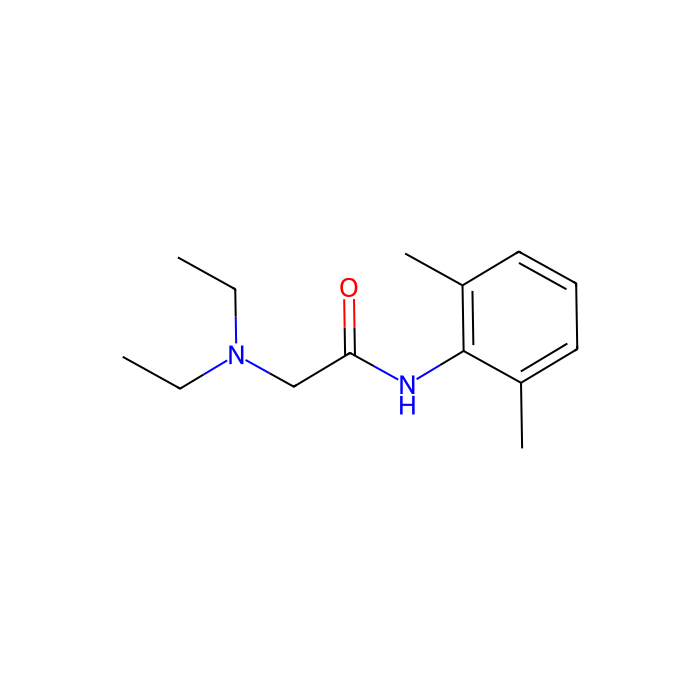
Brief overview: Lidocaine is a tertiary amide bearing a basic tertiary amine and a 2,6-dimethylphenyl (anilide) moiety; commonly used as a reference small molecule in screening collections.
Identity fields not specified in item listing: InChIKey, SMILES, molecular formula, molecular weight — Not specified for this item; refer to CoA/Spec Sheet.
Literature/Reference identity (for context; not item specifications)
Preferred IUPAC name (literature): 2-(diethylamino)-N-(2,6-dimethylphenyl)acetamide
Aromatic ring: 2,6-dimethyl-substituted phenyl directly bonded to the amide nitrogen (anilide).
Amide: Tertiary anilide (resonance-stabilized, non-basic) linking to a two-carbon side chain.
Amine: Terminal tertiary amine [N(diethyl)] providing basicity and salt-forming capability.
2D description: A 2,6-dimethylphenyl–N–C(=O)–CH2–N(Et)2 linear connectivity; no stereocenters (achiral).
Synthetic Utility
Although lidocaine is generally used as a target/reference compound rather than a reagent, its functional groups and well-studied chemistry make it useful as a substrate or probe in synthetic and mechanistic investigations.
Functional group behavior (general)
Tertiary amide (anilide): High stability due to resonance; resistant to nucleophiles. Hydrolysis typically requires strong acid/base, high temperature, or catalysis (enzymatic amidases), providing a testbed for amide activation strategies.
Tertiary amine: Reacts readily with alkyl halides to give quaternary ammonium salts; forms stable salts with mineral/organic acids (HCl, HBr, TFA) that alter solubility/crystallinity.
Aromatic ring (2,6-dimethyl): Ortho-dimethyl substitution reduces electrophilic aromatic substitution reactivity; serves as a steric probe in C–H activation or oxidative functionalization studies.
Named/contextual transformations (literature)
Quaternization: Alkylation with MeI/EtOTf to generate quaternary salts for structure–property studies or phase-transfer analogs.
Amide bond activation: Use of coupling reagents or reagents like POCl3/SOCl2 after prior modification (e.g., N-protection or conversion to activated intermediates) to explore amide reactivity paradigms.
Reductive pathways: Harsh conditions (e.g., LiAlH4) can reduce amides to amines; lidocaine can serve as a reference substrate for such reductions in methodological work.
Analytical derivatization
Formation of stable salts (e.g., perchlorate, picrate—observe safety) historically used for characterization; modern practice favors benign counterions and MS/NMR.
Target Specificity
Item-specific, product-validated target information: Not specified for this item; refer to CoA/Spec Sheet.
Literature context (for background only; not a guarantee for this lot)
Primary pharmacological target class: Voltage-gated sodium channels (NaV), with state- and use-dependent block (literature).
Off-targets at higher concentrations can occur, but selectivity data are assay- and system-dependent.
Researchers should establish target engagement and specificity in their own assay systems using appropriate controls and orthogonal readouts.
We use cookies to ensure the website functions properly and, where permitted, to improve your experience. You can manage your preferences at any time in Settings. Learn more in our Cookie Policy.
Shall we send you a message when we have discounts available?
Remind me later
Thank you! Please check your email inbox to confirm.
Products are supplied to verified businesses, institutions, and qualified professionals for research and development use only. Not for use in humans, animals, diagnosis, or therapy.