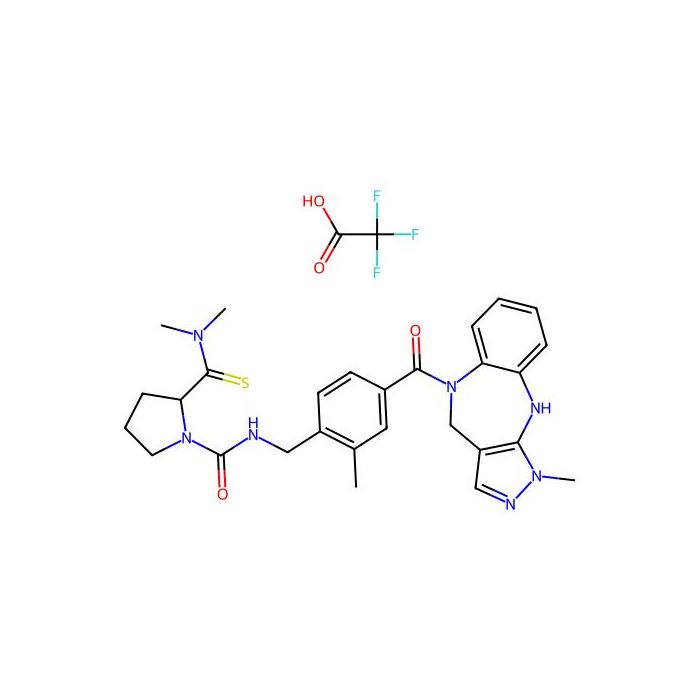
LIT-001 is the first nonpeptide oxytocin receptor (OT-R) agonist ( EC 50 =55 nM; K i =226 nM). LIT-001 improves social interaction in a mouse model of autism
In Vitro
In vitro signaling experiments, LIT-001 is a nonbiased OT-R agonist on the two main signaling pathways of this receptor, with minor antagonist effect on V1a and agonist effect on V1b receptors, observed at high concentrations only. MCE has not independently confirmed the accuracy of these methods. They are for reference only.
In Vivo
LIT-001 (10-20 mg/kg; i.p.) alleviates core symptoms in the context of autism spectrum disorders (ASD ) . MCE has not independently confirmed the accuracy of these methods. They are for reference only. Animal Model: Oprm1 –/– mice (bred in house on a 50% 129SVPas–50% C57BL/6J hybrid background) Dosage: 10, 20 mg/kg Administration: i.p. Result: Alleviated core symptoms in the context of ASD.
LIT-001 is the first nonpeptide oxytocin receptor (OT-R) agonist ( EC 50 =55 nM; K i =226 nM). LIT-001 improves social interaction in a mouse model of autism.
Condizioni di conservazione di stoccaggio
Desiccated,Store at -80°C
Spedito in
Dry ice packs + Cold packs
Questo prodotto richiede spedizione a catena fredda. I servizi di terra e altri servizi economici non sono disponibili.
Certificati (CoA, COO, BSE/TSE e tabella di analisi)
C of A & Other Certificates(BSE/TSE, COO):
Analytical Chart:
Calcolatori di soluzioni
Molarity Calculator
Determine the necessary mass, volume, or concentration for preparing a solution.
Dilution Calculator
Determine the dilution needed to prepare a stock solution.
Reconstitution Calculator
Recensioni
Recensioni dei clienti
Application Protocols
No tested application protocols (e.g., WB, IHC, IF, FC) are applicable to a small-molecule library compound, and none are provided in the Product Data.
Item-specific protocols: Not specified for this item; refer to CoA/Spec Sheet.
General handling protocol for screening (guidance):
Thaw once on ice or at room temperature, centrifuge briefly to collect contents, and prepare fresh aliquots to avoid repeated freeze–thaw.
Prepare a 10–20 mM DMSO stock; verify solubility and stability over 24–48 h.
Dilute into assay media maintaining ≤0.5–1% DMSO final; include vehicle controls and perform serial dilutions using low-binding plastics.
Filter working solutions (0.22 µm) if precipitation is observed.
Biological Roles
No biological function or pathway annotation is available for this specific item in the Product Data. Without a disclosed structure, any assignment of targets or roles would be speculative.
Item-specific biological information: Not specified for this item; refer to CoA/Spec Sheet and any associated screening data.
General considerations for library compounds (general guidance):
Potential interaction profiles span enzymes, receptors, transporters, and nucleic acid-binding sites depending on chemotype.
Prior to mechanistic claims, confirm target engagement using orthogonal assays (e.g., thermal shift, SPR/BLI, CETSA) after the structure is confirmed and solubility/stability are validated.
Evaluate off-target liabilities (e.g., hERG binding, covalent reactivity) in follow-up profiling once hit activity is observed.
Buffer Applications
This product is a small-molecule library member rather than a buffering reagent. No buffer capacity or pH-system utility can be described without knowledge of ionizable groups.
Item-specific buffer data: Not specified for this item; refer to CoA/Spec Sheet.
Practical note (general):
When preparing assay solutions, select buffers based on the biological target (e.g., HEPES pH 7.4 for enzymes near physiological pH), and verify that the compound remains soluble and non-aggregating at the working pH with the chosen cosolvent percentage.
Green Alternatives
With no structural or process context provided, specific greener substitutions for this compound cannot be prescribed. The following general guidance addresses greener practices when working with small-molecule libraries.
Solvent optimization (general):
Favor lower-toxicity, biorenewable solvents where compatible (e.g., ethanol, isopropanol) over chlorinated options.
In medicinal chemistry synthesis, consider 2-MeTHF or CPME as alternatives to THF/ether; ethyl acetate or MTBE instead of DCM when feasible.
Process efficiency:
Minimize DMSO volumes in assays to reduce hazardous waste; use high-concentration stocks and precise liquid handling.
Employ microplate formats and acoustic dispensing to decrease solvent consumption and evaporation losses.
Comparison snapshot (general):
DMSO vs ethanol for stocks: DMSO offers broader solvency but is less benign; ethanol is greener but may give poorer solubility for lipophilic scaffolds.
ACN vs MeOH for LC: ACN often yields better chromatographic performance but has higher environmental impact; MeOH is greener but may change selectivity.
Waste management:
Segregate halogenated from non-halogenated waste; capture high-DMSO streams separately to facilitate compliant disposal.
Pharmaceutical Uses
No pharmacopeial status, excipient role, or formulation use is provided for this item. As listed, it is intended for research use only and is not for human or veterinary use.
Item-specific regulatory/formulation details: Not specified for this item; refer to CoA/Spec Sheet.
General notes for discovery compounds (non-clinical):
Early developability assessments (solubility, permeability, stability in simulated fluids) may guide follow-up, but such testing is beyond the scope of this catalog entry.
Any consideration of formulation vehicles (e.g., PEG400, cyclodextrins, lipid emulsions) should follow structure disclosure and thorough safety review; do not extrapolate clinical suitability from screening-grade materials.
Physical Properties
Item-specific properties are not provided in the Product Data. Do not infer these values—consult the CoA/Spec Sheet for definitive specifications.
Item-specific values (from Product Data):
Appearance: Not specified for this item; refer to CoA/Spec Sheet.
Molecular weight: Not specified for this item; refer to CoA/Spec Sheet.
Molecular formula: Not specified for this item; refer to CoA/Spec Sheet.
Melting point (MP): Not specified for this item; refer to CoA/Spec Sheet.
Boiling point (BP): Not specified for this item; refer to CoA/Spec Sheet.
Density: Not specified for this item; refer to CoA/Spec Sheet.
Solubility: Not specified for this item; refer to CoA/Spec Sheet.
LogP/logD: Not specified for this item; refer to CoA/Spec Sheet.
pKa: Not specified for this item; refer to CoA/Spec Sheet.
Refractive index/UV cutoff: Not specified for this item; refer to CoA/Spec Sheet.
Practical guidance (general, not specific to this item):
For unknown solids in screening libraries, begin with a 10–20 mM stock in anhydrous DMSO, assessing clarity and stability over 24–48 h at room temperature and at 4 °C.
If aqueous use is needed, evaluate cosolvent systems (e.g., 1–5% DMSO or 10–30% acetonitrile in buffer) and filter through 0.22 µm if particulates appear.
Perform a quick thermal profile (DSC/TGA, if available) to understand any low-temperature transitions or sublimation tendencies prior to automated dispensing.
Quality and Grades
No grade or purity specification is provided in the Product Data for this item. For experimental planning or regulatory documentation, obtain the CoA/Spec Sheet for batch-specific details (purity method and result, residual solvents, water content, and identity confirmation).
Item-specific statements (from Product Data):
Grade/Purity: Not specified for this item; refer to CoA/Spec Sheet.
Guidance on common grades (general context):
Screening/library grade: Typically suitable for discovery assays; purity is often ≥90–95% by LC/UV or LC/MS. Exact thresholds vary by supplier and collection.
Analytical/Reference grade: Higher characterization (NMR, HRMS), tight impurity profiling, and often higher purity claims; appropriate for method development and reference standards.
HPLC grade solvents vs compound grade: For solutions, solvent grade (e.g., anhydrous or LC–MS grade) can dominate assay background and stability; match solvent grade to detection method.
Methods of verification (recommended practice):
Identity: LC–MS with exact mass confirmation; supplementary 1H NMR if quantity permits.
Purity: Orthogonal assessments (LC/UV at multiple wavelengths, ELSD when UV-silent, quantitative NMR if needed).
Stability: Short-term isotherms (bench, 4 °C) and freeze–thaw cycling in DMSO/water to determine aliquot strategy.
Reaction and Applications
No specific reactivity or application claims can be made without the structure. However, as a small-molecule library member, LIT-001 is positioned for discovery workflows.
Item-specific application notes: Not specified for this item; refer to CoA/Spec Sheet.
Typical research uses for library compounds (general guidance):
Primary/secondary screening in biochemical or cell-based assays to identify hits and explore SAR.
Orthogonal profiling (e.g., counterscreens for selectivity, cytotoxicity panels, aggregation checks via detergent sensitivity or DLS).
Chemical biology probes after follow-up derivatization, if structure allows attachment points.
Good practices:
Implement PAINS and aggregator filters once the structure is known; validate actives with dose–response and orthogonal detection methods.
Assess redox activity and thiol reactivity using cheminformatic alerts and empirical assays (e.g., ALARM NMR) after structural disclosure.
Confirm compound identity and purity prior to decisive assays (LC–MS, NMR where possible).
Reaction Conditions
No specific reaction conditions apply to this product as sold (a library screening compound). Lacking structure and functional group information, we cannot recommend synthesis or transformation conditions for this exact item.
Item-specific conditions: Not specified for this item; refer to CoA/Spec Sheet.
General notes (if derivatization is pursued after structure disclosure):
Choose solvents and temperatures based on functional group compatibility; establish moisture/air sensitivity before applying strong bases, oxidants, or reductants.
For cross-couplings, typical conditions include Pd catalysts (e.g., Pd(PPh3)4, Pd-PEPPSI), bases (K2CO3, Cs2CO3), and solvents (dioxane, 2-MeTHF, toluene, or aqueous micellar systems), 25–110 °C, 1–16 h (literature ranges).
For amide couplings, employ EDC/HOBt, HATU, or CDI in DMF/DCM/MeCN with DIPEA (0–25 °C) while monitoring for racemization if chiral centers are present.
Safety and Handling
Safety information specific to this item has not been provided. Always consult the product SDS for authoritative, up-to-date hazard and precautionary statements.
Item-specific hazards (from Product Data):
Signal word: Not specified for this item; refer to SDS.
H-statements: Not specified for this item; refer to SDS.
GHS classification: Not specified for this item; refer to SDS.
Pictograms: Not specified for this item; refer to SDS.
General laboratory precautions for small organic molecules (general guidance):
Use in a fume hood; avoid inhalation of dusts/aerosols.
Wear appropriate PPE: lab coat, safety glasses, and disposable nitrile gloves. Upgrade PPE if handling larger quantities or if solvent use increases exposure potential.
Avoid contact with strong oxidizers, strong acids/bases, or reactive metals unless compatibility is known. Segregate from oxidants and sensitizing reagents.
For potential DMSO solutions, remember DMSO can enhance dermal absorption of solutes—minimize skin contact.
First-aid overview (general):
Skin/eye contact: Rinse with water for at least 15 minutes; remove contaminated clothing; seek medical advice.
Inhalation: Move to fresh air; seek medical attention if symptoms occur.
Ingestion: Rinse mouth; do not induce vomiting; seek medical attention.
Spill & waste (general):
Contain small spills with inert absorbent; collect in compatible waste containers. Dispose of waste per institutional and regulatory requirements.
Solvent Selection
Given the structure is not provided, solvent choice should be determined empirically with a solubility screen tailored to the assay format.
Item-specific solubility: Not specified for this item; refer to CoA/Spec Sheet.
General solvent strategy for small-molecule libraries (general guidance):
Primary stock solvent: Anhydrous DMSO (common 10–50 mM stocks). Advantages: broad solvency, assay compatibility at ≤0.5–1% v/v.
Secondary organic options: DMF, acetonitrile, methanol, ethanol. Evaluate UV absorbance if optical readouts are used.
Aqueous workup: Use compatible buffers (e.g., PBS, HEPES) with 0.5–5% cosolvent and surfactant (0.01–0.05% Tween-20) if warranted to mitigate aggregation.
Avoid strong acids/bases unless the compound’s ionization and stability are known.
Practical workflow:
Conduct a micro-solubility panel in 96-well plates across DMSO, MeOH, ACN, and buffered cosolvents; inspect clarity and measure by nephelometry or UV.
Verify that working solutions remain clear upon dilution into assay media; pre-warm to 37 °C if needed to dissolve.
Comparison (general):
DMSO: broad solvency, potential to enhance skin absorption; keep final assay % low.
MeOH/EtOH: volatile, convenient; watch cytotoxicity in cell-based assays.
ACN: good solvency, low viscosity; can affect protein stability at higher %.
Storage and Reconstitution
Item-specific conditions (from Product Data):
Storage conditions: Desiccated, Store at -80 °C.
Shipped in: Dry ice packs + Cold packs.
Additional item-specific information:
Appearance: Not specified for this item; refer to CoA/Spec Sheet.
Stabilizers/antioxidants: Not specified for this item; refer to CoA/Spec Sheet.
Practical guidance (general, aligned to provided conditions):
Upon receipt: Keep the package cold; transfer immediately to a -80 °C freezer in a desiccator or with desiccant packs. Avoid condensation—allow to equilibrate to room temperature in a sealed container before opening.
Aliquoting: If solid, subdivide quickly in a low-humidity environment (glovebox or dry room if available). If preparing a stock solution (e.g., 10–50 mM in anhydrous DMSO), dispense into single-use aliquots in inert vials or 96/384-well plates, then store at -80 °C.
Freeze–thaw: Minimize cycles; repeated thawing can accelerate degradation and concentration drift from moisture uptake. Use each aliquot once when possible.
Light and moisture: Protect from light if chromophores are suspected; always keep desiccated. Purge headspace with dry nitrogen or argon after opening.
Stability checks: Periodically verify integrity by LC–MS/LC–UV of retained aliquots. Discard if discoloration, precipitation (from solution), or new peaks are observed.
Reconstitution (general):
Use anhydrous DMSO as a primary solvent unless the CoA specifies otherwise. Mix gently, sonicate briefly if needed, and confirm full dissolution before dilution into assay media.
Research use note: For research use only.
Structure and Identity
Concise identity overview for a small-molecule library member intended for research screening.
Item-specific facts (from Product Data):
SKU: L654789
Product Name: LIT-001
CAS: 2245072-21-1
PubChem CID: 145711713
InChIKey: Not specified for this item; refer to CoA/Spec Sheet.
SMILES: Not specified for this item; refer to CoA/Spec Sheet.
Molecular formula: Not specified for this item; refer to CoA/Spec Sheet.
Molecular weight: Not specified for this item; refer to CoA/Spec Sheet.
Structural features:
Specific ring systems, heteroatoms, stereochemistry, and functional groups cannot be described without the structural string or a structural drawing. Not specified for this item; refer to CoA/Spec Sheet.
2D structure description (general note):
Once SMILES/InChI is available, a 2D depiction can be interpreted to identify aromatic versus aliphatic regions, hydrogen-bond donors/acceptors, ionizable centers, and potential reactive handles. This supports rational selection of solvents, assay media, and storage form.
Synthetic Utility
Without the disclosed structure, specific synthetic transformations, functional group strategies, or named-reaction applicability cannot be outlined for this item.
Item-specific reactivity handles: Not specified for this item; refer to CoA/Spec Sheet.
General guidance for follow-up chemistry (once structure is known):
Identify vectors for SAR: positions tolerant to substitution, heteroatom alkylations/acylations, or bioisosteric replacements.
Consider modular routes enabling rapid analog generation (e.g., Suzuki–Miyaura for aryl-aryl variations, amide couplings for side-chain sweeps, SNAr on activated heteroarenes).
Plan orthogonal protection and late-stage diversification to accelerate hit-to-lead optimization.
Use parallel synthesis or automated platforms for small libraries with consistent purification (mass-directed prep-LC).
Target Specificity
Target, epitope, clone, and species reactivity fields are not applicable to this product category and are not provided.
Item-specific data: Not specified for this item; refer to CoA/Spec Sheet.
Note: As a small-molecule library member, any target associations would arise from screening results and are not inherent specifications of the catalog entry.
Domande frequenti
How should this product be stored?
Store at ?80 °C, desiccated. Keep the container tightly closed with desiccant — the material is moisture-sensitive.
How is this product shipped?
This product ships frozen with dry ice and cold packs. Unpack on arrival and transfer it to the storage condition stated above; handle dry ice with insulated gloves in a ventilated area.
What are the CAS number, molecular formula and molecular weight?
The CAS Number is 2245072-21-1, the molecular formula is C30H34F3N7O4S, and the molecular weight is 645.7 g/mol.
What documentation is provided?
Available product documentation, including Certificates of Analysis (COA), Safety Data Sheets (SDS), and specification sheets, is shown in the product document area. Document availability and access follow the current site policy.
Utilizziamo i cookie per garantire il corretto funzionamento del sito web e, ove consentito, per migliorare la tua esperienza. Puoi gestire le tue preferenze in qualsiasi momento nelle Impostazioni. Per saperne di più, consulta la nostra Cookie Policy.
Desidera che le inviamo un messaggio quando avremo sconti disponibili?
Ricordamelo più tardi
Grazie! Controlli la sua casella di posta per confermare.
Products are supplied to verified businesses, institutions, and qualified professionals for research and development use only. Not for use in humans, animals, diagnosis, or therapy.