≥98% per flussi di lavoro cromatografici e analitici sensibili che richiedono un'interferenza minima della linea di base.
🌡
Stoccaggio e spedizione
Store at 2-8°C,Argon charged Spedizione Wet ice. Consultare il COA specifico del lotto per le specifiche esatte.
📋
Documenti di qualità
SDS, COA, scheda tecnica e scheda delle specifiche disponibili per il download. COA specifico del lotto accessibile tramite ricerca per numero di lotto.
📚
Prova documentale
Citato in 0 pubblicazioni peer-reviewed su cromatografia, sintesi organica e reazioni di accoppiamento incrociato.
Panoramica
General Description
We are committed to bringing you Greener Alternative Products, which adhere to one or more of The 12 Principles of Greener Chemistry. This product has been enhanced for energy efficiency. Find details here . Lithium hexafluoroarsenate(V) is a class of electrolytic materials that can be used in the fabrication of lithium-ion batteries. Lithium-ion batteries consist of anode, cathode, and electrolyte with a charge-discharge cycle. These materials enable the formation of greener and sustainable batteries for electrical energy storage.
Application
The surface chemistry of Li electrodes in ethereal LiAsF 6 was tested with new salts for potential battery systems.
Metalloid fluoride - Inorganic lithium salt - Inorganic salt
Descrizione
This compound belongs to the class of inorganic compounds known as metalloid fluorides. These are inorganic compounds in which the largest halogen atom is fluorine, and the heaviest metal atom is a metalloid.
External Descriptors
Not available
1. Djoumbou Feunang Y, Eisner R, Knox C, Chepelev L, Hastings J, Owen G, Fahy E, Steinbeck C, Subramanian S, Bolton E, Greiner R, and Wishart DS. ClassyFire: Automated Chemical Classification With A Comprehensive, Computable Taxonomy. Journal of Cheminformatics, 2016, 8:61.
Certificati (CoA, COO, BSE/TSE e tabella di analisi)
C of A & Other Certificates(BSE/TSE, COO):
Analytical Chart:
Proprietà chimiche e fisiche
Sensibilità
Moisture sensitive
Punto di fusione (°C)
240 °C (lit.)
Peso molecolare
195.900 g/mol
XLogP3
Hydrogen Bond Donor Count
0
Hydrogen Bond Acceptor Count
7
Rotatable Bond Count
0
Exact Mass
195.928 Da
Monoisotopic Mass
195.928 Da
Topological Polar Surface Area
0.000 Ų
Heavy Atom Count
8
Formal Charge
0
Complexity
62.700
Isotope Atom Count
0
Defined Atom Stereocenter Count
0
Undefined Atom Stereocenter Count
0
Defined Bond Stereocenter Count
0
Undefined Bond Stereocenter Count
0
The total count of all stereochemical bonds
0
Covalently-Bonded Unit Count
2
Calcolatori di soluzioni
Molarity Calculator
Determine the necessary mass, volume, or concentration for preparing a solution.
Dilution Calculator
Determine the dilution needed to prepare a stock solution.
Reconstitution Calculator
Recensioni
Recensioni dei clienti
Application Protocols
No bioassay or immunoassay protocols apply to this inorganic salt. For electrochemical use, a generic workflow (literature guidance; adapt to your SOPs):
Glovebox setup: <1 ppm H2O/O2 preferred. Pre-dry all glassware (120–150 °C oven, cool in desiccator or glovebox antechamber).
Solvent blending: Mix dry carbonate co-solvents (e.g., EC/DEC 3:7 v/v). Verify water content by Karl Fischer.
Salt dissolution: Add the weighed LiAsF6 portion slowly with stirring. Allow complete dissolution; warm gently if needed.
Filtration and storage: 0.2 µm PTFE filter into dry, sealable bottles. Store under inert gas at 2–8 °C if viscosity permits, or at ambient in a dry room depending on your SOP.
Cell assembly: Fill coin/pouch cells under inert atmosphere. Perform formation cycles and baseline EIS to qualify the batch.
These steps are general literature practices and not item-specific qualifications. Always follow your institutional safety and quality procedures.
Biological Roles
This product is an inorganic lithium arsenic salt intended for materials science and electrochemistry research. It has no normal biological role.
General note (literature): Arsenic compounds are toxic to biological systems and can interfere with enzyme function and cellular respiration. Lithium salts may affect biological signaling in clinical contexts, but this is irrelevant here.
Application relevance: There are no biochemical or cellular roles appropriate for this material. Do not use in cell culture, in vivo, or any food/clinical settings.
Laboratory hygiene: Prevent environmental or biological exposure; contain and dispose of all arsenic-containing residues as hazardous waste.
If you require biologically compatible electrolytes or buffers, select established biochemical-grade salts and buffers instead of arsenic-containing materials.
Buffer Applications
Not typically applicable. Lithium hexafluoroarsenate(V) is not used to prepare aqueous biological buffers due to moisture sensitivity and arsenic toxicity.
If an ionic medium is needed for electrochemistry, use dry, nonaqueous solvent systems (see Solvent Selection and Reaction & Applications).
For aqueous buffering needs, choose conventional buffer systems (e.g., phosphate, HEPES, acetate) rather than arsenic-containing salts.
Green Alternatives
Context: While LiAsF6 is scientifically valuable, arsenic content raises significant environmental, health, and disposal concerns. Consider alternatives where performance permits.
Comparison (literature; qualitative):
LiPF6
Pros: Industry-standard for Li-ion; high conductivity in carbonate blends; widely characterized.
Cons: Thermally/hydrolytically less stable; generates PF5/HF under abuse; moisture sensitivity.
LiBF4
Pros: Better hydrolytic stability than LiPF6; less hazardous than arsenic salts.
Pros: Excellent conductivity; wide electrochemical window; good thermal stability.
Cons: Potential Al corrosion at high potentials; PFAS persistence concerns; regulatory scrutiny increasing.
LiFSI (LiN(SO2F)2)
Pros: High conductivity; promising low-temperature performance; often reduced viscosity.
Cons: Corrosion risks and evolving regulatory landscape for fluorosulfonyl species.
Sustainability/Process tips when LiAsF6 is required:
Minimize scale; maximize recovery of unused salt and spent electrolyte via closed containers.
Use dry rooms/gloveboxes to reduce waste from moisture-compromised batches.
Implement rigorous waste segregation for arsenic-containing streams and contract with licensed hazardous waste handlers.
Conduct life-cycle and exposure assessments early in project planning to justify use over alternatives.
Bottom line: Prefer less toxic salts (LiPF6, LiBF4, LiFSI/TFSI) when they meet performance targets. Reserve LiAsF6 for hypothesis-driven comparisons or specific stability studies that require AsF6−.
Pharmaceutical Uses
Not applicable for pharmaceutical formulation or excipient use.
No pharmacopeial monograph or excipient role is associated with lithium hexafluoroarsenate(V) (literature context).
Due to arsenic content and moisture sensitivity, it is unsuitable for drug product manufacturing or processing aids.
Use is restricted to research and materials science, particularly nonaqueous electrochemistry. For research use only (per Product Data).
Physical Properties
Item-specific measured specifications are not provided in the Product Data. Consult the CoA/Spec Sheet for lot-resolved values.
Literature/general properties (for planning only; not item-specific):
Physical state/appearance: typically a white to off‑white crystalline solid (literature).
Melting/decomposition: Many hexafluoroarsenates decompose before a sharp melt; LiAsF6 is reported to be thermally less stable than LiBF4 but often more stable than LiPF6 under dry conditions (literature trend). Treat as heat- and moisture-sensitive.
Density: on the order of 2–3 g/cm³ for related MF6− salts; specific value for LiAsF6 not widely tabulated (literature gap).
Solubility (qualitative, literature):
Highly soluble in polar aprotic solvents used for electrolytes: cyclic/linear carbonates (EC, PC, DMC, DEC, EMC), nitriles (acetonitrile), sulfones/sulfolane, and certain ethers (DME, Dioxolane) under dry conditions.
Limited solubility in nonpolar hydrocarbons; reacts with water over time—prepare solutions under anhydrous conditions.
Conductivity (literature context): 0.5–1.5 M solutions in carbonate blends provide high ionic conductivity comparable to LiPF6 at similar concentrations.
Hygroscopicity: moisture sensitive; water uptake degrades performance and can promote decomposition.
Partition/logP: not applicable to inorganic salts.
Refractive index: not typically reported for salts.
Practical notes:
Dry all glassware/solvents rigorously. Work under inert atmosphere to prevent hydrolysis and HF formation risks from downstream decomposition pathways.
Verify exact physical constants with primary literature or your in‑house measurements for method validation.
Quality and Grades
Item-specific grade/purity is not provided in the Product Data. For exact specifications (purity assay, water, metals, acid number, particle size), consult the CoA/Spec Sheet for SKU L432564.
General guidance on grades relevant to this material (literature/industry context):
Battery/electrolyte grade: Emphasizes ultra-low water (often ≤10–50 ppm), low total acid/fluoride, and low metal impurities to minimize impedance growth and side reactions. Also targets low particulates for cell assembly.
Electronic/semiconductor grade: Adds stringent limits on alkali/transition metals, anions, and particles for high-purity electrochemistry or plating.
Research grade: Suitable for exploratory nonaqueous electrochemistry where ultimate impurity control is not critical; may require additional in-house drying/filtration.
Stabilizers/additives:
None are indicated for this item in the Product Data. If any stabilizers or surface treatments are used, they would be disclosed on the CoA. Absent such disclosure, assume neat salt and handle under dry inert gas.
What to verify upon receipt (best practices):
CoA lot match, impurity profile, loss-on-drying/moisture, free fluoride/acid number, and particulate content (if battery work).
Perform Karl Fischer on your solvent blends after salt dissolution; consider in-line drying or sieving if your process allows.
Reminder: Do not ascribe specific numeric limits to this catalog entry without the item’s CoA.
Reaction and Applications
Primary research applications (literature; not item-specific):
Nonaqueous electrolyte salt for electrochemistry:
Lithium-ion battery research: Employed as an alternative to LiPF6 in carbonate-based electrolytes to probe SEI/CEI chemistry, oxidative stability, and low-temperature performance.
Supercapacitors and electroanalytical work: Used as a high-conductivity supporting electrolyte in acetonitrile, propylene carbonate, or sulfones for voltammetry and controlled-potential experiments.
Weakly coordinating anion provider: AsF6− forms ion pairs weakly, benefiting cation mobility and minimizing specific ion–solvent interactions in mechanistic studies.
Practical considerations:
Dry handling: Prepare and transfer under inert atmosphere (N2/Ar glovebox or Schlenk) to prevent moisture-induced degradation and HF/byproduct fluoride formation downstream.
Solution prep: Pre-dry solvents and glassware. Add salt slowly with stirring to avoid localized supersaturation; warm gently (≤40 °C) if needed under inert gas.
Electrochemical window: Literature reports wide anodic stability of AsF6−; validate on your electrode set, as window depends strongly on solvent/electrode surface.
Compatibility: Check aluminum current collector stability at high potentials; arsenic species can complicate surface chemistry—run baseline CV/impedance.
Secondary/synthetic uses (literature):
Anion metathesis to generate AsF6− salts of complex cations (e.g., via reaction of a chloride/bromide salt with LiAsF6 or AgAsF6 in dry media), useful for characterization of highly electrophilic or oxidized cations.
Note: Due to arsenic content, establish closed-loop handling/waste protocols in all electrochemical experiments.
Reaction Conditions
General, literature-based conditions for common uses (not item-specific; validate in your system):
Electrolyte preparation (battery research):
Concentration: 0.5–1.2 M LiAsF6 in EC/DEC, EC/DMC, or EC/EMC blends (ratios such as 1:1 to 3:7 by vol are common starting points). Adjust for viscosity and low-temperature targets.
Dryness: Aim for low water content in both salt and solvents (often ≤10–50 ppm in literature). Prepare under inert atmosphere (Ar/N2) using dry glassware.
Temperature: Ambient dissolution; gentle warming (30–40 °C) under inert gas if needed.
Filtration: Final 0.2 µm PTFE filtration into pre-dried containers for cell filling.
Electroanalytical supporting electrolyte (e.g., in acetonitrile):
Concentration: 0.05–0.2 M common for CV/DPV studies (literature).
Electrochemical window: Wide anodic stability on inert electrodes; confirm by cyclic voltammetry in your solvent/electrode system.
Anion metathesis to prepare [Cat][AsF6]:
Solvent: Dry MeCN, DCM, or nitromethane.
Stoichiometry: ~1.0–1.2 equiv LiAsF6 relative to cationic substrate; if halide present, consider AgAsF6 to precipitate AgX and drive exchange.
Workup: Remove inorganic residues by filtration, concentrate under reduced pressure at low temperature, crystallize from dry solvents.
Safety overlay: Keep water excluded; avoid heating to dryness in open systems; vent carefully when preparing concentrated solutions. Dispose of arsenic-containing wastes via approved routes.
Safety and Handling
Always consult the SDS for authoritative, lot-specific hazard information. The Product Data does not list GHS phrases for this item.
Item-specific safety fields (from Product Data):
GHS Classification: Not specified for this item; refer to CoA/Spec Sheet and SDS.
Signal Word / H-Statements / Pictograms: Not specified for this item; refer to SDS.
Storage Conditions: Store at 2–8 °C, Argon charged.
Shipment: Wet ice.
General safety considerations for lithium hexafluoroarsenate (literature/generic guidance):
Toxicity: Contains arsenic; arsenic compounds are acutely toxic and potentially carcinogenic. Avoid inhalation, ingestion, and skin contact. Prevent environmental release.
Corrosivity/reactivity: Moisture-sensitive. Hydrolysis can lead to acidic/byproduct fluoride species; contact with strong acids/bases or heat may accelerate decomposition.
PPE: Use lab coat, chemical-resistant gloves (e.g., fluoride/solvent‑compatible), splash goggles, and, if dust/aerosol may form, a suitable particulate respirator. Handle powders in a ventilated enclosure or glovebox.
Incompatibilities: Water/humidity, strong acids/bases, strong oxidizers, and Lewis acids/bases that can abstract fluoride. Avoid contact with glassware etched by fluoride only under harsh conditions; routine contact in dry media is common but keep systems dry.
First aid (overview; follow SDS):
Inhalation: Move to fresh air; seek medical attention.
Skin/eye: Immediate, copious water rinse for ≥15 min; remove contaminated clothing; seek medical attention.
Ingestion: Rinse mouth; do not induce vomiting; seek immediate medical attention.
Spill response: Avoid dust. Collect with non-sparking tools into compatible containers. Neutralize/clean area with suitable fluoride-compatible absorbents; dispose as hazardous arsenic/fluoride waste.
Note: Implement rigorous engineering controls (dry room/glovebox), dedicated electrolyte benches, and validated waste segregation for As-containing materials.
Solvent Selection
This product is a highly polar inorganic salt used primarily to create conducting nonaqueous electrolytes.
General solvent compatibility and selection (literature; not item-specific):
Polarity/miscibility: Dissolves well in high–dielectric constant, polar aprotic solvents and blends.
Common choices for Li-ion battery electrolytes:
Carbonates: EC (high permittivity film former), PC (avoid with graphite unless co-solvents/additives are tuned), linear carbonates (DMC, DEC, EMC) as diluents for viscosity/conductivity tuning.
Nitriles: Acetonitrile (AN) for high-conductivity electrochemistry and voltammetry (non-battery research).
Ethers: DME, diglyme, and dioxolane for some non-graphite chemistries; consider stability vs oxidative limits.
Sulfones/sulfolane: High oxidation stability; higher viscosity—often blended.
Less suitable: Hydrocarbons (poor solubility), protic solvents (water, alcohols) due to hydrolysis and conductivity/side reactions.
Selection tips:
Target salt concentration typically 0.5–1.5 M in carbonate blends for battery tests (literature). Optimize EC fraction for SEI formation and low-temperature performance.
Carefully dry all solvents (<~20 ppm H2O typical for electrolyte work; literature). Employ molecular sieves or distillation; verify by Karl Fischer.
Additives (VC, FEC, LiBOB, TMSP, etc.) may be used to stabilize SEI/CEI layers; compatibility with AsF6− should be validated experimentally.
Comparison snapshot (literature trends):
LiAsF6 vs LiPF6: Similar conductivity; LiAsF6 may show improved hydrolytic stability in some systems but carries arsenic toxicity concerns.
LiAsF6 vs LiTFSI/LiFSI: TFSI/FSI provide wide electrochemical windows and low viscosity but introduce PFAS/persistence concerns and Al corrosion at high potentials.
Storage Conditions: Store at 2–8 °C, Argon charged.
Shipped In: Wet ice.
General handling and reconstitution (literature guidance; not item-specific):
Unopened containers: Keep tightly sealed under inert gas. Allow to equilibrate to room temperature before opening to avoid condensation.
After opening: Work in a dry room or glovebox. Reseal promptly under Ar/N2. Consider secondary containment with desiccant.
Solution preparation: Dissolve in anhydrous, oxygen-free solvents suitable for your application (e.g., EC/DEC, acetonitrile). Filter through 0.2 µm PTFE into dry, inert-gas-purged bottles.
Storage of solutions: Store under inert atmosphere in compatible fluoropolymer-lined or borosilicate containers. Refrigeration (2–8 °C) can slow degradation; verify solution stability before use.
Freeze–thaw: Avoid repeated freeze–thaw cycles of solutions that could precipitate salt or concentrate impurities. Prepare working aliquots when possible.
Notes:
No stabilizers, assay, or water limits are specified for this item; refer to the CoA/Spec Sheet for any lot-specific instructions.
Label and segregate arsenic-containing materials. Track shelf-life in your LIMS and re-qualify electrolytes periodically by conductivity, KF, and impedance on a standard test cell.
Structure and Identity
Brief: Lithium hexafluoroarsenate(V) is an inorganic lithium salt featuring the weakly coordinating hexafluoroarsenate anion (AsF6−), widely used as an electrolyte salt in nonaqueous electrochemistry and battery research.
Item-specific identifiers (from Product Data)
SKU: L432564
CAS: 29935-35-1
CID: 9837036
InChIKey: 111483 (as provided)
SMILES: Not specified for this item; refer to CoA/Spec Sheet.
Literature/computed identity (general reference; not item-specific)
Ionic compound composed of a small, hard Lewis acidic cation (Li+) and a large, weakly coordinating anion (AsF6−).
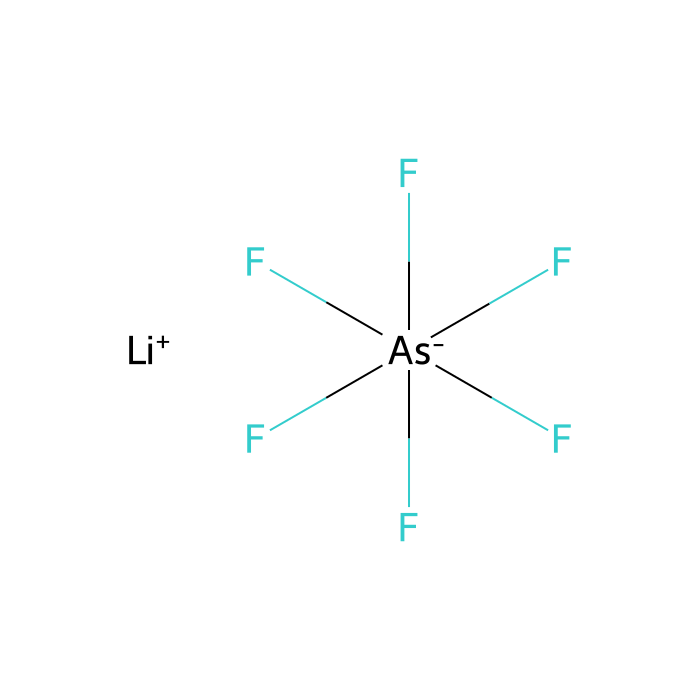
The anion is an octahedral As(V) center coordinated by six fluorides; highly symmetric (Oh symmetry in the ideal gas/solid-state limit).
Functional/coordination groups: Fluoroanionic coordination sphere; no covalent hydrogen or carbon present.
2D depiction (verbal): Central As atom with six equivalent As–F bonds radiating to F atoms; Li+ is separate and solvates strongly in polar media.
Notes
Always cross-reference the actual Certificate of Analysis for definitive identifiers tied to a specific lot.
Synthetic Utility
While primarily an electrolyte salt, lithium hexafluoroarsenate(V) can serve as a useful reagent in ionic manipulations (literature; not item-specific):
Anion exchange/metathesis: Conversion of cationic complexes or onium salts (e.g., iminium, diazonium, triarylmethyl cations) to their weakly coordinating AsF6− counterparts to enhance stability or crystallinity for characterization. Typical routes involve salt metathesis with LiAsF6 (or AgAsF6 when halide abstraction is needed) in dry polar solvents.
Weakly coordinating counterion: AsF6− minimizes ion pairing and nucleophilic participation, aiding formation/isolation of highly electrophilic cations for spectroscopic or structural studies.
Electrochemical synthesis: Functions as a supporting electrolyte in anodic/cathodic transformations in nonaqueous media, improving solution conductivity without strongly interacting with reactive intermediates.
Practical tips:
Maintain rigorously anhydrous conditions to prevent fluoride release and loss of anion integrity.
For halide-rich substrates, AgAsF6 is often preferred (AgX precipitation drives equilibrium); however, LiAsF6 may still be effective for metathesis where halide abstraction is unnecessary.
Crystallization of AsF6− salts can often be achieved from dry acetonitrile or dichloromethane/ether mixtures at low temperature; confirm stability before solvent removal.
Caution: All arsenic-containing byproducts and mother liquors must be collected and disposed of as hazardous waste.
Target Specificity
Not applicable. This product is an inorganic salt, not a biological targeting reagent (no antigen/epitope/clone/isotype data). For research in materials science and electrochemistry only.
Utilizziamo i cookie per garantire il corretto funzionamento del sito web e, ove consentito, per migliorare la tua esperienza. Puoi gestire le tue preferenze in qualsiasi momento nelle Impostazioni. Per saperne di più, consulta la nostra Cookie Policy.
Desidera che le inviamo un messaggio quando avremo sconti disponibili?
Ricordamelo più tardi
Grazie! Controlli la sua casella di posta per confermare.
Products are supplied to verified businesses, institutions, and qualified professionals for research and development use only. Not for use in humans, animals, diagnosis, or therapy.