QUALITÀ & PUREZZAAnhydrous Grade?Anhydrous grade — water removed and packaged dry for moisture-sensitive chemistry. Use in reactions where even trace water would interfere or quench.PrimorTrace™?PrimorTrace™ — Aladdin's trace-metal-analysis line with ultra-low metal background. Use for ICP/AAS trace-metal work where contamination must be minimal.≥99.99% metals basis
PrimorTrace™, anhydrous, ≥99.99% metals basis Anhydrous Grade,PrimorTrace™ per flussi di lavoro cromatografici e analitici sensibili che richiedono un'interferenza minima della linea di base.
🌡
Stoccaggio e spedizione
Room temperature Spedizione Normal. Consultare il COA specifico del lotto per le specifiche esatte.
📋
Documenti di qualità
SDS, COA, scheda tecnica e scheda delle specifiche disponibili per il download. COA specifico del lotto accessibile tramite ricerca per numero di lotto.
📚
Prova documentale
Citato in 70 pubblicazioni peer-reviewed su cromatografia, sintesi organica e reazioni di accoppiamento incrociato.
Alkali metal sulfate - Inorganic lithium salt - Inorganic oxide - Inorganic salt
Descrizione
This compound belongs to the class of inorganic compounds known as alkali metal sulfates. These are inorganic compounds in which the largest oxoanion is sulfate, and in which the heaviest atom not in an oxoanion is an alkali metal.
External Descriptors
metal sulfate
1. Djoumbou Feunang Y, Eisner R, Knox C, Chepelev L, Hastings J, Owen G, Fahy E, Steinbeck C, Subramanian S, Bolton E, Greiner R, and Wishart DS. ClassyFire: Automated Chemical Classification With A Comprehensive, Computable Taxonomy. Journal of Cheminformatics, 2016, 8:61.
Determine the necessary mass, volume, or concentration for preparing a solution.
Dilution Calculator
Determine the dilution needed to prepare a stock solution.
Reconstitution Calculator
Recensioni
Recensioni dei clienti
Application Protocols
No manufacturer-validated biological assay protocols are provided for this inorganic salt, and such methods (WB, IHC, IF, FC) are not applicable.
Representative, non-validated lab procedures (literature-based, for research use only):
Preparation of a 1.00 M Li2SO4 aqueous stock:
Weigh 109.94 g Li2SO4 (anhydrous, literature MW) and transfer to a 1 L volumetric flask.
Add ~700 mL ultrapure water at room temperature; stir to dissolve. Bring to volume with water. Filter through 0.2 µm if clarity is required. Label with concentration, date, and lot.
Electrolyte conditioning for cyclic voltammetry:
Degas the 1.0 M Li2SO4 solution with N2 for 20 minutes.
Assemble a three-electrode cell with inert working electrode (e.g., glassy carbon), Ag/AgCl reference, and Pt counter. Record background to assess cleanliness.
Solid-state drying before flux use:
Spread the salt in a shallow glass/porcelain dish and heat at 130 °C under vacuum (literature) for 4–6 h. Cool in a desiccator or glovebox before blending with other precursors.
These are general examples; optimize for your system. For this item, any specific procedural certifications or application validations are Not specified; refer to CoA/Spec Sheet.
Biological Roles
This item is intended for research use only. The following notes are general, literature-based background on ionic components and do not imply suitability for clinical/diagnostic use.
Lithium ion (Li+):
Small, highly hydrated cation with strong kosmotropic character; influences water structure and macromolecular interactions in solution (literature).
In biophysical studies, Li+ can substitute for Na+ in some systems to probe ion-specific effects on enzymes, nucleic acids, and membranes; binding is typically weak and non-specific compared to divalent cations.
Sulfate (SO4^2−):
A common, strongly hydrated anion; participates in Hofmeister series effects and is widely used in protein precipitation (though ammonium sulfate is preferred for salting-out).
Serves as a counterion in various biochemical formulations where chloride avoidance is desired (e.g., to reduce corrosion or interference in certain assays).
Laboratory uses touching biology (examples):
Adjusting ionic strength in buffer systems for spectroscopic/kinetic studies where halide-free conditions are required.
Osmotic stress experiments with microbial or cell-free systems, exploiting the high hydration energy of Li+ and SO4^2−.
Notes:
Lithium salts can affect cellular physiology; avoid exposure and contamination in cell culture unless specifically designed experiments warrant it.
For any bioassay or biophysical experiment, confirm lot-specific impurity profiles (trace metals, endotoxin if relevant) on the CoA; none are specified for this item.
Buffer Applications
Lithium sulfate is not a buffering agent (no conjugate acid/base pair in the physiological pH range). However, it is useful for tuning ionic strength and reducing halide content in aqueous systems.
Typical roles (literature):
Ionic strength modifier: Add to existing buffers (e.g., phosphate, Tris) to modulate activity coefficients and stabilize macromolecular complexes without introducing chloride.
Sulfate-based media: In certain spectroscopy/electrochemistry experiments, sulfate is preferred to avoid halide adsorption on metal surfaces.
Practical preparation (general guidance):
Prepare a concentrated stock (e.g., 1.0–2.0 mol/L) in high-purity water at room temperature; filter (0.2 µm) if needed. Be aware of retrograde solubility—avoid heating to dissolve unless you consult solubility data.
Add aliquots to your buffer while monitoring pH (sulfate can slightly acidify depending on buffer capacity and CO2 content). Re-adjust pH after addition if necessary.
Compatibility:
Common buffers: Phosphate, borate, HEPES, MOPS, and acetate are generally compatible. Avoid precipitating combinations (e.g., high concentrations with certain divalent cations) that can form insoluble sulfates.
Not typically applicable:
As a primary buffer component: Li2SO4 does not provide buffering capacity; select an appropriate acid/conjugate base system for pH control and use Li2SO4 solely to adjust ionic strength.
Green Alternatives
Lithium sulfate is often chosen as a comparatively benign, non-volatile inorganic salt. Its sulfate counterion is generally considered lower risk than perchlorate or fluorinated anions. Selection should weigh performance versus environmental, safety, and cost considerations.
Greenness profile (literature, comparative):
Sulfate vs perchlorate (LiClO4): Sulfate is non-oxidizing and far less hazardous in storage/handling. However, LiClO4 offers higher conductivity in many nonaqueous media.
Sulfate vs PF6−/TFSI− (LiPF6, LiTFSI): Fluorinated anions provide high conductivity and wider electrochemical windows in organic solvents, but have hydrolysis or persistence concerns; Li2SO4 excels in aqueous systems and has better EHS profile.
Sulfate vs chloride (LiCl): Chloride affords higher aqueous conductivity but can promote corrosion and interfere via complexation; sulfate is less corrosive and more environmentally acceptable for certain discharges.
LiClO4: Excellent conductivity in organics; strong oxidizer, safety burdens.
LiPF6/LiTFSI: High-performance in carbonate solvents; cost and environmental persistence/training needs.
Practical guidance:
For green-by-design aqueous electrochemistry, start with Li2SO4 and benchmark conductivity and electrode stability before escalating to halide or fluorinated salts.
Waste minimization: Sulfate-containing effluents are typically more straightforward to neutralize and treat than perchlorate- or fluorinated-anion streams. Verify local discharge limits.
Pharmaceutical Uses
No clinical/therapeutic claims. This section addresses formulation/manufacturing contexts only and is provided as general literature background. It does not imply suitability or pharmacopeial compliance for this SKU.
Excipient status: Lithium sulfate is not a common pharmaceutical excipient. Other lithium salts (e.g., carbonate, citrate) are known active ingredients; sulfate salts are more often found as excipients for other cations (e.g., sodium sulfate) than as lithium salts.
Potential roles in R&D and manufacturing (literature-based):
Analytical reference salt for validating ion chromatography or ICP workflows involving sulfate determinations.
Processing aid in specialized, non-ingestible applications where a halide-free, high-ionic-strength medium is desired (e.g., certain coating baths or device processing steps).
Model electrolyte for in vitro device testing (electrochemical sensors) where chloride avoidance is preferred to limit corrosion of Ag/AgCl-incompatible components.
Regulatory considerations:
No pharmacopeial monograph for lithium sulfate as an excipient is commonly cited. If excipient use is contemplated, comprehensive qualification would be required (elemental impurities per ICH Q3D, residual solvents per ICH Q3C, microbiological quality where applicable). For this item, specific impurity limits are Not specified; refer to CoA/Spec Sheet.
Bottom line: Lithium sulfate is mainly a research/materials-oriented salt rather than a standard pharmaceutical excipient. Use is restricted to research use only as per Product Data.
Physical Properties
Item-specific specifications are not provided in the Product Data. Values below are typical literature data for anhydrous lithium sulfate; they are NOT specifications for this item.
Appearance: Not specified for this item; refer to CoA/Spec Sheet.
Molecular weight: ~109.94 g/mol (literature)
Physical state: Ionic solid (literature)
Melting point: ~859–860 °C (literature)
Boiling point: Not applicable; decomposes before boiling (literature)
Density (anhydrous, 20–25 °C): ~2.21–2.22 g/cm³ (literature)
Solubility (literature):
Water (25 °C): ~35 g per 100 g H2O; exhibits retrograde solubility (solubility decreases with temperature)
Ethanol: slightly soluble to sparingly soluble
Methanol/acetone/ethers: low to negligible solubility
Hygroscopicity: Tends to absorb moisture and convert partially to monohydrate under humid air (literature)
pH (aq. solution): Neutral to slightly acidic depending on purity and CO2 uptake; no buffering capacity (literature)
Refractive index: Not applicable to bulk solid
Partition coefficient (logP): Not applicable; inorganic salt (literature)
Dielectric behavior: As a salt, does not have a dielectric constant; aqueous solutions increase ionic strength and conductivity (literature)
Notes:
Because of retrograde solubility, hot solutions can precipitate upon heating; dissolve preferably at ambient temperature and cool cautiously.
Always verify critical parameters needed for your method (e.g., water content, trace metals) on the CoA for the specific lot.
Quality and Grades
Item-specific details from Product Data:
Grade/Purity: Anhydrous Grade, PrimorTrace™
Storage: Room temperature; shipped under normal conditions
What “Anhydrous Grade” implies (general guidance):
Manufactured and packaged to minimize water content and hydrate formation. This is critical when precise stoichiometry, conductivity, or moisture-sensitive downstream processes (e.g., solid-state synthesis, molten-salt processing) are involved.
Exact residual water content and hydrate profile are lot-dependent. Not specified for this item; refer to CoA/Spec Sheet for Karl Fischer or loss-on-drying.
PrimorTrace™ positioning (general description):
Aladdin PrimorTrace™ lines are intended for applications where trace-element background must be controlled (e.g., analytical calibration, advanced materials). For this SKU, specific elemental limits are Not specified for this item; refer to CoA/Spec Sheet.
Benefits typically include reduced background in ICP/ICP-MS and improved reproducibility in electrochemical or solid-state studies when trace metal burden is critical.
Practical recommendations:
Upon receipt, keep the container tightly closed to preserve the anhydrous grade; consider handling in a dry room or glovebox if your application is moisture-sensitive.
For trace-analysis work, pre-rinse labware with high-purity acids/water and assess blanks; confirm the lot’s impurity profile on the CoA before use.
If a defined hydrate state is required for your method, verify by TGA/DSC or XRD; lithium sulfate readily forms a monohydrate under humid conditions.
Reaction and Applications
This product is most relevant to materials chemistry, electrochemistry, and ionic-strength control. Below are representative, literature-based uses; they are not manufacturing claims for this specific item.
Electrolyte and electrochemistry:
Aqueous lithium-ion and hybrid supercapacitors: Li2SO4 serves as a stable, non-oxidizing supporting electrolyte; typical concentrations 0.5–2.0 m. Sulfate avoids halide-induced corrosion.
Electrodeposition and plating baths: Used to adjust ionic strength and conductivity while minimizing complexation versus halides.
Solid-state and crystal growth:
Flux for growth of oxides (e.g., lithium-containing perovskites, ferrites) where sulfate fluxing can lower synthesis temperature and influence grain morphology.
Precursor in preparing lithium silicates/aluminates where sulfate decomposes to give volatile SOx under high T, leaving Li2O-equivalents.
Synthetic/analytical roles:
Salting-out and phase behavior studies; adjustment of activity coefficients in aqueous reactions and kinetics investigations.
Additive in polymer systems to tune conductivity and water structuring (e.g., PVA hydrogels, polyacrylamide), leveraging Li+ kosmotropic effects.
Standard for sulfate chemistry in ion chromatography method development and instrument qualification (prepare calibration solutions in ultrapure water).
Practical tips:
Because of retrograde solubility, prepare solutions at ambient temperature and filter if needed before gently cooling. Avoid heating to dissolve unless solubility curves are accounted for.
For electrochemical work, pre-dry the salt (literature: 120–150 °C, vacuum) to minimize adventitious water or hydrate transitions, then prepare solutions with degassed, high-resistivity water to reduce dissolved gas effects.
Reaction Conditions
Representative literature conditions where lithium sulfate is employed; these are illustrative and not specifications for this item.
Temperature: 20–30 °C for dissolution; avoid excessive heating due to retrograde solubility. Operate cells from ~0 to 60 °C depending on electrode/system limits.
Degassing: Optional N2/Ar sparging to minimize O2 in sensitive measurements.
Filtration: 0.2 µm to remove particulates before cell filling.
Ionic-strength adjustment in buffered reactions:
Add solid or concentrated stock to the buffered solution while stirring; verify pH and re-adjust. Typical ionic strengths: 0.1–1.0 M total (buffer + salt) depending on the kinetic regime studied.
Solid-state/flux syntheses:
Mixing: Combine Li2SO4 with oxide/oxide precursors in an agate mortar; optional wet-milling with minimal solvent followed by thorough drying.
Thermal profile: Ramp to 600–900 °C as dictated by target material; sulfate may decompose to SOx at elevated T, effectively delivering Li2O-equivalents.
Atmosphere: Air or O2 for oxide formation; inert gas if reduction is involved.
Drying/activation (before use):
Literature practice: Heat at 120–150 °C under vacuum for several hours to remove adsorbed moisture/incipient hydrate, cool under dry inert gas, and store in a desiccator.
Notes:
Avoid combinations that precipitate (e.g., with Ba2+, Pb2+, Sr2+ yielding insoluble sulfates) if homogeneity is required.
Corrosion: Sulfate is generally less corrosive than chloride but still increases solution conductivity; select compatible metals and seals.
Safety and Handling
Item-specific GHS details were not provided. Always consult the product SDS for authoritative safety information for this SKU and lot.
GHS classification, signal word, pictograms, and H-statements: Not specified for this item; refer to SDS.
General safety guidance for lithium sulfate (literature-based, not item-specific):
Hazards: Inorganic salt that may cause irritation to eyes, skin, and respiratory tract upon contact with dust. Avoid inhalation and ingestion. Not known to be combustible; may evolve irritating fumes if strongly heated.
Personal Protective Equipment (PPE): Use laboratory coat, safety glasses or splash goggles, and appropriate gloves (e.g., nitrile). Handle powders in a fume hood or with local extraction to minimize airborne dust.
Handling practices:
Minimize dust generation; avoid contact with acids that could release heat and aerosols.
Keep container tightly closed to limit moisture uptake; anhydrous material can hydrate in humid air.
Incompatibilities (general): Strong acids/bases in concentrated form (exotherm on dissolution), strong dehydrating agents, and materials that can be sensitive to ionic strength. No known dangerous polymerization.
First aid (summary):
Eyes: Rinse cautiously with water for several minutes; remove contacts if present and easy; seek medical attention if irritation persists.
Skin: Wash with soap and water; remove contaminated clothing.
Inhalation: Move to fresh air; seek medical attention if symptoms develop.
Ingestion: Rinse mouth; do not induce vomiting; seek medical advice.
Fire: Not flammable; use extinguishing media appropriate for surrounding fire; thermal decomposition may produce sulfur oxides.
Solvent Selection
Lithium sulfate is an inorganic ionic solid; solvent selection considerations focus on dissolution, ionic strength, and conductivity rather than classic solvent polarity for organics.
Polarity class: Strong electrolyte; dissolves via ion–dipole interactions in highly polar protic solvents.
Miscibility/solubility profile (literature):
Water: Freely soluble at room temperature (~35 g/100 g H2O at 25 °C). Retrograde solubility upon heating.
Lower alcohols (MeOH/EtOH): Slight to poor solubility; expect slow dissolution.
Polar aprotic solvents (DMSO, DMF, acetonitrile): Very limited solubility as a salt; consider using water or mixed aqueous media.
Aqueous electrolyte studies (battery, plating, electrochemistry): Use high-purity water; adjust molality (e.g., 0.5–2.0 m) for target conductivity/viscosity. Control temperature to avoid retrograde precipitation.
Precipitation/ionic strength control: Lithium sulfate can salt out some organics or proteins less effectively than ammonium sulfate but with a benign sulfate counterion; use buffered aqueous systems if pH control is required.
Molten-salt or flux applications: For high-temperature syntheses or crystal growth, the anhydrous solid can be blended with other lithium salts/oxides; no solvent required.
Comparison highlight (literature):
Versus LiCl/Na2SO4: Li2SO4 offers a non-chloride, oxidatively stable sulfate anion; conductivity in water is generally lower than LiCl at equal molarity but sulfate is less corrosive to some metals.
Storage and Reconstitution
Item-specific storage and shipping (from Product Data):
Storage Conditions: Room temperature
Shipped In: Normal
Container handling:
Keep tightly closed to limit moisture uptake and preserve the anhydrous grade. If frequent access is expected, consider aliquoting into smaller, dry containers.
Store in a low-humidity environment or desiccator. For moisture- and trace-sensitive work, handling in a dry box is advisable.
Reconstitution/dissolution (general literature guidance):
Use high-purity (18 MΩ·cm) water at room temperature. Add salt gradually with stirring. Because Li2SO4 shows retrograde solubility, avoid heating to dissolve unless guided by a solubility curve.
For defined molal solutions, weigh both solute and solvent accurately; molality avoids density corrections.
Filter solutions (0.2 µm) for electrochemistry or spectroscopy to remove particulates.
Stability of solutions:
Aqueous solutions are stable for weeks at ambient conditions in clean, closed vessels. To minimize contamination and microbial growth, prepare smaller volumes freshly or store at 2–8 °C and allow to equilibrate before use. Monitor for precipitation if temperature changes.
Drying/rehydration notes:
If hydration is suspected (mass gain, TGA), literature practice is to dry at 120–150 °C under vacuum to regenerate the anhydrous form. Confirm hydration state by TGA/DSC or XRPD if critical to your application.
Research Use Note: For research use only.
Structure and Identity
Concise identity of an inorganic lithium salt suitable for materials science and general laboratory use.
Product Data (item-specific):
SKU: L130837
Product Name: Lithium sulfate
CAS: 10377-48-7
Grade/Purity: Anhydrous Grade, PrimorTrace™
Storage: Room temperature; shipped under normal conditions
InChIKey (as provided): 145462
Literature/computed identifiers (for reference; not item specifications):
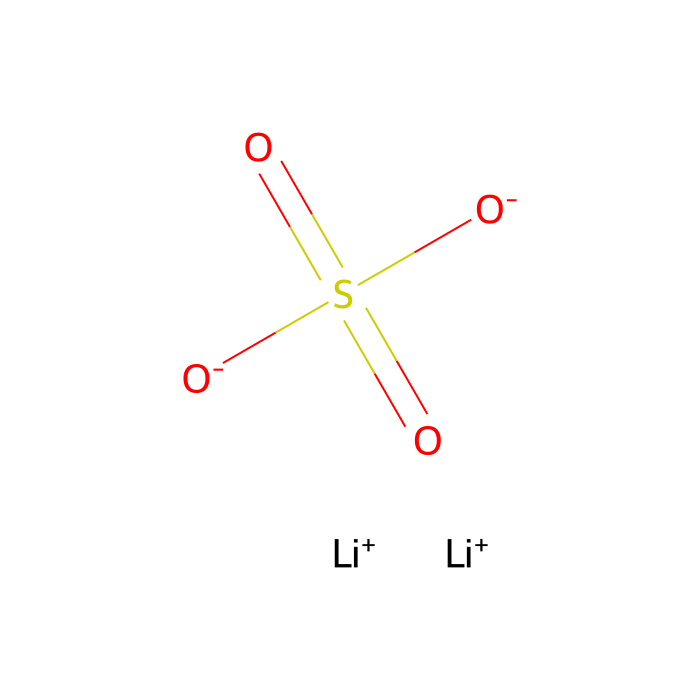
Molecular formula: Li2SO4 (lithium cation balanced by sulfate anion)
Structural features (general chemistry description):
Composed of two monovalent lithium cations (Li+) and one tetrahedral sulfate dianion (SO4^2−).
The sulfate unit features a central sulfur atom in +6 oxidation state, bonded to four oxygen atoms in a near-perfect tetrahedral geometry.
In the solid state (anhydrous), Li+ ions occupy coordination sites around sulfate oxygens in an extended ionic lattice; hydration leads to distinct lattices (e.g., monohydrate) via Li–O(H2O) coordination.
No stereocenters, no covalent C–H functionality; purely inorganic ionic compound.
2D structural description (words):
A central S atom double-bonded formally to two O atoms and single-bonded to two O− atoms, overall SO4^2−, electrostatically paired with two Li+ countercations positioned around the oxygens in the lattice.
Synthetic Utility
Lithium sulfate’s utility in synthesis stems from its ionic character, benign sulfate anion, and lithium’s influence on solvation and reactivity. While it is not a classic organic reagent, it plays several enabling roles (literature-based):
Ionic-strength and selectivity effects:
Rate and selectivity modulation in aqueous and mixed-solvent reactions via activity coefficient control. Li+ can alter transition-state stabilization differently from Na+/K+ due to stronger hydration and unique ion pairing.
Precipitation and separation:
Induces salting-out of organics or macromolecules; can be exploited to shift equilibria, enhance phase separations, or crystallize sulfate salts of target cations.
Solid-state precursor and flux:
Source of lithium for ceramic, glass, and oxide synthesis. As a flux, lowers sintering temperatures and influences grain growth in solid-state reactions.
Electrolyte support:
As a non-coordinating background electrolyte in aqueous electro-organic transformations, supporting current flow without introducing reactive halides.
Compatibility notes:
Generally inert toward most organic functional groups under neutral conditions. In strong acid/base or at high temperature, sulfate can participate in exchange or decomposition processes (to SOx), which can be harnessed in solid-state synthesis.
Practical tips:
For moisture-sensitive steps (e.g., molten-salt routes), pre-dry anhydrous Li2SO4 (literature: 120–150 °C under vacuum) and handle in dry atmosphere.
When used as an additive, run small-scale screens comparing Li+, Na+, and K+ sulfates to quantify specific ion effects.
Target Specificity
Not applicable. This product is an inorganic salt and not a biomolecular targeting reagent. No antigen/epitope/clone/isotype information is relevant.
Tested target reactivity, clone, isotype: Not applicable.
Any such parameters are Not specified for this item; refer to CoA/Spec Sheet if you require analytical characterization data (e.g., trace metals) rather than biological target data.
La nostra guida alla selezione delle qualità copre purezza, stato dello stabilizzatore e idoneità all'applicazione per tutte le varianti del nostro catalogo.
Utilizziamo i cookie per garantire il corretto funzionamento del sito web e, ove consentito, per migliorare la tua esperienza. Puoi gestire le tue preferenze in qualsiasi momento nelle Impostazioni. Per saperne di più, consulta la nostra Cookie Policy.
Desidera che le inviamo un messaggio quando avremo sconti disponibili?
Ricordamelo più tardi
Grazie! Controlli la sua casella di posta per confermare.
Products are supplied to verified businesses, institutions, and qualified professionals for research and development use only. Not for use in humans, animals, diagnosis, or therapy.

 J2610935