QUALITÀ & PUREZZAPrimorTrace™?PrimorTrace™ — Aladdin's trace-metal-analysis line with ultra-low metal background. Use for ICP/AAS trace-metal work where contamination must be minimal.≥99.99% metals basis
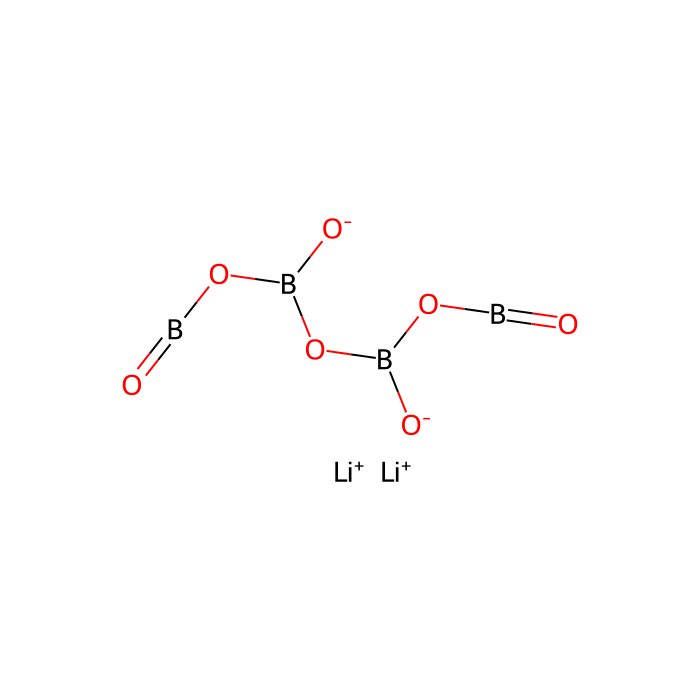
Lithium tetraborate (Li2B4O7) is a piezoelectric material. It can be synthesized from boric acid. Its pyroelectric, piezoelectric and dielectric properties have been evaluated. It is a widely used material in the field of non-linear optics. Its electronic structure has been investigated by x-ray photoelectron spectroscopy (XPS) and quantum mechanical modelling methods. Lithium tetraborate is a pyroelectric and piezoelectric material with potential applications in pressure sensors and surface acoustic wave (SAW) devices. In the presence of activators such as terbium and cupric ions, it shows thermoluminesence property Lithium tetraborate is a spectroscopic fluxing agent which is used for fusing basic oxides, glass, alumino-silicates, ceramics, carbonates, cement, steel, aluminum, soil, concrete mixes, bauxites, magnesites and rare earth oxides.
Borate - Alkali metal borate - Inorganic lithium salt - Inorganic oxide - Inorganic salt - Inorganic metalloid salt
Descrizione
This compound belongs to the class of inorganic compounds known as alkali metal borates. These are inorganic compounds in which the largest oxoanion is borate, and in which the heaviest atom not in an oxoanion is an alkali metal.
External Descriptors
Not available
1. Djoumbou Feunang Y, Eisner R, Knox C, Chepelev L, Hastings J, Owen G, Fahy E, Steinbeck C, Subramanian S, Bolton E, Greiner R, and Wishart DS. ClassyFire: Automated Chemical Classification With A Comprehensive, Computable Taxonomy. Journal of Cheminformatics, 2016, 8:61.
La nostra guida alla selezione delle qualità copre purezza, stato dello stabilizzatore e idoneità all'applicazione per tutte le varianti del nostro catalogo.
Utilizziamo i cookie per garantire il corretto funzionamento del sito web e, ove consentito, per migliorare la tua esperienza. Puoi gestire le tue preferenze in qualsiasi momento nelle Impostazioni. Per saperne di più, consulta la nostra Cookie Policy.
Desidera che le inviamo un messaggio quando avremo sconti disponibili?
Ricordamelo più tardi
Grazie! Controlli la sua casella di posta per confermare.
Products are supplied to verified businesses, institutions, and qualified professionals for research and development use only. Not for use in humans, animals, diagnosis, or therapy.

 G2617390