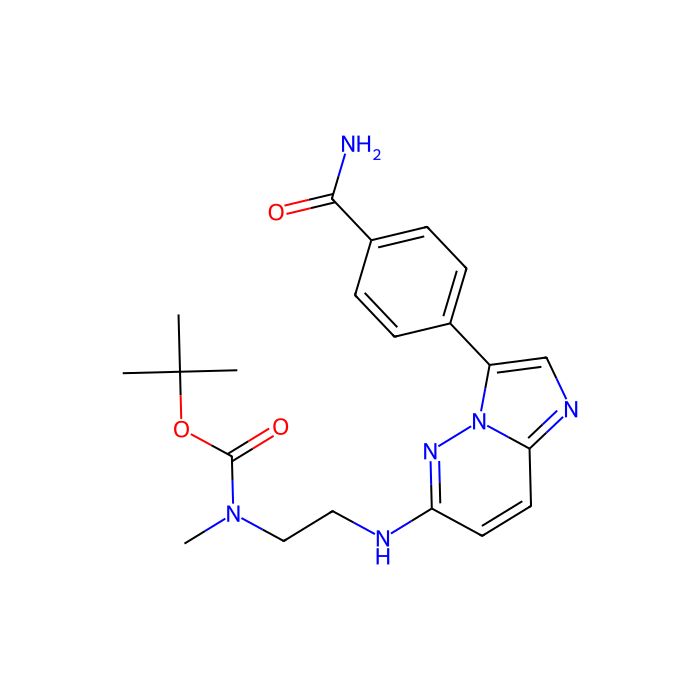
Potent AAK1 inhibitor (IC50values are 4.8 and 7.6 nM in enzyme and cell assays, respectively). Exhibits some selectivity for AAK1 over BIKE, and exhibits no significant activity at opioid, adrenergic α2or GABAAreceptors. Orally bioavailable. Peripherally restricted.
Condizioni di conservazione di stoccaggio
Store at -20°C
Spedito in
Ice chest + Ice pads
Questo prodotto richiede spedizione a catena fredda. I servizi di terra e altri servizi economici non sono disponibili.
This compound belongs to the class of organic compounds known as phenylimidazoles. These are polycyclic aromatic compounds containing a benzene ring linked to an imidazole ring through a CC or CN bond.
External Descriptors
Not available
1. Djoumbou Feunang Y, Eisner R, Knox C, Chepelev L, Hastings J, Owen G, Fahy E, Steinbeck C, Subramanian S, Bolton E, Greiner R, and Wishart DS. ClassyFire: Automated Chemical Classification With A Comprehensive, Computable Taxonomy. Journal of Cheminformatics, 2016, 8:61.
Certificati (CoA, COO, BSE/TSE e tabella di analisi)
C of A & Other Certificates(BSE/TSE, COO):
Analytical Chart:
Proprietà chimiche e fisiche
Solubilità
Solvent:DMSO, Max Conc. mg/mL: 20.52, Max Conc. mM: 50
Peso molecolare
410.500 g/mol
XLogP3
2.100
Hydrogen Bond Donor Count
2
Hydrogen Bond Acceptor Count
6
Rotatable Bond Count
8
Exact Mass
410.207 Da
Monoisotopic Mass
410.207 Da
Topological Polar Surface Area
115.000 Ų
Heavy Atom Count
30
Formal Charge
0
Complexity
602.000
Isotope Atom Count
0
Defined Atom Stereocenter Count
0
Undefined Atom Stereocenter Count
0
Defined Bond Stereocenter Count
0
Undefined Bond Stereocenter Count
0
The total count of all stereochemical bonds
0
Covalently-Bonded Unit Count
1
Calcolatori di soluzioni
Molarity Calculator
Determine the necessary mass, volume, or concentration for preparing a solution.
Dilution Calculator
Determine the dilution needed to prepare a stock solution.
Reconstitution Calculator
Recensioni
Recensioni dei clienti
Application Protocols
No tested applications or specific protocols are provided for LP-922761 in this listing.
General starting points (non-item-specific; adapt to your material and CoA)
If protein/peptide:
Reconstitution: Chill buffer, add minimal volume, gently mix to dissolve, and allow complete hydration. Optional: 0.22 µm filtration if compatible.
Aliquoting: Prepare single-use aliquots to avoid freeze–thaw. Store at −20°C or per CoA.
Assays: For binding/activity assays, prepare a serial dilution series (e.g., 10-point 1:3 dilutions) and include vehicle/buffer controls.
If small molecule:
Stock: Prepare 10 mM in DMSO; verify solubility. Store small aliquots at −20°C, desiccated, protected from light as needed.
Dilution: Add to assay buffer with vigorous mixing to the desired final concentration keeping DMSO ≤0.1–1% v/v.
Documentation
Record lot number, preparation date, solvent/buffer composition, and storage history to ensure reproducibility.
For validated, item-specific protocols, consult the lot-specific CoA/Spec Sheet or contact Aladdin Scientific technical support.
Biological Roles
No biological function, target, or sequence is provided for LP-922761 in this listing. Consequently, specific cellular pathways, ligand/receptor interactions, or enzyme activities cannot be described for this item.
General considerations (for planning, non-item-specific)
If LP-922761 is a protein or peptide (per catalog category):
Biological roles are determined by sequence, folding state, and post-translational modifications. Activity often depends on buffer composition, cofactors, and temperature.
Typical characterization includes activity assays, binding kinetics (SPR/BLI/ITC), and stability profiling (DSF/DSC).
If LP-922761 is a small-molecule probe/inhibitor:
Biological role would depend on target class (kinase, GPCR, epigenetic enzyme, etc.). Key parameters include potency (IC50/Ki), selectivity panel data, permeability, and stability in assay media.
Recommendations
Use the lot-specific CoA/Spec Sheet to identify any known targets, recommended assay systems, or reference publications.
Validate activity in your own hands with positive/negative controls and concentration–response analyses to confirm on-target effects.
Reminder: This product is for research use only.
Buffer Applications
Specific buffer systems or formulations for LP-922761 are not disclosed. If your lot is a protein or peptide (as suggested by the catalog category), buffer choice critically affects stability and activity.
General buffer guidance (non-item-specific)
Common working buffers: PBS (10–50 mM phosphate, 150 mM NaCl, pH 7.2–7.4), HEPES (25–50 mM, pH 7.2–7.6). Maintain ionic strength (100–200 mM total salt) to reduce nonspecific adsorption.
Additives (if compatible per CoA): 5–10% glycerol to reduce freeze–thaw stress; 0.01–0.1% non-ionic surfactant (Tween-20/Polysorbate 80) to limit surface adsorption in low-protein matrices; 0.1% carrier protein (BSA) for very low-concentration storage.
Metal-sensitive proteins: Consider Chelex-treated buffers or low-EDTA formulations depending on activity requirements.
Filtration: 0.22 µm sterile filtration for cell-based applications if the protein tolerates it.
pH range and stability
Optimal pH and salt are protein-specific. Avoid extremes of pH and high phosphate with divalent-cation-requiring assays unless validated.
If LP-922761 is a small molecule, traditional biological buffer preparation is not typically applicable; instead, prepare DMSO stocks and dilute into assay buffers while keeping final organic content low (≤0.1–1% v/v) to minimize biological interference.
Green Alternatives
Without knowledge of LP-922761’s chemical identity or solvent requirements, green chemistry substitutions cannot be specified for this item.
General guidance (non-item-specific)
Solvent selection: Favor water, bio-based solvents (e.g., 2-MeTHF for hydrophobic organic reactions, Cyrene, propylene carbonate), or ethanol/isopropanol where performance allows. For protein work, aqueous buffers at ambient temperature are inherently greener than organic-heavy systems.
Energy minimization: Store as recommended (−20°C here), but perform reactions/assays at ambient temperature when feasible to reduce energy demand from heating/cooling cycles.
Waste reduction: Prepare minimal volumes, use microscale assays, and segregate halogenated from non-halogenated waste. For proteins, adopt single-use aliquots to prevent repeated freeze–thaw and product loss.
Safer auxiliaries: Prefer non-toxic salts/buffers (HEPES, phosphate) and avoid azide or heavy-metal preservatives unless required.
Comparison examples (illustrative only)
If a DMSO stock is needed for a small molecule, consider whether aqueous cyclodextrin complexes or ethanol co-solvent can achieve performance with lower environmental impact. Trade-offs include solubility limits and potential assay interference.
Note: Apply these principles only after confirming LP-922761’s identity and compatibility on the CoA/SDS.
Pharmaceutical Uses
No pharmacopeial designation, excipient role, or GMP status is provided for LP-922761. This product is labeled for research use only and is not intended for human or veterinary use, drug substance/intermediate manufacture under GMP, or clinical applications.
General information (non-item-specific)
Proteins/peptides intended for formulation studies typically require detailed comparability data (purity by orthogonal methods, aggregation, charge variants, endotoxin), none of which are specified here.
Small molecules used in pre-formulation may require solid-state characterization (polymorph, particle size, residual solvents) and compatibility with common excipients; again, not specified for this product.
Recommendations
Do not use this material for clinical or diagnostic purposes.
If formulation-related research is intended, request extended analytical data (e.g., DSC/DSF for proteins, PXRD/TGA/KF for small molecules) and confirm material suitability contractually for your intended non-clinical studies.
Physical Properties
Item-specific physicochemical specifications are not disclosed in this listing. Do not assume values for experimental design. Instead, consult the CoA/Spec Sheet that ships with your lot.
State/appearance: Not specified for this item; refer to CoA/Spec Sheet.
Molecular weight (exact): Not specified for this item; refer to CoA/Spec Sheet.
Molecular formula: Not specified for this item; refer to CoA/Spec Sheet.
Melting point / glass transition: Not specified for this item; refer to CoA/Spec Sheet.
Boiling point / decomposition temperature: Not specified for this item; refer to CoA/Spec Sheet.
Density: Not specified for this item; refer to CoA/Spec Sheet.
Solubility: Not specified for this item; refer to CoA/Spec Sheet.
pKa/logP/logD: Not specified for this item; refer to CoA/Spec Sheet.
Refractive index/optical rotation: Not specified for this item; refer to CoA/Spec Sheet.
General guidance (literature/best-practice, not item-specific)
If LP-922761 is supplied as a protein or peptide (per category tag), typical reconstitution uses aqueous buffers (e.g., PBS, HEPES) at neutral pH with optional carrier protein to minimize adsorption. Solubility and stability can be highly sequence- and formulation-dependent.
If LP-922761 is a small molecule (as suggested by the presence of a CAS and CID), non-aqueous solvents such as DMSO are commonly used for initial stock solutions, followed by dilution into assay buffers; actual solvent choice must be confirmed from the CoA.
Always test a small aliquot to confirm clarity and stability of solutions before scale-up.
Quality and Grades
Grade/purity and any stabilizers for LP-922761 are not specified in this listing. Do not infer assay purity, sequence integrity (if a protein), or residual solvent/metal content without the CoA.
Grade/Purity: Not specified for this item; refer to CoA/Spec Sheet.
Stabilizers/Excipients (e.g., BSA, trehalose, glycerol, salts): Not specified for this item; refer to CoA/Spec Sheet.
Guidance on interpreting grades (general information)
Research grade: Suitable for most discovery applications. May not meet pharmacopeial monographs or GMP documentation.
HPLC grade (solvents) or >98% purity (small molecules): Indicates low non-volatile residue/UV background or high assay purity, respectively. Not stated for this product.
For proteins: Common quality attributes include purity by SDS-PAGE, endotoxin level, host cell protein/DNA, aggregation by SEC, and activity assays. None are specified here; consult the CoA.
Recommendations
Cross-check your lot’s CoA for acceptance criteria (purity, identity test such as MS/sequence, residuals, water content) before critical experiments.
If your workflow is sensitive (e.g., biophysical assays, crystallography, cell culture), request or review analytical chromatograms and characterization data to confirm suitability.
Reaction and Applications
This section is typically applicable to small molecules and synthetic reagents. For LP-922761, no structure, functional groups, or reactivity profile are disclosed in the listing, so specific synthetic or reaction applications cannot be assigned.
General research-use contexts (non-item-specific)
If LP-922761 is a protein/peptide: potential uses may include biochemical assays (binding/enzymatic activity), cell signaling studies, protein–protein interaction mapping, or as a standard/control. Actual applications must be derived from the CoA and any manufacturer’s application notes.
If LP-922761 is a small molecule: it may be used as a probe, ligand, inhibitor, or building block in discovery studies. Reaction participation (e.g., coupling, protection/deprotection) cannot be stated without structural information.
Practical considerations
Verify identity and purity (MS, HPLC/UPLC, SDS-PAGE for proteins) before high-value experiments.
Establish stability-indicating methods (HPLC, LC–MS, SEC for proteins) to monitor degradation during handling and storage.
If using in bioassays, perform a solvent and vehicle control ladder to identify non-specific effects from co-solvents.
Conclusion
Please consult the CoA/Spec Sheet or contact Aladdin Scientific technical support with your lot number for tailored application guidance.
Reaction Conditions
Definitive reaction conditions cannot be recommended without a disclosed structure or target chemistry for LP-922761.
General frameworks (non-item-specific)
Small molecule use:
Stock preparation: 1–10 mM in dry DMSO; dilute into assay buffer to ≤0.1–1% DMSO final. Verify solubility visually and by HPLC.
Stability: Protect from light and moisture as needed; test at 4°C, 25°C, and 37°C in your assay matrix to establish working windows.
Protein/peptide use:
Reconstitution: Gentle swirling in chilled buffer; avoid vigorous vortexing to reduce aggregation. Allow full hydration before use (5–15 min) and, if compatible, brief low-speed spin to collect material.
Assay setup: Maintain pH near neutral and include cofactors/metal ions only if validated for activity.
Monitoring and analytics
Employ LC–MS/HPLC (small molecules) or SEC/CE-SDS/MS (proteins) to confirm integrity over the course of your protocol.
Yields and timelines
Not applicable to this item as a catalog reagent without disclosed synthetic role; consult literature once the identity is confirmed from the CoA.
Safety and Handling
Hazard classification for this specific item is not provided in the listing. Treat as potentially hazardous and consult the SDS for your lot before use.
GHS classification: Not specified for this item; refer to SDS.
Signal word / pictograms / H-statements: Not specified for this item; refer to SDS.
General laboratory precautions (best-practice)
PPE: Wear lab coat, safety glasses, and appropriate chemically resistant gloves. Use a certified chemical fume hood when handling powders, volatile solvents, or unknown toxicity materials.
Avoid ingestion, inhalation of dust/aerosols, and skin/eye contact. Decontaminate benches and tools after use.
Incompatibilities: Unknown for this item. Segregate from oxidizers, acids/bases, and reducing agents until specific compatibility is confirmed from the SDS/CoA.
Spills: Contain and absorb with inert material. Avoid dust generation. Dispose in accordance with institutional and local regulations.
First aid (overview): In case of skin/eye contact, rinse with water for at least 15 minutes and seek medical attention. If inhaled, move to fresh air. If ingested, rinse mouth and seek medical advice. Always follow the SDS instructions.
Storage and transport
Storage: Store at −20°C (per Product Data). Protect from light and moisture unless your CoA indicates otherwise.
Shipping: Shipped in an ice chest with ice pads, maintaining a cold chain to preserve integrity.
Note: Ethers, peroxides, or other special hazards are not indicated here because the structure and formulation are not disclosed; defer to SDS.
Solvent Selection
Because the molecular identity and formulation of LP-922761 are not disclosed in this listing, solvent selection must be based on the CoA/Spec Sheet and a small-scale solubility screen.
Decision framework (general guidance)
If supplied as a protein/peptide (per catalog category):
Primary diluents: aqueous buffers (e.g., PBS pH 7.2–7.4, HEPES pH 7.5), with optional 5–10% glycerol and 0.1% carrier protein (e.g., BSA) to minimize adsorption and freeze–thaw stress (only if compatible per CoA).
Avoid strong acids/bases and chelators unless specified; maintain isotonicity for cellular assays.
If supplied as a small molecule (presence of CAS/CID suggests this possibility):
Stock solvents: anhydrous DMSO is commonly used; alternatives include DMF, ethanol, or aqueous buffers with co-solvent. Begin with 1–10 mM stocks, then dilute into assay medium.
Miscibility and polarity (not item-specific)
DMSO is miscible with water and many organics, enabling staged dilutions to minimize precipitation in aqueous media.
Ethanol offers lower cytotoxicity at low percentages but reduced solubilizing power for highly lipophilic compounds compared with DMSO.
Practical tips
Filter sterilize solutions for cell-based work (0.22 µm) if the product is compatible.
Prepare the minimum volume needed and assess clarity; adjust solvent composition incrementally to avoid supersaturation/precipitation.
Record exact solvent lots and compositions for reproducibility.
Storage and Reconstitution
Item-specific storage and shipping details are provided; reconstitution details are not disclosed and must be taken from the CoA/Spec Sheet.
Storage conditions (from Product Data): Store at −20°C.
Shipping (from Product Data): Shipped in an ice chest with ice pads to maintain cold chain.
General reconstitution guidance (non-item-specific; follow your CoA)
If supplied as a lyophilized or frozen protein/peptide:
Equilibrate to 2–8°C before opening to minimize condensation. Reconstitute with sterile, chilled buffer (e.g., PBS or HEPES, pH ~7.2–7.5) to the desired concentration. Gently swirl; avoid vigorous vortexing or foaming.
Optional stabilizers if compatible: 5–10% glycerol; 0.1% carrier protein (e.g., BSA) for very dilute stocks. Filter sterilize (0.22 µm) if required for cell culture.
Aliquot into single-use volumes; avoid repeated freeze–thaw cycles. Store working aliquots at −20°C or as recommended on the CoA.
If supplied as a small-molecule solid or solution:
For solids, prepare concentrated stocks in an appropriate solvent (commonly anhydrous DMSO) based on CoA solubility guidance. For solutions, confirm solvent, concentration, and any stabilizers.
Protect from light and moisture if indicated; use desiccants and inert atmosphere where appropriate.
Always defer to the lot-specific CoA/SDS for definitive instructions and stability limits (e.g., bench life, number of freeze–thaw cycles).
Structure and Identity
LP-922761 is listed without a disclosed chemical or biomolecular structure in this catalog entry. The following identifiers are provided; all other structural details should be confirmed on the product CoA/Spec Sheet.
Item name: LP-922761 (SKU: L287650)
CAS: 1454808-95-7 (catalog identifier; verify before regulatory reporting)
PubChem CID: 86696405 (catalog identifier)
InChIKey (as provided): 442047 — note: this is atypically short for a standard InChIKey; confirm the definitive identifier on the CoA/SDS.
SMILES: Not specified for this item; refer to CoA/Spec Sheet.
Molecular formula: Not specified for this item; refer to CoA/Spec Sheet.
Molecular weight: Not specified for this item; refer to CoA/Spec Sheet.
Structural description
Specific functional groups, ring systems, and stereochemistry: Not disclosed in this listing. No 2D/3D structure can be described without the definitive SMILES/InChI.
Notes
This product is categorized under proteins in the catalog taxonomy; however, no sequence, construct, or protein class is provided. Users should consult the product CoA/Spec Sheet for confirmation of molecular identity (small molecule vs. protein/peptide), exact structure or sequence, and any post-translational modifications or salt forms if applicable.
For database cross-referencing, use the CAS/CID above as starting points and verify against your internal registration system before use in regulated work.
Synthetic Utility
Synthetic utility depends entirely on the chemical structure and functional groups, which are not disclosed for LP-922761 in this listing. Therefore, specific transformations, protecting-group strategies, or coupling methodologies cannot be provided.
General notes (non-item-specific)
If LP-922761 is a small molecule building block: assess reactive handles (e.g., halides for cross-coupling, amines/acids for amide formation, alcohols for esterification/etherification) and functional group compatibility to plan convergent routes. Establish orthogonal protection where necessary.
If LP-922761 is a protein/peptide: synthetic considerations shift toward bioconjugation (maleimide–thiol, NHS–amine), site-specific labeling (enzymatic tags, click chemistry), or assembly (SPPS, native chemical ligation). Such uses require confirmed sequence and reactive residue availability.
Action item
Consult the CoA/Spec Sheet for definitive identity and any recommended chemistries. Perform a small pilot reaction/conjugation to assess compatibility before scale-up.
Target Specificity
Target specificity data are not provided for LP-922761.
Antigen/target name: Not specified for this item; refer to CoA/Spec Sheet.
Species reactivity/orthologs: Not specified for this item; refer to CoA/Spec Sheet.
Clone/isotype (if antibody): Not applicable unless the product is confirmed to be an antibody; no such information is provided here.
Guidance
If LP-922761 is a protein or ligand, verify binding partners and selectivity using orthogonal methods (e.g., SPR/BLI for affinity, functional cell-based assays for activity). Include appropriate negative/positive controls.
If LP-922761 is a small-molecule probe, consult the CoA for selectivity panels (e.g., kinase or GPCR selectivity) and confirm in-house with concentration–response curves.
Domande frequenti
What is the purity of this product, and how is it determined?
This product is supplied at ≥98% purity, determined by HPLC. Lot-specific values are stated on the Certificate of Analysis.
How should this product be stored?
Store at ?20 °C. Freezer storage is required to maintain the specified shelf life.
How is this product shipped?
This product ships in an insulated container with ice pads. Unpack on arrival and transfer it to the storage condition stated above.
What are the CAS number, molecular formula and molecular weight?
The CAS Number is 1454808-95-7, the molecular formula is C21H26N6O3, and the molecular weight is 410.47 g/mol. InChIKey YNQNYIHMAZLJAV-UHFFFAOYSA-N.
What documentation is provided?
Available product documentation, including Certificates of Analysis (COA), Safety Data Sheets (SDS), and specification sheets, is shown in the product document area. Document availability and access follow the current site policy.
Utilizziamo i cookie per garantire il corretto funzionamento del sito web e, ove consentito, per migliorare la tua esperienza. Puoi gestire le tue preferenze in qualsiasi momento nelle Impostazioni. Per saperne di più, consulta la nostra Cookie Policy.
Desidera che le inviamo un messaggio quando avremo sconti disponibili?
Ricordamelo più tardi
Grazie! Controlli la sua casella di posta per confermare.
Products are supplied to verified businesses, institutions, and qualified professionals for research and development use only. Not for use in humans, animals, diagnosis, or therapy.