GRADE & PURITYMoligand™?Moligand™ — Aladdin's line of ligands and bioactive small molecules. Use for receptor, pathway, and binding studies needing defined small-molecule tools.10 mM in DMSO
1.Dai-Yu Sun, Jia-Qi Wu, Zhi-Heng He, Ming-Fang He, Hong-Bin Sun. (2019) Cancer-associated fibroblast regulate proliferation and migration of prostate cancer cells through TGF-β signaling pathway. LIFE SCIENCES, [PMID:31465732][10.1016/j.lfs.2019.116791]
2.Junjuan Lu, Caihong Liu, Ting Yuan, Honghui Yang, Li Zhang. (2025) Neutrophil-derived exosomal thrombospondin-1 exacerbates endothelial progenitor cell senescence and lung injury via TGF-β/SMAD signaling in COPD. Translational Research, [PMID:41412416][10.1016/j.trsl.2025.12.004]
Calcolatori di soluzioni
Molarity Calculator
Determine the necessary mass, volume, or concentration for preparing a solution.
Dilution Calculator
Determine the dilution needed to prepare a stock solution.
Reconstitution Calculator
Recensioni
Recensioni dei clienti
Application Protocols
No item-specific, tested application protocols (e.g., WB, IHC, IF, FC) are provided for this small-molecule product. General screening workflows (dose–response curves, time courses, target engagement) should be developed and validated in-house for your biological system. For this item, recommended dilutions, positive controls, and assay conditions are Not specified for this item; refer to CoA/Spec Sheet and relevant literature.
Biological Roles
General biological context (literature; not item specifications)
LY2109761 is widely reported as a small-molecule inhibitor of transforming growth factor-β (TGF-β) receptor kinases and has been used to interrogate canonical SMAD2/3 signaling in cellular systems.
Mechanistic framework: TGF-β ligand binding to TGF-βRII promotes transphosphorylation and activation of TGF-βRI, which then phosphorylates receptor-regulated SMADs (R-SMADs). LY2109761 has been used in vitro to attenuate this cascade, enabling studies of transcriptional responses, EMT-like phenotypes, extracellular matrix regulation, and crosstalk with MAPK/PI3K pathways.
Applications in research: Tool compound for dissecting pathway dependencies in fibrosis models, developmental signaling, and immune regulation in cellular assays. Also employed to separate ligand-mediated versus receptor-kinase–dependent effects by pairing with ligand traps or neutralizing antibodies in orthogonal designs.
Important notes
Potency, selectivity across the kinome, and cellular efficacy depend on assay conditions (cell type, protein binding, efflux, and metabolism). Always confirm activity in your system with appropriate positive/negative controls.
No medical or clinical use is implied. This product is provided strictly for research use only, as stated in the Product Data.
Item-specific target specificity and bioactivity parameters are not specified for this item; consult primary literature and validate empirically.
Buffer Applications
Not typically applicable. LY2109761 is a small-molecule research ligand, not a buffering reagent. For biological assays, prepare working solutions by diluting a DMSO stock into your assay buffer immediately before use. Maintain a consistent final DMSO percentage across controls and treated samples. Item-specific buffer compatibility is not specified for this item; verify experimentally.
Green Alternatives
This item is a targeted research ligand rather than a process solvent or bulk reagent; traditional “green replacement” analysis is not typically applicable.
Sustainability considerations (general)
Minimize DMSO usage and prepare the smallest practical stock volumes to reduce hazardous waste.
Use microscale assay formats (e.g., 384/1536-well plates) to lower compound consumption and solvent volumes.
Choose aqueous assay buffers and low-percentage DMSO where performance allows; validate for precipitation and on-target activity.
Consolidate shipments on dry ice where possible to reduce packaging and cold-chain footprint while maintaining product integrity.
If you require a probe with similar biological pathway coverage but different EHS or stability properties, consult comparative probe compendia and evaluate life-cycle impacts (solubility, stability, and waste streams). Item-specific “green alternative” equivalents are not specified for this product.
Pharmaceutical Uses
This product is for research use only. It is not intended for human or veterinary use, medicinal formulation, or clinical applications.
Typical roles in pharmaceutical R&D (general):
Reference tool compound in target validation and pathway deconvolution.
Positive control in assay development for receptor-kinase signaling.
Benchmark in SAR studies when exploring related chemical matter.
Regulatory/compendial status: Not specified for this item; refer to CoA/Spec Sheet. No pharmacopeial monograph is implied.
For any GLP/GMP context, obtain and qualify full documentation (CoA, SDS, impurity profile) and perform internal QC to ensure suitability for intended non-clinical use.
Physical Properties
Item-specific properties
Appearance: Not specified for this item; refer to CoA/Spec Sheet.
Molecular weight: Not specified for this item; refer to CoA/Spec Sheet.
Commonly referenced properties (literature/general guidance; not item specifications)
Solubility practices for kinase inhibitors: Frequently prepared as concentrated DMSO stocks (e.g., 10 mM) for screening; aqueous solubility is often limited and formulation-dependent. Verify this item’s actual solubility on the CoA before use.
Melting point, logP/logD, pKa, and UV–Vis characteristics are frequently reported in primary literature for this scaffold; however, these values are method- and form-dependent. Do not treat literature numbers as specifications for this catalog item.
Practical notes
If quantitative solubility or extinction coefficients are required for assay design (e.g., absorbance normalization), determine experimentally under your exact conditions or refer to the CoA/Spec Sheet. Avoid assuming equivalence across salt forms, hydrates/solvates, or polymorphs.
Quality and Grades
Grade designation: Moligand™
Moligand™ is Aladdin’s designation for small-molecule ligands intended for discovery and screening workflows. It emphasizes suitability for research use in biochemical, cellular, or target-engagement assays.
Purity, residual solvent levels, salt/solvate form, and analytical verification are lot-dependent. Item-specific specifications are Not specified for this item; refer to CoA/Spec Sheet.
What to look for on the CoA/Spec Sheet
Identity confirmation: Typically by NMR and/or LC–MS/HRMS; verify that spectra correspond to the exact form you intend to use (free base vs. salt; solvate state).
Purity: Ensure purity and chromatography trace meet your assay tolerance (e.g., for SAR screening vs. mechanistic enzymology).
Counterions/solvates: Note any TFA/HCl or solvate content; these affect mass calculations and solubility.
Water content and residual solvents: Not specified for this item; refer to CoA/Spec Sheet.
Assay suitability considerations
For quantitative biology, minor impurities or alternate forms can alter potency readouts. Cross-check with internal analytical QC (LC–MS retention time, single-peak assessment) prior to screening.
If low UV background is required (e.g., HPLC-UV quantitation), confirm absorbance characteristics of the lot; set detection wavelengths accordingly.
Reaction and Applications
This product is supplied as a research ligand and is not primarily intended as a synthetic reagent.
Research applications (literature/general)
Pathway interrogation: Widely used as a chemical probe in vitro to modulate TGF-β receptor signaling for target validation, phenotypic screening, and mechanistic studies.
Assay modalities: Biochemical kinase assays, cell-based reporter assays, phospho-protein readouts (e.g., pSMAD2/3 by Western blot), and high-content imaging where modulation of TGF-β pathways is under study.
Selectivity profiling: Often included in kinase panel screens or orthogonal target engagement assays (e.g., NanoBRET/thermal shift) to benchmark on-target activity vs. off-target liabilities.
Practical tips (general; verify suitability for your lab)
Prepare fresh DMSO stocks and aliquot to avoid repeated freeze–thaw. Filter (0.2 µm PTFE) if particulate is observed after dilution.
Perform a solvent-only control at matched DMSO content for all assays.
For time-course studies, verify compound stability in the assay medium over the experiment duration (LC–MS check for degradation).
Note: Item-specific activity data, target potency (IC50/Ki), and assay performance characteristics are not specified for this item; consult primary literature and the CoA/Spec Sheet.
Reaction Conditions
Not applicable to this product’s intended use. This item is a research ligand and not a reagent for synthetic transformations. There are no item-specific reaction conditions to report. If you are exploring derivatizations for probe development, follow standard medicinal chemistry optimization workflows and consult literature precedents for this scaffold.
Safety and Handling
GHS and hazard data (item-specific)
Signal word: Not specified for this item; refer to SDS.
Hazard statements, pictograms, and classification: Not specified for this item; refer to SDS.
General laboratory precautions (not a substitute for SDS)
Handle in a chemical fume hood; avoid inhalation, ingestion, and skin/eye contact.
Recommended PPE: lab coat, safety glasses or splash goggles, and appropriate chemically resistant gloves (e.g., nitrile). Change gloves regularly to minimize permeation by DMSO solutions.
Avoid dust/aerosol formation when weighing; use antistatic tools or weigh boats as needed.
Incompatibilities: Strong oxidizers and strong acids/bases may degrade organic kinase inhibitors; segregate from oxidants and reactive reagents. Keep away from moisture if the compound is hydrolysis-sensitive (verify on CoA/SDS).
First aid (summary; follow institutional protocol):
Skin/eye contact: Rinse with water for ≥15 min; remove contaminated clothing; seek medical attention.
Inhalation: Move to fresh air; assist breathing if needed; seek medical attention.
Ingestion: Rinse mouth; do not induce vomiting; seek medical attention.
Spill response: Absorb with inert material, collect in a sealable container for disposal. Decontaminate surfaces with suitable solvent/detergent compatible with your facility’s waste procedures.
Waste: Dispose as organic hazardous waste according to local regulations.
Always consult the product’s SDS for authoritative hazard, exposure limits, and emergency measures.
Solvent Selection
Item-specific solubility/miscibility: Not specified for this item; refer to CoA/Spec Sheet.
General guidance for small-molecule kinase inhibitors (literature/practice)
Primary stock solvent: DMSO is commonly used due to broad solubilizing power for aromatic heterocycles and amide/urea-containing scaffolds. Typical working stocks: 1–20 mM, prepared under dry, inert conditions to minimize hydrolysis/oxidation of sensitive motifs.
Aqueous vehicles: Dilute DMSO stocks into assay buffers just before use. Include surfactants (e.g., 0.01–0.05% Tween-20) or co-solvents if precipitation occurs; maintain final DMSO below assay tolerance (often ≤0.1–0.5% v/v in cell assays; ≤1–2% in biochemical assays).
Alternative organic cosolvents: DMF, ethanol, or acetonitrile may assist in sample prep, but verify target/tissue compatibility for biological assays.
Adsorption mitigation: Hydrophobic inhibitors can adsorb to plastic. Use low-binding tubes/plates or pre-condition surfaces with buffer containing protein (e.g., BSA) when compatible with the assay.
When to choose DMSO vs alternatives
DMSO: Highest success rate for concentrated stocks; broad compatibility.
Ethanol/ACN: Faster evaporation and lower viscosity but narrower solubility coverage and potential target disruption.
For this item, confirm actual solvent compatibility on the CoA and validate empirically at experimental concentrations.
Storage and Reconstitution
Storage (item-specific)
Storage conditions: Store at -80°C.
Shipped in: Dry ice packs + Cold packs.
Handling guidance
Upon receipt, keep frozen. Minimize freeze–thaw by aliquoting the solid (if applicable) or any prepared stock solution into single-use portions.
Protect from moisture and light during handling; use desiccation and amber vials if stability is light- or hydrolysis-sensitive (verify on CoA/SDS).
Reconstitution
Item-specific reconstitution solvent and concentration: Not specified for this item; refer to CoA/Spec Sheet.
General practice for small-molecule ligands: Prepare concentrated stocks in anhydrous DMSO, vortex/sonicate briefly to dissolve, then dilute into assay buffer immediately before use. Filter if particulates remain after dilution (0.2 µm PTFE).
Stability
Working solutions in aqueous buffers are typically least stable; prepare fresh as needed. Establish in-house stability (bench, 4°C, −20°C) by LC–MS or activity assays under your exact conditions.
Always defer to the product’s CoA/SDS for definitive storage limits, shelf life, and compatibility.
Structure and Identity
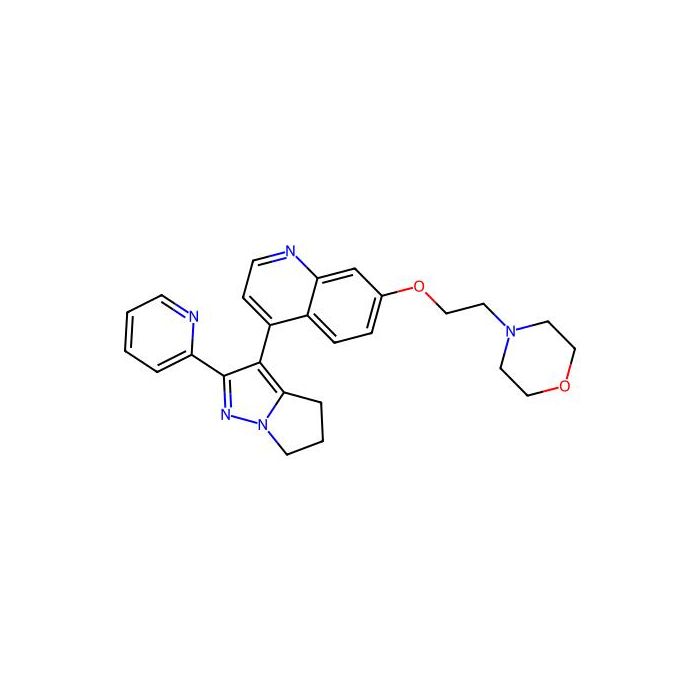
Product name: LY2109761 (SKU: L1495300)
CAS: 700874-71-1
PubChem CID: 11655119
InChIKey: Not specified for this item; refer to CoA/Spec Sheet.
SMILES: Not specified for this item; refer to CoA/Spec Sheet.
Molecular formula: Not specified for this item; refer to CoA/Spec Sheet.
Molecular weight: Not specified for this item; refer to CoA/Spec Sheet.
General structural notes (literature):
LY2109761 is widely described in the literature as a small‑molecule kinase inhibitor targeting the TGF-β receptor family. Detailed atom connectivity, stereochemistry, and salt/solvate state may vary by supplier and lot; consult the item’s CoA for definitive identity parameters.
Without supplier-confirmed structure strings, do not construct internal reference structures or analytical methods from third-party depictions. Use the Certificate of Analysis for definitive identity markers (e.g., 1H/13C NMR, HRMS).
Synthetic Utility
Not typically applicable. LY2109761 is supplied as a finalized small-molecule ligand for biological research rather than as a synthetic building block. If derivatization, tagging (e.g., biotinylation/fluorophore conjugation), or immobilization is desired for chemoproteomics or assay development, consult the primary literature for functional handles on this scaffold and develop route-specific protection/deprotection strategies. Item-specific functional group details and reactivity are not specified for this item; refer to the CoA/Spec Sheet and perform feasibility studies on small scale.
Target Specificity
Item-specific target, epitope, clone/isotype, or species reactivity information is not applicable and not provided for this small-molecule product. For literature-reported biochemical targets and selectivity profiles of LY2109761, consult primary publications and independent databases. For this catalog item, target specificity data are Not specified for this item; refer to CoA/Spec Sheet.
We use cookies to ensure the website functions properly and, where permitted, to improve your experience. You can manage your preferences at any time in Settings. Learn more in our Cookie Policy.
Shall we send you a message when we have discounts available?
Remind me later
Thank you! Please check your email inbox to confirm.
Products are supplied to verified businesses, institutions, and qualified professionals for research and development use only. Not for use in humans, animals, diagnosis, or therapy.