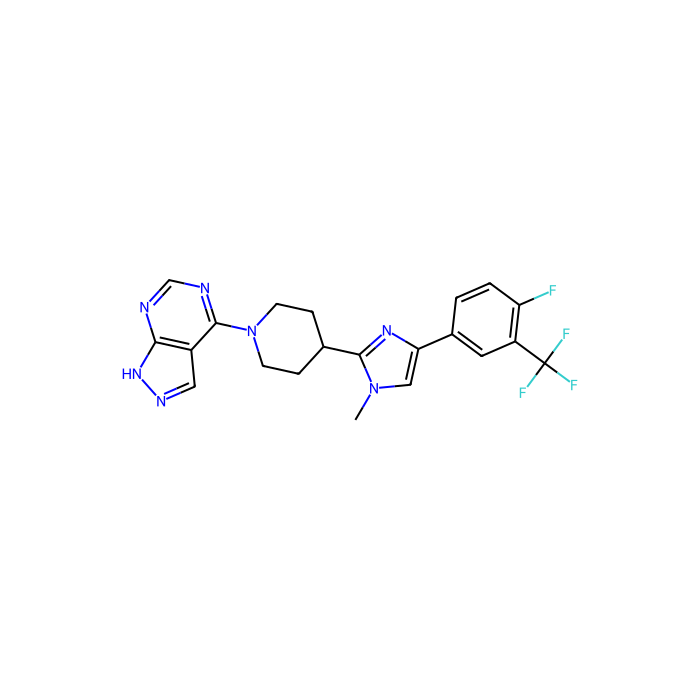
LY2584702 - Moligand™, ≥98% , Ribosomal protein S6 kinase 1 inhibitor, CAS No.1082949-67-4, Ribosomal protein S6 kinase 1 inhibitor

CAS: 1082949-67-4 Cat. No.: L413817 Formula: C21H19F4N7 Peso molecolare: 445.42
Disponibile su ordine
QUALITÀ & PUREZZA Moligand™ ? Moligand™ — Aladdin's line of ligands and bioactive small molecules. Use for receptor, pathway, and binding studies needing defined small-molecule tools. ≥98%
Synonyms
LY-2584702 free base|LY 2584702|Tris-N-lost (Salt/Mix)|1H-Pyrazolo(3,4-d)pyrimidine, 4-(4-(4-(4-fluoro-3-(trifluoromethyl)phenyl)-1-methyl-1H-imidazol-2-yl)-1-piperidinyl)-|TRICLOSAN (USP MONOGRAPH)|4-{-4-[4-(4-Fluoro-3-trifluoromethyl-phenyl)-1-methyl-1H-imidazol-2-yl]-piperidin-1-yl}-1H-pyrazolo[3,4-d]pyrimidine|4-{4-[4-(4-fluoro-3-trifluoromethyl-phenyl)-1-methyl-1H-imidazol-2-yl]-piperidin-1-yl}-1H-pyrazolo[3,4-d]pyrimidine|4-(4-(4-(4-Fluoro-3-(trifluoromethyl)phenyl)-1-methyl-1H-imidazol-2-yl)piperidin-1-yl)-1H-pyrazolo[3,4-d]pyrimidine|4-[4-[4-[4-fluoro-3-(trifluoromethyl)phenyl]-1-methylimidazol-2-yl]piperidin-1-yl]-1H-pyrazolo[3,4-d]pyrimidine|LY2584702|LY-2584702
Storage
Store at -20°C
Shipped In
Ice chest + Ice pads
★
Dimensione
Germania (EU)
USA*
Prezzo
Qtà
5mg
L413817-5mg
—
3 Disponibile
84,08€
25mg
L413817-25mg
—
3 Disponibile
268,91€
100mg
L413817-100mg
—
3 Disponibile
774,80€
Enter a quantity for the sizes you want to add.

Panoramica

Information

LY2584702 LY2584702 is a selective, ATP-competitive p70S6K inhibitor with IC50 of 4 nM. Phase 1.


Targets

p70S6K 4 nM


In vitro

In HCT116 colon cancer cells, LY2584702 inhibits phosphorylation of the S6 ribosomal protein (pS6) with IC50 of 0.1-0.24 μM. LY2584702 has significant synergistic effects when combined with EGFR inhibitor erlotinib or with the mTOR inhibitor everolimus.


In vivo

LY2584702 (12.5 mg/kg BID), demonstrates significant antitumor efficacy in both U87MG glioblastoma and HCT116 colon carcinoma xenograft models.

Specifiche

Sinonimi
LY-2584702 free base | LY 2584702 | Tris-N-lost (Salt/Mix) | 1H-Pyrazolo(3,4-d)pyrimidine, 4-(4-(4-(4-fluoro-3-(trifluoromethyl)phenyl)-1-methyl-1H-imidazol-2-yl)-1-piperidinyl)- | TRICLOSAN (USP MONOGRAPH) | 4-{-4-[4-(4-Fluoro-3-trifluoromethyl-phenyl)-1-methyl-1H-imidazol-2-yl]-piperidin-1-yl}-1H-pyrazolo[3,4-d]pyrimidine | 4-{4-[4-(4-f Mostra altro
Specifiche e purezza
Moligand™, ≥98%
Meccanismi biochimici e fisiologici
LY2584702 is a selective, ATP-competitive p70S6K inhibitor with IC50 of 4 nM. Phase 1.
Condizioni di conservazione di stoccaggio
Store at -20°C
Spedito in
Ice chest + Ice pads
Questo prodotto richiede spedizione a catena fredda. I servizi di terra e altri servizi economici non sono disponibili.
Grado
Moligand™
Tipo di azione
INHIBITOR
Meccanismo d'azione
Ribosomal protein S6 kinase 1 inhibitor
Purezza
≥98%
Proprietà del prodotto
ALogP
4.18
hba_count
4
Conteggio HBD
1
Legame rotabile
4
Nomi e identificatori
Pubchem Sid
Pubchem Sid Url
https://pubchem.ncbi.nlm.nih.gov/substance/504769974
SMILES
CN1C=C(N=C1C2CCN(CC2)C3=NC=NC4=C3C=NN4)C5=CC(=C(C=C5)F)C(F)(F)F
IUPAC Name
4-[4-[4-[4-fluoro-3-(trifluoromethyl)phenyl]-1-methylimidazol-2-yl]piperidin-1-yl]-1H-pyrazolo[3,4-d]pyrimidine
InChIKey
FYXRSVDHGLUMHB-UHFFFAOYSA-N
InChI
1S/C21H19F4N7/c1-31-10-17(13-2-3-16(22)15(8-13)21(23,24)25)29-19(31)12-4-6-32(7-5-12)20-14-9-28-30-18(14)26-11-27-20/h2-3,8-12H,4-7H2,1H3,(H,26,27,28,30)
Isomeri SMILES
CN1C=C(N=C1C2CCN(CC2)C3=NC=NC4=C3C=NN4)C5=CC(=C(C=C5)F)C(F)(F)F
Peso molecolare
445.42
Reaxys
18671704
Reaxys-RN_link_address
https://www.reaxys.com/reaxys/secured/hopinto.do?context=S&query=IDE.XRN=18671704&ln=

Dati avanzati

Taxonomic Classification

Taxonomy Tree

KingdomOrganic compounds
SuperclassOrganoheterocyclic compounds
ClasseAzoles
SubclassImidazoles
Intermediate Tree Nodes Substituted imidazoles
Direct ParentPhenylimidazoles
Alternative Parents Trifluoromethylbenzenes  Pyrazolo[3,4-d]pyrimidines  1,2,4-trisubstituted imidazoles  Dialkylarylamines  Aminopyrimidines and derivatives  Fluorobenzenes  Piperidines  N-substituted imidazoles  Imidolactams  Aryl fluorides  Pyrazoles  Heteroaromatic compounds  Azacyclic compounds  Hydrocarbon derivatives  Organofluorides  Alkyl fluorides  Organopnictogen compounds  
Molecular FrameworkAromatic heteropolycyclic compounds
Substituents 5-phenylimidazole - 4-phenylimidazole - Trifluoromethylbenzene - Pyrazolo[3,4-d]pyrimidine - Pyrazolopyrimidine - 1,2,4-trisubstituted-imidazole - Dialkylarylamine - Trisubstituted imidazole - Aminopyrimidine - Fluorobenzene - Halobenzene - Aryl fluoride - Aryl halide - Monocyclic benzene moiety - N-substituted imidazole - Imidolactam - Piperidine - Benzenoid - Pyrimidine - Heteroaromatic compound - Pyrazole - Azacycle - Organohalogen compound - Organopnictogen compound - Hydrocarbon derivative - Organofluoride - Organonitrogen compound - Organic nitrogen compound - Alkyl fluoride - Alkyl halide - Aromatic heteropolycyclic compound
DescrizioneThis compound belongs to the class of organic compounds known as phenylimidazoles. These are polycyclic aromatic compounds containing a benzene ring linked to an imidazole ring through a CC or CN bond.
External Descriptors Not available
Struttura 3D
Modello di struttura chimica interattiva


Obiettivi associati (umani)
RPS6KB1 Tchem Ribosomal protein S6 kinase beta-1 (3 Activities)
Activity TypeActivity Value -log(M)Mechanism of ActionActivity ReferencePublications (PubMed IDs)
ABL1 Tclin Tyrosine-protein kinase ABL (18331 Activities)
Activity TypeRelationActivity valueUnitsAction TypeJournalPubMed IddoiAssay Aladdin ID
EGFR Tclin Epidermal growth factor receptor erbB1 (33727 Activities)
Activity TypeRelationActivity valueUnitsAction TypeJournalPubMed IddoiAssay Aladdin ID
INSR Tclin Insulin receptor (5558 Activities)
Activity TypeRelationActivity valueUnitsAction TypeJournalPubMed IddoiAssay Aladdin ID
IMPDH2 Tclin Inosine-5'-monophosphate dehydrogenase 2 (1326 Activities)
Activity TypeRelationActivity valueUnitsAction TypeJournalPubMed IddoiAssay Aladdin ID
KCNH2 Tclin HERG (29587 Activities)
Activity TypeRelationActivity valueUnitsAction TypeJournalPubMed IddoiAssay Aladdin ID
PDGFRB Tclin Platelet-derived growth factor receptor beta (5195 Activities)
Activity TypeRelationActivity valueUnitsAction TypeJournalPubMed IddoiAssay Aladdin ID
IGF1R Tclin Insulin-like growth factor I receptor (8605 Activities)
Activity TypeRelationActivity valueUnitsAction TypeJournalPubMed IddoiAssay Aladdin ID
DCK Tchem Deoxycytidine kinase (530 Activities)
Activity TypeRelationActivity valueUnitsAction TypeJournalPubMed IddoiAssay Aladdin ID
MAPK11 Tchem MAP kinase p38 beta (2785 Activities)
Activity TypeRelationActivity valueUnitsAction TypeJournalPubMed IddoiAssay Aladdin ID
LCK Tclin Tyrosine-protein kinase LCK (9212 Activities)
Activity TypeRelationActivity valueUnitsAction TypeJournalPubMed IddoiAssay Aladdin ID
NQO2 Tchem Quinone reductase 2 (885 Activities)
Activity TypeRelationActivity valueUnitsAction TypeJournalPubMed IddoiAssay Aladdin ID
ADK Tchem Adenosine kinase (1481 Activities)
Activity TypeRelationActivity valueUnitsAction TypeJournalPubMed IddoiAssay Aladdin ID
MAPK14 Tchem MAP kinase p38 alpha (12866 Activities)
Activity TypeRelationActivity valueUnitsAction TypeJournalPubMed IddoiAssay Aladdin ID
AK2 Tbio Adenylate kinase 2 (264 Activities)
Activity TypeRelationActivity valueUnitsAction TypeJournalPubMed IddoiAssay Aladdin ID
GSK3B Tclin Glycogen synthase kinase-3 beta (11785 Activities)
Activity TypeRelationActivity valueUnitsAction TypeJournalPubMed IddoiAssay Aladdin ID
PRKACB Tchem cAMP-dependent protein kinase beta-1 catalytic subunit (589 Activities)
Activity TypeRelationActivity valueUnitsAction TypeJournalPubMed IddoiAssay Aladdin ID
MAP2K6 Tchem Dual specificity mitogen-activated protein kinase kinase 6 (1284 Activities)
Activity TypeRelationActivity valueUnitsAction TypeJournalPubMed IddoiAssay Aladdin ID
MYLK Tchem Myosin light chain kinase, smooth muscle (1267 Activities)
Activity TypeRelationActivity valueUnitsAction TypeJournalPubMed IddoiAssay Aladdin ID
CSNK1G1 Tchem Casein kinase I gamma 1 (2496 Activities)
Activity TypeRelationActivity valueUnitsAction TypeJournalPubMed IddoiAssay Aladdin ID
FGFR1 Tclin Fibroblast growth factor receptor 1 (9149 Activities)
Activity TypeRelationActivity valueUnitsAction TypeJournalPubMed IddoiAssay Aladdin ID
STK3 Tchem Serine/threonine-protein kinase MST2 (3069 Activities)
Activity TypeRelationActivity valueUnitsAction TypeJournalPubMed IddoiAssay Aladdin ID
PRKAG1 Tchem AMP-activated protein kinase, gamma-1 subunit (254 Activities)
Activity TypeRelationActivity valueUnitsAction TypeJournalPubMed IddoiAssay Aladdin ID
CSNK1D Tchem Casein kinase I delta (4546 Activities)
Activity TypeRelationActivity valueUnitsAction TypeJournalPubMed IddoiAssay Aladdin ID
MAP2K5 Tchem Dual specificity mitogen-activated protein kinase kinase 5 (650 Activities)
Activity TypeRelationActivity valueUnitsAction TypeJournalPubMed IddoiAssay Aladdin ID
SRC Tclin Tyrosine-protein kinase SRC (10310 Activities)
Activity TypeRelationActivity valueUnitsAction TypeJournalPubMed IddoiAssay Aladdin ID
MAP2K3 Tchem Dual specificity mitogen-activated protein kinase kinase 3 (632 Activities)
Activity TypeRelationActivity valueUnitsAction TypeJournalPubMed IddoiAssay Aladdin ID
CDK6 Tclin Cyclin-dependent kinase 6 (1724 Activities)
Activity TypeRelationActivity valueUnitsAction TypeJournalPubMed IddoiAssay Aladdin ID
PRKAG2 Tchem AMP-activated protein kinase, gamma-2 subunit (243 Activities)
Activity TypeRelationActivity valueUnitsAction TypeJournalPubMed IddoiAssay Aladdin ID
AKT2 Tchem Serine/threonine-protein kinase AKT2 (4301 Activities)
Activity TypeRelationActivity valueUnitsAction TypeJournalPubMed IddoiAssay Aladdin ID
AKT3 Tchem Serine/threonine-protein kinase AKT3 (3157 Activities)
Activity TypeRelationActivity valueUnitsAction TypeJournalPubMed IddoiAssay Aladdin ID
GRK2 Tchem G-protein coupled receptor kinase 2 (1019 Activities)
Activity TypeRelationActivity valueUnitsAction TypeJournalPubMed IddoiAssay Aladdin ID
PYGB Tchem Brain glycogen phosphorylase (474 Activities)
Activity TypeRelationActivity valueUnitsAction TypeJournalPubMed IddoiAssay Aladdin ID
AURKB Tchem Serine/threonine-protein kinase Aurora-B (6805 Activities)
Activity TypeRelationActivity valueUnitsAction TypeJournalPubMed IddoiAssay Aladdin ID
RPS6KA4 Tchem Ribosomal protein S6 kinase alpha 4 (2104 Activities)
Activity TypeRelationActivity valueUnitsAction TypeJournalPubMed IddoiAssay Aladdin ID
ROCK1 Tclin Rho-associated protein kinase 1 (4723 Activities)
Activity TypeRelationActivity valueUnitsAction TypeJournalPubMed IddoiAssay Aladdin ID
PIM1 Tchem Serine/threonine-protein kinase PIM1 (9629 Activities)
Activity TypeRelationActivity valueUnitsAction TypeJournalPubMed IddoiAssay Aladdin ID
PKN2 Tchem Protein kinase N2 (1991 Activities)
Activity TypeRelationActivity valueUnitsAction TypeJournalPubMed IddoiAssay Aladdin ID
CSK Tchem Tyrosine-protein kinase CSK (2395 Activities)
Activity TypeRelationActivity valueUnitsAction TypeJournalPubMed IddoiAssay Aladdin ID
RPS6KA5 Tchem Ribosomal protein S6 kinase alpha 5 (3355 Activities)
Activity TypeRelationActivity valueUnitsAction TypeJournalPubMed IddoiAssay Aladdin ID
PRKD3 Tchem Protein kinase C nu (2315 Activities)
Activity TypeRelationActivity valueUnitsAction TypeJournalPubMed IddoiAssay Aladdin ID
PRKCI Tchem Protein kinase C iota (2821 Activities)
Activity TypeRelationActivity valueUnitsAction TypeJournalPubMed IddoiAssay Aladdin ID
SYK Tclin Tyrosine-protein kinase SYK (7372 Activities)
Activity TypeRelationActivity valueUnitsAction TypeJournalPubMed IddoiAssay Aladdin ID
JAK1 Tclin Tyrosine-protein kinase JAK1 (8569 Activities)
Activity TypeRelationActivity valueUnitsAction TypeJournalPubMed IddoiAssay Aladdin ID
RPS6KA1 Tchem Ribosomal protein S6 kinase alpha 1 (2796 Activities)
Activity TypeRelationActivity valueUnitsAction TypeJournalPubMed IddoiAssay Aladdin ID
RPS6KA6 Tchem Ribosomal protein S6 kinase alpha 6 (2027 Activities)
Activity TypeRelationActivity valueUnitsAction TypeJournalPubMed IddoiAssay Aladdin ID
PFKP Tbio Phosphofructokinase platelet type (224 Activities)
Activity TypeRelationActivity valueUnitsAction TypeJournalPubMed IddoiAssay Aladdin ID
CSNK1E Tclin Casein kinase I epsilon (1412 Activities)
Activity TypeRelationActivity valueUnitsAction TypeJournalPubMed IddoiAssay Aladdin ID
CAMK4 Tbio CaM kinase IV (2116 Activities)
Activity TypeRelationActivity valueUnitsAction TypeJournalPubMed IddoiAssay Aladdin ID
GSK3A Tclin Glycogen synthase kinase-3 alpha (3764 Activities)
Activity TypeRelationActivity valueUnitsAction TypeJournalPubMed IddoiAssay Aladdin ID
PRKG1 Tchem cGMP-dependent protein kinase 1 beta (2814 Activities)
Activity TypeRelationActivity valueUnitsAction TypeJournalPubMed IddoiAssay Aladdin ID
Obiettivi associati (non umani)
Cdk4 Cyclin-dependent kinase 4 (3 Activities)
Activity TypeRelationActivity valueUnitsAction TypeJournalPubMed IddoiAssay Aladdin ID
Pygl Liver glycogen phosphorylase (81 Activities)
Activity TypeRelationActivity valueUnitsAction TypeJournalPubMed IddoiAssay Aladdin ID
Prkcd Protein kinase C delta (192 Activities)
Activity TypeRelationActivity valueUnitsAction TypeJournalPubMed IddoiAssay Aladdin ID
Prkcb Protein kinase C beta (2 Activities)
Activity TypeRelationActivity valueUnitsAction TypeJournalPubMed IddoiAssay Aladdin ID
Mapk1 MAP kinase ERK2 (650 Activities)
Activity TypeRelationActivity valueUnitsAction TypeJournalPubMed IddoiAssay Aladdin ID
Hdac6 Histone deacetylase 6 (222 Activities)
Activity TypeRelationActivity valueUnitsAction TypeJournalPubMed IddoiAssay Aladdin ID
Camk2g CaM kinase II gamma (1 Activities)
Activity TypeRelationActivity valueUnitsAction TypeJournalPubMed IddoiAssay Aladdin ID
Tec Tyrosine-protein kinase TEC (25 Activities)
Activity TypeRelationActivity valueUnitsAction TypeJournalPubMed IddoiAssay Aladdin ID
AIRC Multifunctional protein ADE2 (8 Activities)
Activity TypeRelationActivity valueUnitsAction TypeJournalPubMed IddoiAssay Aladdin ID
rep Replicase polyprotein 1ab (378 Activities)
Activity TypeRelationActivity valueUnitsAction TypeJournalPubMed IddoiAssay Aladdin ID
Septin9 Septin-9 (1 Activities)
Activity TypeRelationActivity valueUnitsAction TypeJournalPubMed IddoiAssay Aladdin ID
Acadvl Very long-chain specific acyl-CoA dehydrogenase, mitochondrial (1 Activities)
Activity TypeRelationActivity valueUnitsAction TypeJournalPubMed IddoiAssay Aladdin ID
Meccanismi d'azione
Certificati (CoA, COO, BSE/TSE e tabella di analisi)
C of A & Other Certificates(BSE/TSE, COO):
Analytical Chart:

Find and download the COA for your product by matching the lot number on the packaging.

4 results found

Lot NumberCertificate TypeDataOggetto
C2503387C2503387Certificate of AnalysisJun 20, 2022 L413817
I2208970I2208970Certificate of AnalysisJun 20, 2022 L413817
I2208971I2208971Certificate of AnalysisJun 20, 2022 L413817
I2208972I2208972Certificate of AnalysisJun 20, 2022 L413817
Proprietà chimiche e fisiche
SolubilitàSolubility (25°C) In vitro DMSO: 4.44 mg/mL warmed with 50ºC Water: bath (9.96 mM); Water: Insoluble; Ethanol: Insoluble;
DMSO (mg/mL) Solubilità massima1
DMSO (mM) Solubilità massima2.245072067
Acqua (mg/mL) Solubilità massima<1
Peso molecolare445.4
XLogP33.600
Hydrogen Bond Donor Count1
Hydrogen Bond Acceptor Count9
Rotatable Bond Count3
Exact Mass445.164 Da
Monoisotopic Mass445.164 Da
Topological Polar Surface Area75.500 Ų
Heavy Atom Count32
Formal Charge0
Complexity644.000
Isotope Atom Count0
Defined Atom Stereocenter Count0
Undefined Atom Stereocenter Count0
Defined Bond Stereocenter Count0
Undefined Bond Stereocenter Count0
The total count of all stereochemical bonds0
Covalently-Bonded Unit Count1
Sicurezza e pericoli (GHS)
Pictogrammi
Segnale
Warning
Indicazioni di pericolo

H315:Causes skin irritation

H319:Causes serious eye irritation

H335:May cause respiratory irritation

Precauzioni

P261:Avoid breathing dust/fume/gas/mist/vapors/spray.

P280:Wear protective gloves/protective clothing/eye protection/face protection.

P305+P351+P338:IF IN EYES: Rinse cautiously with water for several minutes. Remove contact lenses if present and easy to do - continue rinsing.

Reaxys
18671704
Reaxys-RN_link_address
https://www.reaxys.com/reaxys/secured/hopinto.do?context=S&query=IDE.XRN=18671704&ln=
Calcolatori di soluzioni
Recensioni

Recensioni dei clienti

Application Protocols

No vendor-validated application protocols are provided for this item in the product data.

What is not specified for this item:

  • Tested applications (e.g., enzymatic inhibition, receptor binding, cell-based assays): Not specified for this item; refer to CoA/Spec Sheet.
  • Recommended working concentrations or dilution series: Not specified for this item; determine empirically.
  • Positive controls, vehicle controls, or plate maps: Not specified for this item; establish per laboratory SOPs.

General reminder:

  • Standard practice for small-molecule ligands involves preparing DMSO stock solutions, performing serial dilutions to generate concentration–response curves, and including vehicle-matched controls. However, these are general practices and not item-specific recommendations.
Biological Roles

This listing does not provide target, pathway, or mechanistic information for LY2584702. Therefore, no specific biological role can be stated in this context.

General context for small-molecule research ligands (non-item-specific):

  • Screening ligands are used to probe protein function, validate targets, and support structure–activity relationship (SAR) studies in discovery research.
  • Biophysical methods (e.g., SPR, ITC, DSF) and biochemical/cellular assays are commonly employed to assess binding and functional effects. Orthogonal readouts help deconvolute off-target or assay-interference liabilities.
  • ADME profiling (solubility, stability, permeability, metabolic liability) may be performed to contextualize observed activity; such data are not provided for this item and should be generated as needed.

Caveats:

  • Without item-specific target data, this compound should be treated as a generic research tool pending user validation.
  • Avoid making biological or therapeutic inferences without corroborating literature and internal controls.

Research Use Note (from Product Data):

  • For research use only.
Buffer Applications

Not typically applicable. LY2584702 is a small-molecule ligand and not a buffering agent.

Practical considerations for assay buffers (general):

  • Choose buffers (e.g., HEPES, PBS, Tris) that are compatible with the biological target and assay modality.
  • Maintain consistent ionic strength and pH across wells; control for organic co-solvent (e.g., DMSO) by matching vehicle concentrations.
  • Pre-dissolve the compound in DMSO before dilution into buffer to minimize precipitation; add slowly with mixing.

Item-specific buffer capacity, pKa, or solution behavior: Not specified for this item; refer to CoA/Spec Sheet and verify empirically during assay development.

Green Alternatives

Because this item is a finished small-molecule ligand rather than a reaction solvent or bulk reagent, “green alternatives” primarily concern solvent choices for dissolution and assay preparation rather than substituting the compound itself.

Greener handling considerations (general):

  • Prefer aqueous buffers with minimal organic co-solvent after preparing a concentrated DMSO stock. Keep final DMSO at the lowest level compatible with solubility and target tolerance (e.g., ≤0.5–1% v/v where feasible).
  • If organic co-solvents are necessary, ethanol is often more benign than DMF or acetonitrile for biological systems; verify target compatibility.
  • Use microvolume, high-concentration stocks to reduce solvent consumption and waste.

Comparison (general guidance):

  • DMSO vs DMF/ACN: DMSO offers broader solvency and typically lower acute toxicity in biological assays, enabling lower final concentrations.
  • Ethanol vs isopropanol: Ethanol is commonly preferred for lower toxicity and better regulatory acceptance in labs.

Operational green tips:

  • Implement plate-based miniaturization (e.g., 384/1536-well formats) to reduce total solvent use.
  • Adopt sealed storage (inert atmosphere where indicated) to extend solution life and limit evaporative losses.

Note: No compound-specific environmental fate or degradability data are provided here. Consult the SDS and institutional EHS for waste minimization and disposal strategies.

Pharmaceutical Uses

No pharmacopeial status or excipient role is claimed for this listing. The product is designated Research Use Only and is not intended for human or veterinary applications.

General context (non-item-specific) relevant to discovery labs:

  • Screening/reference standards: Small molecules like this are often used as internal standards or reference comparators in discovery-stage assays and analytical method development.
  • Preformulation research: Limited solubility/stability assessments may be performed to support in vitro studies (e.g., cosolvent screening, pH-solubility profiling), but such data are not provided here and must be generated by the user.
  • CMC relevance: If used as a tool compound in enabling studies, document the exact salt/form and purity to ensure reproducibility.

Strict limitations:

  • Not for diagnostic use, not for therapeutic use, and not for API or GMP manufacturing.
  • No medical or clinical claims are made or implied.
Physical Properties

Item-specific physicochemical data are not included in this listing. Use the lot-specific CoA/SDS or trusted databases for exact values.

  • Appearance: Not specified for this item; refer to CoA/Spec Sheet.
  • Melting point (MP): Not specified for this item; refer to CoA/Spec Sheet.
  • Boiling point (BP): Not specified for this item; refer to CoA/Spec Sheet.
  • Density: Not specified for this item; refer to CoA/Spec Sheet.
  • LogP/logD: Not specified for this item; refer to CoA/Spec Sheet.
  • pKa: Not specified for this item; refer to CoA/Spec Sheet.
  • Refractive index: Not applicable for solids; Not specified for this item; refer to CoA/Spec Sheet if liquid.
  • Solubility: Not specified for this item; refer to CoA/Spec Sheet. For small-molecule screening compounds, DMSO is commonly used to prepare stock solutions (see Storage & Reconstitution).

General guidance (literature/practice):

  • Small-molecule ligands are frequently provided as crystalline solids or amorphous powders with variable aqueous solubility; DMSO stocks (e.g., 10–50 mM) are typical for assay use.
  • If light-sensitive chromophores are present (unknown here), protect solutions from light to minimize degradation.
  • Hygroscopicity or polymorphism, if relevant, will be noted on the CoA; check these to guide weighing, drying, and solution preparation.

Note: Do not treat the above general practices as specifications. Always defer to the delivered lot’s CoA for binding values, purity profile, and handling characteristics.

Quality and Grades

Grade/Purity: Moligand™ (research ligand/small-molecule screening grade).

What Moligand™ typically implies (general description; verify on CoA):

  • Intended for medicinal chemistry, target screening, and SAR studies rather than for clinical or GMP applications.
  • Identity and purity are commonly verified by orthogonal analytical methods (e.g., LC–MS, 1H NMR). Exact acceptance criteria and methods are lot-specific; consult the CoA.
  • Impurity profile and salt/solvate form, if applicable, are documented on the CoA/Spec Sheet.

Item-specific notes from this listing:

  • Declared purity value, water/peroxide content, residual metals, and UV cutoff are Not specified for this item; refer to CoA/Spec Sheet.
  • Stabilizers/inhibitors: Not specified for this item; refer to CoA/Spec Sheet.

Practical guidance for assay work:

  • For bioassays and screening, ensure lot purity and counter-ion form are compatible with target biology (e.g., avoid unintended cations/anions that affect activity or solubility).
  • Record the exact lot number, purity, and salt form in ELNs/LIMS to maintain data integrity in SAR campaigns.

Regulatory note:

  • Research Use Only (RUO). Not intended for diagnostic, therapeutic, or human/animal consumption. No pharmacopeial status is claimed in this listing.
Reaction and Applications

This product is supplied as a small-molecule research ligand rather than as a synthetic reagent. Consequently, it is not typically used as a stoichiometric reagent or catalyst in preparative organic reactions.

Most relevant use-cases (research context):

  • As a reference or screening compound in biochemical, biophysical, or cellular assays to evaluate target engagement, potency ranking, or preliminary SAR.
  • Tool compound for mechanism-of-action exploration in discovery workflows, subject to target validation and appropriate controls.

If used in chemistry workflows (general, non-specific):

  • Analytical characterization: LC–MS, 1H/13C NMR, and HRMS are standard to confirm identity prior to biological testing.
  • Formulation for assays: Prepare DMSO stock (e.g., 10–50 mM) followed by serial dilution into assay buffer; maintain consistent final DMSO across experimental and control wells.

Not applicable here:

  • Named synthetic reactions (e.g., cross-couplings, Grignard) are not generally relevant to this finished ligand product and are not recommended use-cases.

Important: No target, pathway, or mechanism details are specified in this listing. Users should rely on their own validations and literature sources corresponding to the CAS/CID when designing biological experiments.

Reaction Conditions

Not applicable to this product’s primary use. LY2584702 is provided as a completed small-molecule ligand, not as a reagent for performing named organic reactions.

For laboratory handling and solution preparation (general best practices):

  • Stock solutions: Prepare at high concentration in DMSO (e.g., 10–50 mM) to minimize solvent carryover into assays; exact solubility must be established empirically.
  • Dilution: Add DMSO stocks to buffered media with vigorous mixing to avoid local supersaturation and precipitation. Maintain constant vehicle percentage across controls and treated samples.
  • Stability: Keep on ice during extended setup if thermal sensitivity is suspected; protect from light when appropriate. Confirm solution stability over experimental timeframes by LC–MS or UV–Vis as needed.

No item-specific temperatures, catalysts, or reaction times are applicable or provided for this listing.

Safety and Handling

Safety information is not fully specified in this listing; consult the SDS for authoritative guidance before use.

  • GHS classification: Not specified for this item; refer to SDS.
  • Signal word: Not specified for this item; refer to SDS.
  • Hazard (H) statements: Not specified for this item; refer to SDS.
  • Pictograms: Not specified for this item; refer to SDS.

General laboratory precautions (good practice):

  • Engineering controls: Work in a fume hood when weighing or preparing solutions to avoid inhalation of dusts or aerosols.
  • PPE: Lab coat, safety glasses, and appropriate chemically resistant gloves (e.g., nitrile). Consider double-gloving for extended handling of DMSO solutions.
  • Avoid ingestion, inhalation, and skin contact. Wash thoroughly after handling.
  • Incompatibilities: Avoid strong oxidizers and strong acids/bases unless compatibility is confirmed from SDS. Do not mix with reactive metals or reducing agents without a risk assessment.
  • Thermal/light sensitivity: If the compound is potentially photosensitive or thermally labile (unknown here), minimize exposure to heat and ambient light during handling and storage.

First aid (overview; defer to SDS):

  • Skin/eye contact: Rinse with water for at least 15 minutes; remove contaminated clothing.
  • Inhalation: Move to fresh air; seek medical advice if symptoms persist.
  • Ingestion: Rinse mouth; seek medical attention.

Waste disposal:

  • Collect solutions and solids as organic hazardous waste per institutional and regulatory requirements. Avoid drain disposal.

Shipping and storage conditions from Product Data:

  • Shipped in: Ice chest + ice pads.
  • Storage: Store at −20°C.
Solvent Selection

This item’s solubility profile is not specified; typical practice for small-molecule ligands is to use high-purity DMSO for primary stock solutions, with aqueous buffer dilution as needed for assays.

General solvent guidance (best practices for screening compounds):

  • Primary stock solvent: DMSO (anhydrous or low-water content) is preferred due to broad solvency and biocompatibility in low final assay percentages (e.g., ≤0.5–1% v/v).
  • Co-solvents: If required for kinetic or spectroscopic assays, water-miscible options like ethanol or acetonitrile may be used at low percentages, subject to target tolerance.
  • Buffered systems: Dilute DMSO stocks into assay buffers (e.g., HEPES, PBS) with gentle mixing. Pre-wet tips/vials with buffer to minimize adsorption losses for lipophilic compounds.

Solvent comparison (general):

  • DMSO: Highest solvency for diverse chemotypes; biologically tolerated at low %.
  • DMF/ACN: Good solvency, but higher cytotoxicity; use sparingly in biological assays.
  • Ethanol: Moderate solvency; often acceptable up to ~0.5–1% v/v in enzyme/cell assays (verify target tolerance).
  • Aqueous buffers: Use after DMSO pre-dissolution; direct dissolution feasible only for sufficiently polar compounds.

Practical tips:

  • Warm gently (room temperature) and vortex/sonicate to aid dissolution. Avoid heating above ambient unless stability is known.
  • Filter sterilize (0.22 µm) only if the compound is stable and adsorption losses are acceptable; otherwise, prepare aseptically.
  • Always confirm compatibility with plastics or glassware; highly lipophilic or cationic compounds may adsorb to surfaces.
Storage and Reconstitution

From Product Data:

  • Storage conditions: Store at −20°C.
  • Shipped in: Ice chest + ice pads.

General best practices for small-molecule screening compounds (non-item-specific):

  • Reconstitution solvent: Use dry, high-purity DMSO for initial stock solutions unless item-specific solubility guidance indicates otherwise.
  • Stock concentration: Commonly 10–50 mM; determine the maximum soluble concentration empirically without visible particulates.
  • Aliquoting: Dispense into single-use or limited-use aliquots (e.g., 10–50 µL) in inert, low-bind tubes or 96/384-well source plates to avoid repeated freeze–thaw cycles.
  • Freeze–thaw: Minimize cycles; thaw on ice or at room temperature, mix gently, and promptly return unused aliquots to −20°C.
  • Light/air sensitivity: If the compound is potentially photosensitive or air-sensitive (unknown here), store under inert gas (N2/Ar) and protect from light (amber vials/foil).
  • Aqueous working solutions: Prepare fresh on the day of use when possible. Keep on ice for extended setups and filter only if adsorption losses are acceptable.
  • Record keeping: Document lot number, preparation date, solvent, concentration, and storage conditions in ELN/LIMS.

Not specified for this item; refer to CoA/Spec Sheet:

  • Exact solubility limits, solution stability (t1/2) at room temperature/4°C, and any stabilizers or special handling notes.
Structure and Identity

Brief overview: LY2584702 is supplied as a small-molecule screening/ligand candidate under Aladdin’s Moligand™ line. Limited structural details are available in this listing; consult the CoA or public databases for full structure.

  • SKU: L413817
  • Product name: LY2584702 (research compound)
  • CAS: 1082949-67-4
  • PubChem CID: 25118925
  • InChIKey: 95823 (as provided in listing)
  • SMILES: Not specified for this item; refer to CoA/Spec Sheet.
  • Molecular formula: Not specified for this item; refer to CoA/Spec Sheet.
  • Molecular weight: Not specified for this item; refer to CoA/Spec Sheet.

Structural features (general notes):

  • Item-specific functional groups and stereochemistry are not provided in this listing. For structural verification and cheminformatics use (ring systems, heteroatoms, stereocenters), retrieve the canonical SMILES/InChI from the CoA or authoritative databases tied to the CAS/CID above.
  • 2D description in words: Not specified for this item; refer to CoA/Spec Sheet.

Identity assurance (general practice):

  • For Moligand™ items, identity is typically confirmed by orthogonal methods (e.g., LC–MS, 1H NMR, HRMS). Exact methods and acceptance criteria should be verified on the CoA for the delivered lot.
  • If integrating into informatics pipelines, cross-check CAS and CID mappings to avoid synonym collisions common to early-code compounds.
Synthetic Utility

Not typically applicable. LY2584702 is offered as a finished small-molecule research ligand and is not intended to serve as a starting material or reagent in synthetic transformations.

General notes (non-item-specific) if used in method development controls:

  • Analytical benchmarks: May serve as a test article for validating extraction, chromatographic separations, or mass spectrometric detection parameters in discovery workflows.
  • Derivatization for studies: If users elect to derivatize for probe development (e.g., biotinylation, photoaffinity tags), confirm structural handles and stability from primary structural data; such features are not provided in this listing and must be sourced from the CoA/literature.

Caution:

  • Do not infer functional group compatibility or reactive handles without confirmed structural information. Reaction conditions and yields cannot be recommended for this specific item due to lack of disclosed structure.
Target Specificity

Not specified for this item; refer to CoA/Spec Sheet and primary literature associated with CAS 1082949-67-4 or CID 25118925.

Notes:

  • No antigen/epitope, species reactivity, or binding target information is included in this product data.
  • Users should perform independent verification of target engagement using appropriate positive/negative controls and orthogonal methods (e.g., SPR, enzymatic assays, cellular readouts).

Domande frequenti

What is the purity of this product?
This product is supplied at ≥98% purity (chemical assay). Lot-specific values are stated on the Certificate of Analysis.
How should this product be stored?
Store at ?20 °C. Freezer storage is required to maintain the specified shelf life.
What is Moligand??
Moligand? is one of Aladdin Scientific's premium product lines, formulated for high-purity applications across multiple workflows. Compared to standard grades in the same workflow, Moligand? products typically offer tighter specifications, more rigorous QC, and stronger lot-to-lot consistency.
How is this product shipped?
This product ships in an insulated container with ice pads. Unpack on arrival and transfer it to the storage condition stated above.
What are the CAS number, molecular formula and molecular weight?
The CAS Number is 1082949-67-4, the molecular formula is C21H19F4N7, and the molecular weight is 445.42 g/mol. InChIKey FYXRSVDHGLUMHB-UHFFFAOYSA-N.
What documentation is provided?
Available product documentation, including Certificates of Analysis (COA), Safety Data Sheets (SDS), and specification sheets, is shown in the product document area. Document availability and access follow the current site policy.

Hai bisogno di aiuto per scegliere la qualità?

La nostra guida alla selezione delle qualità copre purezza, stato dello stabilizzatore e idoneità all'applicazione per tutte le varianti del nostro catalogo.

Visualizza la guida alle qualità Moligand™ →

Desidera che le inviamo un messaggio quando avremo sconti disponibili?

Ricordamelo più tardi

Grazie! Controlli la sua casella di posta per confermare.

Ops! Le notifiche sono disabilitate.