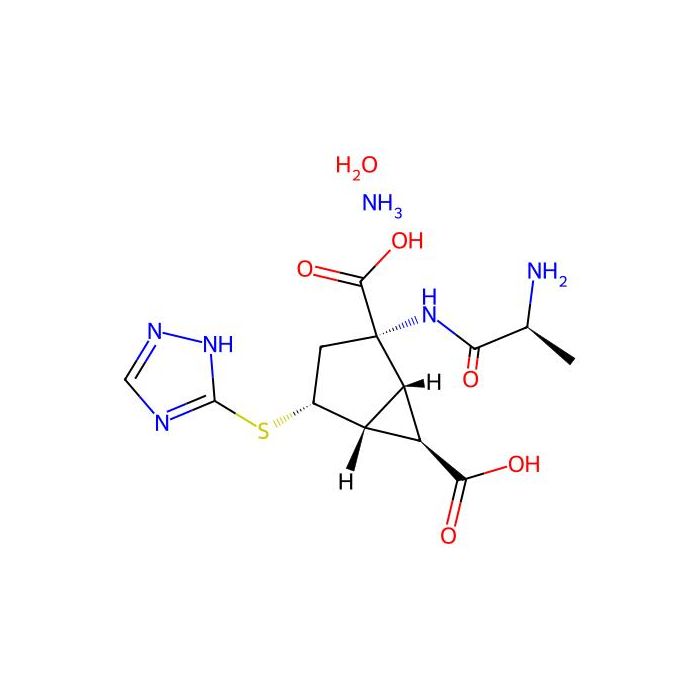
LY2979165 is the alanine proagent of 2812223, a selective and potent orthosteric mGlu2 receptor agonist
In Vivo
LY2979165 attenuated the ketamine-evoked BOLD phMRI signal in vivo. MCE has not independently confirmed the accuracy of these methods. They are for reference only.
IC50& Target:mGlu2 Receptor
Specifiche
Specifiche e purezza
10mM in Water
Meccanismi biochimici e fisiologici
LY2979165 is the alanine proagent of 2812223, a selective and potent orthosteric mGlu2 receptor agonist.
Condizioni di conservazione di stoccaggio
Desiccated,Store at -80°C
Spedito in
Dry ice packs + Cold packs
Questo prodotto richiede spedizione a catena fredda. I servizi di terra e altri servizi economici non sono disponibili.
Certificati (CoA, COO, BSE/TSE e tabella di analisi)
C of A & Other Certificates(BSE/TSE, COO):
Analytical Chart:
Calcolatori di soluzioni
Molarity Calculator
Determine the necessary mass, volume, or concentration for preparing a solution.
Dilution Calculator
Determine the dilution needed to prepare a stock solution.
Reconstitution Calculator
Recensioni
Recensioni dei clienti
Application Protocols
No vendor‑validated application protocols are supplied for LY2979165 in the current listing.
General example workflow (for small‑molecule screening; non‑item‑specific)
Stock preparation: Dissolve at 10 mM in anhydrous DMSO. Vortex and, if needed, sonicate briefly. Filter if particles remain and chemistry permits.
Plate handling: Dispense with acoustic or pin tools into assay plates to achieve ≤0.1–0.5% final DMSO. Include vehicle controls matched to the highest DMSO content.
Serial dilution: Prepare half‑log or 3‑fold dilution series across 10–12 points. Randomize plate positions to minimize edge effects.
Readouts: Select orthogonal readouts where possible (e.g., fluorescence and luminescence, or activity and biophysical binding) to rule out artifacts.
Data QC: Monitor Z’‑factor, signal windows, and Hill slopes. Confirm hits by independent re‑prep and fresh aliquots.
For any specialized application (WB, IHC, IF, FC, in vivo), no recommendations can be made without item‑specific validation; design and validate protocols internally.
Biological Roles
Item‑specific biological function, target, or pathway information for LY2979165 is not provided in the current listing.
General context (not item‑specific)
Small‑molecule tool compounds are used to probe biochemical pathways (e.g., kinase cascades, GPCR signaling, epigenetic regulation) by modulating protein activity, stability, or interactions. Their utility depends on potency, selectivity, cell permeability, and metabolic stability.
In cell systems, apparent effects can arise from polypharmacology or off‑target actions. Rigorous counterscreening, chemoproteomics, and structure–activity relationship (SAR) studies are recommended to attribute phenotypes to a defined mechanism.
For pathway assignment, integrate orthogonal readouts (transcriptomics/proteomics, reporter assays, phospho‑mapping) with chemical probes of distinct chemotypes to limit scaffold bias.
Important caveats
Without disclosed structure and target data, no assumptions should be made about the compound’s mode of action, permeability, or safety profile.
If used as a putative reference tool, verify identity and reported bioactivity from primary literature (cross‑checking by CAS 1311385‑32‑6 and CID 66577008) and reproduce key results under your assay conditions before reliance in mechanistic studies.
Buffer Applications
This product is a small organic research compound and is not a buffering agent. No buffer capacity or pKa information is provided.
Practical notes (general)
For biological assays, prepare stock solutions in DMSO and dilute into the assay buffer of choice (e.g., PBS, HEPES, Tris) ensuring final DMSO is compatible with the biology (commonly ≤0.1–0.5% v/v).
If precipitation occurs upon dilution, consider incremental titration, warming to 37 °C, or adding non‑ionic surfactant at low percentage per assay tolerance.
Do not rely on the compound to control pH; select an appropriate buffer system based on your assay’s pH requirements.
Green Alternatives
Because LY2979165 is a discrete research compound rather than a process solvent or reagent, “green alternative” considerations relate primarily to solvent use and handling practices rather than replacement of the compound itself.
Greener practice considerations (general)
Stock solutions: Prefer aqueous‑tolerant dissolution in DMSO, then dilute into buffered aqueous media to minimize use of chlorinated or high‑boiling aprotic solvents.
Analytical methods: Use water–MeCN or water–MeOH mobile phases with volatile buffers for LC–MS/UV to reduce toxic solvents.
Waste minimization: Miniaturize assay volumes (e.g., 384/1536 plates), standardize concentrations, and centralize compound management to lower solvent/waste footprint.
Energy use: Adhere to the specified −80 °C storage but consolidate freezers and maintain seals/defrost schedules to reduce energy burden.
Comparison of common stock solvents (general)
DMSO: Widely accepted; relatively benign but hygroscopic; compatible with aqueous dilution—often the most practical green choice for discovery.
DMF/NMP: Powerful but flagged in several green chemistry frameworks for reproductive toxicity—use only when necessary and at small scale.
Chlorinated solvents (DCM, CHCl3): Generally avoid for preparation/cleanup of bioassay stocks; replace with EtOAc, MeCN, or MTBE when feasible.
Trade‑offs
While greener solvents may reduce hazard, they can compromise solubility or assay compatibility. Validate alternatives empirically to ensure data quality.
Pharmaceutical Uses
No pharmacopeial status, excipient role, or manufacturing use is provided for this item. LY2979165 is sold strictly for research use only and is not intended for human or veterinary applications.
General considerations (non‑item‑specific)
If used in preclinical discovery experiments, ensure sourcing documentation (CoA, lot traceability, impurity profile) is maintained for data integrity and reproducibility.
For formulation research (in vitro or ex vivo only), solubility screening in biorelevant media (FaSSIF/FeSSIF), assessment of pH‑solubility profile, and compatibility with common excipients (captisol, PEGs, lipids) can inform tool use. Such work does not imply suitability for clinical development without comprehensive CMC and safety evaluation.
Salt/cocrystal screening, solid‑state characterization (XRPD, DSC/TGA), and polymorph control are typical pharmaceutical R&D activities but are beyond the scope of this research‑use listing unless specified.
Physical Properties
Item‑specific physical properties are not provided in the current listing and should be confirmed on the CoA/SDS prior to use.
Appearance: Not specified for this item; refer to CoA/Spec Sheet.
Molecular weight: Not specified for this item; refer to CoA/Spec Sheet.
Melting point: Not specified for this item; refer to CoA/Spec Sheet.
Boiling point: Not specified for this item; refer to CoA/Spec Sheet.
Density: Not specified for this item; refer to CoA/Spec Sheet.
Refractive index: Not applicable/unknown for a solid; if liquid, Not specified for this item; refer to CoA/Spec Sheet.
LogP/logD, pKa, dielectric properties: Not specified for this item; refer to literature or CoA/Spec Sheet.
Solubility: Not specified for this item; refer to CoA/Spec Sheet.
General guidance (not item‑specific)
Small‑molecule screening compounds are frequently supplied as crystalline solids with good solubility in polar aprotic organics (e.g., DMSO, DMF) and variable solubility in aqueous buffers. Perform a micro‑solubility screen (DMSO, DMF, MeCN, EtOH, PBS with 0.1–1% DMSO) at target working concentrations prior to assay deployment.
If UV–vis or LC–MS analysis is planned, determine λmax and response factors empirically due to lack of disclosed chromophores. Conduct a quick scan (200–400 nm) on a dilute DMSO solution to assess detection windows.
Hygroscopicity and polymorphism can affect handling; equilibrate to room temperature in a desiccator before unsealing to prevent condensate intake from cold storage.
Quality and Grades
Grade/Purity: Not specified for this item; refer to CoA/Spec Sheet.
Interpretation and best practices (general, for small‑molecule research compounds)
Purity reporting: For screening compounds, purity is typically reported by HPLC/UPLC (UV or CAD) with area‑% at a specified wavelength and method, and may be accompanied by LC–MS purity confirmation and/or NMR identity checks. Confirm the assay method and detection wavelength, as chromophore strength can bias UV area‑%.
Identity: Cross‑verify CAS (1311385‑32‑6) and PubChem CID (66577008) with provided NMR (1H/13C), HRMS, and, if available, IR data. If stereochemistry is relevant, request optical rotation, chiral HPLC, or enantiomeric ratio data.
Impurities: If the structure is sensitive (e.g., hydrolysis, oxidation), ask for limits on related substances and residual solvents. Absent item‑specific limits, treat as unknown and qualify internally if critical to your application.
Stabilizers/Salts: Not specified for this item. Confirm free base vs. salt form and any stabilizers/antioxidants on the CoA, as they impact molecular weight and solubility.
Suitability for bioassays: For biophysical/cellular assays, aim for ≥95% LC purity with clean MS. If lower, assess off‑target effects from impurities and apply background controls.
Documentation
Always refer to the lot‑specific CoA and SDS for definitive specifications and quality attributes.
Reaction and Applications
This product is positioned as a research small molecule for screening and discovery. No specific biochemical target or application is provided in the listing.
Research use scenarios (general guidance)
Primary screening: Include in enzyme, receptor, or phenotypic assays as part of a focused or diversity set. Validate activity across orthogonal assay formats to exclude artifacts (e.g., aggregation, redox cycling, fluorescence interference).
Hit validation: Determine concentration–response curves, counterscreen against related targets, and evaluate time dependence and reversibility. Employ detergent controls to mitigate colloidal aggregation.
Mechanistic characterization: If activity is observed, use kinetic profiling, thermal shift (DSF), SPR/BLI, or CETSA for binding assessment. For covalent mechanisms, check time‑dependent inhibition and adduct formation by intact‑protein MS.
ADME profiling (in vitro): Solubility, permeability (PAMPA/Caco‑2), microsomal stability, and plasma protein binding to qualify tool suitability.
Assay quality safeguards
Monitor compound integrity by LC–MS before and after assays, particularly if stock solutions have been stored long‑term.
Use fresh aliquots to avoid freeze–thaw degradation. Confirm absence of particulates via light scattering or filtration.
Note: No manufacturer‑supplied target, potency, or selectivity data are provided for LY2979165 in this listing. Consult primary literature or internal databases if a specific biological hypothesis is intended.
Reaction Conditions
Not applicable. LY2979165 is provided as a research test article, not as a chemical reagent for promoting or undergoing specific synthetic reactions in user workflows.
General laboratory operations (non‑item‑specific)
Solution preparation: Dissolve in DMSO to make concentrated stocks (e.g., 10–50 mM), then dilute into assay media. Confirm solubility and stability by LC–MS prior to extended experiments.
Stability checks: Conduct short‑term (room temperature, 4 °C) and long‑term (−20/−80 °C) stability assessments in intended solvents to define handling windows.
Light/oxidation sensitivity: Unknown—minimize exposure to strong light and air during stock preparation; consider inert gas overlay for long‑term storage of solutions.
Because no structure, reactivity, or vendor‑stated chemistry use cases are provided, there are no recommended reaction temperatures, catalysts, or expected yields to report for this item.
Safety and Handling
Hazard classification details are not provided in the listing; handle conservatively under a research‑use framework.
GHS classification, signal word, H‑statements, pictograms: Not specified for this item; refer to SDS.
Research Use Note: For research use only (from Product Data). Not for human or veterinary use.
General laboratory precautions (non‑item‑specific)
PPE: Lab coat, nitrile gloves, and safety glasses as a minimum. Use in a chemical fume hood to avoid inhalation of dust/aerosols.
Storage incompatibilities: Segregate from strong oxidizers, acids/bases, and moisture until specific compatibility is known. The product indicates desiccated storage, implying moisture sensitivity—keep tightly closed with desiccant.
First aid (overview; defer to SDS): If inhaled—move to fresh air; if on skin—wash with soap/water; if in eyes—rinse cautiously for several minutes; if ingested—rinse mouth and seek medical attention. Provide SDS to healthcare personnel.
Spill response: Avoid dust formation. Absorb solids with inert material (e.g., vermiculite), place in chemical waste. Decontaminate area and ventilate.
Thermal/photostability: Unknown. Protect from elevated temperatures and direct light until characterized.
Shipping and storage per Product Data
Shipped on dry ice packs + cold packs.
Storage: Desiccated, Store at −80 °C. Allow container to equilibrate to room temperature in a desiccator before opening to prevent condensation ingress.
Solvent Selection
Item‑specific solubility is not provided. The following is general guidance for small‑molecule screening compounds.
Primary stock solvent: DMSO is typically preferred for 10–50 mM stocks due to broad solubilizing power and assay compatibility at ≤0.5% v/v in most biological systems.
Secondary solvents (for preparation or analytics): DMF, NMP, MeCN, ethanol/IPA. Use co‑solvent systems (e.g., DMSO + aqueous buffer, or ethanol + buffer with 0.5–1% Tween‑80 if allowed) for difficult solutes.
Aqueous work: Titrate in DMSO stock into warmed buffer (e.g., PBS, HBSS, assay buffer) under vortex to avoid local supersaturation and precipitation. Filter through 0.22 µm if compatible.
Avoid: Uncharacterized alkaline media or strong acids until functional group stability is known. Minimize water exposure if desiccated storage suggests moisture sensitivity.
Small comparison (general)
DMSO: Highest success rate for library compounds; hygroscopic; potential assay interference at high %.
DMF/NMP: Strong solvents; consider cytotoxicity in live‑cell systems; harder to remove.
MeCN/EtOH: Useful for analytical injection and some crystallization; limited solubility for highly lipophilic compounds.
Practical tips
Run a micro‑solubility panel (100 µL scale) at target concentrations; inspect clarity after 30–60 min at room temp and 37 °C.
Record exact solvent lot and water content when reproducibility is critical.
Storage and Reconstitution
From Product Data
Storage Conditions: Desiccated, Store at −80 °C.
Shipped In: Dry ice packs + Cold packs.
General best practices (applicable to small‑molecule research compounds)
Upon receipt: Keep sealed at −80 °C. Before opening, allow the container to equilibrate to room temperature in a desiccator (30–60 min) to prevent condensation entry.
Reconstitution: Prepare concentrated stocks in anhydrous DMSO (e.g., 10–50 mM) under dry conditions. Record exact concentration gravimetrically or by UV if chromophore is known. If aqueous use is required, dilute DMSO stocks into buffer with vigorous mixing to avoid precipitation.
Aliquoting: Dispense single‑use aliquots (e.g., 10–50 µL) in inert, low‑bind vials or 96‑well tubes. Overlay with dry inert gas (N2/Ar) if long‑term storage of solutions is necessary.
Storage of solutions: Prefer −80 °C for long‑term and −20 °C for short‑term. Protect from light until photostability is known. Avoid repeated freeze–thaw; discard aliquots after first thaw.
Stability monitoring: Periodically assess integrity by LC–MS/UPLC. If degradation is observed, adjust storage temperature, headspace, and light protection accordingly.
Note: Item‑specific solubility, stability, and concentration limits are Not specified for this item; refer to CoA/Spec Sheet and SDS for definitive guidance.
Structure and Identity
LY2979165 is listed as a small‑molecule research compound intended for screening and discovery workflows. Item‑specific structural identifiers are limited in the current listing.
CAS: 1311385-32-6 (from Product Data)
PubChem CID: 66577008 (from Product Data)
InChIKey: Not specified for this item; refer to CoA/Spec Sheet.
SMILES: Not specified for this item; refer to CoA/Spec Sheet.
Molecular formula: Not specified for this item; refer to CoA/Spec Sheet.
Molecular weight: Not specified for this item; refer to CoA/Spec Sheet.
Structural features
Item‑specific functional groups, ring systems, stereochemistry: Not specified for this item; refer to CoA/Spec Sheet.
Descriptive structure note (general)
As a designated “LY‑series” small molecule, LY2979165 is typically supplied for biochemical/cellular testing as a discrete organic entity. Without a disclosed structure here, users should consult the Certificate of Analysis (CoA), Specification Sheet, or authoritative databases (cross‑checking by CAS and CID) before structure‑dependent experimental planning (e.g., choice of solvent, photostability, predicted ionization, or target engagement modeling).
Synthetic Utility
LY2979165 is offered as a finalized small molecule for biological screening rather than as a synthetic building block or reagent. No functional group information is provided to enable planning of downstream transformations.
Reagent role: Not typically used as a catalyst, ligand, or stoichiometric reagent.
Building‑block role: Not positioned as a fragment or intermediate; derivatization pathways cannot be proposed without structure disclosure.
General guidance (if derivatization is contemplated)
Obtain the full structure and assess handles for modification (e.g., halides for cross‑coupling, amines/acids for amidation, phenols for etherification). Confirm IP/freedom‑to‑operate prior to analog synthesis.
If pursuing SAR, consider late‑stage diversification strategies (C–H functionalization, SuFEx, photoredox) only after stability and compatibility are established.
Conclusion: Absent item‑specific structural information, LY2979165 should be treated as a terminal test article for assays rather than a synthetic intermediate.
Target Specificity
Target, mechanism of action, and selectivity profile for LY2979165 are not provided in the current product data.
Specific protein target(s): Not specified for this item; refer to CoA/Spec Sheet or primary literature.
Potency metrics (IC50/Ki/EC50): Not specified for this item.
Selectivity vs. related targets/panels: Not specified for this item.
Guidance (general)
If adopting LY2979165 as a probe, determine selectivity by running focused counterscreens (e.g., kinome, GPCR, ion channel panels as relevant) and confirm orthogonally (biochemical vs. cellular readouts).
Assess assay interference liabilities (spectral overlap, redox activity, aggregation) using standard PAINS/IMAP filters and empirical controls.
For target ID, chemoproteomic pulldown or CETSA/thermal profiling combined with transcriptomic response mapping can provide unbiased insights.
Domande frequenti
How should this product be stored?
Store at ?80 °C, desiccated. Keep the container tightly closed with desiccant — the material is moisture-sensitive.
How is this product shipped?
This product ships frozen with dry ice and cold packs. Unpack on arrival and transfer it to the storage condition stated above; handle dry ice with insulated gloves in a ventilated area.
What are the CAS number, molecular formula and molecular weight?
The CAS Number is 1311385-32-6, the molecular formula is C13H22N6O6S, and the molecular weight is 390.42 g/mol.
What documentation is provided?
Available product documentation, including Certificates of Analysis (COA), Safety Data Sheets (SDS), and specification sheets, is shown in the product document area. Document availability and access follow the current site policy.
Utilizziamo i cookie per garantire il corretto funzionamento del sito web e, ove consentito, per migliorare la tua esperienza. Puoi gestire le tue preferenze in qualsiasi momento nelle Impostazioni. Per saperne di più, consulta la nostra Cookie Policy.
Desidera che le inviamo un messaggio quando avremo sconti disponibili?
Ricordamelo più tardi
Grazie! Controlli la sua casella di posta per confermare.
Products are supplied to verified businesses, institutions, and qualified professionals for research and development use only. Not for use in humans, animals, diagnosis, or therapy.