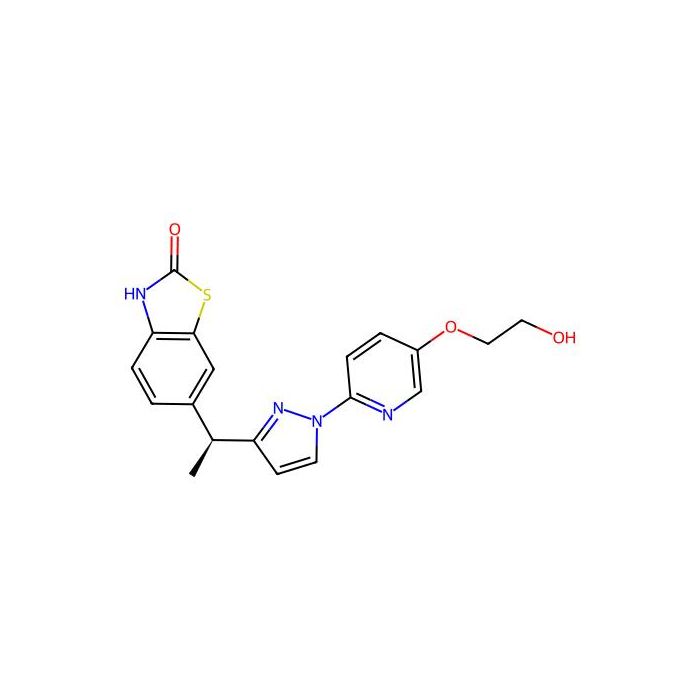
10mM in DMSO per flussi di lavoro cromatografici e analitici sensibili che richiedono un'interferenza minima della linea di base.
🌡
Stoccaggio e spedizione
Store at -80°C Spedizione Dry ice packs + Cold packs. Consultare il COA specifico del lotto per le specifiche esatte.
📋
Documenti di qualità
SDS, COA, scheda tecnica e scheda delle specifiche disponibili per il download. COA specifico del lotto accessibile tramite ricerca per numero di lotto.
📚
Prova documentale
Citato in 0 pubblicazioni peer-reviewed su cromatografia, sintesi organica e reazioni di accoppiamento incrociato.
Panoramica
LY3130481 is an AMPA receptor antagonist that is dependent upon transmembrane AMPA receptor regulatory protein (TARP) γ-8, selective inhibits AMPA/TARP γ-8 with an IC 50 of 65 nM
IC50& Target:IC50:65 nM (AMPA/TARP γ-8)
Specifiche
Specifiche e purezza
10mM in DMSO
Meccanismi biochimici e fisiologici
LY3130481 is an AMPA receptor antagonist that is dependent upon transmembrane AMPA receptor regulatory protein (TARP) γ-8, selective inhibits AMPA/TARP γ-8 with an IC 50 of 65 nM.
Condizioni di conservazione di stoccaggio
Store at -80°C
Spedito in
Dry ice packs + Cold packs
Questo prodotto richiede spedizione a catena fredda. I servizi di terra e altri servizi economici non sono disponibili.
Certificati (CoA, COO, BSE/TSE e tabella di analisi)
C of A & Other Certificates(BSE/TSE, COO):
Analytical Chart:
Calcolatori di soluzioni
Molarity Calculator
Determine the necessary mass, volume, or concentration for preparing a solution.
Dilution Calculator
Determine the dilution needed to prepare a stock solution.
Reconstitution Calculator
Recensioni
Recensioni dei clienti
Application Protocols
No tested-application panel is provided for this item. The following general protocols support typical usage of small-molecule research compounds in discovery workflows.
A. DMSO stock preparation (general):
Allow vial to equilibrate to room temperature inside a desiccator to avoid moisture condensation.
Add anhydrous DMSO to achieve 10–50 mM; vortex until dissolved; brief sonication if needed.
Optionally filter (0.22 µm PTFE) if particulate is suspected.
Aliquot into low-bind tubes; label with compound ID, concentration, date; store per guidance below.
B. Aqueous dilution for assays:
Add stock to buffer with vigorous mixing to reach desired test concentrations; maintain final DMSO ≤0.1–1% v/v.
Include vehicle controls at matched DMSO percentages; run a precipitation check (visual or nephelometry).
C. LC–MS purity check (outline):
Column: RP C18; Mobile A: water + 0.1% formic acid; Mobile B: acetonitrile + 0.1% formic acid.
Gradient: 5% to 95% B over 5–10 min; detect by UV (200–400 nm) and MS (ESI±).
D. Stability spot-check:
Incubate working solution under assay conditions; re-inject by LC–MS at 0 and 4–24 h to assess degradation.
These are general templates; adapt to your assay and institutional SOPs.
Biological Roles
No target, pathway, or mechanism information is provided in this product listing for LY3130481. Therefore, specific biological roles cannot be stated.
General considerations for small-molecule research compounds (context, not item-specific claims):
Compounds in discovery libraries are often screened against enzymes, receptors, ion channels, or transporters to identify modulators for tool compound development.
If later literature associates LY3130481 with a particular biological target, roles might include inhibition/activation, allosteric modulation, or ligand binding, which would guide downstream phenotypic or mechanistic assays.
Prior to biological interpretation, confirm compound integrity (purity, identity, absence of aggregates or colloids) and control for assay interference (fluorescence quenching, redox activity, detergent sensitivity).
Practical guidance:
Use orthogonal assays and counter-screens to exclude pan-assay interference (PAINS) or nonspecific effects.
Maintain vehicle controls and, where possible, structure–activity relationships (SAR) to support causality.
Disclaimer:
This product is supplied strictly for research use only. No medical, diagnostic, or therapeutic use is intended or implied.
Buffer Applications
LY3130481 is not a buffer reagent. However, practical buffer considerations apply when using small-molecule DMSO stocks in biochemical or cell-based assays.
Assay buffer considerations (general):
Keep final DMSO ≤0.1–1% v/v to limit vehicle effects.
Use common assay buffers (e.g., PBS, HEPES, Tris) in the pH 6.5–8.0 range, unless the biology dictates otherwise.
To reduce nonspecific adsorption and improve solubility, consider 0.05–0.1% BSA or 0.01–0.05% Tween-20 (verify compatibility with your assay).
Pre-warm buffers to assay temperature to minimize precipitation on dilution, and verify thermodynamic solubility by visual inspection or nephelometry.
Recipe hints (examples; not item-specific):
HEPES buffer, 25–50 mM, pH 7.4; 150 mM NaCl; 0.01% Tween-20 for many biochemical readouts.
Phosphate-buffered saline (PBS), pH 7.4; add 0.05% BSA to mitigate surface sticking in low-volume plates.
Controls:
Include buffer + vehicle controls matched to the highest DMSO concentration in test wells.
For pH-sensitive targets, confirm that the addition of DMSO or co-solvents does not shift buffer pH (measure after dosing).
Green Alternatives
With no structure or process use case provided for LY3130481, green chemistry considerations focus on the selection of dissolution vehicles and assay-compatible solvents rather than on reaction solvents.
Greener choices for stock preparation and formulation (general guidance):
Prefer EtOH or 2-propanol over chlorinated solvents when feasible for intermediate dilutions; verify solubility and assay compatibility.
Consider aqueous co-solvent systems (e.g., EtOH/water, PEG400/water) at low organic percentages to reduce DMSO reliance while maintaining solubility.
For in vivo formulation research (not for clinical use), vehicles such as Captisol (sulfobutyl ether β-cyclodextrin) or HP-β-CD can enable aqueous delivery, potentially lowering organic solvent load.
Comparison (general; not item-specific specifications):
DMSO: Excellent solubilizer; persistent and problematic in waste streams; target ≤0.1–1% v/v in final systems.
EtOH/Water: Lower toxicity and environmental impact; may require higher volumes due to limited solubility.
PEG400/Water: Enables higher apparent solubility; viscous and can complicate handling/analysis.
Operational tips:
Use miniaturized assays and high-concentration master stocks to reduce solvent consumption.
Adopt closed-vial handling and cold traps to minimize VOC emissions.
Segregate organic waste and explore solvent recycling where institutional infrastructure allows.
Always validate that greener substitutions do not alter assay outcomes (e.g., target engagement, reporter readouts, or cell viability) before large-scale deployment.
Pharmaceutical Uses
No pharmacopeial status, excipient role, or clinical formulation information is provided for LY3130481. This product is supplied for research use only and is not intended for human or veterinary use.
General R&D formulation context for small molecules (not item-specific claims):
In preclinical research, compounds may be formulated for exploratory studies using cyclodextrins (HP-β-CD, SBE-β-CD), co-solvent systems (e.g., PEG400/EtOH/saline), or nano-suspensions to address solubility and exposure.
Early-stage developability assessments include chemical stability, photostability, solid-state form (amorphous vs crystalline), and hygroscopicity screening.
If ionizable, salt selection (e.g., HCl for bases, sodium/potassium for acids) can improve solubility and stability for nonclinical studies.
Operational cautions:
Maintain rigorous documentation and traceability (batch ID, storage history) when generating in vivo data.
Verify endotoxin and sterility only when required for specific biological studies; this listing does not include such specifications.
Reminder: Absence of any therapeutic or clinical claim is intentional; consult your institutional review and regulatory teams before any non-research use.
Physical Properties
Item-specific physico-chemical data were not supplied in this listing.
Appearance: Not specified for this item; refer to CoA/Spec Sheet.
Molecular Weight: Not specified for this item; refer to CoA/Spec Sheet.
Molecular Formula: Not specified for this item; refer to CoA/Spec Sheet.
Melting point (mp): Not specified for this item; refer to CoA/Spec Sheet.
Boiling point (bp): Not specified for this item; refer to CoA/Spec Sheet.
Density: Not specified for this item; refer to CoA/Spec Sheet.
LogP/logD, pKa, refractive index: Not specified for this item; refer to CoA/Spec Sheet.
Solubility: Not specified for this item; refer to CoA/Spec Sheet.
General guidance for small-molecule solids (literature/practice—not item specifications):
Many drug-like molecules are sparingly soluble in water; typical stock preparation uses anhydrous DMSO (e.g., 10–50 mM) with subsequent dilution into assay buffers. Keep final DMSO ≤0.1–1% v/v where biological systems are involved.
If ionizable groups are present (unknown here), solubility may be improved by pH adjustment (acidic media for basic compounds; basic media for acidic compounds) or by co-solvents (DMF, ethanol) and carriers (PEG400, cyclodextrins).
Conduct a tiered solubility screen (DMSO, MeCN, EtOH, PBS, pH 5–9) and a thermodynamic vs kinetic solubility check prior to HTS.
For analytical characterization, develop a short LC gradient using mixed aqueous/organic eluents (e.g., water/0.1% formic acid–acetonitrile) to assess purity and stability.
Always defer to the batch CoA for any numeric properties and to the SDS for handling precautions.
Quality and Grades
Grade/Purity: Not specified for this item; refer to CoA/Spec Sheet.
Appearance: Not specified for this item; refer to CoA/Spec Sheet.
Guidance on interpreting grades (general context):
Library or screening compounds are typically provided at research grade with assay-appropriate purity verified by LC–MS/UV and often by 1H NMR. Unless explicitly stated, assume the material is intended for discovery research and not for GMP use.
If “HPLC-grade solvent” or “spectrophotometric-grade” language is present for solvents (not applicable here), it denotes low UV background for chromatography. For solids like LY3130481, purity by HPLC area% and identity by MS are the key release criteria.
Batch documentation and QC:
Request the batch Certificate of Analysis (CoA) for exact purity, analytical method (HPLC/UPLC conditions), retention time, and spectral data.
If your application requires metal content, residual solvent, water Karl Fischer, or enantiomeric purity, confirm availability with customer support. Where not specified, these attributes should be verified in-house to meet program needs.
Stabilizers and additives:
No stabilizers are indicated in this listing. If your application is sensitive to trace acids/bases or antioxidants, perform a compatibility check or contact us to verify additive-free supply.
Recommendation:
For bioassays and HTS, consider receiving smaller aliquots to reduce freeze–thaw cycles and to maintain integrity over the campaign.
Reaction and Applications
Manufacturer application notes are not provided for this item; LY3130481 is cataloged within a small-molecule/compound library, implying intended use as a research tool or screening hit/standard rather than as a synthetic reagent.
Potential research applications (general; not item-specific claims):
Assay development and HTS: Use as a reference compound or test article in biochemical, biophysical, or cell-based assays once identity and purity are confirmed.
Mechanistic studies: If literature identifies a target (not provided here), deploy in target engagement assays (e.g., CETSA, SPR, ITC) and MOA exploration.
ADME profiling: Solubility, stability (chemical and metabolic), and permeability measurements to benchmark series liabilities.
Orthogonal readouts: Evaluate activity across multiple assay formats to control for reporter and solvent artifacts.
Practical tips:
Prepare concentrated DMSO stocks (10–50 mM); confirm absence of particulates by visual inspection or light scattering.
Perform a solubility limit test at the intended assay temperature and buffer composition before running a full plate.
Include DMSO-only controls matched to the highest vehicle percentage in test wells.
If instability is suspected, use freshly thawed aliquots, and check by LC–MS pre/post assay.
Note: Without a provided mechanism or target, application scope remains generic. Consult current literature and the CoA for any compound-specific recommendations.
Reaction Conditions
Not applicable in the usual synthetic sense: LY3130481 is provided as a research compound, not as a reagent. No reaction condition data are supplied for transformations involving this material.
Handling/dissolution conditions (general guidance, not specifications):
Prepare concentrated DMSO stocks (10–50 mM) under dry conditions; vortex and, if needed, sonicate briefly. Verify complete dissolution visually and, when critical, by nephelometry.
For aqueous working solutions, add compound stock last, with rapid mixing, to minimize local supersaturation. Maintain final DMSO typically ≤0.1–1% v/v.
If precipitation occurs, adjust using small percentages of compatible co-solvents (EtOH, MeCN) or carrier proteins (BSA) after confirming assay compatibility.
If stability is in question, work at low light exposure, reduced temperature during setup, and minimize time in solution prior to use. Check integrity by LC–MS before and after the experiment.
Expected yields/times/catalysts:
Not applicable to this listing; no synthetic reaction data are provided for LY3130481.
Safety and Handling
Safety information in this listing is limited; treat as a potentially bioactive small molecule.
GHS Classification / Pictograms / Signal Word / H-Statements: Not specified for this item; consult the SDS for authoritative safety data.
Primary storage condition (item-specific): Store at −80°C.
Shipping (item-specific): Shipped on dry ice packs + cold packs.
General laboratory precautions (best practice; not item-specific):
Wear lab coat, safety glasses, and nitrile gloves. Avoid inhalation and skin/eye contact. Handle powders in a fume hood or ventilated enclosure.
Assume potential for acute toxicity or cellular activity; minimize exposure and avoid aerosol generation.
Avoid incompatible operations with strong oxidizers/reductants and strong acids/bases until compatibility is known.
Many small molecules can be light- and moisture-sensitive; protect from light and work under dry conditions when preparing concentrates.
First-aid overview (consult SDS first):
Inhalation: Move to fresh air; seek medical attention if symptoms occur.
Skin/eye contact: Rinse with water for several minutes; remove contaminated clothing; obtain medical advice if irritation persists.
Ingestion: Rinse mouth; do not induce vomiting; seek medical attention.
Spill and waste:
Avoid dust formation; absorb solutions with inert material. Dispose according to institutional and local regulations under organic laboratory waste streams.
Always consult the product-specific SDS before first use and train personnel accordingly.
Solvent Selection
Because no structure or solubility profile is provided, solvent selection should follow a pragmatic screening approach appropriate for small-molecule libraries.
Primary stock solvent:
DMSO (anhydrous) is the default for discovery compounds; start 10–50 mM.
Co-solvent strategies (general):
If precipitation occurs on aqueous dilution, pre-dilute DMSO stock 1:10 into MeCN, EtOH, or PEG400, then into buffer.
Use surfactant-free conditions for biophysical assays; for cellular assays, keep total organic ≤0.1–0.5% v/v if possible.
Buffer compatibility:
Many compounds show improved tolerance in buffers with 0.05–0.1% BSA or 0.01–0.05% Tween-20; verify assay compatibility first.
pH leverage (if ionizable, structure-dependent):
Basic compounds: improve dissolution in slightly acidic media (e.g., acetate pH 4.5–5.5).
Acidic compounds: use slightly basic media (e.g., Tris pH 8–9). Avoid extreme pH for biological assays.
Brief comparison (general, not item-specific):
DMSO: maximal solubilizing power; potential biological interference at >1%.
DMF/NMP: strong solvents but greater toxicity; reserve for analytical prep.
EtOH/MeOH: moderate solubility, lower toxicity; volatility can change concentrations.
PEG400: useful co-solvent/vehicle; viscous; may affect readouts.
Tip: Run a 5–7 solvent panel (DMSO, MeCN, EtOH, MeOH, isopropanol, PEG400, buffer at two pH values) to establish a robust handling recipe for LY3130481 in your assays.
Storage and Reconstitution
Item-specific conditions:
Storage: Store at −80°C (as provided in the product data). Minimize freeze–thaw cycles.
Shipping: Dispatched on dry ice packs + cold packs.
General best practices for small-molecule solids/solutions (not specifications):
Upon receipt, allow the sealed container to equilibrate to room temperature before opening to prevent moisture condensation.
If supplied as a solid: subdivide into single-use aliquots in low-bind tubes under dry air or inert gas; protect from light as a precaution.
If supplied in solution: keep frozen at −80°C; avoid repeated thawing. Thaw on ice, mix gently, and promptly return unused portions to storage.
Reconstitution guidance (typical, adjust as needed):
Dissolve in anhydrous DMSO to prepare a 10–50 mM master stock. Confirm dissolution; if needed, use brief sonication.
For aqueous use, dilute into assay buffer with vigorous mixing, targeting ≤0.1–1% v/v DMSO in final solutions.
For sterile applications, pass through a 0.22 µm PTFE syringe filter into sterile vials.
Stability monitoring:
Track time-out-of-freezer (TOOF) and the number of freeze–thaw cycles. If activity loss is suspected, verify by LC–MS/HPLC and use fresh aliquots.
Note: Where precise stability, hygroscopicity, or photolability data are required, consult the batch CoA and SDS, as these attributes are not specified in this listing.
Structure and Identity
Brief description: LY3130481 is listed as a small-molecule research compound in our small-molecule library category. Detailed structural identifiers are not provided in this listing.
Product Name: LY3130481 (SKU: L654736)
CAS: 1610802-47-5 (item-specific)
PubChem CID: 74223604 (item-specific)
Molecular Formula: Not specified for this item; refer to CoA/Spec Sheet.
Molecular Weight: Not specified for this item; refer to CoA/Spec Sheet.
SMILES: Not specified for this item; refer to CoA/Spec Sheet.
InChIKey: Not specified for this item; refer to CoA/Spec Sheet.
Structural features (general statement):
Specific ring systems, heteroatoms, stereochemistry, and functional groups are not provided in the product data. Consult the CoA/SDS or authoritative databases for exact structure prior to structure-dependent applications (e.g., docking, QSAR, or property prediction).
2D structure description (general):
Without an available SMILES/InChI, a textual 2D description cannot be rendered here. If you require depiction files (SDF/Mol), please request the latest CoA package from Aladdin Scientific customer support.
Notes for identity verification:
Cross-reference the CAS (1610802-47-5) and CID (74223604) against your internal registry before use.
For regulated workflows (HTS, GLP-adjacent), confirm identity by LC–MS and, if necessary, 1H NMR against a reference standard.
Retain shipment documentation and batch-specific labels to ensure traceability of LY3130481 in screening campaigns.
Synthetic Utility
LY3130481 is offered as a finished small-molecule research compound and is not positioned as a synthetic building block in this listing. Without structural information, specific reactivity or functional group transformations cannot be discussed.
General guidance (context for chemists managing analog campaigns):
If LY3130481’s structure is known within your program, retrosynthetic planning should evaluate: (a) core scaffold assembly (ring construction, cross-coupling, cyclization), (b) late-stage diversification (halogenation, C–H functionalization, amide coupling), and (c) protecting group strategy aligned with functional group compatibility.
For purity upgrades or salt formation, recrystallization or reverse-phase preparative HPLC are common routes, contingent on polarity and ionizability.
If chiral, assess enantiopurity by chiral SFC/HPLC and consider asymmetric synthesis or resolution.
Note:
No functional groups, leaving groups, or handle counts are available from the product data; therefore, specific named-reaction suitability (e.g., Suzuki, Buchwald–Hartwig) cannot be asserted for this item.
Target Specificity
Target, mechanism, and selectivity information are not provided in this product listing for LY3130481.
Antigen/epitope, species reactivity, clone/isotype: Not applicable; this is a small molecule, not an antibody or protein reagent.
Any target-binding claims must be sourced from the primary literature or the batch CoA/technical note; none are included here.
Recommendation:
If LY3130481 is under evaluation for a specific target in your program, establish in vitro potency (IC50/EC50) and selectivity panels, and confirm on-target engagement through orthogonal methods (e.g., CETSA, NanoBRET, SPR), documenting all assay conditions and vehicle levels.
Domande frequenti
How should this product be stored?
Store at ?80 °C. Ultra-low temperature storage is required to maintain the specified shelf life.
How is this product shipped?
This product ships frozen with dry ice and cold packs. Unpack on arrival and transfer it to the storage condition stated above; handle dry ice with insulated gloves in a ventilated area.
What are the CAS number, molecular formula and molecular weight?
The CAS Number is 1610802-47-5, the molecular formula is C19H18N4O3S, and the molecular weight is 382.44 g/mol.
What documentation is provided?
Available product documentation, including Certificates of Analysis (COA), Safety Data Sheets (SDS), and specification sheets, is shown in the product document area. Document availability and access follow the current site policy.
Utilizziamo i cookie per garantire il corretto funzionamento del sito web e, ove consentito, per migliorare la tua esperienza. Puoi gestire le tue preferenze in qualsiasi momento nelle Impostazioni. Per saperne di più, consulta la nostra Cookie Policy.
Desidera che le inviamo un messaggio quando avremo sconti disponibili?
Ricordamelo più tardi
Grazie! Controlli la sua casella di posta per confermare.
Products are supplied to verified businesses, institutions, and qualified professionals for research and development use only. Not for use in humans, animals, diagnosis, or therapy.