≥98% per flussi di lavoro cromatografici e analitici sensibili che richiedono un'interferenza minima della linea di base.
🌡
Stoccaggio e spedizione
Store at -20°C Spedizione Ice chest + Ice pads. Consultare il COA specifico del lotto per le specifiche esatte.
📋
Documenti di qualità
SDS, COA, scheda tecnica e scheda delle specifiche disponibili per il download. COA specifico del lotto accessibile tramite ricerca per numero di lotto.
📚
Prova documentale
Citato in 0 pubblicazioni peer-reviewed su cromatografia, sintesi organica e reazioni di accoppiamento incrociato.
Panoramica
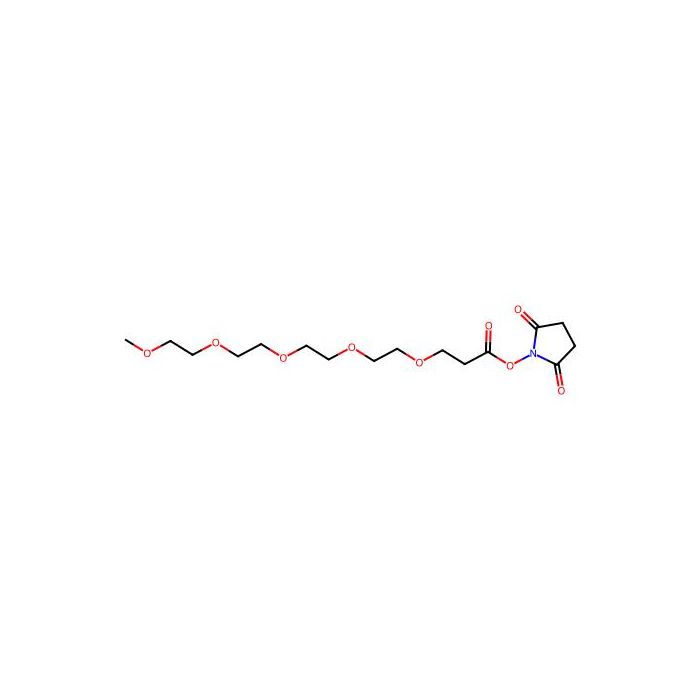
m-PEG5-NHS ester is a PEG derivative containing an NHS ester. The NHS ester can be used to label the primary amines (-NH2) of proteins, amine-modified oligonucleotides, and other amine-containing molecules. The hydrophilic PEG spacer increases solubility in aqueous media.
Specifiche
Specifiche e purezza
≥98%
Condizioni di conservazione di stoccaggio
Store at -20°C
Spedito in
Ice chest + Ice pads
Questo prodotto richiede spedizione a catena fredda. I servizi di terra e altri servizi economici non sono disponibili.
Purezza
≥98%
Nomi e identificatori
Peso molecolare
377.4
Documentazione
📋 Scheda di dati di sicurezza (SDS)
Documento completo su pericoli, manipolazione, stoccaggio e conformità normativa.
Certificati (CoA, COO, BSE/TSE e tabella di analisi)
C of A & Other Certificates(BSE/TSE, COO):
Analytical Chart:
Proprietà chimiche e fisiche
Solubilità
Solubility in DMSO, DCM, DMF
Calcolatori di soluzioni
Molarity Calculator
Determine the necessary mass, volume, or concentration for preparing a solution.
Dilution Calculator
Determine the dilution needed to prepare a stock solution.
Reconstitution Calculator
Recensioni
Recensioni dei clienti
Application Protocols
No vendor-validated, application-specific protocols are provided for this item. Below is a general research-use workflow for amine coupling with m-PEG5-NHS ester (literature/practice; adjust to your system):
General aqueous bioconjugation (protein/peptide):
Prepare 10–50 mg/mL stock in anhydrous DMF or DMSO immediately before use.
Buffer the amine-containing biomolecule in 50 mM phosphate (pH 7.4–7.8) or 50 mM bicarbonate (pH 8.3), 100–150 mM NaCl.
Add NHS ester stock dropwise to achieve 2–10 equiv per predicted reactive amine. Final organic fraction 5–15%.
Incubate 30–60 minutes at room temperature (or 4–10°C for sensitive proteins), maintaining pH.
Quench with 50 mM ethanolamine (pH 8.0) for 10–15 minutes.
Purify by SEC or dialysis; analyze by SDS-PAGE and intact MS.
Small-molecule/surface coupling (nonaqueous):
Dissolve amine substrate in dry DMF or DCM; add m-PEG5-NHS (1.2–2.0 equiv) and DIPEA (2–3 equiv).
Stir 1–3 hours at 20–30°C under dry N2.
Workup by aqueous quench, extraction, and purification (silica gel or precipitation), avoiding basic, amine-containing eluents.
Note: These are generic research guidelines. Validate conditions for your specific substrate, scale, and analytical criteria. This item is for research use only.
Biological Roles
This product is a synthetic linker and does not possess intrinsic biological function. However, it is extensively used in bioanalytical and biomaterials research to modulate the behavior of biomolecules and surfaces.
General/literature context:
PEGylation effects: Covalent attachment of short PEG chains to proteins or peptides can reduce nonspecific adsorption, diminish aggregation, and alter hydrodynamic radius. Even short PEG5 segments can reduce surface fouling and improve solubility of hydrophobic motifs.
Surface passivation: m-PEGylated surfaces (e.g., glass, silica, polymers) reduce protein binding and cell adhesion in vitro, enabling controlled studies of specific ligand–receptor interactions when combined with defined functional handles.
Conjugate behavior: The methoxy terminus provides an inert cap, ensuring that only one reactive site participates in coupling, which simplifies bioconjugate heterogeneity relative to multi-armed or difunctional PEGs.
Analytical advantages: Installing a short PEG tag can shift retention in reversed-phase HPLC, improve MS ionization in some cases, or assist phase transfer, aiding method development.
Scope limitations:
NHS chemistry is amine-directed and nonselective among accessible primary amines (lysines/N-termini), which can lead to heterogeneous labeling of proteins. Site-selective strategies (e.g., enzymatic tags or orthogonal handles) may be preferable when precise modification is required.
Note: All uses are for research and laboratory development. No medical, diagnostic, or clinical applications are implied for this catalog item.
Buffer Applications
m-PEG5-NHS ester is not a buffering reagent. However, successful amine-coupling in aqueous media depends critically on buffer selection and pH control (literature/practice guidance):
Bicarbonate/Carbonate (25–100 mM), pH 8.0–8.5: increases coupling rate but also hydrolysis; shorten reaction times and keep solutions cold if using higher pH.
HEPES or MES (where applicable), pH near neutrality: compatible and amine-free.
Borate (25–50 mM), pH 8.5–9.0: can boost rates for small-molecule amines; use cautiously to limit hydrolysis.
Buffers to avoid: Tris, glycine, ammonium, ethanolamine, and other primary/secondary amine-containing buffers or additives (e.g., azides with amines), which will quench NHS esters.
Ionic strength: 50–200 mM NaCl often stabilizes proteins and reduces nonspecific interactions without interfering with coupling.
Co-solvents: Introduce a minimal fraction (5–20%) of anhydrous DMF or DMSO to aid solubility of the NHS ester or hydrophobic substrates; add immediately prior to reaction.
Practical tips:
Degas and pre-chill buffers for sensitive proteins.
Adjust pH at working temperature; maintain pH within ±0.1 during the coupling window.
After the desired reaction time, quench with ethanolamine or Tris to cap unreacted NHS groups, then proceed to purification.
These recommendations are general; optimize for your specific substrate and stability constraints.
Green Alternatives
While m-PEG5-NHS ester is widely used due to reliable amine coupling, greener practices can target solvent choice, coupling chemistry, and process intensification.
Greener options and trade-offs (literature/practice):
Solvent substitution:
Replace DMF with safer polar aprotics where feasible: propylene carbonate (PC) or Cyrene can dissolve PEG linkers and many substrates; however, their higher viscosity and limited protein compatibility may hinder bioconjugations. 2-MeTHF or ethyl acetate can work for surface/organic couplings but are less miscible with water for aqueous bioconjugation.
Minimize DMSO/DMF volume by using concentrated stocks and immediate dilution into buffer.
Alternative activation chemistries:
Carbonyl diimidazole (CDI) activation in situ on carboxylic acids reduces use of pre-activated esters, but requires handling reactive intermediates and careful moisture control.
Pentafluorophenyl (PFP/TFP) esters offer longer hydrolytic stability, potentially reducing waste from hydrolysis; however, PFP residues raise environmental concerns and analytical burden.
Enzymatic ligations (e.g., transglutaminase) avoid organic solvents but require specific recognition motifs and conditions.
Process improvements:
Employ microdialysis or tangential-flow filtration for purification to reduce solvent usage.
Conduct reactions at lower temperature and higher substrate concentration to decrease hydrolysis losses.
Comparison snapshot (general):
NHS in DMF/DMSO: fastest, most general; higher EHS burden.
NHS in ethyl acetate/2-MeTHF for surfaces: greener solvent; may require anhydrous workup and longer times.
Enzymatic/biocatalytic methods: aqueous and mild; limited scope vs. NHS ester generality.
Choose greener routes when substrate and performance requirements permit, balancing stability, scope, and EHS profiles.
Pharmaceutical Uses
No therapeutic, diagnostic, or clinical uses are claimed or supported for this catalog item; it is for research use only.
General/literature context on role in formulation science (non-clinical discussion):
PEGylation motifs are frequently investigated in pre-formulation and analytical studies to assess how short PEG segments influence solubility, viscosity, and surface adsorption of candidate biomolecules. m-PEG5-NHS provides a straightforward route to install a short PEG cap on lysines/N-termini during such exploratory work.
Excipient/compatibility assessments: Short PEG chains can reduce interfacial stress and protein adsorption to processing surfaces in lab-scale studies, informing later excipient selection. However, m-PEG5-NHS itself is a reactive reagent, not an excipient; any residual reagent must be removed post-reaction.
Device and surface evaluation: In materials science related to drug delivery research, amine-bearing substrates (e.g., catheter polymers, silica) are often modified with methoxy-PEG to impart hydrophilicity and decrease fouling during benchtop flow or stability tests.
Regulatory notes:
Pharmacopoeial status, GMP grade, residual solvent limits, and endotoxin/bioburden controls are not specified for this item. Any use beyond laboratory research would require additional qualification not covered here.
Conclusion: Use this reagent solely within research and development workflows to explore PEGylation effects; do not deploy in human or veterinary applications.
Physical Properties
Item-specific numerical specifications (BP, MP, density, refractive index, water/peroxide/metal limits, UV cutoff): Not specified for this item; refer to CoA/Spec Sheet.
General/literature-based characteristics for m-PEGn-NHS (n≈5):
Physical state: typically a waxy solid or viscous oil at ambient temperature depending on exact distribution and hydration; hygroscopic and moisture-sensitive due to NHS ester hydrolysis susceptibility.
Solubility: good solubility in polar aprotic organic solvents (DMF, DMSO, acetonitrile, dichloromethane, THF, ethyl acetate). Soluble to sparingly soluble in water; hydrolysis of the NHS ester in aqueous media leads to the corresponding m-PEG5 acid over time (literature). Co-solvents (DMF/DMSO) are commonly used for aqueous coupling.
Partitioning: PEG chains confer hydrophilicity; the NHS ester increases hydrophobicity relative to the free acid. LogP is not typically reported for oligomeric PEG linkers; behavior is amphiphilic.
Thermal behavior: NHS esters generally decompose/hydrolyze rather than exhibit a sharp boiling point; avoid prolonged heating. Glass transition or softening can occur for short PEG oligomers (literature).
pKa: not applicable as an NHS ester (no ionizable proton relevant in working pH); the conjugate m-PEG5 carboxylic acid would exhibit an aliphatic carboxyl pKa ≈ 4–5 (literature, for the hydrolysis product), but the activated ester itself does not buffer.
Note: Because PEG-based reagents are often described by average repeat number, exact constants vary with supplier, lot, and distribution.
Quality and Grades
Item-specific grade/purity: Not specified for this item; refer to CoA/Spec Sheet.
Context for PEG–NHS quality attributes (general guidance for professional users):
Purity metrics: For activated PEG linkers, practical performance is driven by (1) content of active NHS ester vs. hydrolyzed acid, (2) residual solvents and inorganic salts, and (3) polydispersity (distribution around n≈5). CoA often reports active ester content (e.g., by titration or HPLC) and overall assay.
Stabilizers: NHS esters are typically supplied without stabilizers; product stability derives from rigorous drying, low-temperature storage, and moisture barrier packaging. Any stabilizer use would be declared on the CoA; none are specified here.
Grades you may encounter (literature/market definitions):
Research grade: suitable for routine conjugations; typical for materials science and bioconjugation method development.
Bioconjugation/Biopure grade: additional controls on endotoxin, bioburden, and trace metals; often low UV-absorbing impurities.
GMP or pharma-support grades: Sourced and documented under quality systems for manufacturing support; NOT implied for this item.
Practical QC checks: Verify active ester content prior to critical work (e.g., test coupling to an amine under defined conditions with HPLC monitoring). Monitor hydrolysis by observing the appearance of m-PEG5-acid (shift in LC-MS or HPLC retention).
Conclusion: Use the CoA/Spec Sheet for lot-specific purity, assay, water content, and recommended acceptance criteria. If not provided, perform incoming QC appropriate to your application.
Reaction and Applications
This reagent is designed for efficient acylation of primary amines to form stable amide bonds, leveraging the high leaving-group ability of N-hydroxysuccinimide.
Key application families (literature/practice for m-PEGn-NHS):
Protein and peptide PEGylation: Targets lysine ε-amines or N-termini to modulate solubility, reduce nonspecific adsorption, and tune surface properties in analytical and materials contexts. Reaction control via pH (7.2–8.5) and stoichiometry reduces over-PEGylation.
Surface and particle functionalization: Grafting to amine-functional polymers, silica, magnetic beads, quantum dots, and nanocarbon surfaces previously aminated (e.g., APTES-treated silica). Provides a hydrophilic, protein-resistant corona.
Polymer and dendrimer modification: Termination or spacing via short PEG segments to adjust hydrophilicity and spacing between active domains.
Small-molecule derivatization: Installation of a short PEG tail to enhance solubility or modulate chromatographic behavior.
Mechanistic notes:
NHS ester reacts with deprotonated amines to yield amides; the rate increases with pH (up to ~8.5) but hydrolysis competes as pH rises. Aprotic cosolvents slow hydrolysis and enhance effective molarity.
Byproducts: N-hydroxysuccinimide and the corresponding amide. Excess reagent and NHS are typically removed by dialysis, SEC, spin filters, or precipitation, depending on scale.
Practical tips:
Prepare fresh stock (e.g., 10–100 mg/mL) in dry DMF/DMSO. Add to buffered amine solution under gentle stirring and react for 15–120 minutes at 4–25°C. Quench residual activity with ethanolamine or Tris after the desired extent of modification.
For surfaces, ensure thorough drying of substrates and remove adventitious amines prior to coupling to maximize grafting efficiency.
Reaction Conditions
General guidance for amine coupling with m-PEG5-NHS ester (literature/practice):
Solvent system:
For small molecules/surfaces: anhydrous DMF, DCM, ACN, THF, or EtOAc. Add a non-nucleophilic base (e.g., DIPEA, 1–2 equiv) to promote amine deprotonation in nonaqueous media.
For bioconjugation: aqueous buffer (phosphate or bicarbonate, 10–100 mM) at pH 7.2–8.5 with 5–20% dry DMF/DMSO as cosolvent. Avoid amine-containing buffers.
Concentration: Prepare fresh stock solutions at 10–100 mg/mL in dry DMF/DMSO. Final reagent concentration typically 0.1–10 mM depending on substrate abundance and scale.
Stoichiometry: 1.1–10 equivalents of NHS ester per reactive amine site, adjusted based on desired degree of substitution. For proteins, begin with 2–5 equiv per accessible lysine and optimize.
Temperature/time: 4–25°C for 15–120 minutes for proteins/peptides; 20–40°C for 0.5–4 h for small molecules and surfaces. Lower temperatures slow hydrolysis at higher pH.
pH control: Maintain pH 7.2–8.5. Increased pH accelerates coupling but also hydrolysis; monitor reaction progress and avoid prolonged exposure.
Quench: After coupling, quench unreacted NHS ester with ethanolamine or Tris (10–100 mM) then purify (SEC, dialysis, spin filtration, precipitation, or chromatography as appropriate).
Monitoring: Track conversion by LC-MS (small molecules), SDS-PAGE shift and MS (proteins), XPS/ATR-IR/contact angle (surfaces), or HPLC for appearance of NHS byproduct.
Notes:
Hydrolysis kinetics of NHS esters are strongly buffer- and temperature-dependent; plan additions to minimize the time reagent spends in aqueous media before encountering the target amine.
For moisture-sensitive operations, maintain inert gas blankets and use anhydrous glassware.
Safety and Handling
Authoritative safety classification for this item:
Signal word: Not specified for this item; refer to SDS.
H-statements: Not specified for this item; refer to SDS.
GHS classification and pictograms: Not specified for this item; refer to SDS.
General safety guidance for NHS-activated PEG reagents (literature/practice):
Hazards: May cause skin/eye irritation. NHS esters react with nucleophiles (amines), potentially sensitizing for individuals with amine-containing biomolecules on skin. Hydrolysis releases N-hydroxysuccinimide.
PPE: Wear lab coat, safety glasses, and appropriate gloves (e.g., nitrile). Work in a fume hood when weighing and preparing solutions.
Handling: Avoid moisture; open vials only at ambient humidity for minimal time. Keep under inert atmosphere or desiccated conditions. Prepare fresh solutions immediately before use. Avoid contact with amine-containing buffers (e.g., Tris, glycine) that can quench the reagent.
Incompatibilities: Water, bases, nucleophiles (amines, hydroxylamines), and prolonged exposure to elevated temperatures. Avoid strong acids/bases that accelerate decomposition.
First aid (overview; consult SDS): In case of skin contact, wash with soap and water. For eye contact, rinse cautiously with water for several minutes and seek medical attention if irritation persists. If inhaled as dust/aerosol, move to fresh air. If ingested, rinse mouth; do not induce vomiting; seek medical advice.
Waste: Collect solutions and rinses containing NHS esters as halogen-free organic waste unless otherwise required. Quench residual reactivity by controlled hydrolysis (aqueous buffer) before disposal, consistent with local regulations.
Always defer to the product-specific SDS for definitive hazard and response guidance.
Solvent Selection
NHS-activated m-PEG5 is amphiphilic and dissolves well in polar aprotic solvents. Solvent choice should balance solubility, moisture content, and compatibility with the amine substrate.
Primary organic solvents (literature/practice):
DMF (anhydrous): excellent solubility; low volatility; widely used for stock solutions. Water content must be minimized to suppress hydrolysis.
DMSO (anhydrous): similar to DMF; convenient for preparing concentrated stocks for immediate addition to aqueous buffers.
Acetonitrile, THF, dichloromethane, ethyl acetate: good solubility for nonaqueous couplings and surface grafting.
Aqueous media: The NHS ester hydrolyzes in water; for bioconjugations, add a small aliquot of concentrated solution in DMF/DMSO into a buffered aqueous amine solution immediately before use. Maintain pH 7.2–8.5 and minimize reaction time.
Buffer compatibility (critical): Avoid amine-containing buffers (Tris, glycine, ammonia), which outcompete the target amine. Preferred: phosphate, bicarbonate/carbonate, HEPES, or borate buffers.
Moisture control: Use freshly opened anhydrous solvents and consider molecular sieves (3Å) for DMF/ACN if long operations are expected.
Small comparison (general):
DMF vs DMSO: DMF offers easier removal post-reaction for some systems; DMSO often provides higher substrate solubility. Both are acceptable if kept dry.
ACN vs THF: ACN is more polar and miscible with water; THF offers faster wetting of hydrophobic surfaces for coatings but can swell some polymers.
Select solvents based on substrate solubility and downstream purification constraints, always prioritizing anhydrous conditions prior to quenching into aqueous buffers.
Storage and Reconstitution
Item-specific storage and shipping:
Storage conditions: Store at -20°C (per product data). Keep tightly sealed under dry, inert atmosphere with desiccant.
Shipped in: Ice chest + Ice pads (per product data) to maintain a cool chain and limit hydrolysis.
General best practices for NHS-activated PEG reagents:
Protection from moisture: Store in original moisture-barrier packaging. After opening, immediately reseal under inert gas (N2/Ar) and return to -20°C. Consider storing within a secondary sealed container with desiccant.
Aliquoting: If supplied in bulk, subdivide into single-use aliquots in a glovebox or dry box to prevent repeated freeze–thaw and moisture ingress.
Light/heat: Protect from elevated temperatures and prolonged light exposure; avoid repeated warming cycles. Thaw at room temperature in a desiccator before opening to prevent condensation.
Reconstitution and use:
Solvents: Reconstitute in anhydrous DMF or DMSO to prepare concentrated stocks (e.g., 10–100 mg/mL). Use immediately; discard any unused solution after the session due to hydrolysis risk.
Aqueous use: Add organic stock directly to buffered amine solutions at the moment of reaction. Do not pre-dilute in water.
Stability once dissolved: Working solutions in dry DMF/DMSO are most reliable when used within a few hours at room temperature; chill if delays are expected.
Disposal: Quench leftover reactivity by controlled hydrolysis in aqueous buffer, then dispose according to institutional chemical waste procedures.
Always consult the lot-specific CoA and SDS for definitive guidance on storage, stability, and handling.
Structure and Identity
m-PEG5-NHS ester is a methoxy-terminated oligo(ethylene glycol) chain (average of ~5 ethylene oxide units) bearing an N-hydroxysuccinimide (NHS) activated ester at the opposite terminus. This reagent is a monofunctional PEGylation linker commonly used to acylate primary amines to form stable amide bonds.
SKU: M595647
Product name: m-PEG5-NHS ester
CAS: 874208-94-3
InChIKey: Not specified for this item; refer to CoA/Spec Sheet.
SMILES: Not specified for this item; refer to CoA/Spec Sheet.
Molecular formula: Not specified for this item; refer to CoA/Spec Sheet.
Molecular weight: Not specified for this item; refer to CoA/Spec Sheet.
Structural features (general/literature description):
Functional groups: terminal methoxy ether on one end; activated carboxylic acid derivative as an NHS ester on the other end; internal ethylene glycol ether repeats (–CH2–CH2–O–)n where n ≈ 5 (average).
The NHS group is a five-membered succinimide ring fused to the carbonyl, enhancing leaving-group ability for amine acylation.
2D description in words: a linear PEG chain capped by a methyl ether on one terminus and by a carbonyl attached to an N-hydroxysuccinimide ring on the other terminus; no stereocenters.
Polydispersity: As with most PEG-based reagents defined by repeat unit count, material is typically an oligomeric mixture centered around n ≈ 5 (literature). Exact distribution for this item: Not specified for this item; refer to CoA/Spec Sheet.
Category pathway context: listed under Materials Science; frequently used for surface modification, polymer conjugation, and nanomaterials functionalization (general use).
Synthetic Utility
Functional profile:
Electrophile: The NHS ester serves as an activated carboxylate derivative, enabling rapid formation of amide bonds with primary amines under mild conditions. The methoxy terminus is nonreactive, delivering monofunctional modification.
Spacer: The PEG5 segment introduces a hydrophilic, flexible spacer that can reduce steric hindrance and improve aqueous compatibility of conjugates.
Uses in synthesis and materials (literature/practice):
Spacer installation in bifunctional constructs where one site is an amide-linked amine and the other site remains inert (methoxy-capped), aiding SAR studies by minimizing non-specific interactions.
Attachment to solid supports: Immobilization on amine-bearing resins, silica, or planar surfaces to generate PEG-passivated media for chromatography or biosensing development.
Modular assembly: Combine with orthogonal handles on the amine partner (azides, alkynes, halides) to build multi-step constructs; the PEG spacer can alleviate solubility issues and improve coupling in subsequent steps.
Protecting-group strategies: Because coupling proceeds under mild, near-neutral conditions, sensitive functional groups (e.g., unprotected phenols, some heterocycles) on the amine partner often tolerate the reaction, reducing protecting-group requirements.
Retrosynthetic value:
Consider m-PEG5-NHS as a terminal capping or solubilizing fragment in route design. Its installation late in synthesis can improve handling and purification of otherwise lipophilic intermediates.
Limitations:
Nonselectivity among multiple primary amines can generate mixtures; employ orthogonal protection or site-specific strategies if needed. Hydrolysis competes, necessitating timely execution and controlled pH.
Target Specificity
Not applicable to this product category. m-PEG5-NHS ester is a small-molecule/oligomeric coupling reagent, not an antibody, affinity ligand, or biological targeting agent. It reacts broadly with accessible primary amines (e.g., lysine side chains, N-termini, aliphatic amines on surfaces/polymers) without inherent sequence or epitope specificity.
For selective bioconjugation requirements, consider target-specific chemistries (e.g., enzymatic ligation tags, thiol-selective maleimides, aldehyde/oxime ligation) rather than NHS esters.
Domande frequenti
What is the purity of this product?
This product is supplied at ≥98% purity (chemical assay). Lot-specific values are stated on the Certificate of Analysis.
How should this product be stored?
Store at ?20 °C. Freezer storage is required to maintain the specified shelf life.
How is this product shipped?
This product ships in an insulated container with ice pads. Unpack on arrival and transfer it to the storage condition stated above.
What are the CAS number, molecular formula and molecular weight?
The CAS Number is 874208-94-3, the molecular formula is C16H27NO9, and the molecular weight is 377.4 g/mol.
What documentation is provided?
Available product documentation, including Certificates of Analysis (COA), Safety Data Sheets (SDS), and specification sheets, is shown in the product document area. Document availability and access follow the current site policy.
Utilizziamo i cookie per garantire il corretto funzionamento del sito web e, ove consentito, per migliorare la tua esperienza. Puoi gestire le tue preferenze in qualsiasi momento nelle Impostazioni. Per saperne di più, consulta la nostra Cookie Policy.
Desidera che le inviamo un messaggio quando avremo sconti disponibili?
Ricordamelo più tardi
Grazie! Controlli la sua casella di posta per confermare.
Products are supplied to verified businesses, institutions, and qualified professionals for research and development use only. Not for use in humans, animals, diagnosis, or therapy.