m-PEG8-bromide - ≥98% , CAS No.1056881-04-9

CAS: 1056881-04-9 Cat. No.: M596671 Formula: C17H35BrO8 Peso molecolare: 447.4
Disponibile su ordine
QUALITÀ & PUREZZA ≥98%
Storage
Store at -20°C
Shipped In
Ice chest + Ice pads
Application
227,228,229
★
Dimensione
Germania (EU)
USA*
Prezzo
Qtà
250mg
M596671-250mg
Su ordinazione · 8–12 settimane

115,32€

173,46€
Salva 58,14 € (33.52%)
1g
M596671-1g
Su ordinazione · 8–12 settimane

311,43€

467,62€
Salva 156,19 € (33.40%)
5g
M596671-5g
Su ordinazione · 8–12 settimane

934,47€

1.402,18€
Salva 467,71 € (33.36%)
Enter a quantity for the sizes you want to add.
🧪
Perché questa qualità

≥98% per flussi di lavoro cromatografici e analitici sensibili che richiedono un'interferenza minima della linea di base.

🌡

Stoccaggio e spedizione

Store at -20°C Spedizione Ice chest + Ice pads. Consultare il COA specifico del lotto per le specifiche esatte.

📋

Documenti di qualità

SDS, COA, scheda tecnica e scheda delle specifiche disponibili per il download. COA specifico del lotto accessibile tramite ricerca per numero di lotto.

📚

Prova documentale

Citato in 0 pubblicazioni peer-reviewed su cromatografia, sintesi organica e reazioni di accoppiamento incrociato.

Panoramica

m-PEG8-bromide is a PEG derivative containing a bromide group. The bromide (Br) is a very good leaving group for nucleophilic substitution reactions. The hydrophilic PEG spacer increases solubility in aqueous media.

Specifiche

Specifiche e purezza
≥98%
Condizioni di conservazione di stoccaggio
Store at -20°C
Spedito in
Ice chest + Ice pads
Questo prodotto richiede spedizione a catena fredda. I servizi di terra e altri servizi economici non sono disponibili.
Purezza
≥98%
Nomi e identificatori
Peso molecolare
447.4

Documentazione

📋 Scheda di dati di sicurezza (SDS)

Documento completo su pericoli, manipolazione, stoccaggio e conformità normativa.

<<<<<<< HEAD Scarica SDS → ======= Scarica SDS → >>>>>>> release248-p3

✅ Certificato di analisi (COA)

Dati di qualità specifici del lotto. Inserisci il numero di lotto per recuperare il COA esatto.

Cerca COA →

📊 Scheda tecnica

Riepilogo di riferimento rapido delle specifiche e applicazioni del prodotto.

Visualizza scheda tecnica →

🔬 Scheda delle specifiche

Attributi di qualità completi e criteri di accettazione per questa qualità.

Visualizza scheda delle specifiche →

Dati avanzati

Certificati (CoA, COO, BSE/TSE e tabella di analisi)
C of A & Other Certificates(BSE/TSE, COO):
Analytical Chart:
Proprietà chimiche e fisiche
SolubilitàSolubility in Water, DMSO, DMF, DCM
Calcolatori di soluzioni
Recensioni

Recensioni dei clienti

Application Protocols

No assay or kit-style application protocols are specified for this SKU, and there are no tested immunoassay conditions (e.g., WB, IHC, IF, FC) relevant to this reagent.

General procedural pointers (literature/general) for small-scale SN2 substitution:

  • Dry glassware and establish inert atmosphere (N2 or Ar) for moisture-sensitive substitutions.
  • Dissolve m-PEG8-bromide in anhydrous DMF or MeCN. Prepare nucleophile (e.g., thiolate from RSH + base) in the same solvent.
  • Add nucleophile slowly at 0–5 °C if exothermic; then warm to the planned reaction temperature.
  • Monitor by TLC (PEG-active staining) or LCMS/GPC. Quench with water and remove salts by extraction or filtration.
  • Isolate by precipitation into cold ether/acetone or by flash chromatography with polar eluents; dry thoroughly under high vacuum.

For ATRP grafting-from protocols, consult detailed polymerization literature to select ligands, deoxygenation methods, and monomer/initiator ratios suitable for your target molecular weights.

Always adapt conditions to the specific nucleophile/monomer and confirm end-group integrity by NMR/MS.

Biological Roles

No intrinsic biological function is claimed for this product. The following notes describe general properties of PEG materials in biological contexts (for research use only):

  • PEG is widely used as an inert, hydrophilic spacer to reduce protein adsorption and minimize nonspecific interactions on surfaces. An ~8-unit PEG segment adds nanometer-scale separation and hydration shells around ligands.
  • In bioconjugation workflows, PEG linkers can enhance water solubility of hydrophobic scaffolds and modulate steric accessibility of recognition elements. The terminal bromide on this item is a synthetic handle and is usually transformed (e.g., to azide, amine, thiol) prior to biological attachment chemistry.
  • In macromolecular crowding or phase separation studies, PEG oligomers and polymers are used as crowding agents; however, a bromide-terminated oligomer is reactive and not typically used directly for crowding without prior derivatization.
  • PEG chains can influence pharmacokinetic behavior when appended to molecules (PEGylation), but this product is supplied strictly for research use in materials and chemical synthesis. No claims are made regarding in vivo or clinical use.

Conclusion: Treat m-PEG8-bromide as a synthetic intermediate enabling installation of a short PEG spacer; transform to biocompatible end groups before introducing into biological systems.

Buffer Applications

This product is not a buffering agent and is not typically used to prepare buffer systems.

  • PEG materials are sometimes included in biological buffers as crowding or precipitation agents. However, a bromide-terminated PEG oligomer is reactive and generally unsuitable as a direct buffer additive without prior conversion to a non-reactive terminus (e.g., hydroxyl, methoxy at both ends) or incorporation into a conjugate.
  • If a PEG additive effect is desired (e.g., protein crystallography screens), use non-reactive PEGs of defined MW that are intended for buffer applications.

For this SKU, focus on the sections Reaction & Applications, Synthetic Utility, and Reaction Conditions for relevant usage guidance.

Green Alternatives

Greener choices can be considered at both the reagent and solvent levels without sacrificing performance.

  • Reagent-level alternatives (literature/general):
    • m-PEG8-azide: Avoids handling of alkyl bromide and enables rapid CuAAC/SPAAC click chemistry, often in aqueous or mixed green solvents.
    • m-PEG8-mesylate/tosylate: Less volatile halide-free leaving groups; can offer improved shelf stability and similar SN2 reactivity.
    • m-PEG8-OTf (triflate): Highly reactive leaving group, enabling milder conditions (tradeoff: PFAS-related sustainability concerns).
  • Solvent-level substitutions:
    • Replace DMF/NMP with dimethyl carbonate (DMC), propylene carbonate (PC), Cyrene, or PolarClean when compatible with base/nucleophile solubility.
    • Use 2-MeTHF or CPME instead of THF/CH2Cl2 for substitutions under PTC or with soluble organic bases.

Comparison (general considerations):

  • Parameter | Alkyl bromide (this item) | Azide derivative | Mesylate/tosylate
  • Reactivity (SN2) | High | High (post-conversion via click) | Moderate–High
  • Safety profile | Electrophilic; potential irritant | Avoids alkyl halide; azide handling precautions | Generally less volatile; acidic byproducts
  • Solvent flexibility | Broad in polar aprotics | Broad, including aqueous for click | Broad; often similar to bromide

Tradeoffs:

  • Bromides offer direct SN2 routes and ATRP initiation but require dry handling and careful waste management.
  • Azides provide orthogonal selectivity and water-compatibility but add a conversion step and require azide safety.

Always evaluate LCA, worker safety, and waste minimization alongside yield and selectivity.

Pharmaceutical Uses

No pharmacopeial status or excipient use is claimed for this item. It is supplied for research use only.

General context (non-clinical, literature):

  • PEG polymers and oligomers are common pharmaceutical excipients (solubilizers, plasticizers, ointment bases). However, reactive end-groups such as alkyl bromides are not typical for finished dosage forms.
  • m-PEG8-bromide functions as a synthetic intermediate to introduce a short PEG spacer into small molecules, surfaces, or polymers during R&D. After derivatization (e.g., conversion to azide and subsequent click to a ligand), the resulting conjugates may be evaluated in preformulation or materials testing.
  • Quality considerations for any research material evaluated in formulation studies include residual halide content, end-group conversion, bioburden/endotoxin (if contacting biological systems), and solvent residues—these are item- and batch-specific and must be verified on the CoA/Spec Sheet.

Important: No therapeutic, diagnostic, or clinical application is implied or supported for this SKU.

Physical Properties

Item-specific numeric physical constants are not provided in the Product Data for this SKU.

  • Appearance: Not specified for this item; refer to CoA/Spec Sheet.
  • Molecular weight: Not specified for this item; refer to CoA/Spec Sheet.
  • Density, melting point, boiling point, refractive index: Not specified for this item; refer to CoA/Spec Sheet.
  • Solubility (general/literature expectations for PEG oligomers):
    • Typically highly soluble or miscible in polar aprotic solvents (DMF, DMSO, NMP, acetonitrile) and in many alcohols (MeOH, EtOH), with variable solubility in water depending on terminal group hydrophobicity and spacer to bromide.
    • Frequently soluble in chlorinated solvents (CH2Cl2, CHCl3) and ethereal solvents (THF, 2-MeTHF); limited solubility in nonpolar hydrocarbons.
  • Hygroscopicity (literature/general): PEG oligomers are commonly hygroscopic and can absorb atmospheric moisture; anhydrous handling improves reproducibility in substitution reactions.
  • Partitioning (literature/general): mPEG chains increase hydrophilicity; the terminal bromide modestly increases lipophilicity at the reactive end. Overall polarity remains high relative to alkyl bromides without PEG.
  • Stability (general): Alkyl bromides can undergo hydrolysis and substitution by adventitious nucleophiles; PEG backbone is generally stable to mild bases and nucleophiles but may degrade under strong basic or strongly acidic conditions and at elevated temperatures.

For precise batch-specific properties (MW distribution, residual solvents, water content, UV cutoff, metal content), consult the CoA/Spec Sheet.

Quality and Grades

Grade/purity information for this SKU is not provided in the Product Data.

  • Grade/Purity: Not specified for this item; refer to CoA/Spec Sheet.
  • Typical quality considerations for PEG-based reagents (general guidance):
    • MW and polydispersity (Ð): Oligomeric PEGs are often defined by an average repeat count (here ~8). Narrow MW distribution improves reproducibility in bioconjugation and polymer synthesis.
    • End-group fidelity: Confirm mono-methoxy capping and bromide functionality by NMR/FTIR and, where applicable, titration or functional end-group assays.
    • Residuals and moisture: Low water and low residual solvents are important for moisture-sensitive SN2 or ATRP workflows. Karl Fischer moisture values, residual halide/anion content, and residual catalyst/metals (if any) should be referenced in the CoA.
    • UV background: While PEGs have low UV absorbance above 210–220 nm, halogenated end-groups and residual organics may contribute to baseline in LC detection; HPLC-grade solvents and cleanup can mitigate.
  • Stabilizers: Not specified for this item; refer to CoA/Spec Sheet. Many PEG halides do not require stabilizers but benefit from cold, dry storage to limit hydrolysis.
  • Suitability notes:
    • For sensitive conjugations or polymer-initiated syntheses, verify end-group conversion (>95%) and low acid/bromide hydrolysis by 1H/13C NMR and mass spectrometry.
    • If using in GMP-adjacent research, request expanded analytical package (end-group analysis, bioburden/endotoxin if relevant to surface contact studies).
Reaction and Applications

As a monomethoxy-PEG bearing a terminal bromide, m-PEG8-bromide is a versatile electrophilic spacer for surface modification, small-molecule diversification, and polymer chemistry.

Key application families (literature/general):

  • Nucleophilic substitution (SN2):
    • Thiolates: Efficient formation of thioether-linked mPEG8 conjugates (R–S–(CH2/O)8–). Typical bases: NaH/NaOMe for thiol deprotonation; solvents: DMF/DMSO/MeCN.
    • Alkoxides/phenoxides: Williamson ether synthesis to install mPEG8–O–R linkages; requires strong base (NaH, KOtBu) and anhydrous conditions.
    • Azide displacement: Conversion to m-PEG8-azide (for CuAAC/SPAAC) using NaN3 in polar aprotic solvent.
    • Secondary amines: N-alkylation to give tertiary or quaternary ammonium PEGylated salts (control stoichiometry to avoid over-alkylation).
  • Initiator/handle for controlled radical polymerization:
    • ATRP from the terminal bromide to grow vinyl polymers (e.g., MMA, styrene, acrylates), yielding PEG-based block copolymers or polymer brushes (CuBr/ligand systems).
  • Surface and material modification:
    • Grafting mPEG onto nanoparticles, resins, silica, or membranes via substitution onto pre-installed nucleophiles or by azide conversion followed by click chemistry to generate protein-resistant, antifouling coatings.
  • Spacer arm in bioconjugation (research use only):
    • Installing a hydrophilic, ~8-unit PEG spacer between a ligand and a scaffold improves solubility and reduces nonspecific interactions; the bromide enables modular conversion to azide, amine, or thiol handles prior to conjugation.

Practical notes:

  • End-group purity is crucial; small amounts of di-functional impurities can cause crosslinking.
  • Control moisture and use slight excess of nucleophile to minimize hydrolysis to the corresponding alcohol.
Reaction Conditions

The following are general literature-guided conditions; optimize for your substrate and scale. These are not item-specific specifications.

  • Azidation (to m-PEG8-azide):

    • Reagents: NaN3 (1.2–2.0 equiv)
    • Solvent: Anhydrous DMF or DMSO
    • Temperature: 60–90 °C
    • Time: 4–24 h
    • Notes: Ensure thorough drying; monitor by 1H NMR/LCMS. Work up by aqueous quench and extraction or precipitation into ether.
  • S-Alkylation (thiolate to thioether):

    • Base: NaH (1.1–1.5 equiv) to generate RS− in DMF/THF; or use K2CO3 for milder systems in MeCN/acetone
    • Temperature: 0–25 °C (NaH) or 25–50 °C (K2CO3)
    • Time: 1–6 h
    • Notes: Avoid excess heat to minimize elimination; degas if thiol is air-sensitive.
  • O-Alkylation (phenols/alcohols, Williamson):

    • Base: NaH or KOtBu (1.1–1.5 equiv)
    • Solvent: Anhydrous DMF, DMSO, or THF
    • Temperature: 0–60 °C
    • Time: 2–16 h
    • Notes: For aliphatic alcohols, stronger base and higher temperature may be required; crown ethers can assist with inorganic bases.
  • N-Alkylation (secondary amines):

    • Base: K2CO3 or DIPEA
    • Solvent: MeCN, DMF, or DCM (as solubility allows)
    • Temperature: 0–25 °C
    • Notes: Control equivalents to limit over-alkylation to quaternary salts; monitor closely.
  • ATRP initiation (grafting-from):

    • Catalyst: CuBr/CuBr2 with ligand (e.g., PMDETA, bpy)
    • Monomer: MMA, styrene, or acrylates
    • Solvent: Anisole, toluene, or DMF
    • Temperature: 60–110 °C
    • Notes: Deoxygenate thoroughly; target low dispersity by tuning Cu(I)/Cu(II) ratio and ligand.

General workup: Remove polar aprotic solvents under reduced pressure with co-evaporation (toluene/MeCN). Purify by precipitation (cold ether/acetone/hexanes), dialysis (for higher MW), or silica using polar eluents if compatible.

Safety and Handling

Safety classifications specific to this SKU are not provided in the Product Data.

  • Signal word (GHS), hazard statements, pictograms: Not specified for this item; refer to SDS.
  • General hazard profile (literature/chemical class):
    • Alkyl bromides are electrophilic and can be irritating to skin, eyes, and respiratory tract; they may alkylate biological nucleophiles. Avoid inhalation, ingestion, and skin contact.
    • PEG backbones are typically of low intrinsic toxicity, but functionalized PEG halides should be treated as reactive intermediates.
  • Recommended PPE: lab coat, safety glasses or face shield, and appropriate chemical-resistant gloves (e.g., nitrile). Use in a fume hood to control vapors/aerosols.
  • Handling considerations:
    • Work under dry, inert atmosphere if performing moisture-sensitive reactions; keep containers tightly closed when not in use.
    • Avoid contact with strong bases, strong nucleophiles, and strong oxidizers except as planned reaction partners.
    • Prevent exposure to heat sources that may accelerate decomposition or volatilization of any low-MW impurities.
  • First aid (general):
    • Skin/eye contact: Immediately flush with copious water for ≥15 minutes; remove contaminated clothing; seek medical attention if irritation persists.
    • Inhalation: Move to fresh air; seek medical attention if symptoms occur.
    • Ingestion: Rinse mouth; do not induce vomiting; obtain medical advice.
  • Storage and transport:
    • Storage: Store at −20 °C (per Product Data). Keep desiccated and protected from light if possible.
    • Shipping: Ice chest + ice pads (per Product Data).

Always consult the product-specific SDS for authoritative hazard classifications and response procedures.

Solvent Selection

m-PEG8-bromide is a polar, hydrophilic electrophile. Solvent choice is governed by: (1) maintaining anhydrous conditions; (2) maximizing nucleophile solubility; (3) moderating substitution rates to reduce side reactions.

  • Polarity class (general): Polar aprotic solvents are preferred for SN2 reactions of alkyl bromides and to keep PEG fully dissolved.
  • Common solvent choices (literature/general):
    • DMF, DMSO, NMP: Excellent for SN2 with thiolates/alkoxides/azide; high dielectric constant; anhydrous grades recommended.
    • Acetonitrile: Useful for soluble bases and phase-transfer catalysis; lower boiling facilitates removal.
    • THF or 2-MeTHF: For reactions requiring less polar media; may need phase-transfer additives or salts with crown ethers to solubilize inorganic bases.
    • Dichloromethane/chloroform: Suitable for some substitutions with soluble organic bases; ensure dryness.
    • Alcohols and water: Although PEG is soluble, protic media suppress SN2 reactivity and promote hydrolysis; generally avoided unless deliberate.
  • Miscibility profile (general):
    • Typically miscible with water, DMF/DMSO, and many alcohols; limited miscibility with hexanes/aliphatics.
  • When to choose alternatives:
    • If nucleophile is poorly soluble in DMF/DMSO, consider mixed solvent systems (e.g., DMSO/MeCN) or use phase-transfer catalysis (PTC) in toluene/CH2Cl2.
    • For greener process development, 2-MeTHF or CPME can replace THF/CH2Cl2 in some cases; adjust temperature and base accordingly.

Tip: Dry solvents with molecular sieves (3Å or 4Å) and verify dryness (e.g., by Karl Fischer) for moisture-sensitive couplings.

Storage and Reconstitution

Storage and shipping (from Product Data):

  • Storage conditions: Store at −20 °C.
  • Shipped in: Ice chest + ice pads.

General handling and reconstitution (practical guidance):

  • Atmosphere and moisture: Handle under dry inert gas when opening. PEG oligomers are often hygroscopic; moisture promotes hydrolysis of alkyl bromides to the corresponding alcohol.
  • Solvents for stock solutions: Use anhydrous polar aprotics such as DMF, DMSO, NMP, or dry acetonitrile. Solubility in chlorinated solvents (DCM/CHCl3) and ethers (THF/2-MeTHF) is often good; confirm on a small scale.
  • Concentration: Prepare concentrated stocks (e.g., 0.1–1.0 M) as needed for coupling; filter through 0.2 µm PTFE if particulates are present.
  • Aliquoting: Divide into single-use aliquots in moisture-tight vials; backfill with N2/Ar, cap tightly, and freeze at −20 °C to minimize freeze–thaw and moisture ingress.
  • Thawing: Warm to room temperature in a desiccator; wipe condensation from exterior before opening.
  • Shelf life: Not specified for this item; refer to CoA/Spec Sheet. As a best practice, limit cumulative time at room temperature and avoid prolonged light/air exposure.
  • Compatibility: Avoid strong bases/acids and oxidizers during storage. Keep away from nucleophiles unless in a controlled reaction setup.

Appearance, stabilizers, and exact reconstitution instructions (if any) are not specified for this item; consult the CoA/Spec Sheet for batch-specific details.

Structure and Identity

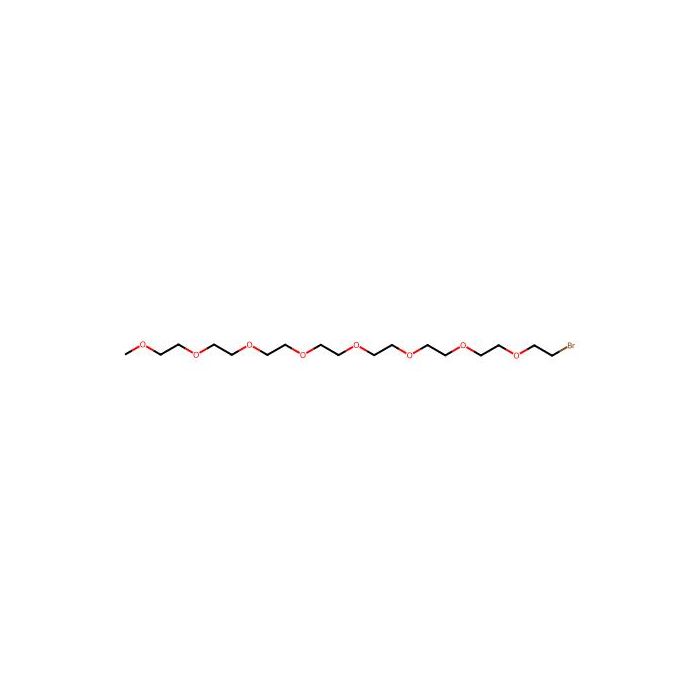
Monomethoxy-poly(ethylene glycol) with a terminal bromide (m-PEG8-bromide) is a bifunctional PEG oligomer: one terminus is capped with a non-reactive methoxy group (mPEG), and the opposite terminus bears an alkyl bromide that serves as a good leaving group for substitution and radical processes.

  • SKU: M596671
  • Product name: m-PEG8-bromide
  • CAS: 1056881-04-9
  • Molecular formula: Not specified for this item; refer to CoA/Spec Sheet.
  • Molecular weight: Not specified for this item; refer to CoA/Spec Sheet.
  • SMILES: Not specified for this item; refer to CoA/Spec Sheet.
  • InChIKey: Not specified for this item; refer to CoA/Spec Sheet.

Structural features (general/literature description):

  • Contains an oligomeric poly(ethylene glycol) chain of approximately 8 ethylene glycol repeat units, i.e., –CH2CH2O– repeated ~8 times.
  • One terminus is methyl-capped (–O–CH3), rendering that end non-nucleophilic and non-reactive under typical conditions.
  • The opposite terminus is an alkyl bromide (–(CH2)n–Br or equivalent), functioning as a primary electrophile for SN2 substitutions and as a halide initiator site for controlled radical polymerizations (e.g., ATRP).
  • 2D description in words: a flexible, hydrophilic PEG chain (≈ eight –CH2–CH2–O– links) with a methyl ether at one end and a bromomethylene/bromoalkyl handle at the other for derivatization.

Notes on identity (applicability):

  • Exact spacer length adjacent to the bromide (e.g., methylene count before Br), precise MW, and polydispersity are item-specific and should be confirmed on the CoA/Spec Sheet for this SKU.
Synthetic Utility

m-PEG8-bromide is a practical PEGylating electrophile and polymer-initiator that integrates a hydrophilic spacer into molecules, surfaces, and macromolecules.

Functional group reactivity (literature/general):

  • Terminal alkyl bromide: Undergoes SN2 substitution with soft/hard nucleophiles (RS−, RO−, N3−, R2NH), enabling modular conversion to a breadth of end-groups (thioethers, ethers, quaternary ammonium salts, azides for click).
  • PEG backbone: Chemically robust under mild conditions; confers solubility in polar media and can act as a phase-transfer shuttle between aqueous/organic phases.
  • Methoxy cap: Prevents undesired reactions at the opposite end, ensuring monofunctional installation.

Use cases:

  • Build hydrophilic spacers on small molecules (phenols, thiols) via O- or S-alkylation to improve solubility and reduce aggregation.
  • Prepare mPEG–N3 via azidation, then perform CuAAC/SPAAC to attach ligands, dyes, or handles to biomolecules or surfaces.
  • Serve as a macroinitiator for ATRP/ARGET ATRP to grow blocks (PMMA, polystyrene, polyacrylates) from PEG, yielding amphiphilic block copolymers and brushes.
  • Fabricate antifouling coatings by grafting-to or grafting-from strategies on silica, gold (via thiol linkers), oxides, or polymer substrates.

Strategic notes:

  • Verify high end-group fidelity to avoid crosslinking/gelation from difunctional impurities.
  • Choose base/nucleophile and solvent to balance rate and selectivity; minimize elimination or over-alkylation with amines by stoichiometry and temperature control.
  • For scale-up, consider greener solvents or PTC to reduce reliance on DMF/NMP.
Target Specificity

This product is a small-molecule/oligomeric reagent and does not have biological “target specificity” in the sense of antibodies, enzymes, or receptor ligands.

  • Antigen/epitope, species reactivity, clone, isotype: Not applicable for this item.

If your workflow involves targeting biomolecules, convert the bromide to an appropriate handle (e.g., azide for click, NHS-ester after suitable transformation) and select targeting moieties separately.

Domande frequenti

What is the purity of this product?
This product is supplied at ≥98% purity (chemical assay). Lot-specific values are stated on the Certificate of Analysis.
How should this product be stored?
Store at ?20 °C. Freezer storage is required to maintain the specified shelf life.
How is this product shipped?
This product ships in an insulated container with ice pads. Unpack on arrival and transfer it to the storage condition stated above.
What are the CAS number, molecular formula and molecular weight?
The CAS Number is 1056881-04-9, the molecular formula is C17H35BrO8, and the molecular weight is 447.4 g/mol.
What documentation is provided?
Available product documentation, including Certificates of Analysis (COA), Safety Data Sheets (SDS), and specification sheets, is shown in the product document area. Document availability and access follow the current site policy.

Desidera che le inviamo un messaggio quando avremo sconti disponibili?

Ricordamelo più tardi

Grazie! Controlli la sua casella di posta per confermare.

Ops! Le notifiche sono disabilitate.