≥98% for sensitive chromatographic and analytical workflows requiring minimal baseline interference.
🌡
Storage & shipping
Store at -20°C Ships Ice chest + Ice pads Check lot-specific COA for exact specifications.
📋
Quality documents
SDS, COA, datasheet, and spec sheet available for download. Lot-specific COA accessible via lot number lookup.
📚
Literature proof
Cited in 0 peer-reviewed publications across chromatography, organic synthesis, and cross-coupling reactions.
Panoramica
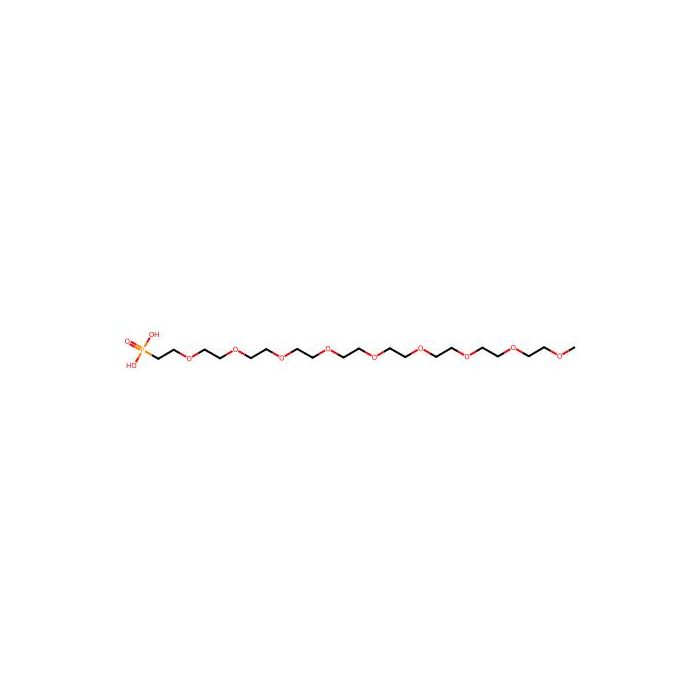
m-PEG9-phosphonic acid ethyl ester is a PEG chain derivative. The hydrophilic PEG linkers increase the water solubility of compound in aqueous media. Longer PEG chains have better water solubility properties relative to shorter PEG chains.
Specifications
Specifiche e purezza
≥98%
Condizioni di conservazione di stoccaggio
Store at -20°C
Spedito in
Ice chest + Ice pads
Questo prodotto richiede spedizione a catena fredda. I servizi di terra e altri servizi economici non sono disponibili.
Purezza
≥98%
Nomi e identificatori
Peso molecolare
492.5
Documentazione
📋 Safety Data Sheet (SDS)
Comprehensive hazard, handling, storage, and regulatory compliance document.
Certificati (CoA, COO, BSE/TSE e tabella di analisi)
C of A & Other Certificates(BSE/TSE, COO):
Analytical Chart:
Calcolatori di soluzioni
Molarity Calculator
Determine the necessary mass, volume, or concentration for preparing a solution.
Dilution Calculator
Determine the dilution needed to prepare a stock solution.
Reconstitution Calculator
Recensioni
Recensioni dei clienti
Application Protocols
No manufacturer-validated protocols are provided for this specific item. The following are general, literature-based workflows to guide setup and optimization.
A. Monolayer formation on TiO2 or ITO substrates (general):
Surface prep: Clean substrates (solvent rinse), then activate (UV-ozone 15–30 min or O2 plasma 5–10 min) to increase –OH density.
Solution: 0.5–2 mM m-PEG9-phosphonic acid in EtOH or EtOH/water; adjust to pH ~2–3 with HCl if using aqueous media.
Incubation: Immerse substrates 2–12 h at RT (or 40–60°C for faster kinetics).
Rinse/dry: Rinse thoroughly with solvent and water; dry with N2.
Optional cure: 80–120°C for 30–60 min to strengthen P–O–M bonds (verify substrate stability).
Characterization: Contact angle, ellipsometry, XPS, ATR-FTIR, and AFM for coverage and thickness.
B. Ligand exchange on metal oxide nanoparticles (general):
Disperse nanoparticles in EtOH or water (low ionic strength).
Add m-PEG9-phosphonic acid at 5–20× molar excess vs. estimated surface sites; pH 3–6.
Stir 2–24 h at RT; monitor dispersion visually and by DLS.
Purify by centrifugation and redispersion or by dialysis (MWCO chosen per particle size); repeat until supernatant shows minimal 31P signal.
Validate by zeta potential shift, TGA (organic loading), and stability tests (salt/pH).
These protocols are starting points; optimize concentration, time, and temperature for your substrate and performance goals.
Biological Roles
Applicability: This is a synthetic PEGylated phosphonic acid intended for materials/surface science. It does not have intrinsic biological activity specified for this product.
General/literature perspective:
PEG segment:
PEG is widely regarded as chemically inert and highly hydrophilic, promoting water compatibility and reducing protein adsorption via steric repulsion and hydration shells.
PEGylated surfaces often exhibit reduced cell adhesion and biofouling; the effect scales with chain length and grafting density.
Phosphonic acid terminus:
Provides strong coordination to metal ions and oxide surfaces; not a typical metabolite in mammalian systems. Phosphonates can resist enzymatic hydrolysis compared with phosphates due to P–C bonds in many phosphonates; here the anchor is used for materials binding rather than metabolic mimicry.
Biointerfaces:
m-PEG9-phosphonic acid can be used to create bioinert interfaces on oxide-containing devices, sensors, and nanoparticles to minimize nonspecific protein adsorption during in vitro assays.
Caveats:
No biological targets, pathways, or pharmacology are claimed or provided for this item.
Any use involving cells/biomolecules should be validated for cytocompatibility and endotoxin levels as needed for the specific assay context.
Item-specific biological data (e.g., endotoxin content, bioburden): Not specified for this item; refer to CoA/Spec Sheet if such testing is offered.
Buffer Applications
This product is not a buffering agent per se. However, solutions are commonly prepared in aqueous media for surface modification or nanoparticle work.
Practical guidance (general):
Solubility and pH:
Readily dissolves in water; the phosphonic acid group exhibits pKa1 ~1–2 and pKa2 ~6–7 (literature), so speciation depends on pH. Near neutral pH, mono-/di-anionic forms predominate, increasing solubility but potentially altering oxide binding mode.
Recommended media for applications:
For surface grafting on oxides: use deionized water, dilute HCl-adjusted water (pH 2–4), or alcohol/water mixtures to promote strong anchoring; avoid high ionic strength until after grafting.
For nanoparticle dispersions: low-ionic-strength buffers (e.g., 1–10 mM) can help stabilize colloids; avoid buffers rich in multivalent cations (phosphate with Ca2+/Mg2+) that may bridge/precipitate phosphonates.
Compatibility notes:
Phosphate buffers can compete with phosphonic acid for oxide surface sites; if strong binding to oxides is desired, use non-phosphate buffers during the grafting step (e.g., acetate, citrate at appropriate pH), then exchange later if required.
Item-specific buffer preferences/concentrations: Not specified for this item; optimize empirically for your substrate and application.
Green Alternatives
Perspective: The compound itself is a PEG-based, water-compatible modifier. Greener choices relate to solvent selection, processing conditions, and alternative anchoring chemistries with lower environmental footprints.
Greener processing choices (general):
Prefer water or aqueous alcohols over high-boiling polar aprotics (DMSO/DMF) whenever solubility/performance allows.
Use lower temperatures and shorter curing times to reduce energy use; consider UV/thermal post-treatments optimized for minimal energy.
Alternative anchoring chemistries (trade-offs):
Carboxylates: greener synthesis routes are possible, but carboxylate binding to oxides is generally weaker and less hydrolytically stable than phosphonates.
Silanes: effective on silica/silica-rich surfaces with robust Si–O–Si bonds; however, many alkoxysilanes are moisture-sensitive and may release alcohols; hydrolysis/condensation generates byproducts.
Catechols (e.g., dopamine anchors): strong adhesion to many substrates and can be prepared in water; catechols are oxidation-sensitive and can crosslink undesirably.
Comparison summary (literature/general):
Phosphonate vs carboxylate: higher binding strength/stability for phosphonates on Ti/Al oxides; slightly more specialized synthesis.
Phosphonate vs silane: broader oxide compatibility for phosphonates (beyond silica); silanes excel on silica but need careful moisture control.
Mini table (general characteristics):
Water as solvent: lowest environmental impact, slower drying.
EtOH/iPrOH: low toxicity, good volatility, renewable sources available.
DMSO: relatively benign but difficult to remove; DMF: effective solvent but reproductive toxin—avoid when possible.
No item-specific environmental metrics are provided; choose conditions aligning with your lab’s green chemistry goals.
Pharmaceutical Uses
No pharmacopeial status, excipient grade, or GMP-related information is provided for this item. It is supplied for research use only.
General context (non-clinical, non-therapeutic):
PEG-based phosphonate modifiers are sometimes employed in R&D to adjust surface properties of inorganic excipients, sensors, or diagnostic device components, imparting hydrophilicity and lowering nonspecific adsorption during in vitro evaluations.
As a surface modifier for nanoparticles in formulation research, phosphonate-terminated PEGs can enhance aqueous dispersibility and provide steric stabilization during process development studies.
Considerations for formulation research (general):
Residual solvent, metal content, endotoxin/bioburden, and polydispersity of PEG chains can affect reproducibility in analytical or device studies—verify via CoA/Spec Sheet.
Buffer selection can impact stability and binding to inorganic substrates; avoid buffers or ions that compete for surface sites during coating steps.
Caution:
No claims are made regarding suitability for human or veterinary use. Do not use for clinical or diagnostic purposes. If translation toward regulated applications is intended, source appropriate GMP-grade materials and perform full qualification.
Physical Properties
Item-specific specifications:
Appearance: Not specified for this item; refer to CoA/Spec Sheet.
Molecular weight: Not specified for this item; refer to CoA/Spec Sheet.
Other physicochemical specs (mp/bp, water/peroxide content, UV cutoff, refractive index): Not specified for this item; refer to CoA/Spec Sheet.
General/literature characteristics for mPEG oligomers with phosphonic acid termini (for context only):
Physical state: typically a waxy solid or highly viscous syrup at ambient temperature for PEG chains of ~9 units; exact state depends on microstructure and counterion/water content.
Solubility: highly soluble in water and polar protic solvents (MeOH, EtOH), and in polar aprotics (DMSO, DMF). Limited solubility in nonpolar solvents (hexanes, toluene).
Hydrophilicity: PEG chains are strongly hydrophilic; expect low logP and strong hydrogen-bonding with water (literature: PEG oligomers are miscible with water across a broad range).
pKa (phosphonic acid): typically two stepwise acidities; pKa1 ~1–2 and pKa2 ~6–7 (literature, varies with substituents and medium). Consequently, the group is largely mono/deprotonated near neutral pH, which enhances water solubility and binding to metal oxides.
Thermal behavior: PEG segments soften with increasing temperature and may show glass-transition-like behavior rather than a sharp melting point for short oligomers (literature observation). Avoid prolonged heating when bound to surfaces to prevent degradation.
Note: Exact numerical values for this catalog item are not provided here; consult the CoA/Spec Sheet for item-specific data.
Quality and Grades
Item-specific grade/purity: Not specified for this item; refer to CoA/Spec Sheet.
Research use statement: For research use only (per Product Data). Not for human or animal diagnostic or therapeutic use.
General guidance on quality considerations for mPEG–phosphonic acids:
Purity dimensions typically relevant:
Oligomer distribution (Poisson-like around the target repeat number) and low polydispersity for discrete mPEG oligomers.
End-group fidelity: quantitative methoxy capping and correct phosphonic acid functionality (absence of phosphate or ester impurities when not intended).
Residual solvents/reagents: removal of chlorophosphorylating agents, coupling reagents, and metal catalysts if used in synthesis.
Practical implications:
Surface chemistry applications (e.g., SAMs on TiO2/ITO) benefit from high end-group fidelity to maximize surface coverage and binding strength.
Chromatographic or spectroscopic applications may require low UV-absorbing impurities; HPLC/UV profiles and 1H/31P NMR are common QC tools.
Stabilizers: None specified for this item. In general, PEGylated materials do not commonly include added stabilizers; if present, they should be disclosed on the CoA.
Documentation to request/consult:
CoA for lot-specific assay, water content (Karl Fischer), residual solvents, and 1H/13C/31P NMR.
Spec Sheet for recommended analytical acceptance criteria and application guidance.
Reaction and Applications
Focus: m-PEG9-phosphonic acid is primarily a surface-anchoring, hydrophilic modifier rather than a classical stoichiometric reagent. Its strengths lie in building robust, antifouling, and dispersing layers on inorganic materials.
Surface functionalization of metal oxides (literature/general):
Phosphonic acids bind strongly (mono-/bi-/tridentate) to TiO2, ZrO2, Al2O3, HfO2, ITO, Fe3O4, and similar oxides, forming durable monolayers or polymer brushes via physisorption and chemisorption.
Applications: antifouling coatings, colloidal stabilization of nanoparticles, improved wettability, suppression of nonspecific adsorption, and interfacial engineering in electronics/OPV/Perovskite devices.
Ligand exchange on nanoparticles:
Replace native ligands (e.g., oleic acid) with PEG-phosphonates to impart water dispersibility and reduce aggregation; typical workflows use alcohol/water at mildly acidic pH with excess ligand and subsequent purification (centrifugation/dialysis).
Hybrid materials and adhesion promoters:
Acts as a coupling/adhesion layer between inorganic fillers (TiO2, silica with hydroxylated surfaces) and polymer matrices, enhancing dispersion and mechanical/optical properties.
Immobilization scaffolds:
Terminal methoxy provides inert terminus, minimizing nonspecific interactions; the PEG spacer (~9 units) creates a defined steric barrier distance from the surface.
Practical tips:
Pre-clean and hydroxylate oxide surfaces (UV-ozone, piranha, oxygen plasma) to increase surface –OH density.
Control pH (≈2–4) during deposition to favor protonated surface sites and strong anchoring; rinse thoroughly and consider mild thermal curing to strengthen P–O–M bonds.
Note: No manufacturer application text was provided for this item; guidance above reflects general literature practices.
Reaction Conditions
General, literature-based guidance for typical use scenarios (not item-specific specifications):
Self-assembly on metal oxides (TiO2, ZrO2, ITO):
Solvent: EtOH, iPrOH, or water/EtOH mixtures; alternatively, dry polar aprotics (DMF) for challenging substrates.
Concentration: 0.1–5 mM in solution is commonly reported for monolayer formation; optimize for substrate area and desired coverage.
pH: mildly acidic (pH 2–4) aqueous conditions enhance surface protonation and binding; avoid strongly basic conditions during grafting.
Temperature/time: ambient to 60°C for 1–24 h for adsorption; optional post-anneal at 80–120°C (30–120 min) to strengthen P–O–M bonding (ensure substrate compatibility).
Rinsing: extensive rinsing with solvent and water to remove physisorbed excess; drying under N2.
Ligand exchange on nanoparticles:
Medium: alcohol or water; ionic strength kept low initially.
Stoichiometry: excess ligand (5–50× vs. estimated surface sites) to drive exchange; monitor by zeta potential/DLS and 31P NMR (supernatant) where feasible.
Purification: centrifugation, dialysis, or ultrafiltration to remove unbound ligand.
Stability considerations:
Elevated temperatures and prolonged exposure to strong oxidants can degrade PEG; avoid metal-catalyzed oxidation.
Multivalent cations (Ca2+, Fe3+) may crosslink phosphonates; control during processing unless crosslinking is desired.
Note: Expected yields/coverages depend on substrate and conditions; consult the primary literature for your specific system.
Safety and Handling
GHS classification, signal word, pictograms, and H-statements: Not specified for this item; refer to SDS for authoritative safety information.
General hazard profile (literature/general):
PEG oligomers are generally considered of low acute toxicity and low volatility; the phosphonic acid terminus imparts acidity (corrosivity is typically mild-to-moderate compared to strong mineral acids, but can be irritant).
Polyethers can form peroxides upon prolonged exposure to air/UV, especially in the presence of metal contaminants; risk is lower than for low-MW dialkyl ethers but good practice is to store away from light and monitor long-stored solutions.
Recommended PPE and practices:
Wear lab coat, safety glasses, and appropriate chemically resistant gloves (e.g., nitrile). Handle in a fume hood when making solutions or heating.
Avoid contact with eyes/skin; in case of contact, rinse with copious water. If ingested or inhaled as aerosol, seek medical advice; provide SDS to healthcare personnel.
Incompatibilities and reactivity (general):
Strong oxidizers may degrade the PEG backbone; strong bases/acids can alter ionization state and promote hydrolysis/dehydration at elevated temperatures.
Multivalent metal salts may form complexes or insoluble phosphonate salts; mixing concentrated solutions with Ca2+/Mg2+/Fe3+ can induce precipitation.
Spills and waste:
Absorb small spills with inert material; rinse residue with water. Dispose of waste according to institutional and local regulations.
Storage notes (item-specific): Store at −20°C (per Product Data). Protect from moisture; tightly cap to minimize water uptake.
Solvent Selection
Applicability: As a highly polar, hydrophilic PEGylated acid, m-PEG9-phosphonic acid dissolves readily in aqueous and polar organic media. Solvent choice should balance substrate compatibility (e.g., oxide surfaces), ionization state, and downstream processing.
Polarity/miscibility (general):
Water: typically freely soluble; degree of ionization (pH) affects binding to oxides and solubility.
Alcohols: MeOH, EtOH, iPrOH—good solvents for solution processing and dip-coating.
Polar aprotics: DMSO, DMF—excellent solubility; useful for high-concentration stock solutions.
Nonpolar solvents: limited solubility (toluene, hexanes); addition of alcohol cosolvents can help.
Selection guidance by use case:
Surface modification of metal oxides (TiO2, ZrO2, ITO): water/EtOH mixtures (e.g., 50–95% EtOH) or dry polar aprotics minimize premature ion-exchange; mildly acidic water can enhance anchoring.
Nanoparticle ligand exchange: use alcohols or water with controlled ionic strength; avoid high concentrations of multivalent cations that can bridge/precipitate.
Film formation/dip-coating: EtOH or iPrOH evaporate cleanly and reduce coffee-ring effects relative to water.
Comparison snapshot (general):
Water: greenest, best for biocompatible workflows; slow drying.
EtOH/iPrOH: good volatility, broad compatibility with oxides.
DMSO/DMF: maximal solubility; more challenging to remove, potential residue on surfaces.
Note: No item-specific solvent restrictions are provided. Always verify substrate compatibility and desired surface chemistry before scale-up.
Storage and Reconstitution
Item-specific storage and shipping:
Storage Conditions: Store at −20°C (per Product Data).
Shipped In: Ice chest + ice pads (per Product Data) to maintain low temperature during transit.
General handling best practices:
Hygroscopicity: PEG-based materials can absorb moisture; keep container tightly sealed. Warm to room temperature in a desiccator before opening to minimize condensation.
Light/air: Store protected from light; minimize headspace and repeated air exposure for long-term stability.
Aliquoting: If frequent use is anticipated, aliquot into small, dry vials to avoid repeated freeze–thaw and moisture uptake.
Reconstitution and solution preparation (general):
Solvents: Readily dissolves in water, ethanol, and polar aprotics (DMSO/DMF). Choose solvent compatible with your substrate and application.
Concentration: Prepare stock solutions as needed (e.g., 10–100 mM) based on solubility and downstream use; filter through 0.22 µm if particulate-free solutions are required.
pH control: For oxide grafting, mildly acidic solutions (pH ~2–4) often improve anchoring; for nanoparticle stabilization, adjust pH and ionic strength to balance charge and colloidal stability.
Shelf life and quality control:
No item-specific shelf-life is provided; monitor by 1H/31P NMR or IR for integrity if stored long term.
For critical applications, verify water content (KF) and absence of particulates before use.
Always consult the product’s CoA/Spec Sheet and SDS for lot-specific guidance.
Structure and Identity
Brief description: m-PEG9-phosphonic acid is a methoxy-capped oligo(ethylene glycol) with approximately nine ethylene oxide repeat units terminating in a phosphonic acid (–PO3H2) anchor group.
Item-specific identifiers from Product Data:
CAS: 2055016-25-4
SKU: M597142
InChIKey: Not specified for this item; refer to CoA/Spec Sheet.
SMILES: Not specified for this item; refer to CoA/Spec Sheet.
Molecular formula: Not specified for this item; refer to CoA/Spec Sheet.
Molecular weight: Not specified for this item; refer to CoA/Spec Sheet.
Structural features (general description; literature):
Backbone: linear polyether segment consisting of ~9 –CH2–CH2–O– units (PEG9).
End groups: one terminus is methoxy (–O–CH3), the opposite terminus is a phosphonic acid (–PO3H2) functionality.
Stereochemistry: none (achiral backbone; no stereocenters expected).
2D structure in words: a chain of alternating –CH2–CH2– and –O– linkages (PEG) starting from a methoxy group, ending with a short linker to a tetra-coordinated phosphorus center double-bonded to oxygen and bearing two hydroxyls (–P(=O)(OH)2).
Identity notes (general):
“m-PEG” denotes methoxy termination that suppresses further chain growth/reactivity on that end and imparts protein-resistance/antifouling character.
The phosphonic acid terminus provides strong, often bidentate/tridentate binding to metal oxide surfaces (e.g., TiO2, ZrO2, ITO, Fe3O4), enabling robust surface modification.
Synthetic Utility
While primarily a surface chemistry tool, m-PEG9-phosphonic acid can participate in several synthetic transformations and interfacial assemblies (general/literature guidance):
Surface coupling/assembly:
Formation of phosphonate–metal oxide bonds (P–O–M) via adsorption and condensation on hydroxylated surfaces; yields robust monolayers or grafted layers used as antifouling and wetting modifiers.
Derivatization (off-surface):
Conversion to phosphonate esters under dehydrative conditions (e.g., alcohols with coupling agents) to generate protected derivatives for further processing; subsequent deprotection regenerates –PO3H2 for binding.
Salt formation with alkali metals or amines to tune solubility and processing (e.g., sodium or triethylammonium salts for organic solvent compatibility).
Macromolecular assembly:
Acts as a hydrophilic spacer and terminator in blocky architectures or mixed monolayers, defining interfacial density and spacing relative to other functional ligands.
Retrosynthetic perspective:
The methoxy cap ensures inertness at one end; the phosphonic acid serves as the sole “handle” for surface attachment or further P-chemistry, simplifying orientation on surfaces.
Practical notes:
Avoid strong dehydrating conditions that could promote backbone degradation of PEG (e.g., high temps with strong acids); use mild coupling strategies when forming esters or salts.
Item-specific reactivity testing, catalysts, or conversions: Not specified; the above reflects general phosphonate/PEG chemistry.
Target Specificity
Not applicable. This product is a small-molecule/oligomeric surface modifier and does not target a biological antigen or receptor.
Item-specific immunochemical attributes (clone, isotype, species reactivity): Not applicable.
If used in bioassays, any observed selectivity arises from surface chemistry (e.g., antifouling via PEG) rather than biochemical target binding.
Domande frequenti
What is the purity of this product?
This product is supplied at ≥98% purity (chemical assay). Lot-specific values are stated on the Certificate of Analysis.
How should this product be stored?
Store at ?20 °C. Freezer storage is required to maintain the specified shelf life.
How is this product shipped?
This product ships in an insulated container with ice pads. Unpack on arrival and transfer it to the storage condition stated above.
What are the CAS number, molecular formula and molecular weight?
The CAS Number is 2055016-25-4, the molecular formula is C19H41O12P, and the molecular weight is 492.5 g/mol.
What documentation is provided?
Available product documentation, including Certificates of Analysis (COA), Safety Data Sheets (SDS), and specification sheets, is shown in the product document area. Document availability and access follow the current site policy.
We use cookies to ensure the website functions properly and, where permitted, to improve your experience. You can manage your preferences at any time in Settings. Learn more in our Cookie Policy.
Shall we send you a message when we have discounts available?
Remind me later
Thank you! Please check your email inbox to confirm.
Products are supplied to verified businesses, institutions, and qualified professionals for research and development use only. Not for use in humans, animals, diagnosis, or therapy.