This compound belongs to the class of organic compounds known as nitrobenzoic acids and derivatives. These are compounds containing a nitrobenzoic acid moiety, which consists of a benzene ring bearing both a carboxylic acid group and a nitro group on two different ring carbon atoms.
External Descriptors
Not available
1. Djoumbou Feunang Y, Eisner R, Knox C, Chepelev L, Hastings J, Owen G, Fahy E, Steinbeck C, Subramanian S, Bolton E, Greiner R, and Wishart DS. ClassyFire: Automated Chemical Classification With A Comprehensive, Computable Taxonomy. Journal of Cheminformatics, 2016, 8:61.
Determine the necessary mass, volume, or concentration for preparing a solution.
Dilution Calculator
Determine the dilution needed to prepare a stock solution.
Reconstitution Calculator
Recensioni
Recensioni dei clienti
Application Protocols
No assay or bioanalytical application protocols are specified for this chemical building block. For synthetic applications, refer to the Reaction Conditions section for representative procedures, and consult primary literature for scale-up and substrate-specific optimization.
Biological Roles
This product is a synthetic aromatic building block and is not intended for biological use in cells or organisms.
Biological function (applicability): Not a natural metabolite or cofactor; no inherent biological role is expected for this nitro-substituted aromatic ester.
Biochemical reactivity (general): Nitroaromatics can undergo bioreduction in vivo in other contexts, but such considerations are outside the scope of research reagent use and are not applicable here.
For any bioassay or cell exposure experiments, ensure appropriate toxicology risk assessment and consult the SDS. Research Use Only: not for use in diagnostic or therapeutic applications.
Buffer Applications
Not typically applicable. Methyl 2-bromo-3-nitrobenzoate is a non-ionic, poorly water-soluble organic building block and is not used to prepare laboratory buffer systems. For practical use, focus on the Solvent Selection and Reaction & Applications sections for guidance.
Green Alternatives
Greener choices often center on solvent and catalyst selection rather than replacing the substrate. Consider the following options when planning syntheses with this aryl bromide.
Solvent alternatives (general):
Replace DMF/dioxane with 2-MeTHF, CPME, or bio-based EtOAc where compatible with catalyst/base.
Use aqueous micellar media (e.g., TPGS-750-M systems) for Suzuki couplings to reduce organic solvent usage.
Base and workup (general):
Favor inorganic carbonate/phosphate bases in water-containing media; simplify workup and reduce halogenated solvent use.
Hydrogenation/reduction (general):
Use EtOAc, EtOH, or MeOH instead of chlorinated solvents for nitro reductions; minimize catalyst loading and recover Pd/C where possible.
Comparison snapshot (general):
THF vs 2-MeTHF: Similar polarity; 2-MeTHF derived from renewable feedstock and offers easier phase separation in aqueous workups.
DCM vs EtOAc: EtOAc has a better environmental profile and sufficient solvency for this substrate in many steps.
Note: While bromides are widely used for cross-coupling, iodides can increase reactivity but are less sustainable; conversely, chlorides are greener/cheaper but often require more active catalysts. Balancing substrate reactivity with greener conditions is recommended.
Pharmaceutical Uses
This material is supplied for research use only and is not formulated as a pharmaceutical ingredient.
Typical role (general for building blocks): An intermediate in multi-step syntheses toward active pharmaceutical ingredients (APIs) or advanced intermediates, enabling modular installation of aryl, amine, or carbonyl functionality via cross-coupling and selective reductions.
Excipient/compendial status: Not an excipient and not compendial; no pharmacopeial monograph is expected for this fine chemical.
Process considerations (general): Choice of coupling ligand/base and control of nitro reduction are key to minimize genotoxic impurities; process development should include robust purge studies for Pd and residual halides.
No therapeutic or clinical claims are made for this product.
Physical Properties
Only limited item-specific physical data are provided for this catalog entry. Refer to the product CoA/Spec Sheet for definitive specifications.
Appearance (item-specific): Not specified for this item; refer to CoA/Spec Sheet.
Melting point (literature): Not specified here; consult primary literature or CoA.
Boiling point (literature): Not typically distilled; thermally labile before boil; consult literature if needed.
Density (literature): Not specified here.
Solubility (general/literature expectations):
Organic: Expected to be soluble in moderately polar aprotic solvents (e.g., DCM, THF, EtOAc, MeCN, DMF, DMSO) due to aromatic/ester character.
Aqueous: Expected to be sparingly soluble in water.
LogP, pKa, refractive index: Not specified here; consult literature or predictive tools for planning.
Practical note (general): As an aromatic ester bearing polar substituents, it generally behaves as a crystalline solid with good solubility in common organic reaction solvents suitable for cross-coupling and reduction chemistry.
Quality and Grades
Grade/Purity (item-specific): Not specified for this item; refer to CoA/Spec Sheet.
What grade implies (general guidance):
Research-grade aryl bromide building blocks are typically supplied with GC/HPLC purity suitable for synthesis; specific impurity profiles (e.g., residual halides, unreacted starting materials, moisture) are batch-dependent and provided on the CoA.
UV-Vis characteristics of nitroaromatics can affect photometric methods; for chromatography, low-UV impurity content can be important if using as a standard.
Stabilizers/additives (item-specific): Not specified for this item; refer to CoA/Spec Sheet.
Quality controls (general):
Identity commonly confirmed by 1H/13C NMR, MS, and, for halogenated aromatics, HRMS or elemental analysis; some suppliers may provide HPLC traces.
Water and residual solvent content are often measured by Karl Fischer and GC; exact specifications are lot-specific.
For regulatory or method development work, request the latest CoA/Spec Sheet for confirmed purity, residual solvent profile, and analytical data supporting identity.
Reaction and Applications
As a multifunctional aryl bromide, Methyl 2-bromo-3-nitrobenzoate is valuable in modular synthesis where orthogonal transformations are advantageous.
Cross-coupling platform (literature/general):
Suzuki–Miyaura coupling at the aryl bromide with boronic acids/esters to access 2-aryl-3-nitrobenzoate scaffolds. Bases: K2CO3, Cs2CO3, K3PO4; solvents: dioxane/H2O, toluene/H2O, 2-MeTHF.
Buchwald–Hartwig amination to introduce anilines; careful conditions required due to deactivating –NO2/–CO2Me groups; BrettPhos/XPhos ligands can be effective.
Carbonylation couplings (Pd-catalyzed) to generate amides/esters under CO.
Nitro group transformations (literature/general):
Chemoselective reduction to an aniline (e.g., H2/Pd-C, Fe/AcOH, SnCl2/HCl), enabling subsequent intramolecular cyclizations or acylations. Control conditions to preserve the methyl ester.
Nucleophilic aromatic substitution is generally disfavored at the bromine due to substitution pattern; coupling pathways are preferred.
Ester group manipulations (literature/general):
Saponification to the corresponding acid for subsequent amide coupling (e.g., EDC/HOBt, HATU) or Curtius/Schmidt rearrangements.
Transesterification to tune protecting group or solubility.
Orthogonal strategy examples:
Sequence 1: Suzuki on Ar–Br → nitro reduction → intramolecular amidation from acid (after saponification).
Sequence 2: Nitro reduction → Buchwald amination (now on an activated aniline) → ester hydrolysis.
Tip: The –NO2 and –CO2Me lower aryl bromide reactivity; employ more active catalysts/ligands or higher temperatures to achieve efficient couplings.
Reaction Conditions
The following conditions are representative literature guidance for aryl bromides bearing deactivating groups; optimize per substrate and scale.
Suzuki–Miyaura coupling (general literature):
Catalyst: 1–3 mol% Pd(PPh3)4 or Pd2(dba)3 with XPhos/SPhos.
Base: K2CO3 or K3PO4 (2–3 equiv).
Solvent: 1,4-dioxane/H2O (3:1) or 2-MeTHF/H2O; 80–100 °C, 2–12 h.
Notes: Water improves boronate activation; higher activity ligands mitigate ring deactivation by –NO2/–CO2Me.
Buchwald–Hartwig amination (general literature):
Catalyst: Pd2(dba)3 (1–2 mol%) with BrettPhos or RuPhos; base: NaOtBu or Cs2CO3.
Solvent: Toluene, dioxane, or CPME; 90–110 °C, 6–24 h.
Notes: Avoid strongly basic/wet media if ester integrity is critical; consider protected amines.
Sonogashira coupling (general literature):
Catalyst: Pd(PPh3)2Cl2 (1–2 mol%) + CuI (5 mol%); base: Et3N or i-Pr2NH; solvent: THF, Et3N; rt–60 °C, 2–8 h.
H2 (1–3 bar), Pd/C (5–10 wt% relative), EtOH or EtOAc, rt–40 °C, 2–6 h; or Fe/AcOH or SnCl2/HCl at reflux.
Notes: Monitor for over-reduction or ester hydrogenolysis; choose solvent/pressure accordingly.
Ester hydrolysis (general literature):
Aqueous NaOH/MeOH or THF/H2O, 0–50 °C, 1–6 h; acidification to isolate the acid.
Typical isolated yields for well-optimized couplings of deactivated aryl bromides: 60–90% (literature range), dependent on partner and ligand.
Safety and Handling
GHS classification and hazard statements are not specified in the provided Product Data. Always review the SDS for authoritative safety information before use.
GHS/CLP (item-specific): Not specified for this item; refer to SDS.
Likely hazards (general guidance for similar nitroaromatic aryl bromides):
Irritation to skin/eyes/respiratory tract; harmful if swallowed or inhaled. Nitroaromatics may pose methemoglobinemia risk on significant exposure. Avoid dust formation.
PPE (good laboratory practice):
Wear lab coat, safety glasses or face shield, and appropriate chemical-resistant gloves (e.g., nitrile). Handle in a fume hood.
Incompatibilities (general): Strong bases (saponification), strong reducing agents (may reduce nitro group), strong oxidizers, and moisture for long-term ester integrity.
Special risks and precautions (general):
Thermal decomposition may produce irritating/toxic fumes (NOx, HBr).
Avoid heating under confinement; if performing hydrogenations (nitro reduction), manage hydrogen and exotherm safely.
First aid (overview; defer to SDS):
Inhalation: Move to fresh air; seek medical attention if symptoms persist.
Skin/eye contact: Rinse with water for at least 15 minutes; remove contaminated clothing; obtain medical advice.
Ingestion: Rinse mouth; do not induce vomiting; seek medical attention.
Always consult the SDS and institutional safety protocols prior to scale-up or new applications.
Solvent Selection
This compound is an aromatic ester bearing aryl bromide and nitro substituents; it dissolves readily in common organic solvents used for cross-couplings and functional group interconversions.
Polarity class (general): Moderately polar, non-protic aromatic ester.
Poor: Water; alkanes (hexanes) unless warmed or with co-solvent.
Selection tips (general):
Cross-coupling: Dioxane, THF, toluene, CPME, or 2-MeTHF often perform well; water co-solvent (10–30%) can aid base solubility for Suzuki.
Nitro reduction: EtOH, i-PrOH, EtOAc, or MeOH for catalytic hydrogenation; avoid strong basic media if ester retention is desired.
Ester hydrolysis: MeOH/H2O/NaOH for saponification; keep temperature controlled to avoid side reactions.
Small comparison (general):
THF vs 2-MeTHF: 2-MeTHF offers greener profile and higher boiling point, aiding higher-temperature couplings; THF offers broader literature precedent.
DMF/DMSO vs MeCN: Polar aprotics increase solubility of salts and substrates but complicate workup; MeCN offers easier removal and lower toxicity than DMF.
Shipping (item-specific): Normal shipping conditions.
Container and atmosphere (general best practice): Store tightly closed in an inert atmosphere (e.g., nitrogen) if possible to minimize hydrolysis over long-term storage. Protect from prolonged moisture and strong light.
Stability considerations (general): Stable under recommended conditions. Avoid strong bases or reducing environments during storage to preserve the ester and nitro functionalities.
Reconstitution: Not applicable; use as supplied. For solution-phase use, prepare stock solutions in dry organic solvents (e.g., DCM, THF, MeCN, DMF) immediately prior to use and store short-term at 2–8 °C if needed.
Research Use Note: For research use only.
Consult the CoA/Spec Sheet and SDS for any lot-specific stability notes or recommended storage durations.
Structure and Identity
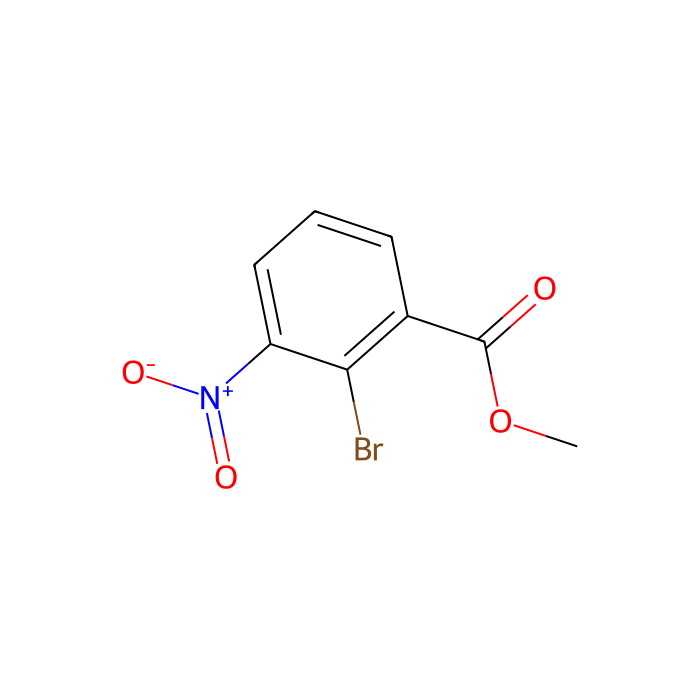
Methyl 2-bromo-3-nitrobenzoate is an ortho-brominated, meta-nitrated methyl benzoate derivative used as an aryl bromide building block for cross-coupling and as a multifunctional handle for orthogonal transformations.
Item-specific identifiers (from Product Data):
SKU: M193791
CAS: 5337-09-7
PubChem CID: 79263
InChIKey (as provided): 447580
Storage: Room temperature; Shipped: Normal
Molecular formula (literature/structure-derived): C8H6BrNO4
Aromatic benzene core bearing three substituents: a methyl ester (–CO2Me) at C1, bromine at C2 (ortho to the ester), and nitro (–NO2) at C3 (meta to the ester).
Functional groups: aryl bromide (cross-coupling handle), nitro group (reducible/transformable), and methyl ester (hydrolyzable/transesterifiable). No stereocenters.
Electronic character: strongly deactivated ring due to –CO2Me and –NO2; aryl bromide remains competent for Pd-catalyzed couplings.
Notes: Where precise identifiers are required (e.g., definitive InChIKey), consult the CoA/Spec Sheet for this specific lot.
Synthetic Utility
This substrate offers three orthogonally addressable handles that enable convergent synthesis strategies.
Aryl bromide (Ar–Br):
Cross-coupling to introduce diverse aryl, vinyl, alkynyl, or heteroaryl fragments (Suzuki, Heck, Sonogashira, Negishi, Kumada). Deactivation by –NO2/–CO2Me may necessitate more active catalysts/ligands.
Nitro group (–NO2):
Reduces to an aniline enabling diazotization (Sandmeyer variants), acylation, sulfonylation, or intramolecular cyclization to benzoxazinones/quinazolinones after suitable functionalization.
Methyl ester (–CO2Me):
Hydrolysis to acid for amide coupling, Curtius rearrangement to isocyanates/carbamates, or ester exchange to tune protecting groups and solubility.
Regiocontrol and orthogonality:
The ortho-bromide positions newly installed substituents adjacent to the carboxyl; subsequent transformations can leverage proximity effects (e.g., directed metalation of neighbor positions after nitro reduction).
Retrosynthetic value:
Serves as a linchpin for late-stage diversification of nitrobenzoate frameworks, allowing parallel library synthesis via modular coupling then chemoselective nitro reduction.
Overall, it is a robust platform for sequence planning where order of operations (couple → reduce → hydrolyze or variants) dictates outcome and selectivity.
Target Specificity
Not applicable. This product is a small-molecule synthetic reagent and is not an antibody, enzyme, or targeted biological agent. No target specificity data are associated with this item.
Domande frequenti
How should this product be stored?
Store at room temperature.
What is the purity of this product?
This product is supplied at ≥97% purity (chemical assay). Lot-specific values are stated on the Certificate of Analysis.
How is this product shipped?
This product ships under standard ambient conditions. No temperature-controlled packaging is required.
What are the CAS number, molecular formula and molecular weight?
The CAS Number is 5337-09-7, the molecular formula is C8H6BrNO4, and the molecular weight is 260.04 g/mol. InChIKey YUWPKYJCYRFBJT-UHFFFAOYSA-N.
What documentation is provided?
Available product documentation, including Certificates of Analysis (COA), Safety Data Sheets (SDS), and specification sheets, is shown in the product document area. Document availability and access follow the current site policy.
Utilizziamo i cookie per garantire il corretto funzionamento del sito web e, ove consentito, per migliorare la tua esperienza. Puoi gestire le tue preferenze in qualsiasi momento nelle Impostazioni. Per saperne di più, consulta la nostra Cookie Policy.
Desidera che le inviamo un messaggio quando avremo sconti disponibili?
Ricordamelo più tardi
Grazie! Controlli la sua casella di posta per confermare.
Products are supplied to verified businesses, institutions, and qualified professionals for research and development use only. Not for use in humans, animals, diagnosis, or therapy.

 D2020134