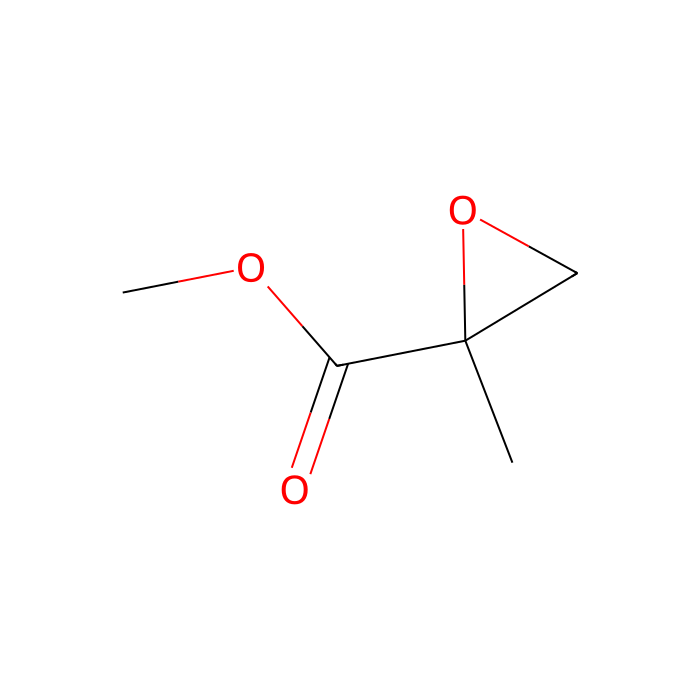
This compound belongs to the class of organic compounds known as oxirane carboxylic acids. These are compounds containing an oxirane ring bearing a carboxylic acid group.
External Descriptors
Not available
1. Djoumbou Feunang Y, Eisner R, Knox C, Chepelev L, Hastings J, Owen G, Fahy E, Steinbeck C, Subramanian S, Bolton E, Greiner R, and Wishart DS. ClassyFire: Automated Chemical Classification With A Comprehensive, Computable Taxonomy. Journal of Cheminformatics, 2016, 8:61.
Certificati (CoA, COO, BSE/TSE e tabella di analisi)
C of A & Other Certificates(BSE/TSE, COO):
Analytical Chart:
Proprietà chimiche e fisiche
Punto di infiammabilità (°F)
129.2 °F
Punto di infiammabilità (°C)
54 °C
Punto di ebollizione (°C)
62-65° C (lit.) at 32 mmHg
Peso molecolare
116.110 g/mol
XLogP3
0.000
Hydrogen Bond Donor Count
0
Hydrogen Bond Acceptor Count
3
Rotatable Bond Count
2
Exact Mass
116.047 Da
Monoisotopic Mass
116.047 Da
Topological Polar Surface Area
38.800 Ų
Heavy Atom Count
8
Formal Charge
0
Complexity
121.000
Isotope Atom Count
0
Defined Atom Stereocenter Count
0
Undefined Atom Stereocenter Count
1
Defined Bond Stereocenter Count
0
Undefined Bond Stereocenter Count
0
The total count of all stereochemical bonds
0
Covalently-Bonded Unit Count
1
Calcolatori di soluzioni
Molarity Calculator
Determine the necessary mass, volume, or concentration for preparing a solution.
Dilution Calculator
Determine the dilution needed to prepare a stock solution.
Reconstitution Calculator
Recensioni
Recensioni dei clienti
Application Protocols
Not applicable. No antibody- or assay-specific applications (WB, IHC, IF, FC) are associated with this small-molecule reagent. For synthetic applications, see the Reaction Conditions and Synthetic Utility sections for general guidance.
Biological Roles
This product is a synthetic small molecule epoxide ester intended for chemical synthesis. No endogenous biological role is associated with methyl 2‑methylglycidate.
General considerations (chemistry/biochemistry):
Low‑molecular‑weight epoxides can react with nucleophilic biomolecules (e.g., proteins containing cysteine/lysine) via ring‑opening, which underlies typical irritation/sensitization concerns. This is a safety consideration, not a biological function.
Esters can undergo enzymatic hydrolysis in biological systems; however, this product is for research and laboratory chemical synthesis only and is not intended for biological exposure studies without appropriate approvals.
Research Use Only: Not for human or animal diagnostic or therapeutic applications.
Buffer Applications
Not typically applicable. Methyl 2‑methylglycidate is an organic epoxide ester and is not used as a buffering agent. In aqueous buffers it can undergo hydrolysis and ring‑opening. For work in aqueous systems, consider biphasic conditions, controlled pH, and minimize residence time to limit decomposition.
Green Alternatives
While methyl 2‑methylglycidate itself is the target electrophile, greener choices can be made around solvent selection and catalysis.
Greener solvent options (literature/guidance):
2‑MeTHF vs THF: 2‑MeTHF is biorenewable, less miscible with water (facilitates separations), and has a higher boiling point, reducing VOC emissions. THF often offers slightly higher solubility and lower viscosity at low temperature.
Ethyl acetate vs dichloromethane: EtOAc is biodegradable, low toxicity, and non‑halogenated; CH2Cl2 offers strong solvating power and Lewis acid compatibility but with higher environmental and health burdens.
Green alcohols (iPrOH, EtOH) as nucleophile/solvent can minimize solvent inventory by dual use, but monitor for transesterification and selectivity shifts.
Catalysis and process intensification:
Use catalytic amounts of Lewis acids (e.g., Zn(OTf)2, Sc(OTf)3) or organocatalysts instead of stoichiometric promoters where feasible to reduce waste.
Employ flow chemistry for exothermic ring‑openings to improve heat transfer and reduce solvent volumes.
Comparison snapshot (general):
THF: petroleum-derived, low bp, peroxide‑forming; excellent for metal reagents.
2‑MeTHF: bio‑based, higher bp, lower peroxide tendency, good for cuprates and organomagnesiums, easier phase separation.
CH2Cl2: excellent for Lewis acid chemistry; halogenated, higher EHS burden.
EtOAc: greener, broadly compatible; may require larger volumes for highly nonpolar nucleophiles.
Select conditions that meet both performance and EHS targets; validate with small‑scale experiments.
Pharmaceutical Uses
As supplied, this product is for research use only.
General context (non-clinical, chemistry manufacturing):
Epoxide esters like methyl 2‑methylglycidate can serve as synthetic intermediates toward fine chemicals, including building blocks relevant to fragrance, agrochemical, or medicinal chemistry research. Any use in regulated manufacturing would require appropriate qualification of the specific lot and supplier per GMP and pharmacopeial requirements.
No pharmacopeial monograph is known for this specific compound (literature context); consequently, compendial specifications are not established. If used as a process intermediate, in‑house specifications (assay, residual solvents, stereochemical purity) must be defined.
No therapeutic claims are made or implied.
Physical Properties
Item-specific physicochemical specifications have not been provided for this SKU. Where values are needed for method development or safety assessment, verify against the item’s CoA/SDS.
Appearance (catalog): Not specified for this item; refer to CoA/Spec Sheet.
Boiling point, melting point, density, refractive index (literature/general for methyl 2‑methylglycidate and related glycidates):
Epoxide methyl esters of this size are typically low‑viscosity liquids at ambient temperature and display moderate volatility. Quantitative values vary with isomeric composition and purity; measure or consult primary literature before scale‑up.
Solubility profile (general):
Expected to be miscible with many polar aprotic organic solvents (e.g., THF, EtOAc, CH2Cl2, MeCN) and moderately soluble in lower alcohols. Hydrolysis can occur in aqueous media, especially under basic or acidic conditions; limit water exposure when purity must be maintained.
Partitioning (general):
The presence of both an ester and an epoxide imparts intermediate polarity; logP is typically in the low-to-moderate range for C5–C7 epoxide esters (literature, compound-class guidance). Determine experimentally for quantitative needs.
Important: Do not treat any literature-class values as specifications for this catalog item. For exact numeric data used in regulated processes, use the CoA and verify with in-house QC.
Quality and Grades
Grade/Purity (item-specific): Not specified for this item; refer to CoA/Spec Sheet.
Appearance (item-specific): Not specified for this item; refer to CoA/Spec Sheet.
Guidance for this compound class (general):
Epoxide esters are sensitive to adventitious acids/bases and moisture, which can induce ring‑opening or ester hydrolysis. High-quality material should show a clean GC/HPLC profile with minimal diol (hydrolysis) or oligomer byproducts.
If an optical grade is required (e.g., enantioenriched 2‑methylglycidate), the CoA should list [α]D and enantiomeric excess (chiral HPLC/GC). Racemic material will lack such specifications.
Stabilizers: Some vendors add trace base (e.g., <0.1% hindered amine) or acid scavengers to minimize acid‑catalyzed decomposition. If a stabilizer is present, it should be disclosed on the CoA since it can affect catalytic or acid‑sensitive sequences.
UV/LC use: For chromatographic applications, low UV background and low metal content may be desirable; these are method-specific and must be verified by CoA.
Best practices:
Request the latest CoA lot‑specific data (assay, residual solvents, water by Karl Fischer, stabilizer content, optical rotation where applicable).
For sensitive transformations, run a small‑scale test reaction to ensure the lot behaves as expected (ring‑opening regioselectivity, background polymerization, etc.).
Reaction and Applications
Methyl 2‑methylglycidate is a versatile electrophilic synthon. Its strained epoxide and activated ester enable diverse bond constructions with predictable regio- and stereochemical outcomes.
Nucleophilic ring‑opening (general/literature):
Heteroatom nucleophiles: Amines, alcohols, thiols, and water open the epoxide to give β‑substituted α‑hydroxy esters. Regioselectivity depends on conditions—acid catalysis favors attack at the more substituted carbon; basic conditions favor the less substituted carbon.
Carbon nucleophiles: Organocuprates, Grignard reagents (under Cu or Lewis acid mediation), and silyl enol ethers (via Mukaiyama-type additions) afford β‑alkyl/aryl‑α‑hydroxy esters.
Catalysis and asymmetric synthesis (literature):
Chiral Lewis acids or organocatalysts can direct enantioselective openings, enabling access to non‑racemic β‑functionalized esters used in fragrance, agrochemical, and materials intermediates.
Phase‑transfer catalysis with quaternary ammonium salts enables efficient ring opening by halides, azides, or cyanide, generating versatile β‑functional handles.
Further elaboration:
The resulting β‑substituted α‑hydroxy esters undergo lactonization, oxidation to α‑keto esters, reduction to diols, or conversion to amino alcohols (via Mitsunobu/inversion or direct amination of mesylates).
The ester can be transformed by saponification to carboxylic acids, transesterification to alternative esters, or reduction to aldehydes/alcohols (DIBAL‑H, LiAlH4 with care).
Process considerations:
Control exotherms in ring‑openings; add nucleophile slowly or dose substrate into nucleophile.
Avoid strong Brønsted acids/bases during storage/handling to minimize premature ring opening and oligomerization.
Always confirm exact reactivity and selectivity with the specific lot; impurities or stabilizers can influence outcomes.
Reaction Conditions
Representative, literature-style conditions for the glycidate class are provided as general guidance only. Always optimize for your substrate and verify with small‑scale trials.
Typical: ROH (solvent/nucleophile), 0.5–5 mol% acid (p‑TsOH, CSA). 0–25 °C, 1–12 h. Regioselectivity tends toward attack at the more substituted epoxide carbon. Quench with base, extract, and purify by column.
Solvent: MeCN, EtOH, or neat amine. Use primary/secondary amine (1.5–3.0 equiv), with or without catalytic base. 20–60 °C, 2–16 h. Monitor by TLC/LC. Protect the resulting amino alcohol if needed.
Organocuprate addition (C–C bond formation):
Prepare R2CuLi (or use higher‑order cuprates) in dry ether/THF at −78 to −20 °C. Add glycidate slowly to control exotherm. Work up with NH4Cl/NH4OH to avoid over‑reduction. Provides β‑alkyl/aryl‑α‑hydroxy esters with high regioselectivity for the less substituted carbon.
Halide/azide opening (for further diversification):
PTC conditions with Bu4N+X− (X = Cl, Br, N3) in toluene/MeCN with aqueous base (e.g., 50% w/w NaOH). 0–25 °C, 1–6 h. Subsequent substitution/reduction affords amino alcohols or other motifs.
Reduction of ester (to aldehyde):
DIBAL‑H (1.1–1.5 equiv) in toluene or CH2Cl2 at −78 to −30 °C. Quench with Rochelle’s salt; maintain low temperature to suppress over‑reduction.
Notes:
Strictly control moisture and acidity to avoid uncontrolled polymerization or hydrolysis.
Verify enantioselectivity where relevant using chiral HPLC/GC.
Yields and times are substrate- and condition-dependent; consult primary literature for precise protocols.
Safety and Handling
Safety classifications specific to this SKU have not been provided. Always consult the SDS for authoritative hazard and first‑aid information.
GHS (item-specific): Signal word, hazard statements, pictograms, and classification: Not specified for this item; refer to SDS.
Likely hazards (general for epoxide methyl esters):
Irritation/Corrosion: Epoxides are typically skin, eye, and respiratory irritants; some epoxides are sensitizers. Avoid inhalation and skin contact.
Reactivity: Epoxides undergo exothermic ring‑opening with strong nucleophiles (amines, thiols), strong acids/bases, and Lewis acids; uncontrolled contact can lead to rapid reaction and heat evolution.
Hydrolysis: The ester function can hydrolyze under acidic or basic aqueous conditions; avoid prolonged water exposure if purity must be preserved.
Incompatibilities (general): Strong acids/bases, nucleophiles (primary/secondary amines, thiols), strong Lewis acids, and strong oxidizers or reducing agents. Avoid catalytic residues of metals that can promote polymerization or ring opening.
Recommended PPE/Engineering controls: Lab coat, chemical‑resistant gloves (e.g., nitrile), splash goggles. Use in a fume hood to minimize vapor and aerosol exposure.
First aid (overview; defer to SDS):
Skin/eyes: Immediately flush with water for ≥15 min; remove contaminated clothing; seek medical attention if irritation persists.
Inhalation: Move to fresh air; monitor for respiratory irritation; seek medical attention if symptoms occur.
Ingestion: Rinse mouth; do not induce vomiting; seek medical attention.
Spill/Fire: Absorb small spills with inert material; for fire use CO2, dry chemical, or foam. Many organic epoxides are combustible—eliminate ignition sources.
Research Use Only. Not for diagnostic or therapeutic use.
Solvent Selection
As a moderately polar, electrophilic epoxide ester, methyl 2‑methylglycidate dissolves well in common organic media; solvent choice should be driven by the intended transformation and stability considerations.
Polarity and miscibility (general):
Good solubility in polar aprotic solvents (THF, MTBE, EtOAc, CH2Cl2, MeCN). Limited miscibility with nonpolar hydrocarbons; toluene or EtOAc/toluene blends often work for less polar nucleophiles.
Aqueous media can induce ester hydrolysis and epoxide opening; if water is required (e.g., biphasic catalysis), maintain controlled pH and short residence time.
When to choose each solvent (general guidance):
THF/2‑MeTHF: Excellent for metal‑mediated nucleophilic ring openings (e.g., cuprates, Grignard reagents), and for organocatalytic reactions; can be used at low temperature.
CH2Cl2: Favored for Lewis acid catalysis and electrophilic activation with good control of exotherms; easy workup.
EtOAc: Greener alternative with good solubility; compatible with many catalytic systems and easy removal.
MeCN: Useful for phase‑transfer catalysis and SN1/SN2 ring‑opening with heteroatom nucleophiles.
Alcohols (MeOH, iPrOH): Serve as both solvent and nucleophile for acid/base‑catalyzed ring‑opening to β‑alkoxy esters; monitor for transesterification in methanol.
Practical tips:
Dry and degas oxygen/moisture‑sensitive media where required; include an acid scavenger if trace acidity accelerates unwanted polymerization.
Test small‑scale stability in the chosen solvent at the target temperature before scale‑up.
Storage and Reconstitution
Storage (item-specific): Room temperature (per Product Data). Store in the original, tightly closed container. Protect from moisture and strong acids/bases to minimize epoxide opening and ester hydrolysis.
Shipping (item-specific): Shipped at ambient temperature (Normal) per Product Data.
Inert atmosphere (general best practice): For long-term storage, consider blanketing with dry nitrogen or argon, especially after opening, to limit moisture/acid uptake.
Containers: Use amber glass where feasible to limit light exposure. Avoid reactive plastics if storing strongly acidic/basic additives.
Reconstitution: Supplied neat; no reconstitution required. If dilution is needed for dosing or stock solutions, prepare in dry, compatible organic solvents (e.g., EtOAc, THF, CH2Cl2, MeCN) immediately before use. Store working solutions refrigerated and use promptly; stability in solution depends on solvent, water content, and pH.
Freeze–thaw: Not typically required. If refrigerated or frozen for stability studies, minimize freeze–thaw cycles by aliquoting.
Always refer to the product’s COA and SDS for lot‑specific guidance on stability and handling.
Structure and Identity
Methyl 2-methylglycidate is a small epoxide-bearing methyl ester used as a versatile electrophilic building block for the preparation of β-substituted α-hydroxy esters and related motifs.
Item-specific identifiers (from Product Data):
CAS: 58653-97-7
CID: 3525005
InChIKey: 266580 (as provided in catalog)
SMILES: Not specified for this item; refer to CoA/Spec Sheet.
Molecular Formula: Not specified for this item; refer to CoA/Spec Sheet.
Molecular Weight: Not specified for this item; refer to CoA/Spec Sheet.
Structural features (general/chemistry description, literature):
Contains an epoxide (oxirane) ring conjugated to a carboxylate ester (methyl ester), and a methyl substituent at the 2-position of the glycidate framework.
Functional groups: epoxide (strained, electrophilic), methyl ester (electrophilic carbonyl, susceptible to hydrolysis/transesterification), alkyl methyl substituent (modulates sterics and regiochemistry in ring opening).
2D description: a three‑membered epoxide ring fused to the α,β‑position of the ester side chain; the carbon adjacent to the ester bears a methyl substituent, creating a substituted glycidate scaffold.
Stereochemistry: commercial listings may be racemic unless otherwise specified. If an enantioenriched material is required, verify optical rotation and enantiomeric purity on the CoA before use.
Note: For exact structural string identifiers (SMILES/InChI) and formula specific to this SKU, consult the item’s CoA/Spec Sheet.
Synthetic Utility
Methyl 2‑methylglycidate offers a compact, functionally dense handle for building β‑functionalized carboxylate derivatives.
Strategic features:
Epoxide ring: unlocks two vicinal stereocenters upon regiocontrolled opening, enabling access to anti/syn β‑substituted α‑hydroxy esters after subsequent inversions/protections.
Methyl ester: serves as a latent carboxylic acid equivalent (hydrolysis, reduction, or cross‑coupling after activation). Compatible with many catalytic systems and allows orthogonal transformations relative to the epoxide.
Common transformations (literature):
Nucleophilic openings with ROH/RSH/RNH2 under acid/base catalysis to furnish β‑heteroatom‑substituted esters; subsequent manipulations yield amino alcohols, thiols, or diols.
Carbon nucleophile additions (e.g., organocuprates, Reformatsky-type variants) to introduce C–C bonds at the epoxide carbon; control of temperature and promoter dictates regioselectivity.
Conversion to α,β‑unsaturated esters via elimination after suitable activation of the β‑hydroxy intermediate (Mesylation/TsCl then base), enabling Michael acceptor chemistry downstream.
Selective reduction of the ester (DIBAL‑H) to the corresponding aldehyde for further homologation (e.g., Wittig, Henry reactions) while retaining information from the original ring‑opening step.
Protecting group logic:
The α‑hydroxy group formed after opening can be protected (silyl, benzyl, acyl) to control subsequent steps. Ester can be transesterified to tune solubility/volatility.
This dual‑functional synthon streamlines concise routes to β‑substituted acids, lactones, and amino alcohol derivatives.
Target Specificity
Not applicable. This product is a small-molecule reagent, not a biologic or affinity reagent. No antigen/epitope, species reactivity, clone, or isotype data apply.
We use cookies to ensure the website functions properly and, where permitted, to improve your experience. You can manage your preferences at any time in Settings. Learn more in our Cookie Policy.
Shall we send you a message when we have discounts available?
Remind me later
Thank you! Please check your email inbox to confirm.
Products are supplied to verified businesses, institutions, and qualified professionals for research and development use only. Not for use in humans, animals, diagnosis, or therapy.