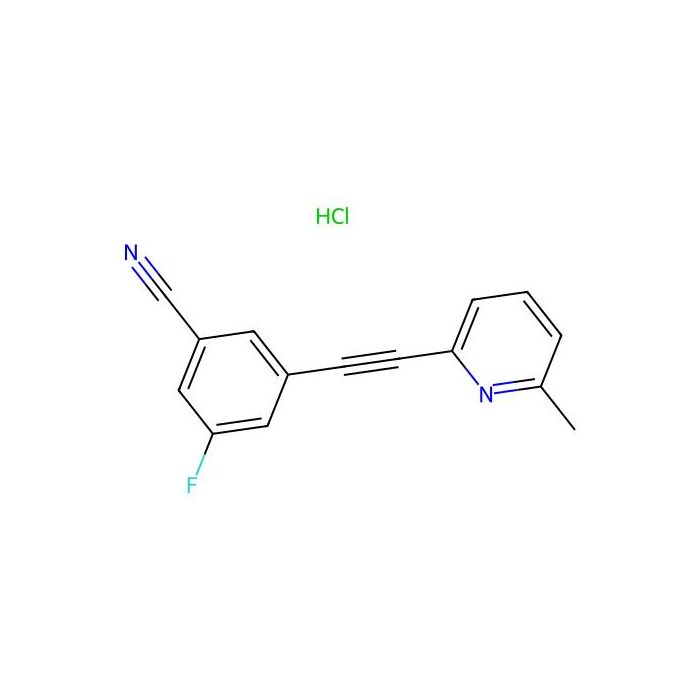
MFZ 10-7 is a highly potent and selective mGluR5 NAM (negative allosteric modulator), with a K i of 0.67 nM for rat mGluR5
In Vitro
MFZ 10-7 has approximately 1150- and 3000-fold lower affinity for MAO-B (monoamine oxidase-B enzyme) and TXA2 (thromboxane A2 receptor), respectively, compared to mGluR5. MCE has not independently confirmed the accuracy of these methods. They are for reference only.
In Vivo
MFZ 10-7 can lower oral sucrose self-administration rate but has no effect on total sucrose intake . MCE has not independently confirmed the accuracy of these methods. They are for reference only.
IC50& Target:rat mGluR5 0.67 nM (Ki)
Specifiche
Specifiche e purezza
10mM in DMSO
Meccanismi biochimici e fisiologici
MFZ 10-7 is a highly potent and selective mGluR5 NAM (negative allosteric modulator), with a K i of 0.67 nM for rat mGluR5.
Condizioni di conservazione di stoccaggio
Store at -80°C
Spedito in
Dry ice packs + Cold packs
Questo prodotto richiede spedizione a catena fredda. I servizi di terra e altri servizi economici non sono disponibili.
Tipo di azione
ANTAGONIST
Nomi e identificatori
Peso molecolare
236.24
Dati avanzati
Certificati (CoA, COO, BSE/TSE e tabella di analisi)
C of A & Other Certificates(BSE/TSE, COO):
Analytical Chart:
Calcolatori di soluzioni
Molarity Calculator
Determine the necessary mass, volume, or concentration for preparing a solution.
Dilution Calculator
Determine the dilution needed to prepare a stock solution.
Reconstitution Calculator
Recensioni
Recensioni dei clienti
Application Protocols
Not specified for this item; refer to CoA/Spec Sheet. No tested applications, recommended dilutions, or usage protocols are provided in the Product Data for MFZ 10-7.
Biological Roles
Item-specific biological targets, pathways, or roles are not provided for MFZ 10-7.
General considerations for small-molecule library members:
No endogenous role is implied. These compounds are synthetic entities used as potential chemical probes or starting points in discovery workflows.
Any observed biological activity should be considered provisional until confirmed by orthogonal assays, counterscreens for assay interference (e.g., aggregation, redox cycling, fluorescence artifacts), and structure verification.
Assess liabilities such as pan-assay interference (PAINS) motifs or reactive functional groups once the structure is available; filter using cheminformatics tools and empirical counterscreens.
Determine baseline properties relevant to biological testing (solubility in assay buffer, stability in media, potential for photolability or oxidation) before committing to large-scale experiments.
No therapeutic or clinical claims are made. All uses are restricted to research applications. For target information, mechanism of action, or biological specificity, refer to project-generated data or contact Aladdin with a request for additional documentation if available for your lot.
Buffer Applications
MFZ 10-7 is not a buffering reagent. However, buffer considerations are often crucial when dosing small molecules in biochemical or cell-based assays.
General guidance:
Dosing vehicle: Prepare a concentrated DMSO stock and dilute into assay buffer (e.g., PBS, HEPES-buffered saline, or assay-optimized buffer) to a final DMSO fraction typically ≤0.1–1% v/v depending on system tolerance.
Precipitation control: Add compound last with vigorous mixing or plate-shaking to avoid local supersaturation. Inspect for turbidity; if precipitation occurs, reduce the dosing concentration or adjust cosolvent fraction within assay limits.
pH stability: In the absence of pKa/structure data, maintain near-neutral pH (7.2–7.5) unless your assay dictates otherwise. Avoid extreme pH that could cause degradation or ionization-driven solubility changes.
Protein interactions: Albumin or serum can bind hydrophobic molecules and alter free concentration; validate effective dosing under both protein-free and protein-containing conditions as needed.
Item-specific buffer recipes or pKa values are not specified for this product; refer to your assay’s established buffer system and the item’s CoA/Spec Sheet if available.
Green Alternatives
MFZ 10-7 is a discrete research compound rather than a process solvent or reagent, so “green alternative” considerations focus on solvent and handling choices in screening workflows rather than replacing the compound itself.
Greener handling strategies (general):
Prefer aqueous buffers for final assay conditions; keep organic cosolvent (e.g., DMSO) ≤0.1–0.5% v/v when compatible with assay performance.
If high DMSO content is unnecessary, consider ethanol or isopropanol as transitional cosolvents for less hazardous profiles; confirm assay tolerance.
Minimize waste: Use miniaturized assay formats (384/1536-well) and single-use aliquots to reduce compound degradation and solvent consumption.
Energy-efficient storage: Consolidate inventories and use well-sealed containers to minimize ultra-cold freezer door-open time.
DMSO: Excellent solvency; miscible with water; moderate environmental impact; widely used in HTS.
Ethanol: Renewable feedstocks available; lower toxicity; limited solvency for very lipophilic compounds.
Isopropanol: Similar to ethanol; slightly higher solvency; flammable—ensure proper controls.
DMF/NMP: High solvency but higher worker/environmental hazard; restrict use to cases where alternatives fail.
Because structural properties are undisclosed for MFZ 10-7, select the most benign solvent system that achieves full dissolution and assay compatibility. Validate that greener choices do not impair readouts or compound stability.
Pharmaceutical Uses
No pharmacopeial status, excipient role, or manufacturing application is specified for MFZ 10-7. This product is supplied strictly for research use only.
Context (general):
Library compounds like MFZ 10-7 can be explored in early discovery for structure–activity relationship (SAR) generation and as potential chemical biology tools. This does not imply suitability for human or veterinary use, formulation development, or GMP manufacturing.
If formulation-like studies (e.g., solubility screening, pre-formulation) are performed for research purposes, ensure materials are handled under appropriate non-GMP conditions and that no clinical or diagnostic use is undertaken.
Statements of therapeutic effects or clinical efficacy are not applicable and are not provided. For any consideration beyond basic research (e.g., scale-up, impurity profiling under ICH frameworks), request detailed specifications and ensure the material grade aligns with the intended non-clinical purpose.
Physical Properties
Item-specific physical constants provided: none.
Appearance: Not specified for this item; refer to CoA/Spec Sheet.
Melting point (MP): Not specified for this item; refer to CoA/Spec Sheet.
Boiling point (BP): Not specified for this item; refer to CoA/Spec Sheet.
Density: Not specified for this item; refer to CoA/Spec Sheet.
Refractive index: Not specified for this item; refer to CoA/Spec Sheet.
Solubility: Not specified for this item; refer to CoA/Spec Sheet.
LogP/logD, pKa: Not specified for this item; refer to CoA/Spec Sheet.
Practical guidance (general, for small-molecule library compounds):
Initial dissolution: Start with an anhydrous, high-boiling polar aprotic solvent such as DMSO to prepare a 10–50 mM master stock. If aqueous compatibility is desired, dilute the DMSO stock into buffered media, keeping final DMSO ≤0.1–1% v/v for biochemical or cell-based assays, as appropriate.
Solubility screening: If DMSO is insufficient, trial co-solvents (DMF, NMP, ethanol) or use cosolvent–water mixtures with gentle warming (≤40 °C) and sonication. Record precipitation upon cooling.
Hygroscopicity and polymorphism: Library compounds may be hygroscopic or exist in multiple forms (free base/salt, solvate). Verify form and purity by NMR, LC–MS, or HPLC prior to critical studies.
All definitive physical property values for this item are not specified; consult the lot-specific CoA/Spec Sheet for authoritative data.
Quality and Grades
Item-specific quality information:
Grade/Purity: Not specified for this item; refer to CoA/Spec Sheet.
Context and expectations for library compounds:
Typical characterization in research-grade screening compounds includes identity confirmation (LC–MS, 1H NMR), purity (HPLC/UPLC area %), and, where relevant, counter-ion or salt form determination. However, no specific values are provided for this item; consult the lot-specific CoA for details.
UV/fluorescence background: For assay compatibility (e.g., absorbance or fluorescence readouts), low-impurity profiles reduce false signals. If spectroscopic cleanliness is critical, request chromatograms or impurity profiles.
Stabilizers/antioxidants: Not specified for this item; refer to CoA/Spec Sheet. If stabilizers are present in some lots, this will be explicitly stated on the CoA.
Trace residual solvents or water: Not specified for this item; refer to CoA/Spec Sheet.
Practical guidance:
Verify purity against internal acceptance criteria before SAR or HTS use. For stringent applications, consider secondary purification (e.g., prep-HPLC) and re-characterization.
Record lot number and attach CoA to experimental records to ensure traceability and reproducibility.
Reaction and Applications
This product is supplied as a research small-molecule library member. No specific reactive functionality or application claims are provided for MFZ 10-7; therefore, synthetic transformations are not defined here.
Research use contexts (general for library compounds):
Primary/secondary screening: Evaluation in biochemical, biophysical, or cell-based assays to identify preliminary activity or tool compound potential.
Orthogonal confirmation: Use across multiple assay modalities (e.g., binding vs functional readouts) to de-risk assay artifacts.
Physicochemical profiling: Determine solubility, stability, permeability, and protein binding as part of developability triage.
Analytical reference: Serve as a reference in LC–MS method development once identity and purity are verified by CoA.
Practical tips:
Compound handling: Prepare a concentrated DMSO stock (e.g., 10 mM), aliquot to single-use vials/plates, and store at −80 °C to limit freeze–thaw cycles.
Plate management: Use low-binding polypropylene plates/tubes and maintain cold chain during plate replication to minimize degradation.
Stability checks: Periodically re-run LC–MS/HPLC to confirm purity, especially after long storage or multiple thaw events.
No specific named-reaction utility or mechanistic roles are assigned to this item due to absent structural information. For building-block or reagent applications, choose items with disclosed functional groups and validated reactivity data.
Reaction Conditions
Not applicable: MFZ 10-7 is not provided as a reagent or building block, and no reactive functionality or transformation context is specified in the product data.
General note (for users considering derivatization once structure is available):
Establish baseline stability of MFZ 10-7 across typical reaction media (e.g., polar aprotic, protic, and basic conditions) via small-scale tests and LC–MS monitoring.
If cross-coupling or condensations are envisioned, determine whether the scaffold tolerates heat, base, and metal catalysts before optimization. Start with mild conditions and scale carefully.
Because item-specific reaction conditions, catalysts, or yields are not provided, consult primary literature relevant to the disclosed scaffold once available. Always confirm identity and purity after any chemical manipulation.
Safety and Handling
GHS/Classification (item-specific):
Signal word: Not specified for this item; refer to SDS.
Hazard statements (H-codes): Not specified for this item; refer to SDS.
Pictograms and GHS class: Not specified for this item; refer to SDS.
General laboratory safety for small organic molecules:
PPE: Wear lab coat, safety glasses, and appropriate chemical-resistant gloves (e.g., nitrile). Work in a fume hood to avoid inhalation of dusts or vapors.
Avoid exposure: Prevent inhalation, ingestion, and skin/eye contact. Use dedicated tools for weighing; minimize dust generation.
First aid (overview; defer to SDS): In case of skin contact, wash with soap and water. For eye exposure, rinse cautiously with water for several minutes. If inhaled, move to fresh air. If ingested, rinse mouth and seek medical attention. Always follow institutional protocols and the SDS.
Incompatibilities: Unknown for this specific item; as a precaution, segregate from strong oxidizers, strong acids/bases, and ignition sources until specific data are confirmed.
Thermal/chemical stability: Not specified; avoid excessive heat and direct sunlight. Follow storage at −80 °C as provided.
Waste: Dispose of according to local regulations for organic laboratory chemicals; collect halogenated vs non-halogenated waste separately as applicable.
Always consult the product’s SDS and CoA/Spec Sheet for definitive hazard, handling, and first-aid information.
Solvent Selection
Because structural details are not specified for MFZ 10-7, select solvents using a staged, risk-aware approach suitable for diverse small molecules.
General strategy:
Primary stock solvent: Start with anhydrous DMSO due to its broad solubilizing power and assay compatibility. Prepare 10–50 mM master stocks; filter if needed (0.2 µm PTFE) to remove particulates.
Secondary options: If limited DMSO solubility is observed, evaluate DMF, NMP, ethanol, or isopropanol. For biological assays, limit final organic cosolvent to ≤0.1–1% v/v depending on system tolerance.
Aqueous compatibility: Titrate DMSO stocks into buffered saline (e.g., PBS, HEPES, or assay-specific buffer) with vigorous mixing to avoid local supersaturation and precipitation. Consider inclusion of low levels of non-ionic surfactant if the assay allows.
pH considerations: If the compound is an acid/base, solubility may improve upon pH adjustment. In absence of pKa data, avoid extreme pH to maintain chemical integrity.
Comparison snapshot (general):
DMSO: Highest solvency; widely accepted in screens; potential to affect cells above ~0.5–1%.
DMF/NMP: Strong solvents; consider cytotoxicity and extractables; use sparingly.
Ethanol/IPA: More biocompatible but lower solvency for highly lipophilic molecules.
Aqueous buffers: Ideal for final assay media if compound remains in solution.
Always confirm solvent choice does not interfere with your specific readout (fluorescence quench/enhancement, absorbance overlap, enzyme inhibition).
Storage and Reconstitution
Item-specific storage and shipping (from Product Data):
Storage Conditions: Store at −80 °C.
Shipped In: Dry ice packs + Cold packs.
Reconstitution and handling:
Reconstitution solvent, concentration, and appearance after dissolution: Not specified for this item; refer to CoA/Spec Sheet.
Freeze–thaw: Not specified for this item; as a general precaution for small molecules in DMSO, minimize freeze–thaw cycles by preparing single-use aliquots and returning unused material promptly to −80 °C.
Container and atmosphere:
Specific requirements (e.g., inert gas, desiccation) are not specified for this item; consult CoA/SDS. As general good practice, keep containers tightly closed, protect from moisture, and minimize exposure to ambient light and heat during handling.
Before first use, equilibrate sealed vials to room temperature to avoid moisture condensation, then open and dispense quickly. Always consult the lot-specific CoA and SDS for definitive instructions.
Structure and Identity
Overview: MFZ 10-7 (SKU: M656189) is listed in Aladdin’s small-molecule/compound library portfolio.
Item-specific identifiers (from Product Data):
CAS: 1224431-15-5
SKU: M656189
Category Path: 全部 / 可售 / 小分子和化合物库
Molecular formula: Not specified for this item; refer to CoA/Spec Sheet.
Molecular weight: Not specified for this item; refer to CoA/Spec Sheet.
SMILES: Not specified for this item; refer to CoA/Spec Sheet.
InChIKey: Not specified for this item; refer to CoA/Spec Sheet.
Structural features:
Functional groups, ring systems, and stereochemistry: Not specified for this item; refer to CoA/Spec Sheet.
2D structural description (general guidance):
Without an available structure line notation (SMILES/InChI), a reliable 2D description cannot be provided. Please consult the CoA/Spec Sheet or SDS for a depiction of the core scaffold, substituents, and any stereochemical elements if present.
Notes:
Where structure is undisclosed or proprietary in screening libraries, structure may be provided under confidentiality or upon request. Verify material identity against CAS and internal lot-specific CoA prior to use in screening or analytical work.
Synthetic Utility
MFZ 10-7 is offered as a finished small-molecule library compound, not as a synthetic building block or reagent. No functional groups, protecting-group handles, or reactivity patterns are specified in the product data.
General guidance (when structure is disclosed):
If used as a scaffold for analog generation, confirm the exact substitution pattern and available diversification points (e.g., halogen, boronate, amine, carboxyl). Plan retrosynthesis accordingly.
Verify chemical stability under standard transformations (e.g., cross-coupling, amide coupling) before committing valuable material; run micro-scale feasibility reactions.
Ensure material balance via quantitative NMR or HPLC to avoid propagating impurities into analogs.
Since no structure or reactive functionality is provided here, no specific named-reaction applications or reactivity guidance can be offered. For synthetic derivatization or scale-up, request the structural dossier and CoA for your lot, or select an alternative catalog item with fully disclosed structure and specifications.
Target Specificity
Not specified for this item; refer to CoA/Spec Sheet. No target, pathway, or binding specificity information is provided in the Product Data for MFZ 10-7.
Domande frequenti
How should this product be stored?
Store at ?80 °C. Ultra-low temperature storage is required to maintain the specified shelf life.
How is this product shipped?
This product ships frozen with dry ice and cold packs. Unpack on arrival and transfer it to the storage condition stated above; handle dry ice with insulated gloves in a ventilated area.
What are the CAS number, molecular formula and molecular weight?
The CAS Number is 1224431-15-5, the molecular formula is C15H9FN2, and the molecular weight is 236.24 g/mol.
What documentation is provided?
Available product documentation, including Certificates of Analysis (COA), Safety Data Sheets (SDS), and specification sheets, is shown in the product document area. Document availability and access follow the current site policy.
Utilizziamo i cookie per garantire il corretto funzionamento del sito web e, ove consentito, per migliorare la tua esperienza. Puoi gestire le tue preferenze in qualsiasi momento nelle Impostazioni. Per saperne di più, consulta la nostra Cookie Policy.
Desidera che le inviamo un messaggio quando avremo sconti disponibili?
Ricordamelo più tardi
Grazie! Controlli la sua casella di posta per confermare.
Products are supplied to verified businesses, institutions, and qualified professionals for research and development use only. Not for use in humans, animals, diagnosis, or therapy.