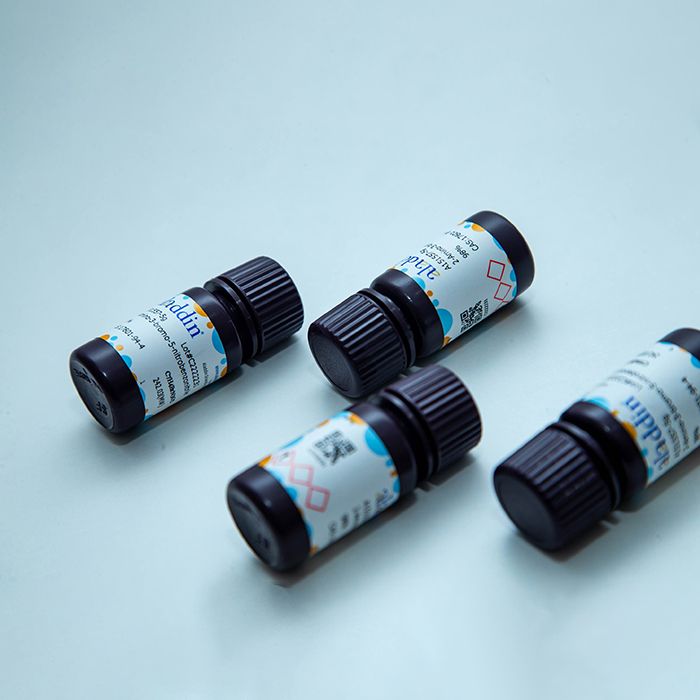
≥99% for sensitive chromatographic and analytical workflows requiring minimal baseline interference.
🌡
Storage & shipping
Store at -20°C Ships Ice chest + Ice pads Check lot-specific COA for exact specifications.
📋
Quality documents
SDS, COA, datasheet, and spec sheet available for download. Lot-specific COA accessible via lot number lookup.
📚
Literature proof
Cited in 0 peer-reviewed publications across chromatography, organic synthesis, and cross-coupling reactions.
Panoramica
Molnupiravir-d 7 is the deuterium labeled Molnupiravir. Molnupiravir (EIDD-2801) is an orally bioavailable prodrug of the ribonucleoside analog EIDD-1931. Molnupiravir has broad spectrum antiviral activity against influenza virus and multiple coronaviruse
Appearance:Solid
In Vitro:Stable heavy isotopes of hydrogen, carbon, and other elements have been incorporated into drug molecules, largely as tracers for quantitation during the drug development process. Deuteration has gained attention because of its potential to affect the phar
Biological Activity:Molnupiravir-d 7 is the deuterium labeled Molnupiravir. Molnupiravir (EIDD-2801) is an orally bioavailable prodrug of the ribonucleoside analog EIDD-1931. Molnupiravir has broad spectrum antiviral activity against influenza virus and multiple coronaviruse
Specifications
Specifiche e purezza
≥99%
Condizioni di conservazione di stoccaggio
Store at -20°C
Spedito in
Ice chest + Ice pads
Questo prodotto richiede spedizione a catena fredda. I servizi di terra e altri servizi economici non sono disponibili.
Certificati (CoA, COO, BSE/TSE e tabella di analisi)
C of A & Other Certificates(BSE/TSE, COO):
Analytical Chart:
Calcolatori di soluzioni
Molarity Calculator
Determine the necessary mass, volume, or concentration for preparing a solution.
Dilution Calculator
Determine the dilution needed to prepare a stock solution.
Reconstitution Calculator
Recensioni
Recensioni dei clienti
Application Protocols
General LC‑MS internal standard workflow (illustrative; adapt to your SOPs):
Stock preparation: Weigh an appropriate amount of Molnupiravir‑d7 quickly in a dry environment. Dissolve in DMSO to 1–10 mg/mL. Vortex to ensure complete dissolution. Aliquot and store at −20 °C.
Intermediate standard: Dilute an aliquot into MeOH or ACN:water (50:50) to prepare a 1–10 µg/mL working internal standard. Keep cold and protect from light.
Calibration curve: Prepare matched matrix calibrators by spiking known amounts of unlabeled molnupiravir into blank matrix and a fixed volume of Molnupiravir‑d7 internal standard into all calibrators, QCs, and unknowns.
Sample preparation (protein precipitation): Add 3–4 volumes of cold ACN (containing internal standard) to plasma/serum. Vortex 30 s, incubate on ice 10 min, centrifuge ≥12,000 g for 10 min at 4 °C. Transfer supernatant, dilute with mobile phase A, and inject.
LC‑MS conditions (typical starting point): RP‑C18 column; mobile phase A = water + 0.1% formic acid; mobile phase B = ACN + 0.1% formic acid; gradient 5→60% B over 5–7 min; autosampler 4–10 °C. Optimize MRM transitions and collision energies for your instrument.
Stability checks: Evaluate bench‑top, autosampler, freeze–thaw, and long‑term stability for both analyte and internal standard.
Note: Numbers above are general guidance, not item‑specific specifications.
Biological Roles
General biochemical context (literature; not product‑specific and not a medical claim):
Molnupiravir is an isopropyl ester prodrug of N4‑hydroxycytidine (NHC). In biological systems, esterases hydrolyze the 5′‑isopropyl ester to liberate NHC, which is then phosphorylated by cellular kinases to the ribonucleoside triphosphate.
The active ribonucleoside triphosphate can be incorporated by RNA‑dependent polymerases in place of cytidine/uridine, introducing base‑pairing errors via tautomerization of the N4‑hydroxy group. This property underlies its utility as a research tool in virology and nucleic acid biochemistry.
Deuteration (d7) does not meaningfully change biochemical mechanism; its purpose is analytical (mass differentiation) rather than altering potency or selectivity. The deuterium atoms are typically installed in non‑exchangeable positions, so H/D exchange in aqueous buffers is minimal.
Hydrolytic conversion to NHC is pH‑ and enzyme‑dependent; in cell‑free assays, ester stability should be considered if intact prodrug levels are monitored.
Note: The above describes biochemical pathways and enzyme interactions for research interpretation only. This product is supplied strictly for laboratory research use; no clinical or therapeutic claims are made.
Buffer Applications
This compound is not a buffering agent and is not used to control pH. For analytical work, it may be dissolved in buffers compatible with LC‑MS (e.g., ammonium formate or formic acid systems), but it does not itself provide buffering capacity.
Practical notes (general):
When preparing aqueous working solutions, use volatile, mildly acidic buffers (e.g., 0.1% formic acid or 5–10 mM ammonium formate, pH 3–6) to limit ester hydrolysis during short analytical runs.
Avoid strong basic buffers (pH > 8) and prolonged residence times in water, which can increase hydrolysis to the nucleoside (NHC) and affect quantitation of the intact prodrug.
Green Alternatives
Context: As a reference standard, solvent and method choices largely determine the environmental footprint. Consider greener analytical workflows without compromising data quality.
Greener choices (general guidance):
Prefer ACN/water over halogenated solvents. Where feasible, use MeOH/water mobile phases; both are widely accepted in green analytical chemistry compared to chlorinated eluents.
Reduce organic consumption via UHPLC (shorter columns, smaller particle sizes) and microflow LC‑MS to cut solvent use and waste.
Consider buffered aqueous mobile phases at mild acidity (e.g., 5–10 mM ammonium formate, pH ~3.5–4.5) instead of non‑volatile acids; maintain analyte stability.
For sample prep, protein precipitation with ACN or MeOH generates less hazardous waste than liquid‑liquid extraction with MTBE/DCM; evaluate SPE with water/MeOH/ACN solvents to minimize chlorinated waste.
Trade‑offs:
Methanol is considered greener than acetonitrile from a life‑cycle view, but may provide slightly different selectivity or solubility; validate method performance and analyte stability (avoid basic MeOH conditions that could promote transesterification/hydrolysis).
Higher aqueous content reduces solvent use but may increase ester hydrolysis; balance run time and stability by optimizing pH and temperature.
Item-specific environmental attributes or green certifications — Not specified for this item; refer to CoA/Spec Sheet.
Pharmaceutical Uses
Acceptable roles in pharmaceutical R&D/QC (no therapeutic claims):
Stable‑isotope internal standard for assay of molnupiravir in drug substance, drug product, dissolution, and stability studies by LC‑MS/LC‑MS/MS.
Reference standard for method validation parameters (accuracy, precision, linearity, carryover, matrix effects) in bioanalytical and quality control laboratories.
System suitability and recovery control during sample preparation (protein precipitation, SPE) and chromatographic analysis.
Impurity profiling: assists in distinguishing the parent ester from its primary degradant/metabolite N4‑hydroxycytidine by mass and retention time.
Regulatory/compendial context:
As an isotopically labeled standard, it is typically characterized by HPLC purity and isotopic enrichment rather than pharmacopeial monographs. Item‑specific certification and traceability — Not specified for this item; refer to CoA/Spec Sheet.
Formulation use:
Not used as an excipient or active ingredient in formulations. Its role is analytical only within development and QC workflows.
Appearance — Not specified for this item; refer to CoA/Spec Sheet.
Melting point — Not specified for this item; refer to CoA/Spec Sheet.
Boiling point — Not applicable (decomposes before boiling; solid), but specific value Not specified for this item; refer to CoA/Spec Sheet.
Density, refractive index, UV cutoff, residual solvents, water/peroxide/metal limits — Not specified for this item; refer to CoA/Spec Sheet.
Solubility — Not specified for this item; refer to CoA/Spec Sheet.
General/literature characteristics (for context; not item specifications):
Physical state: polar, crystalline solid nucleoside prodrug. Typically handled as a solid and dissolved for use in polar aprotic solvents (e.g., DMSO) or aqueous-organic mixtures.
Solubility profile: good solubility in DMSO; moderate in methanol/acetonitrile; limited in nonpolar solvents. Aqueous solubility is formulation- and pH‑dependent; the isopropyl ester can hydrolyze over time in aqueous/basic media.
Stability considerations: moisture and prolonged basic conditions can promote 5′‑ester hydrolysis to the parent nucleoside (NHC). Thermal stability is typical for nucleoside esters, but avoid extended exposure to elevated temperature.
Isotopic integrity: deuterium incorporation at non‑exchangeable positions is stable; avoid conditions that would scramble or cleave the labeled fragment if isotopic fidelity is critical for LC‑MS quantitation.
Quality and Grades
Item-specific grade/purity for this SKU — Not specified for this item; refer to CoA/Spec Sheet.
Interpretive guidance for this material class (stable-isotope‑labeled small molecules):
Intended use: LC‑MS/LC‑MS/MS internal standard or reference standard for method development, calibration, and isotope dilution quantitation of molnupiravir in complex matrices (e.g., plasma, serum, formulated products).
What to look for on the CoA: assay/purity (% area by HPLC/UPLC), isotopic enrichment pattern (d7 distribution and residual protium content), residual solvents, and related substances (e.g., N4‑hydroxycytidine, de‑isopropyl impurity).
Stabilizers: none are typically required for solid nucleoside esters; if any stabilizer is present for this catalog item, it will be listed on the CoA/Spec Sheet. For this listing — Not specified for this item; refer to CoA/Spec Sheet.
UV/LC suitability: reference‑standard grade materials are commonly optimized for chromatographic purity and MS response, with low nonvolatile/UV‑absorbing impurities. Specific UV cutoff or LC absorbance specs — Not specified for this item; refer to CoA/Spec Sheet.
Trace water and residual solvents: important for accurate gravimetric standardization. Item‑specific limits — Not specified for this item; refer to CoA/Spec Sheet.
Reaction and Applications
Primary application domain (for a deuterated small molecule):
Stable‑isotope internal standard (SIS) for LC‑MS/LC‑MS/MS quantitation of molnupiravir in biological matrices, environmental samples, or formulated products. The d7 label provides co‑elution with distinct m/z to correct for matrix effects and ionization variability.
Analytical use cases (general):
Bioanalysis: spike Molnupiravir‑d7 into plasma/serum/urine pre‑extraction for calibration curves and quality controls; quantify parent drug and monitor conversion to N4‑hydroxycytidine (NHC) if required.
Pharmaceutical QC: assay of drug substance/product, content uniformity, and stability‑indicating methods using isotope dilution.
Metabolite tracking: differentiation of parent (ester) versus hydrolyzed nucleoside by MRM transitions and retention time.
Practical tips:
Position of deuterium: labeling at non‑exchangeable carbons (often the isopropyl group) minimizes H/D exchange; nevertheless, avoid harsh acidic/basic conditions and prolonged aqueous exposure to preserve isotopic fidelity.
Sample preparation: add internal standard early (e.g., before protein precipitation or SPE) to maximize correction of losses.
Chromatography: reversed‑phase with water/ACN or water/MeOH containing volatile buffers (e.g., 0.1% FA or ammonium formate) is typical; monitor both molnupiravir and NHC in stability studies.
This section concerns analytical applications; Molnupiravir‑d7 is not typically used as a synthetic reagent in chemical transformations.
Reaction Conditions
As an analytical standard, “reaction conditions” translate to conditions that preserve the analyte and enable robust LC‑MS measurement. General guidance (literature‑style; not item‑specific):
Stock solutions: prepare at 5–20 mg/mL in DMSO or MeOH; store aliquots at −20 °C. Avoid repeated freeze–thaw. Item‑specific solubility — Not specified for this item; refer to CoA/Spec Sheet.
Working solutions: dilute stocks into water/ACN or water/MeOH with volatile modifiers (e.g., 0.1% formic acid or 2–10 mM ammonium formate). Keep final organic 20–70% to balance solubility and chromatographic retention.
Temperature: maintain autosampler at 4–10 °C to limit ester hydrolysis during long sequences.
pH: mildly acidic conditions (pH 3–6) are preferred for stability of the ester.
Extraction: for plasma, add internal standard prior to protein precipitation (3–4 volumes ACN or MeOH), vortex, centrifuge, and inject supernatant after dilution.
LC‑MS detection: reversed‑phase C18, gradients from aqueous (0.1% FA) to ACN (0.1% FA); monitor MRM/PRM transitions of unlabeled molnupiravir and the d7 standard. Optimize collision energies empirically.
Expected performance: isotope‑dilution approaches typically yield excellent linearity over 3–4 orders of magnitude and low bias/precision in compliance with bioanalytical method validation guidelines (numerical metrics are method‑dependent).
Safety and Handling
Item-specific safety data (this catalog entry):
GHS classification, signal word, pictograms, and H‑statements — Not specified for this item; refer to SDS.
Storage conditions — Store at −20 °C (per Product Data). Shipments are sent cold (ice chest + ice pads).
General safety guidance (defer to SDS for authoritative instructions):
Hazard overview: handle as a research-use-only nucleoside analog. Avoid inhalation, ingestion, and skin/eye contact. Use in a chemical fume hood.
PPE: lab coat, safety glasses, and suitable gloves (e.g., disposable nitrile). Consider double‑gloving for extended handling of DMSO stock solutions.
Incompatibilities: strong bases and aqueous alkaline conditions can accelerate ester hydrolysis; avoid strong oxidizers. Protect from moisture when possible.
First‑aid overview: in case of skin contact, wash with soap and water; for eye contact, rinse cautiously with water for several minutes and seek medical attention; if inhaled, move to fresh air; if ingested, seek medical advice. Bring the SDS when obtaining assistance.
Spill/cleanup: avoid dust generation; collect solids with disposable tools, absorb solutions with inert material. Dispose of waste according to institutional and local regulations.
Special risks: although deuterated, toxicological profile is expected to be similar to unlabeled parent. Do not use for human/animal administration. For research use only.
Solvent Selection
Practical considerations for preparing and using Molnupiravir‑d7 solutions (general guidance):
Primary stock solvent: DMSO is the most common choice due to high solubility and chemical compatibility with nucleoside esters. Prepare concentrated stocks (e.g., 5–20 mg/mL) and dilute into aqueous mobile phases immediately before analysis.
Alternative solvents: methanol or acetonitrile provide good solubility and LC‑compatibility. Water alone may be inadequate and can promote ester hydrolysis; add organic cosolvent (e.g., 30–80% MeOH or ACN) to improve stability.
pH effects: avoid basic aqueous media; neutral to slightly acidic conditions (e.g., with 0.1% formic acid or ammonium formate at pH 3–6) help limit hydrolysis during short analytical runs.
Miscibility and matrix compatibility: DMSO stocks are miscible with water/organic LC mobile phases at low final DMSO fractions (<1–2%). For bioanalytical extraction, protein precipitation with ACN/MeOH containing internal standard is common.
Comparison (general):
DMSO: maximal solubility, strong MS ion suppression if too concentrated in final solution; keep final DMSO low.
Methanol: good solubility, fast evaporation; slightly higher risk of transesterification under strong basic conditions (avoid).
Acetonitrile: good for precipitation and LC; slightly lower solubility than MeOH for some nucleoside esters.
Item-specific solubility limits — Not specified for this item; refer to CoA/Spec Sheet.
Storage and Reconstitution
Item-specific storage and shipping:
Storage temperature: Store at −20 °C (per Product Data).
Protect from moisture and light. Allow vials to equilibrate to room temperature in a desiccator before opening to minimize condensation.
For solid material: promptly reseal after removing the needed amount. Purge with inert gas (optional) and return to −20 °C.
Stock solutions: prepare in dry DMSO, MeOH, or ACN at convenient concentrations. Dispense into single‑use aliquots in low‑bind vials. Store at −20 °C.
Freeze–thaw: avoid repeated cycles; thaw aliquots on ice and keep cold during use. Discard aliquots showing precipitation, discoloration, or unexpected LC‑MS response.
Aqueous stability: minimize time in aqueous/basic media to limit ester hydrolysis to N4‑hydroxycytidine. For LC‑MS, keep autosampler cooled (4–10 °C) and use mildly acidic mobile phases.
Any item-specific stabilizers, precise solubility limits, or reconstitution instructions — Not specified for this item; refer to CoA/Spec Sheet.
Structure and Identity
Item-specific identifiers not provided: Molecular formula — Not specified for this item; refer to CoA/Spec Sheet. Molecular weight — Not specified for this item; refer to CoA/Spec Sheet. SMILES — Not specified for this item; refer to CoA/Spec Sheet. InChIKey — Not specified for this item; refer to CoA/Spec Sheet.
General structural description (literature):
Molnupiravir (EIDD‑2801) is an isopropyl ester prodrug of the ribonucleoside analog N4‑hydroxycytidine (NHC). It features a β‑D‑ribofuranose ring (five‑membered sugar) bearing multiple hydroxyl groups and a modified cytidine base with an N4‑hydroxy substituent.
Functional groups: carbamate/urethane-like isopropyl ester on the ribose 5′‑position, multiple alcohols (secondary/primary), an amide-like N‑hydroxy amidine motif within the nucleobase, and heteroatoms capable of hydrogen bonding.
Isotopic labeling: “‑d7” denotes seven deuterium atoms incorporated at non‑exchangeable positions (commonly within the isopropyl moiety for LC‑MS internal standard robustness). Exact labeling positions for this item — Not specified for this item; refer to CoA/Spec Sheet.
2D depiction in words: a ribofuranose scaffold (anomeric linkage to the base) with 1′,2′,3′‑OHs, a 5′‑O‑isopropyl ester tail, and a pyrimidinone/pyrimidinol‑like nucleobase substituted at N4 with hydroxyl.
Stereochemistry: β‑D‑ribofuranose configuration at the anomeric center; additional sugar stereocenters at C2′, C3′, C4′ (literature).
Synthetic Utility
Molnupiravir‑d7 is not commonly used as a synthetic building block due to its complexity and cost; its primary value is as an isotopically labeled analytical standard. Nevertheless, it can support chemical and biochemical studies:
Isotope tracing: track ester hydrolysis pathways and distribution in multi‑compartment systems (e.g., in vitro metabolism) by following d7‑labeled parent relative to unlabeled analyte.
Kinetic isotope effects: although deuterium is at non‑exchangeable positions (e.g., isopropyl group), gross kinetic isotope effects are typically negligible; however, label retention allows definitive assignment of reaction products derived from the prodrug versus nucleoside.
Reference material in synthetic campaigns: benchmark purity and identity of in‑house synthesized molnupiravir by co‑injection and relative response factors using the d7 internal standard.
If chemical modification studies are pursued (e.g., derivatization for mechanistic probes), care should be taken to avoid conditions that cleave the isopropyl ester or otherwise remove the labeled fragment, as this would compromise the utility of the deuterium tag.
Target Specificity
Not applicable. This product is a small‑molecule isotopically labeled standard, not a biological targeting reagent (e.g., antibody, ligand, or inhibitor with defined target binding specificity provided in the product data). No antigen/epitope, species reactivity, clone, or isotype information applies.
We use cookies to ensure the website functions properly and, where permitted, to improve your experience. You can manage your preferences at any time in Settings. Learn more in our Cookie Policy.
Shall we send you a message when we have discounts available?
Remind me later
Thank you! Please check your email inbox to confirm.
Products are supplied to verified businesses, institutions, and qualified professionals for research and development use only. Not for use in humans, animals, diagnosis, or therapy.