QUALITÀ & PUREZZAMoligand™?Moligand™ — Aladdin's line of ligands and bioactive small molecules. Use for receptor, pathway, and binding studies needing defined small-molecule tools.10 mM in DMSO
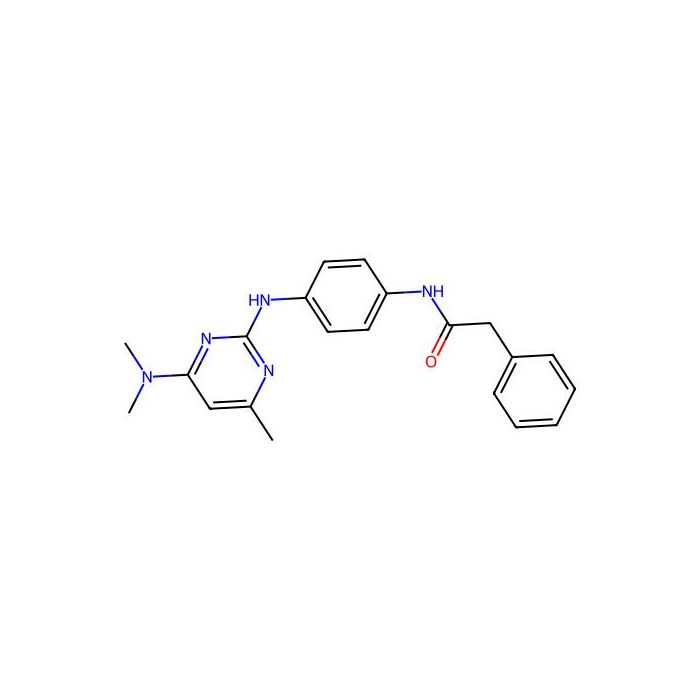
MT-4 blocks the TG2/FN complex at the interface between cancer cells and the tumor niche. MT-4 inhibits the adhesion of ovarian cancer (OC) cells to the peritoneum.
Specifiche
Specifiche e purezza
Moligand™, 10 mM in DMSO
Condizioni di conservazione di stoccaggio
Store at -80°C
Spedito in
Dry ice packs + Cold packs
Questo prodotto richiede spedizione a catena fredda. I servizi di terra e altri servizi economici non sono disponibili.
Grado
Moligand™
Nomi e identificatori
Peso molecolare
361.44
Dati avanzati
Certificati (CoA, COO, BSE/TSE e tabella di analisi)
C of A & Other Certificates(BSE/TSE, COO):
Analytical Chart:
Calcolatori di soluzioni
Molarity Calculator
Determine the necessary mass, volume, or concentration for preparing a solution.
Dilution Calculator
Determine the dilution needed to prepare a stock solution.
Reconstitution Calculator
Recensioni
Recensioni dei clienti
Application Protocols
The following outlines common handling for small-molecule library members in research screening. Adjust to your assay and consult the CoA/Spec Sheet for any item-specific instructions.
Stock preparation (general)
Warm vial to room temperature in a desiccated environment. If solid, rapidly weigh under low humidity.
Prepare a primary DMSO stock at a convenient concentration (e.g., 10–50 mM; choose based on solubility and assay DMSO tolerance). Mix with vortexing and brief sonication if needed. Filter through 0.2 µm PTFE if particulate persists.
Verify concentration by UV–Vis (if chromophore and ε known) or by quantitative 1H NMR with an internal standard.
Aliquoting and storage
Dispense single-use aliquots (10–50 µL) into low-binding tubes or plates; store at −80 °C under inert headspace if possible. Avoid repeated freeze–thaw.
Assay dosing
Thaw an aliquot on ice, briefly spin to collect condensate, and dilute into assay buffer to the desired final concentration, keeping DMSO ≤0.1–1% v/v as permitted.
For cell assays, pre-check cytotoxicity of solvent vehicle and ensure osmolarity/pH are maintained.
Controls and QC
Include vehicle controls, positive/negative reference controls, and a precipitation check (visual inspection or nephelometry) at working concentrations.
Safety
Handle all solutions in a fume hood with appropriate PPE. Dispose according to institutional chemical-waste procedures.
Biological Roles
Item-specific
Biological target(s), mechanism of action, and pathway roles: Not specified for this item; refer to CoA/Spec Sheet or screening documentation.
General guidance for library molecules
As a Moligand™ small-molecule entry, MT-4 is intended for target-agnostic or target-based screening in biochemical, biophysical, or cellular assay formats.
Typical discovery workflows include primary screening, confirmation assays, basic physicochemical profiling (solubility, permeability, stability), and orthogonal counter-screens to identify assay interference.
If activity is observed, follow up with secondary assays (e.g., SPR, DSF, MST for binding; cell-based phenotypic assays for functional response) and initial ADME profiling (microsomal stability, plasma protein binding) as appropriate for research.
Cautions
Avoid over-interpreting single-point readouts; evaluate concentration–response, Hill slope, and potential aggregation (detergent sensitivity, light scattering) to exclude false positives.
Screen for redox- or covalency-driven artifacts if chromophores/electrophiles are present (once structure is known).
Note: All uses are for research only. No clinical/diagnostic claims are made or implied.
Buffer Applications
This product is a small-molecule library member and is not itself a buffering agent.
Item-specific
Buffering capacity, pKa(s), and recommended buffer systems: Not specified for this item; refer to CoA/Spec Sheet if relevant.
Practical note
Select assay buffers based on the biological target (e.g., HEPES 7.2–7.6, PBS 7.2–7.4, Tris 7.5–8.5) and compound stability/solubility. Validate that final DMSO or co-solvent levels do not perturb buffer pH or assay readout.
Green Alternatives
When preparing stocks and assay solutions for MT-4, consider greener solvent choices where compatible with solubility and assay performance.
Use with care: acetonitrile, methanol, 2-propanol/water cosolvent systems.
Minimize: DMF, NMP, dichloromethane, dimethylacetamide due to environmental/health profiles.
Comparison examples (literature/general)
DMSO vs alternatives: DMSO is ubiquitous for stocks but has disposal and odor concerns; ethanol or isopropanol may suffice for hydrophobic molecules when lower stock concentrations are acceptable.
Acetonitrile vs ethanol: Acetonitrile is more toxic and less sustainable; ethanol often provides adequate solubility and is preferred if the compound dissolves.
Practical strategies
Start with ethanol or aqueous ethanol (e.g., 20–50% v/v) to test solubility before resorting to DMF/NMP.
Use the minimum DMSO percentage compatible with assay tolerance (often ≤0.1–1% v/v final).
Employ micro-dosing and sealed microplates to reduce solvent volumes and VOC emissions.
Not specified for this item
No compound-specific solvent restrictions or stability concerns are provided; verify compatibility experimentally and consult the CoA/Spec Sheet.
Pharmaceutical Uses
No pharmacopeial status or excipient role is provided for this item.
Item-specific
Pharmaceutical/formulation uses: Not specified for this item; refer to CoA/Spec Sheet.
General statement
MT-4 is offered for research use only as part of a small-molecule library. Any consideration of formulation studies should remain within non-clinical research contexts (e.g., pre-formulation solubility/stability screening in vitro). No clinical or diagnostic applications are implied.
Physical Properties
Item-specific (from Product Data)
Appearance: Not specified for this item; refer to CoA/Spec Sheet.
Molecular Weight: Not specified for this item; refer to CoA/Spec Sheet.
For library molecules like MT-4, physical state is commonly a crystalline or amorphous solid, or a pre-dosed DMSO solution vial. Verify on receipt.
Initial solubility exploration typically starts with DMSO (miscible with water and many organics) followed by co-solvents (DMF, ethanol, PEG 400) and aqueous cosolvent systems if biological assays are planned.
If hygroscopicity or polymorphism is a concern, assess by dynamic vapor sorption and PXRD before long-term storage.
Not provided in Product Data (do not treat as specifications)
Melting point, boiling point, density, refractive index, logP/logD, pKa, water content, and UV cutoff: Not specified for this item; refer to CoA/Spec Sheet.
Practical tip: Prepare a small solubility screen (e.g., 10 mM targets) in DMSO, DMF, and ethanol at room temperature and at 37 °C; confirm concentration by UV–Vis or quantitative 1H NMR where applicable.
Quality and Grades
Item-specific (from Product Data)
Grade: Moligand™
What Moligand™ implies (general description; not a specification)
Moligand™ items are positioned as small-molecule library members suitable for discovery workflows (e.g., primary HTS, fragment or ligand screening, and follow-up SAR). Documentation such as CoA/Spec Sheet typically provides identity confirmation (e.g., LC–MS) and purity assessment.
Exact analytical methods, acceptance criteria, stabilizers, and impurity limits are not provided here. Refer to the CoA/Spec Sheet for the batch-specific details.
Quality considerations for library compounds (general guidance)
Identity: Verify by orthogonal methods where possible (LC–MS + NMR/HRMS).
Purity: Assess by LC–UV/ELSD/MS across multiple wavelengths; consider chiral purity if stereocenters are present.
Stability: Monitor for hydrolysis/oxidation using time-course LC–MS, especially if the structure contains labile motifs (esters, aldehydes, anilines, thioethers, etc.).
Assay interference: Screen for PAINS/reactive substructures as part of QC-in-use.
Not provided for this item
Exact purity %, residual solvents, water content, metal content, and UV-cutoff: Not specified for this item; refer to CoA/Spec Sheet.
Reaction and Applications
Item-specific note
MT-4 is supplied as a small-molecule library member for research screening. It is not primarily positioned as a synthetic reagent in the Product Data.
Applicability to chemical reactions
Without disclosed structure/functional groups, recommending reaction classes (e.g., cross-coupling, condensations) is not appropriate.
Practical guidance (general)
If MT-4 is to be used in chemical transformations (e.g., for probe derivatization), first confirm functional-group compatibility via small-scale scouting and characterize by LC–MS/NMR.
Consider protecting-group strategies if labile moieties are present (esters, aldehydes, anilines). Optimize reaction solvents based on preliminary solubility screens (see Solvent Selection tab).
For most users
Primary use is expected to be biochemical or cell-based screening, target deconvolution, or SAR exploration once structure is known. See Application Protocols for stock preparation and dilution practices.
Not specified for this item
Named reactions, catalysts, or specific synthetic applications are not provided; refer to literature after structural disclosure.
Reaction Conditions
Not typically applicable. MT-4 is provided as a small-molecule screening library member, and no synthetic reaction usage or conditions are specified in the Product Data.
Item-specific
Reaction conditions, catalysts, or temperatures: Not specified for this item; refer to CoA/Spec Sheet.
If derivatization is attempted (general guidance)
Select solvent and base/acid based on experimental solubility and functional groups (once known). Begin with micro-scale scouting (e.g., 0.5–5 mg) and monitor by LC–MS.
Employ inert atmosphere and anhydrous conditions if moisture-sensitive motifs are suspected.
Purify with flash chromatography or preparative LC; confirm identity and purity by orthogonal methods prior to biological testing.
Safety and Handling
Item-specific (from Product Data)
GHS Classification, Signal Word, H-Statements, and Pictograms: Not specified for this item; refer to SDS.
Storage: Store at −80 °C.
Shipping: Shipped on dry ice packs + cold packs.
General laboratory precautions (not product-specific safety classifications)
Use appropriate PPE: lab coat, safety glasses, and nitrile gloves.
Handle powders and stock solutions in a fume hood to avoid inhalation/dermal exposure.
Avoid repeated freeze–thaw; aliquot upon first thaw to maintain integrity.
Allow frozen vials to equilibrate to ~−20 °C before opening to minimize moisture condensation; then warm to room temperature.
Segregate from strong oxidizers and acids/bases until compatibility is known. Avoid contact with ignition sources when using organic solvents.
First-aid overview (consult SDS for authoritative guidance)
Inhalation: Move to fresh air; seek medical attention if symptoms persist.
Skin/eye contact: Rinse with water for at least 15 minutes; remove contaminated clothing; obtain medical advice as needed.
Ingestion: Rinse mouth; do not induce vomiting; seek medical attention.
Waste and decontamination
Dispose according to local regulations; treat solutions as organic chemical waste. Decontaminate surfaces with appropriate solvent followed by detergent/water.
Always consult the product-specific SDS and your institution’s EH&S policies before use.
Solvent Selection
Because structure is undisclosed here, solvent selection should follow a pragmatic solubility screen tailored to discovery assays.
Primary stock solvent (general guidance)
DMSO: Widely preferred for screening stocks due to broad solubilizing power and aqueous miscibility.
Literature properties: high polarity/proticity index; fully miscible with water and most organics; bp 189 °C; dielectric constant ~47 (literature).
Secondary solvents for recalcitrant solutes (general guidance)
DMF or NMP: High-boiling, polar aprotic; good for difficult solids. Ensure thorough removal before biology where feasible.
Ethanol or isopropanol: Useful for co-solvent systems (e.g., 5–20% v/v in buffers) if compound is alcohol-soluble.
Acetonitrile: Volatile, polar aprotic; compatible with many analytical methods.
PEG 400: For high-concentration intermediates or formulation screens; viscous, biologically tolerated at low levels.
Aqueous workup for assays (general guidance)
Prepare concentrated DMSO stocks (e.g., 10–50 mM; choose based on solubility and assay DMSO tolerance) and dilute into assay buffer to ≤0.1–1% DMSO final.
If precipitation occurs upon dilution, include surfactants (e.g., 0.01–0.05% Tween-20) or raise temperature briefly, then re-check clarity.
Not specified for this item
Specific solubility values, pKa, logP/logD: Not specified for this item; refer to CoA/Spec Sheet.
Tip: Document solvent lot, stock concentration verification (UV or qNMR), and visible precipitation checks for assay reproducibility.
Storage and Reconstitution
Item-specific (from Product Data)
Storage Conditions: Store at −80 °C.
Shipped In: Dry ice packs + Cold packs.
General guidance for reconstitution (not product-specific specifications)
Upon receipt, keep frozen. Allow vials to equilibrate to −20 °C before opening to reduce moisture ingress.
If supplied as a solid: Reconstitute initially in dry DMSO to prepare a concentrated stock suitable for subsequent dilution. Alternative solvents (DMF, ethanol) may be evaluated if DMSO is unsuitable for your assay.
If supplied in DMSO: Mix gently after thawing to homogenize; avoid vortexing if precipitate is present—warm slightly and sonicate briefly instead.
Aliquot into single-use portions to minimize freeze–thaw cycles; purge headspace with inert gas where feasible.
Stability monitoring (general)
Track storage history and number of freeze–thaw events. Periodically check integrity by LC–MS/LC–UV.
Protect from light if chromophoric groups are suspected; store in amber containers.
Not provided for this item
Aqueous stability, pH sensitivity, and long-term solution shelf life: Not specified for this item; refer to CoA/Spec Sheet.
Research use only. Consult the CoA/Spec Sheet and SDS for item-specific instructions and safety before use.
Structure and Identity
Brief description: MT-4 (SKU M1495898) is a Moligand™ small-molecule library member intended for research screening and discovery workflows.
Item-specific (from Product Data)
Product Name: MT-4
SKU: M1495898
CAS: 2327925-35-7
Grade: Moligand™
Molecular Formula: Not specified for this item; refer to CoA/Spec Sheet.
Molecular Weight: Not specified for this item; refer to CoA/Spec Sheet.
SMILES: Not specified for this item; refer to CoA/Spec Sheet.
InChIKey: Not specified for this item; refer to CoA/Spec Sheet.
Structural features (general guidance)
The 2D/3D structure, functional groups, and stereochemistry are not disclosed in the Product Data. Consult the CoA/Spec Sheet for structural identifiers and confirm identity by your in-house orthogonal methods (e.g., HRMS, 1H/13C NMR, LC–MS retention time match to reference).
Synthetic Utility
Item-specific
Functional groups and derivatization handles: Not specified for this item; refer to CoA/Spec Sheet.
General guidance
If used as a starting point for probe development, assess functional-group compatibility and potential points of attachment by NMR/HRMS once structure is available.
Consider late-stage diversification tactics (amide coupling, Suzuki cross-coupling, reductive amination, click chemistry) where applicable to generate SAR around MT-4 for research only.
Limitations
Without disclosed structure, no specific named-reaction recommendations or protecting-group strategies can be responsibly provided.
Target Specificity
Item-specific
Target(s), pathway, species selectivity, and binding constants: Not specified for this item; refer to CoA/Spec Sheet or screening data.
General note
Library compounds like MT-4 are typically screened broadly; any target specificity must be experimentally determined by the user using binding/functional assays and orthogonal confirmation methods.
Hai bisogno di aiuto per scegliere la qualità?
La nostra guida alla selezione delle qualità copre purezza, stato dello stabilizzatore e idoneità all'applicazione per tutte le varianti del nostro catalogo.
Utilizziamo i cookie per garantire il corretto funzionamento del sito web e, ove consentito, per migliorare la tua esperienza. Puoi gestire le tue preferenze in qualsiasi momento nelle Impostazioni. Per saperne di più, consulta la nostra Cookie Policy.
Desidera che le inviamo un messaggio quando avremo sconti disponibili?
Ricordamelo più tardi
Grazie! Controlli la sua casella di posta per confermare.
Products are supplied to verified businesses, institutions, and qualified professionals for research and development use only. Not for use in humans, animals, diagnosis, or therapy.