This compound belongs to the class of organic compounds known as phthalimides. These are aromatic heterocyclic compounds containing a 1,3-dioxoisoindoline moiety. They are imide derivatives of phthalic anhydrides.
External Descriptors
Not available
1. Djoumbou Feunang Y, Eisner R, Knox C, Chepelev L, Hastings J, Owen G, Fahy E, Steinbeck C, Subramanian S, Bolton E, Greiner R, and Wishart DS. ClassyFire: Automated Chemical Classification With A Comprehensive, Computable Taxonomy. Journal of Cheminformatics, 2016, 8:61.
Determine the necessary mass, volume, or concentration for preparing a solution.
Dilution Calculator
Determine the dilution needed to prepare a stock solution.
Reconstitution Calculator
Recensioni
Recensioni dei clienti
Application Protocols
Not applicable. No biological assay protocols (e.g., WB, IHC, IF, FC) are associated with this small-molecule intermediate.
General laboratory use guidance (literature/general):
For deprotection (hydrazinolysis): Dissolve or suspend the imide in EtOH, add hydrazine monohydrate under a fume hood, heat to 60–80 °C with stirring until TLC/HPLC indicates completion, cool, filter off phthalhydrazide, concentrate, and work up to obtain the amine. Optimize equivalents and temperature on small scale first.
For cross-coupling on aryl‑Cl: Select a catalyst/ligand combination suitable for aryl chlorides, ensure anhydrous conditions, and validate base/solvent to preserve the imide ring.
These are illustrative, literature-style process notes rather than validated protocols for this specific SKU.
Biological Roles
This product is a synthetic organic intermediate and not intended for biological use in cells or organisms.
General context (literature/general):
N‑aryl phthalimides do not have intrinsic biological roles; the imide serves primarily as a protecting/transporting group for anilines in synthetic chemistry.
The scaffold may appear transiently as an intermediate in the synthesis of bioactive compounds where a 4‑chloroaniline motif is ultimately required. Any biological activity would derive from the final product, not the protected intermediate.
Physicochemical properties (neutral, hydrophobic, aromatic) suggest low aqueous solubility and limited bioavailability without formulation; however, this is a synthetic consideration rather than a recommended application.
Research Use Only reminder: Per Product Data, this material is for research use only and not for human or veterinary applications.
Buffer Applications
Not typically applicable. N‑(4‑Chlorophenyl)phthalimide is a neutral, poorly water‑soluble organic intermediate and is not used as a buffering agent or pH modifier.
Guidance: For aqueous workups or deprotection steps, choose appropriate laboratory buffers or acid/base solutions based on your reaction (e.g., carbonate/bicarbonate for mild basic washes, dilute HCl for acidification). This product itself does not serve as a buffer component.
Green Alternatives
Context: As a solid building block, the “greenness” lever often lies in solvent/catalyst choices and deprotection strategies rather than the substrate itself.
Greener process considerations (literature/general):
Solvents:
Prefer 2‑MeTHF, CPME, EtOAc, toluene, or propylene carbonate over chlorinated solvents (DCM/CHCl3) when feasible for dissolution, coupling, or crystallization.
For polar media, consider sulfolane or dimethyl isosorbide in place of DMF/NMP where reaction compatibility allows.
Catalysis:
For downstream aryl‑Cl functionalization, use modern ligand systems enabling lower palladium loadings or nickel catalysis to reduce precious metal usage; recover catalysts via immobilization when possible.
Energy:
Microwave or flow conditions may reduce reaction times/energy demand for couplings or deprotections.
Workup/waste:
Optimize hydrazinolysis to minimize hydrazine excess; evaluate alkaline hydrolysis as an alternative to reduce hydrazine handling. Employ solvent recycling (EtOAc, toluene) and aqueous waste neutralization.
Illustrative comparison (general, solvent focus):
DCM vs EtOAc: EtOAc offers lower toxicity and better biodegradability; may require higher temperature for dissolution.
DMF vs Dimethyl isosorbide: the latter is bio‑based and higher boiling; assess removal challenges and reaction rates.
THF vs 2‑MeTHF: 2‑MeTHF is less peroxide‑prone and derived from renewable feedstocks; note different polarity and water content handling.
Note: No item-specific green certifications or metrics are provided; process greening should be tailored to your transformation.
Pharmaceutical Uses
No pharmacopeial grade or excipient role is specified for this item; refer to CoA/Spec Sheet if a compliance claim is required. This product is provided for research use only.
Literature/general context:
Role in process chemistry: N‑aryl phthalimides are frequently used as protected aniline intermediates in API synthesis. Protection as a phthalimide masks basicity and can improve step compatibility, impurity control, and isolation.
Deprotection: Late‑stage unmasking yields the corresponding aniline salt (e.g., as HCl), facilitating further salt formation or coupling.
Advantages: Enhanced stability to oxidation and electrophilic substitution compared with free anilines; crystalline, often easy to handle and purify.
No clinical or therapeutic claims are made or implied.
Physical Properties
Item-specific specifications (this lot):
Appearance: Not specified for this item; refer to CoA/Spec Sheet.
Purity/grade: Not specified for this item; refer to CoA/Spec Sheet.
Literature/computed physical data (for reference; not item specifications):
Molecular formula: C14H8ClNO2 (literature)
Molecular weight: ~257.57 g/mol (literature, calculated from formula)
Physical state: typically a crystalline solid (literature, common for N‑aryl phthalimides)
Poorly soluble in water due to aromaticity and absence of ionizable groups at neutral pH
Soluble in polar aprotic organics (DMF, DMSO, NMP) and moderately in chlorinated/aromatic solvents (DCM, chloroform, toluene); variable in EtOAc/THF depending on temperature
Acid/base: imide N is tied up in resonance; compound is neutral and typically non-basic; imide carbonyls are strongly electron-withdrawing on the N–aryl moiety (general knowledge)
LogP/logS: not readily available for this specific compound; expect moderate hydrophobicity given two aryl rings and an imide (general expectation)
Melting point, boiling point, density, refractive index, pKa, UV cutoff: Not specified for this item; refer to CoA/Spec Sheet.
Practical handling observations (general): tends to have a sharp melting transition and high thermal stability typical for phthalimides; stable under ambient lab atmosphere.
Quality and Grades
Item-specific grade/purity: Not specified for this item; refer to CoA/Spec Sheet.
General notes on quality considerations for N‑aryl phthalimides (literature/general):
Typical impurities: residual starting aniline or aryl halide, unreacted phthalimide, phthalic anhydride, or over‑acylated byproducts; trace inorganic residues from coupling catalysts if used (e.g., Pd/Cu in N‑arylation routes).
Analytical controls: HPLC/GC for organic purity, NMR for identity and residual solvent profiling, HRMS for mass confirmation. If the material is intended for trace-metal sensitive applications, ICP‑MS screening may be relevant (metals limits are not item-specified here).
UV profile: aromatic imide chromophore absorbs in the UV; low-UV grades are not typically defined for such solids unless specified.
Stabilizers/inhibitors: None are typically needed for imide solids; they are intrinsically stable. Any stabilizer would be declared if present; none is specified for this item.
Batch documentation: For exact purity assay, residual solvents, and elemental analysis (CHN), consult the Certificate of Analysis for the shipped lot.
Practical guidance:
If using in metal-catalyzed transformations downstream, consider pre‑washing or recrystallization to reduce trace metals if your process is metal-sensitive.
When deploying as an aniline surrogate (deprotection later), ensure the impurity profile will not complicate hydrolysis/hydrazinolysis workups.
Reaction and Applications
Role and utility (literature/general):
Protected aniline surrogate: N‑(4‑Chlorophenyl)phthalimide functions as a masked 4‑chloroaniline. The robust N–imide bond survives many conditions; subsequent cleavage (hydrazinolysis or acidic/basic hydrolysis) reveals the free aniline.
Intermediate from N‑arylation: Often prepared via Buchwald–Hartwig or Ullmann‑type N‑arylation of phthalimide. The isolable product serves as a bench‑stable intermediate to carry an aniline through multistep sequences without protonation/oxidation issues.
Electrophotocatalytic/N‑centered radical chemistry: N‑aryl imides can participate in SET processes to access N‑centered radicals for downstream transformations (substrate‑dependent; literature evolving).
Directing group effects: The imide exerts a strong –I/–M effect on the aryl–N bond, attenuating aniline basicity and reactivity, which can be advantageous in chemo‑selective sequences.
Typical transformations (literature):
Deprotection to 4‑chloroaniline by hydrazinolysis, yielding phthalhydrazide byproduct.
Hydrolysis under strong base or acid to cleave the imide and liberate the amine with phthalic acid/amide derivatives.
Cross‑coupling on the para‑chloro substituent (e.g., Suzuki–Miyaura, Buchwald–Hartwig on C–Cl) can be executed while the aniline is protected as phthalimide, expanding diversification prior to deprotection.
Practical tips:
For couplings on the aryl chloride, use catalysts/ligands optimized for aryl chlorides (e.g., Pd with bulky phosphines) and bases compatible with the imide.
During deprotection, thoroughly remove phthalhydrazide or phthalic salts via filtration and acid/base washes to avoid carryover into the amine product.
Reaction Conditions
General literature guidance (not item specifications):
Cross-coupling on para‑Cl:
Suzuki–Miyaura: Pd(0/II) catalyst with bulky phosphine (e.g., XPhos/SPhos) or NHC; base K3PO4 or Cs2CO3; solvent toluene/2‑MeTHF or dioxane/water (minimal water to protect the imide); 60–110 °C; hours scale. Target boronic acids/esters. Monitor to avoid imide hydrolysis.
Buchwald–Hartwig amination (on C–Cl): Pd with dialkylbiaryl phosphine ligands; NaOtBu or Cs2CO3 base; toluene/1,4‑dioxane; 80–110 °C.
Sonogashira: Pd/Cu co‑catalysis or copper‑free variants; amine base (iPr2NH/Et3N) in toluene/THF; room temp to 80 °C.
Deprotection to 4‑chloroaniline (mask removal):
Hydrazinolysis: Hydrazine monohydrate (1.5–5 eq) in EtOH/MeOH or EtOH/DMF; 50–90 °C until completion; precipitated phthalhydrazide filtered off; isolate amine as free base or salt (literature practice).
Basic hydrolysis: Aqueous NaOH/KOH (2–6 M) in EtOH/H2O or DMSO/H2O; reflux; neutralize to liberate amine.
Acidic cleavage: Conc. HCl (or H2SO4) under reflux to give anilinium salt; caution with corrosivity.
Workup/purification tips:
Remove inorganic salts and phthalic byproducts by sequential aqueous washes; charcoal treat if needed.
For couplings, hot filtration to remove Pd black; silica gel chromatography with moderately polar eluents (EtOAc/hexanes, toluene/EtOAc).
Notes:
Reaction temperatures/solvents should be optimized per substrate/ligand set.
Expected yields vary widely by coupling partner and conditions; consult primary literature for analogous aryl‑Cl systems with imide‑bearing substrates.
Safety and Handling
Item-specific hazard information:
GHS classification: Not specified for this item; refer to SDS.
Signal word: Not specified for this item; refer to SDS.
Hazard statements (H-codes): Not specified for this item; refer to SDS.
Pictograms: Not specified for this item; refer to SDS.
General safety guidance for aromatic imides (literature/general):
Expected hazards: May cause skin/eye irritation and respiratory tract irritation as a fine organic powder. Avoid dust formation and inhalation.
PPE: Laboratory coat, safety glasses or goggles, appropriate chemically resistant gloves (e.g., nitrile). Handle solids in a fume hood to limit dust exposure.
Storage: Store tightly capped at room temperature away from moisture and incompatible reagents (strong bases and strong acids that can hydrolyze imides; strong oxidizers). Follow the product’s specific storage guidance on the label/CoA.
Incompatibilities: Prolonged exposure to concentrated aqueous base or strong nucleophiles can lead to imide ring opening; strong acids at elevated temperature can also cleave the imide.
First aid overview: In case of contact, rinse skin/eyes with water for several minutes; remove contaminated clothing. If inhaled, move to fresh air. If ingested or if symptoms persist, seek medical attention. Always consult the official SDS for authoritative instructions.
Fire: Combustible organic solid. Use CO2, dry chemical, or foam. Thermal decomposition may form CO/CO2/HCl; firefighters should wear SCBA.
Note: Always defer to the specific SDS of this SKU for definitive hazard, toxicological, and disposal guidance.
Solvent Selection
Applicability: This is a solid building block/intermediate rather than a solvent. Solvent choice pertains to its dissolution and use in reactions or processing.
General solubility/miscibility guidance (literature/general):
Preferred solvents for dissolution and reactions: DMF, DMSO, NMP, and DMAc provide excellent solubility for the polar, conjugated imide; DCM/chloroform and toluene often dissolve it upon warming. THF and EtOAc may be suitable for recrystallizations.
Poor solvents: Water and very nonpolar alkanes (hexanes) are typically unsuitable due to limited polarity match and lack of ionizable sites.
Selection by operation:
N‑arylation synthesis or further transformations: Polar aprotics (DMF/DMAc/NMP) at elevated temperature assist in homogeneous conditions; consider 2‑MeTHF or CPME as greener replacements for THF/Et2O where applicable.
Hydrolysis/hydrazinolysis (deprotection to 4‑chloroaniline, literature context): Alcoholic solvents (EtOH/MeOH) or mixed EtOH/DMF can be used; base or hydrazine solutions require compatible corrosion-resistant glassware and appropriate ventilation.
Purification: Crystallization from toluene, EtOAc/hexanes, or EtOH can afford high purity; final solvent choice is empirical.
Comparison snapshot (general):
DMF/NMP: maximum solubility; higher boiling, harder to remove.
DCM/CHCl3: good solvency; halogenated waste considerations.
Toluene/EtOAc: greener profiles; may require heat to dissolve.
DMSO: excellent solvency; viscosity may slow mass transfer.
Always validate on small scale; solvent-related specifications for this item are not defined by the Product Data.
Storage and Reconstitution
Storage (item-specific): Store at room temperature as indicated in Product Data. Keep container tightly closed in a dry, well‑ventilated place. Protect from moisture and prolonged exposure to strong acids/bases.
Shipping (item-specific): Shipped under normal conditions.
Reconstitution: Not applicable—this is a solid organic compound. Dissolve directly in a compatible organic solvent (e.g., DMF, DMSO, DCM, toluene, alcohols) as required by your application.
Stability (general): Aromatic imides are typically stable on the bench. For long-term storage, minimize exposure to humidity and reactive vapors. If using hydrazine or strong base in subsequent steps, prepare fresh solutions and do not store mixtures.
Freeze–thaw: Not relevant.
Container considerations: Use amber or opaque containers if long light exposure is anticipated during storage, although photolability is not generally problematic for this class.
Note: For definitive shelf life, purity retention, and any lot-specific precautions, consult the CoA and SDS accompanying your shipment.
Structure and Identity
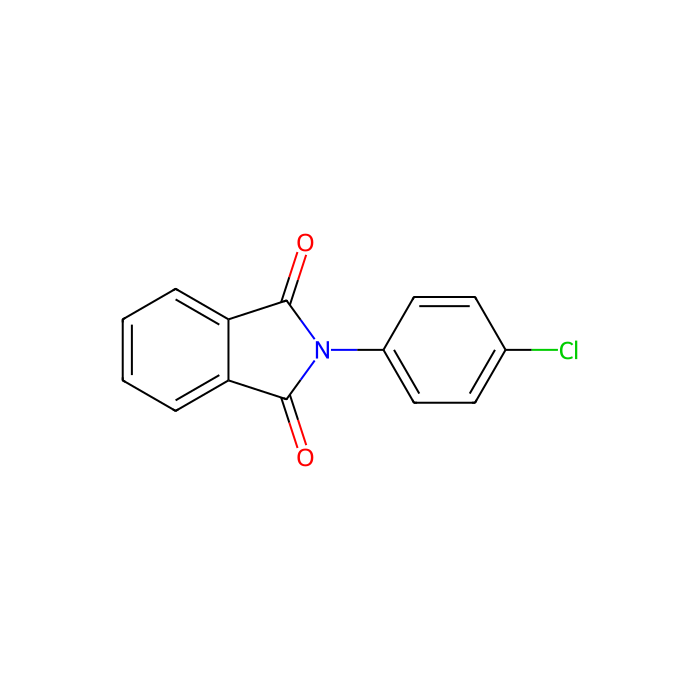
Brief overview: N-(4-Chlorophenyl)phthalimide is an N‑aryl phthalimide formed by coupling a p‑chlorophenyl group to the imide nitrogen of phthalimide; it serves as a protected aniline surrogate and a robust aryl–N imide.
Item-specific (from Product Data):
CAS: 7386-21-2
CID: 81867
InChIKey (as provided): 299237 (note: this string is shorter than a standard InChIKey; verify against CoA/SDS)
Storage: Room temperature
Shipping: Normal
Grade/Purity: Not specified for this item; refer to CoA/Spec Sheet.
Appearance: Not specified for this item; refer to CoA/Spec Sheet.
Literature/computed identifiers and features (for reference; not item specifications):
Structural features: bicyclic phthalimide ring (imide: two carbonyls EWG), N–aryl bond to a para‑chloro substituted phenyl; overall planar, conjugated system; no stereocenters.
2D description: a fused benzene–imide core (phthalimide) with the imide nitrogen bonded to a 1,4‑chlorophenyl ring; para chlorine deactivates the ring and modulates electronics.
General notes:
Functional groups: imide (two carbonyls), aryl chloride substituent (para), two benzene rings linked through N.
Synthetic Utility
Key reactive elements (literature/general):
Imide functionality: Two electron‑withdrawing carbonyls delocalize onto nitrogen, reducing basicity and nucleophilicity of the N‑aryl moiety; the imide carbonyls are susceptible to nucleophilic ring‑opening under forcing conditions.
Aryl chloride handle (para): Amenable to cross‑coupling (Suzuki–Miyaura, Buchwald–Hartwig amination, Sonogashira, Negishi) using catalysts/ligands tuned for aryl chlorides.
Strategic applications:
Protecting group strategy: Carry 4‑chloroaniline through oxidizing or acidic sequences as the phthalimide; deprotect late via hydrazinolysis or hydrolysis.
Orthogonal functionalization: Perform C–Cl diversification while the aniline is masked, then unmask for further derivatization (e.g., ureas, amides, sulfonamides).
N‑centered radical chemistry: Under photoredox or electrochemical conditions, N‑aryl imides can engage in N–O or N–Ar activation pathways to form radicals for C–N functionalization; applicability depends on specific setups.
Retrosynthetic value:
Traces back to readily available 4‑chloroaniline and phthalimide or to 4‑chloroaryl halides via N‑arylation of phthalimide, offering scalable access.
Practical notes:
Imide is robust to many bases and oxidants but can be cleaved by strong aqueous base, strong mineral acid at reflux, or hydrazine; plan protecting group compatibility accordingly.
For cross-couplings, avoid conditions that excessively hydrolyze the imide (prolonged strong base/water at high temperature). Use anhydrous polar aprotics or toluene with carefully chosen bases (e.g., K3PO4, Cs2CO3) and ligands.
Target Specificity
Not applicable. This product is a small-molecule synthetic intermediate and is not an antibody, enzyme, or affinity reagent. No target, epitope, clone, isotype, or species reactivity is associated with this item.
We use cookies to ensure the website functions properly and, where permitted, to improve your experience. You can manage your preferences at any time in Settings. Learn more in our Cookie Policy.
Shall we send you a message when we have discounts available?
Remind me later
Thank you! Please check your email inbox to confirm.
Products are supplied to verified businesses, institutions, and qualified professionals for research and development use only. Not for use in humans, animals, diagnosis, or therapy.

 F2305205