This compound belongs to the class of organic compounds known as carboxylic acids. These are compounds containing a carboxylic acid group with the formula -C(=O)OH.
External Descriptors
beta-alanine derivative - N-acetyl-amino acid
1. Djoumbou Feunang Y, Eisner R, Knox C, Chepelev L, Hastings J, Owen G, Fahy E, Steinbeck C, Subramanian S, Bolton E, Greiner R, and Wishart DS. ClassyFire: Automated Chemical Classification With A Comprehensive, Computable Taxonomy. Journal of Cheminformatics, 2016, 8:61.
Determine the necessary mass, volume, or concentration for preparing a solution.
Dilution Calculator
Determine the dilution needed to prepare a stock solution.
Reconstitution Calculator
Recensioni
Recensioni dei clienti
Application Protocols
No vendor-validated application protocols are provided for this item. General starting points (literature-based) include:
Stock solutions for coupling: 0.1–0.5 M in dry DMF or DMSO; filter if particulates are present; store aliquots at −20 °C to minimize water uptake.
Aqueous handling: dissolve at desired concentration after adjusting pH to 7–9 with NaHCO3 or TEA to form the carboxylate; sterile-filter (0.22 µm) for cell-free biochemical assays.
LC–MS sample prep: dissolve 1–10 mM in 50:50 water–acetonitrile with 0.1% formic acid for positive-mode analysis of derivatives; for the acid itself, negative mode may provide better sensitivity.
For application-specific, validated protocols, consult the primary literature relevant to your transformation or assay.
Biological Roles
Item-specific biological data are not provided. The following are general, literature-based considerations for N-acylated amino acid derivatives and, by analogy, N-acetyl-beta-alanine:
Structural context: N-acetylation converts the primary amine of beta-alanine into a secondary amide, eliminating basicity at nitrogen and altering transport/recognition by amino acid transporters (literature trend).
Metabolic stability: the amide bond is significantly more resistant to hydrolysis than ester or peptide bonds without specialized enzymes or strong chemical conditions, making N-acetyl derivatives useful as stable linkers or analytical standards in metabolism studies.
Charge state: at physiological pH, the carboxylate is typically deprotonated while the amide remains neutral, yielding an overall anionic, hydrophilic species.
Note: No specific biological activity, targets, or physiological roles are claimed for this catalog item. For any in vitro biochemical use, confirm compatibility of pH, ionic strength, and counter-ions with your assay system.
Buffer Applications
N-Acetyl-beta-alanine is not a conventional buffering agent. It contains a single carboxylic acid and a neutral amide, providing limited buffering capacity over a narrow acidic range.
Practical note: If used at all in buffering contexts, its carboxylate/acid pair would provide only weak buffering near the acid pKa (literature, typically around pH 4–5 for simple carboxylic acids). For robust buffering, select established systems (e.g., acetate, MES, MOPS, phosphate) tailored to the target pH.
Recommendation: Use this compound primarily as a building block or spacer (see Synthetic Utility), not as a buffer component.
Green Alternatives
Sustainable choices can be implemented around the use of N-acetyl-beta-alanine by optimizing solvents, reagents, and workups.
Greener solvent choices (literature/general):
Replace DMF/NMP with 2-methyltetrahydrofuran (2-MeTHF) or ethyl acetate (EtOAc) for extractions and some couplings when feasible; for highly polar substrates, propylene carbonate or Cyrene may substitute DMF in certain coupling protocols.
Use water or water–ethanol systems for salt formation and some bioconjugations, assisted by phase-transfer catalysts when needed.
Greener coupling strategies:
Employ EDC·HCl in aqueous or mixed media with additives (e.g., HOAt/HOBt alternatives such as OxymaPure) to reduce hazardous solvent use.
Consider enzymatic or organocatalytic coupling methods when applicable to avoid carbodiimides and uronium reagents (scope-dependent).
Small comparison (general):
DMF: excellent solvency; reproductive toxin concerns; difficult to remove.
2-MeTHF: bio-based, lower toxicity; limited solubility for very polar substrates; flammable.
EtOAc: greener, easy removal; may require co-solvent for dissolution.
Process tips:
Minimize protecting group manipulations; the inherent stability of the N-acetyl group can reduce step count but requires planning for its eventual removal under harsher yet atom-efficient conditions.
Implement aqueous workups with brine minimization and solvent recycling where possible.
Pharmaceutical Uses
No pharmacopeial or excipient designation is provided for this item.
General formulation/manufacturing context (literature-based, non-clinical):
Role as a linker/spacer: The beta-alanine backbone can be incorporated into conjugates to modulate spacing and hydrophilicity; the N-acetyl group provides a neutral, stable cap that resists undesired reactions during processing.
Intermediate in API process chemistry: Can serve as a starting material or intermediate en route to more complex peptidomimetics or small molecules following amide coupling, esterification, or further functionalization at the carboxyl terminus.
Salt selection: Formation of sodium or tromethamine salts may be used to improve aqueous handling during process development (scope-dependent).
Note: This product is for research use only and is not intended for human or veterinary use. No therapeutic claims are made or implied.
Physical Properties
Item-specific physical constants: Not specified for this item; refer to CoA/Spec Sheet.
Literature/typical properties for N-acylated beta-amino acids (for reference only; not specifications for this lot):
Aggregation state: typically a crystalline solid.
Acid–base behavior: contains a carboxylic acid (acidic) and a neutral amide; amide nitrogen is substantially non-basic under typical conditions.
Solubility (general expectations):
Water: expected to be moderate to high due to carboxylate formation above pH ~5–6 (literature trend for N-acyl amino acids).
Alcohols (MeOH, EtOH): generally soluble to moderately soluble.
Polar aprotic (DMF, DMSO): generally freely soluble.
Partitioning/logP: expected to be low (hydrophilic) owing to the acid and amide functionalities (literature trend).
Thermal behavior: amide-containing amino acid derivatives typically melt with decomposition; exact melting point for this item is not provided.
Notes:
Reported numerical values (melting point, pKa, logP, density, refractive index) are not specified for this item; consult the CoA or SDS and primary literature if exact values are required for experimental design.
Quality and Grades
Grade/Purity (item-specific): Not specified for this item; refer to CoA/Spec Sheet.
Appearance (item-specific): Not specified for this item; refer to CoA/Spec Sheet.
Guidance on interpreting grades for amino-acid derivatives (general):
Research/biochemical grade typically indicates low levels of inorganic salts and residual solvents, suitable for synthetic and analytical work.
Chromatography/HPLC grade (if applicable) emphasizes low UV-absorbing impurities; useful where UV detection is used.
Peptide synthesis suitability is often inferred from assays such as residual water, ash, and specific optical purity; for N-acetyl-beta-alanine (achiral), enantiopurity is not a concern, but overall chemical purity and low metal/halide content may still be important for downstream coupling.
Stabilizers: none are typically required for this compound; any added stabilizer would be listed on the CoA.
Verification practices:
Confirm identity by NMR (1H, 13C) and HRMS; IR should show strong amide C=O (~1650–1680 cm−1) and carboxylic acid C=O (~1700–1725 cm−1) (literature).
Assess purity by HPLC or LC–MS. For solid-phase work, monitor residual water (Karl Fischer) as moisture affects coupling efficiency. Exact limits are item-specific and provided on the CoA when applicable.
Reaction and Applications
This compound functions as an N-acylated beta-amino acid building block with a free carboxyl group, making it valuable for linkers, spacers, and amide bond formation in synthetic and conjugation chemistry.
Amide couplings: activation of the carboxylic acid (e.g., EDC/HOBt, HATU, TBTU, or DIC/DMAP) to couple with amines and create extended amide chains, peptidomimetic backbones, or beta-alanine spacers.
Esterifications: formation of esters under Fischer conditions (acidic alcohol) or via DCC/DMAP, enabling prodrug-like esters or protective derivatives for further transformations.
Salt formation: neutralization with amines, alkali, or alkaline-earth bases yields soluble carboxylate salts for bioconjugation in aqueous media.
Hydrolysis/deprotection studies: the N-acetyl group is a robust amide; hydrolysis to regenerate beta-alanine generally requires strong acidic or basic conditions and heat (literature). Selective transformations exploiting the difference in reactivity between amide and acid functions can be designed.
Polymer/linker chemistry: incorporation as a three-carbon hydrophilic spacer improves flexibility and spacing between functional modules in conjugates and resins.
Practical tips:
Dry polar aprotic solvents (DMF, DCM/DMF) improve coupling efficiency; remove water to suppress O→N acyl transfer and minimize hydrolysis.
Use base (e.g., DIPEA) judiciously to deprotonate the incoming amine; excessive base can promote side reactions.
Monitor reactions by LC–MS; the mass of N-acetyl-beta-alanine is ~131 (literature), aiding quick identification of intermediates and byproducts.
Reaction Conditions
General, literature-based guidance for common transformations of N-acetyl-beta-alanine (adjust to your system; not item specifications):
Amide coupling to amines:
Solvent: DMF, NMP, or DCM/DMF (anhydrous).
Reagents: HATU (1.1–1.5 eq) or EDC·HCl (1.2–1.5 eq) + Oxyma/HOAt; base DIPEA (2–3 eq).
Temperature: 0–25 °C; typical times 1–16 h. Monitor by LC–MS.
Esterification to alcohols:
Fischer: ROH (neat or solvent), catalytic H2SO4 or p-TsOH, reflux; water removal (Dean–Stark) improves conversions.
DCC/DMAP: DCM or THF, 0–25 °C; work up to remove dicyclohexylurea.
Activation to acid chloride (for advanced couplings):
Reagents: oxalyl chloride or thionyl chloride (1.5–3 eq) with a catalytic DMF; solvent DCM; 0 °C to rt; then couple with amine + base at 0–25 °C.
N-acetyl hydrolysis (deacetylation):
Conditions: typically requires prolonged reflux in 6 M HCl or 2–6 M NaOH (aqueous or aqueous–alcoholic) to effect amide cleavage (literature). Consider alternative synthetic routes if mild deprotection is required.
Expected outcomes (illustrative, literature):
Couplings can afford 70–95% isolated yields with optimized stoichiometry and anhydrous technique.
Notes:
Avoid excess heating in presence of nucleophiles to limit undesired intramolecular cyclizations or over-acylation of products.
For aqueous bioconjugation, pre-form NHS esters to improve rates under mild pH (7.2–8.5).
Safety and Handling
GHS/SDS information (item-specific):
Signal Word: Not specified for this item; refer to SDS.
Hazard Statements (H-Statements): Not specified for this item; refer to SDS.
GHS Classification and Pictograms: Not specified for this item; refer to SDS.
General laboratory safety guidance (for research use only):
Likely hazard profile: N-acylated amino acids are generally of low acute hazard, but handle as a laboratory chemical. Avoid inhalation of dust and contact with eyes/skin.
PPE: lab coat, safety glasses or goggles, appropriate gloves (e.g., nitrile). Handle powders in a fume hood to minimize dust exposure.
Incompatibilities: strong oxidizers (general precaution). Under strong acidic or basic conditions and heat, amide hydrolysis can occur, generating beta-alanine and acetic acid/salts.
First aid (overview; defer to SDS):
Inhalation: move to fresh air; seek medical attention if symptoms persist.
Skin: wash with soap and water; remove contaminated clothing.
Eyes: rinse cautiously with water for several minutes; remove contact lenses if present and easy; seek medical attention if irritation persists.
Ingestion: rinse mouth; seek medical advice.
Spill/cleanup: avoid dust generation; sweep up carefully and place in suitable container for disposal per local regulations.
Fire response: use water spray, CO2, dry chemical, or foam as appropriate for surrounding materials.
Always consult the product’s SDS for authoritative and item-specific safety information.
Solvent Selection
Solubility behavior and solvent choice for N-acetyl-beta-alanine are governed by its polar carboxylic acid and amide functionalities.
Water: good solubility when partially or fully deprotonated (pH > ~5); lower solubility in strongly acidic water where the acid remains protonated.
Polar aprotic: DMSO and DMF typically dissolve it readily; useful for stock solutions in coupling reactions.
Alcohols: methanol and ethanol provide moderate solubility.
Nonpolar solvents: poor solubility; not recommended.
Practical selection tips:
For amide coupling to amines: DMF, NMP, or DCM/DMF mixtures are commonly used with carbodiimide or uronium reagents (literature).
For aqueous bioconjugation or salt formation: dissolve in water with slight basification (e.g., triethylamine or NaHCO3) to form the carboxylate.
For crystallization/purification: water–alcohol or alcohol–ether antisolvent systems can be effective; optimize empirically.
Comparison notes (general):
DMSO vs DMF: DMSO offers higher solvating power and better EHS profile than DMF but can complicate workup; DMF is often preferred for peptide-like couplings. Consider 2-MeTHF or EtOAc for extractions in greener workflows.
Storage and Reconstitution
Storage conditions (item-specific): Store at −20 °C.
Shipping (item-specific): Shipped in ice chest with ice pads.
Research Use Note: For research use only.
General handling and reconstitution guidance (for this compound class):
Minimize moisture uptake: keep container tightly closed; warm to room temperature in a desiccator before opening to avoid condensation.
Solid handling: if clumping occurs upon cold storage, gently break up under dry atmosphere.
Reconstitution:
Aqueous: dissolve in water; adjust pH with NaHCO3/NaOH to aid dissolution if needed (forms carboxylate). Prepare fresh solutions when possible.
Organic: dissolve in dry DMF or DMSO for coupling chemistry; prepare single-use aliquots and store at −20 °C to limit hydrolysis.
Stability considerations (general): secondary amide is robust; the free acid can slowly esterify or hydrolyze under harsh conditions. Avoid strong acids/bases at elevated temperature during storage.
Freeze–thaw: avoid repeated cycles; aliquot solutions. Inspect for precipitation or discoloration before use.
For exact shelf life, assay, and impurity limits, consult the lot-specific CoA/Spec Sheet.
Structure and Identity
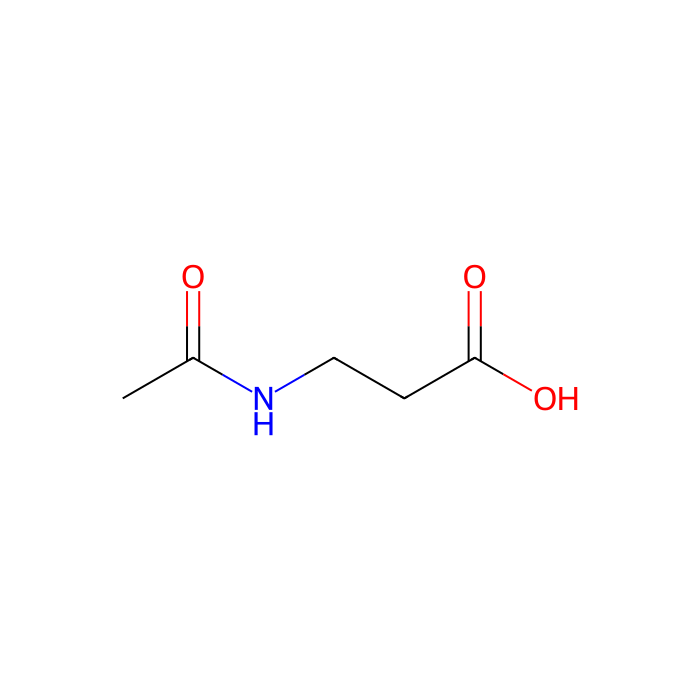
N-Acetyl-beta-alanine is the N-acylated derivative of beta-alanine (3-aminopropionic acid), featuring a terminal carboxylic acid and a secondary amide formed with an acetyl group.
Item-specific identifiers (from Product Data):
SKU: N133308
Product Name: N-Acetyl-beta-alanine
CAS: 3025-95-4
PubChem CID: 76406
InChIKey: Not specified for this item; refer to CoA/Spec Sheet.
SMILES: Not specified for this item; refer to CoA/Spec Sheet.
Literature structural information (for reference; not item specification):
Preferred IUPAC name (literature): N-acetyl-3-aminopropanoic acid
Functional groups and features (general chemistry):
One carboxylic acid (monoprotic, acidic).
One secondary amide (N-acetyl), typically non-basic and hydrogen-bond donating/accepting.
Linear, saturated C3 spacer between amide nitrogen and carboxyl carbon.
2D description (general): acetyl group (CH3–CO–) attached to nitrogen, followed by a three‑carbon chain terminating in a carboxylic acid: CH3–CO–NH–CH2–CH2–COOH.
Synthetic Utility
Key functional elements and reactivity (general literature perspective):
Carboxylic acid handle: amenable to activation (acid chlorides, anhydrides) or coupling (EDC/HOBt, HATU, DIC/DMAP) to install the beta-alanine spacer onto amines, alcohols (esterification), or even thiols (thioesters).
Secondary amide (N-acetyl): chemically robust, conferring stability during multistep synthesis; can direct chemoselectivity by deactivating the nitrogen and preventing undesired N-acylation or alkylation.
Three‑carbon tether: introduces flexibility and distance between conjugated motifs, useful in tuning properties of linkers, affinity tags, or surface modifiers.
Representative synthetic maneuvers:
Amide bond formation to primary/secondary amines using HATU/DIPEA in DMF at 0–25 °C (literature).
Esterification with alcohols via DCC/DMAP in DCM or via acid chloride generated in situ with oxalyl chloride (careful temperature control to avoid side reactions).
Late-stage functionalization: convert the carboxyl to activated esters (e.g., NHS esters) for bioconjugation with lysine residues on proteins/peptides (scope-dependent).
Deprotection strategy planning: N-acetyl is not a removable protecting group under mild conditions; hydrolysis typically requires strong acid/base and heat, so design syntheses accordingly.
Analytical tracking:
IR: distinct amide (∼1650–1680 cm−1) and acid C=O (∼1700–1725 cm−1).
LC–MS: [M+H]+ ~132 (literature) facilitates monitoring of couplings and derivatizations.
Target Specificity
Not applicable. This product is a small-molecule reagent and is not an antibody, enzyme, or affinity reagent. No target, epitope, clone, isotype, or species reactivity data are associated with this item.
Utilizziamo i cookie per garantire il corretto funzionamento del sito web e, ove consentito, per migliorare la tua esperienza. Puoi gestire le tue preferenze in qualsiasi momento nelle Impostazioni. Per saperne di più, consulta la nostra Cookie Policy.
Desidera che le inviamo un messaggio quando avremo sconti disponibili?
Ricordamelo più tardi
Grazie! Controlli la sua casella di posta per confermare.
Products are supplied to verified businesses, institutions, and qualified professionals for research and development use only. Not for use in humans, animals, diagnosis, or therapy.

 B1504029