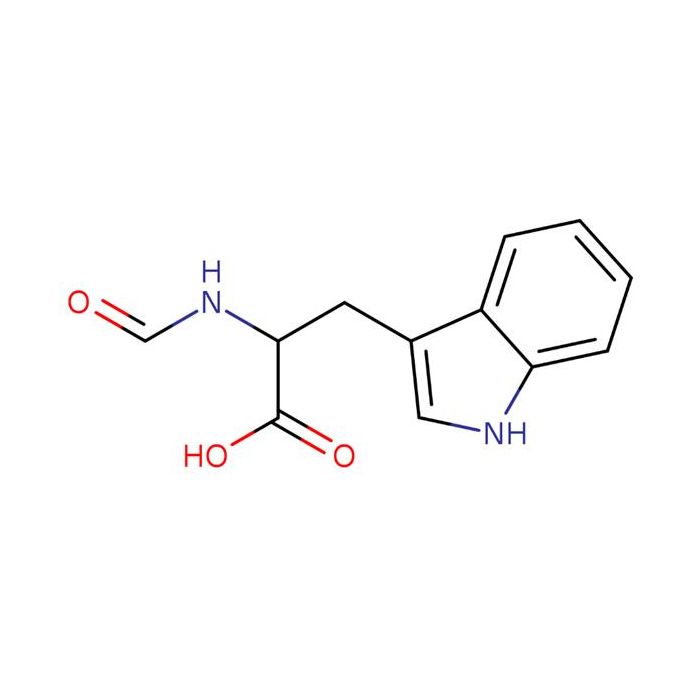
N-Formyltryptophan - ≥98% , CAS No.27520-72-5

CAS: 27520-72-5 Cat. No.: N1026496 Formula: C12H12N2O3 Peso molecolare: 232.24
Disponibile su ordine
GRADE & PURITY ≥98%
Synonyms
For-L-Trp-OH | N-formyltryptophan
Storage
Store at 2-8°C
Shipped In
Wet ice
★
Size
Germania (EU)
USA*
Price
Qty
250mg
N1026496-250mg
Su ordinazione · 8–12 settimane
173,46€
1g
N1026496-1g
Su ordinazione · 8–12 settimane
494,52€
5g
N1026496-5g
Su ordinazione · 8–12 settimane
1.735,39€
Enter a quantity for the sizes you want to add.
🧪

Why this grade

≥98% for sensitive chromatographic and analytical workflows requiring minimal baseline interference.

🌡

Storage & shipping

Store at 2-8°C Ships Wet ice Check lot-specific COA for exact specifications.

📋

Quality documents

SDS, COA, datasheet, and spec sheet available for download. Lot-specific COA accessible via lot number lookup.

📚

Literature proof

Cited in 0 peer-reviewed publications across chromatography, organic synthesis, and cross-coupling reactions.

Specifications

Sinonimi
For-L-Trp-OH | N-formyltryptophan
Specifiche e purezza
≥98%
Condizioni di conservazione di stoccaggio
Store at 2-8°C
Spedito in
Wet ice
Questo prodotto richiede spedizione a catena fredda. I servizi di terra e altri servizi economici non sono disponibili.
Purezza
≥98%
Nomi e identificatori
Sorrisi canoniciC1=CC=C2C(=C1)C(=CN2)C[C@@H](C(=O)O)NC=O
IUPAC Name(2S)-2-formamido-3-(1H-indol-3-yl)propanoic acid
InChIKeyRNEMLJPSSOJRHX-NSHDSACASA-N
INCHI1S/C12H12N2O3/c15-7-14-11(12(16)17)5-8-6-13-10-4-2-1-3-9(8)10/h1-4,6-7,11,13H,5H2,(H,14,15)(H,16,17)/t11-/m0/s1
Peso molecolare 232.24

Documentazione

📋 Safety Data Sheet (SDS)

Comprehensive hazard, handling, storage, and regulatory compliance document.

Download SDS →

✅ Certificate of Analysis (COA)

Lot-specific quality data. Enter your lot number to retrieve the exact COA.

Look up COA →

📊 Datasheet

Quick-reference summary of product specifications and applications.

View datasheet →

🔬 Specification Sheet

Full quality attributes and acceptance criteria for this grade.

View spec sheet →

Advanced Data

Taxonomic Classification

Taxonomy Tree

KingdomOrganic compounds
SuperclassOrganic acids and derivatives
ClasseCarboxylic acids and derivatives
SubclassAmino acids, peptides, and analogues
Intermediate Tree Nodes Amino acids and derivatives - Alpha amino acids and derivatives - N-acyl-alpha amino acids and derivatives - N-acyl-alpha amino acids
Direct ParentN-acyl-L-alpha-amino acids
Alternative Parents N-formyl-alpha amino acids  3-alkylindoles  Substituted pyrroles  Benzenoids  Heteroaromatic compounds  Secondary carboxylic acid amides  Monocarboxylic acids and derivatives  Carboxylic acids  Azacyclic compounds  Organopnictogen compounds  Organonitrogen compounds  Organic oxides  Hydrocarbon derivatives  Carbonyl compounds  
Molecular FrameworkAromatic heteropolycyclic compounds
Substituents N-acyl-l-alpha-amino acid - N-formyl-alpha-amino acid - N-formyl-alpha amino acid or derivatives - 3-alkylindole - Indole - Indole or derivatives - Substituted pyrrole - Benzenoid - Pyrrole - Heteroaromatic compound - Carboxamide group - Secondary carboxylic acid amide - Monocarboxylic acid or derivatives - Carboxylic acid - Azacycle - Organoheterocyclic compound - Carbonyl group - Hydrocarbon derivative - Organooxygen compound - Organonitrogen compound - Organic oxide - Organopnictogen compound - Organic oxygen compound - Organic nitrogen compound - Aromatic heteropolycyclic compound
DescrizioneThis compound belongs to the class of organic compounds known as n-acyl-l-alpha-amino acids. These are n-acylated alpha amino acids which have the L-configuration of the alpha-carbon atom.
External Descriptors Not available
Struttura 3D
Modello di struttura chimica interattiva


Certificati (CoA, COO, BSE/TSE e tabella di analisi)
C of A & Other Certificates(BSE/TSE, COO):
Analytical Chart:
Proprietà chimiche e fisiche
Peso molecolare232.230 g/mol
XLogP31.500
Hydrogen Bond Donor Count3
Hydrogen Bond Acceptor Count3
Rotatable Bond Count4
Exact Mass232.085 Da
Monoisotopic Mass232.085 Da
Topological Polar Surface Area82.200 Ų
Heavy Atom Count17
Formal Charge0
Complexity295.000
Isotope Atom Count0
Defined Atom Stereocenter Count1
Undefined Atom Stereocenter Count0
Defined Bond Stereocenter Count0
Undefined Bond Stereocenter Count0
The total count of all stereochemical bonds0
Covalently-Bonded Unit Count1
Calcolatori di soluzioni
Recensioni

Recensioni dei clienti

Application Protocols

No assay protocols are specified for this item in the Product Data. Typical laboratory uses include:

  • Preparation of stock solutions in DMSO or DMF for use as analytical standards or as building blocks in coupling reactions.
  • Incorporation into peptide sequences using standard solution-phase or solid-phase peptide synthesis workflows (coupling conditions and deprotection must be optimized per system).

For method development, validate solvent choice, concentration, and detection wavelength. Refer to your institution’s SOPs and the product’s CoA/SDS for precise handling instructions.

Biological Roles

General (literature; not product-specific and not clinical)

  • N-Formyl amino acids are recognized motifs in biology. Short N-formylated peptides can engage formyl peptide receptors (FPRs) in mammalian systems, serving as chemoattractant signals in innate immune recognition of bacterial products. The specific potency depends strongly on sequence and residue context.
  • N-Formyltryptophan can arise as a modified residue or model compound in studies of protein oxidation and post-translational modifications involving tryptophan and neighboring amines.
  • The indole ring preserves the spectroscopic signatures of tryptophan, making N-formyltryptophan useful in fluorescence/UV studies to probe microenvironments, quenching, and energy transfer in peptides where N-terminal formylation is relevant.

Important constraints

  • These biological notes are for research context only. This product is for laboratory research use, not for diagnostic, therapeutic, or clinical applications (per Product Data). Verify stereochemistry (L/D) if studying enzyme- or receptor-mediated processes, as biological interactions are stereosensitive.
Buffer Applications

This compound is not typically used as a buffering agent. It lacks a conjugate acid/base pair with a suitable, well-defined pKa window to act as a primary buffer component in common laboratory buffers.

Practical note

  • If dissolution in aqueous media is needed, pH adjustment (slight basification to generate the carboxylate) or inclusion of a miscible organic cosolvent (e.g., DMSO) is generally more relevant than buffer formulation. Select buffer systems (phosphate, HEPES, MOPS) based on your assay requirements rather than the properties of N-formyltryptophan.
Green Alternatives

Greener choices relate primarily to solvent and coupling-reagent selection, as the substrate is fixed.

Comparison of common vs greener options (literature/guidance)

  • Polar aprotic solvent
    • Conventional: DMF (high boiling, reproductive-tox classification in some jurisdictions).
    • Greener alternatives: N-Butylpyrrolidone (NBP), dimethyl isosorbide (DMI), Cyrene, or propylene carbonate. Trade-offs include viscosity, solubility of coupling reagents, and base compatibility.
  • Coupling reagents
    • Conventional: HATU/HBTU (hexafluorophosphate salts; PF6− persistence concerns).
    • Alternatives: OxymaPure/DIC systems in greener solvents; CDI for solution couplings where applicable. Balance safety (nitrosamine, energy content) and waste streams.
  • Work-up
    • Favor aqueous biphasic separations and alcohol/water crystallizations over chlorinated solvents when possible.

Notes and trade-offs

  • Solubility of indole-containing amino-acid derivatives may still necessitate strong polar solvents; small percentages of DMSO/DMF as cosolvents can be justified with proper recovery.
  • Monitor N-formyl stability: greener aqueous conditions at high pH may accelerate deprotection; validate stability before scale-up.
Pharmaceutical Uses

Formulation/processing context (general; no therapeutic claims)

  • Role: Research intermediate and analytical reference for peptide and protein studies; not commonly used as an excipient.
  • Relevance: N-formylated amino acids can be employed as process controls or analytical markers when evaluating peptide N-terminal modifications during manufacturing or stability studies.
  • Regulatory status: No pharmacopeial monograph is commonly associated with N-formyltryptophan. If intended for process development work in regulated environments, qualify the lot with appropriate purity, identity, and residual solvent testing.

Handling in development labs

  • Solubilization for assay/reference standards is typically in DMSO/DMF or aqueous base with careful pH control to avoid N-formyl hydrolysis. Filter sterilization (0.22 µm) may be used for cell-free assays when compatibility is demonstrated.
Physical Properties

Item-specific (from Product Data)

  • Appearance: Not specified for this item; refer to CoA/Spec Sheet.

Literature/Computed information (for context; not item specifications)

  • Physical state: Typically a crystalline solid for isolated N-formyl amino acids.
  • Solubility (qualitative):
    • Water: Moderate to low at neutral pH due to reduced basicity from N-formylation; increased solubility in basic aqueous media (carboxylate form).
    • Polar organics: Readily soluble in DMSO and DMF; often soluble in methanol/ethanol to a moderate extent; limited in nonpolar solvents.
  • Acid–base character: Contains a carboxylic acid (weak acid) and an N-formyl amide (very weak base relative to a free amine); indole N is weakly acidic and largely neutral in water.
  • UV characteristics (qualitative): Indole chromophore shows strong absorption in the 280–290 nm region (literature), enabling UV detection in HPLC.
  • Hygroscopicity: Many amino-acid derivatives show some moisture affinity; handle under dry conditions to preserve integrity.

Practical notes

  • For accurate numerical values such as melting point, logP, pKa, refractive index, density, or UV cutoff, consult the Certificate of Analysis (CoA) or specification sheet for this specific lot. Do not rely on generic literature numbers for method validation without verification.
Quality and Grades

Item-specific (from Product Data)

  • Grade/Purity: Not specified for this item; refer to CoA/Spec Sheet.

Guidance for this compound class (general)

  • Amino acid derivatives are commonly offered as research grade, synthesis grade, or higher-purity grades for analytical/peptide work. Higher grades typically control residual solvents, inorganic salts, heavy metals, and related amino-acid impurities.
  • UV profile: For chromatographic or spectroscopic applications, low UV-absorbing impurities are important because the indole ring is strongly chromophoric near 280 nm.
  • Enantiomeric purity: If chirality is relevant (L- vs D-), check enantiomeric excess or specific rotation on the CoA. If the listing does not specify stereochemistry, treat it as unspecified and verify before use in asymmetric or peptide syntheses.
  • Residual water/peroxide/metal limits: Not specified for this item; refer to CoA/Spec Sheet.

What to request when qualifying lots

  • HPLC purity trace with conditions and detection wavelength(s)
  • Identity confirmation (1H NMR, 13C NMR, MS)
  • Specific rotation or chiral HPLC (if stereochemistry matters)
  • Karl Fischer moisture and residual solvent analysis (if required by your process)
Reaction and Applications

Research/manufacturing contexts (general, literature)

  • Building block in peptide chemistry: The N-formyl group serves as a temporary N-protecting group for tryptophan, preventing undesired reactions at the alpha-amino site during coupling. It can be removed under controlled hydrolytic conditions after chain assembly.
  • Model compound for indole photochemistry/oxidation: Useful in mechanistic studies of indole reactivity, electron transfer, and radical chemistry, where the N-formyl moiety modulates electronic properties relative to free tryptophan.
  • Analytical standard: The indole chromophore enables sensitive UV detection; N-formyl derivatives can be used as reference standards in studies of protein/peptide degradation or food processing products.

Practical tips

  • Coupling: Activate the carboxyl group with carbodiimides (EDC, DIC) or uronium reagents (HATU, HBTU) in DMF or NBP; add bases such as DIPEA or NMM. For indole-containing residues, minimize exposure to strong acids that can lead to indole electrophilic substitution or N-formyl cleavage when not desired.
  • Protection strategy: Side-chain protection on the indole nitrogen (e.g., Boc on indole is uncommon; more typical are PMB or trityl for some contexts) may be considered if conditions risk side reactions; however, many protocols tolerate free indole N.
  • Deprotection of N-formyl: Hydrolysis under aqueous acid or base, or hydrazinolysis, can remove the formyl group. Optimize to avoid racemization at Cα.
  • Purification: Reverse-phase HPLC leveraging the indole UV absorbance (∼280 nm, literature) is effective; alternatively, crystallization from alcohol/water mixtures may be feasible.
Reaction Conditions

General literature guidance (verify experimentally for your system)

  • N-Formylation of tryptophan (preparative):
    • Reagents: Formic acid derivatives (e.g., ethyl formate) or mixed anhydrides; bases such as Na2CO3 in aqueous-organic biphasic systems; or Ac2O/HCO2H (mixed anhydride in situ).
    • Temperature: 0–25 °C for selective N-formylation; avoid prolonged heating to minimize racemization or esterification of the carboxyl group.
    • Work-up: Acidify to precipitate the product; recrystallize from alcohol/water or purify by RP-HPLC.
  • Peptide coupling with N-formyltryptophan (as acid component):
    • Solvent: DMF, NBP, or DCM/DMF mixtures; for greener options, consider NBP or DMI if solubility permits.
    • Activators: HATU or DIC/Oxyma; base: DIPEA or NMM (1.5–3.0 equiv). Typical room temperature couplings reach high conversion within 0.5–4 h, depending on steric hindrance (literature ranges).
  • N-Formyl deprotection (post-assembly):
    • Acidic hydrolysis: Dilute mineral acid (e.g., HCl) at elevated temperature can remove formyl groups; monitor to avoid racemization.
    • Basic hydrolysis: Aqueous base (e.g., NaOH, MeOH/H2O) at controlled temperature; excessive base may impact indole integrity.
    • Hydrazinolysis: Hydrazine or substituted hydrazines can cleave formyl amides under milder conditions in some protocols.

Monitoring

  • HPLC with UV detection at ~280 nm (indole) and LC–MS for mass confirmation are standard. Avoid strong oxidants and prolonged light exposure during reactions.
Safety and Handling

Item-specific (from Product Data)

  • GHS Classification: Not specified for this item; refer to SDS.
  • Signal Word: Not specified for this item; refer to SDS.
  • Hazard Statements (H-Statements): Not specified for this item; refer to SDS.
  • Pictograms: Not specified for this item; refer to SDS.
  • Storage Conditions: Store at 2–8 °C (per Product Data). Shipped on wet ice.

General laboratory safety (literature/good practice)

  • PPE: Lab coat, safety glasses, and appropriate chemical-resistant gloves (e.g., nitrile). Handle powders in a fume hood to minimize inhalation exposure.
  • Incompatibilities: Avoid strong oxidizers and strong bases/acids during storage; N-formyl amides may hydrolyze under strongly acidic or basic conditions, especially at elevated temperatures.
  • Stability considerations: Protect from prolonged moisture and light. The indole ring can be sensitive to strong oxidants and photochemical conditions; minimize exposure.
  • Spill/accidental exposure: For solids, avoid dust formation; collect mechanically and dispose per institutional protocols. In case of skin or eye contact, rinse with water for at least 15 minutes and seek medical attention as appropriate.
  • Fire safety: Combustible organic solid; use CO2, dry chemical, or foam on small fires. Thermal decomposition may produce irritating fumes.

Always consult the product SDS for authoritative hazard classification, exposure controls, and first-aid measures.

Solvent Selection

Compound type: Aromatic amino-acid derivative (indole) with N-formyl amide and a free carboxylic acid.

Solubility/miscibility guidance (general)

  • Preferred stock solvents for assays and synthesis: DMSO or DMF for concentrated stock solutions due to high polarity and hydrogen-bonding capability.
  • Alcohols: Methanol or ethanol can dissolve modest amounts; solubility may improve with slight warming.
  • Aqueous systems: Solubility increases at basic pH where the carboxylate forms. At neutral pH, solubility may be limited; consider co-solvent strategies (e.g., DMSO cosolvent <1–5% v/v) or pH adjustment.
  • Nonpolar solvents (e.g., hexanes, toluene): Typically poor solvents due to polarity and hydrogen-bonding nature.

When to choose alternatives

  • If water-only media are mandatory, consider using salts (e.g., sodium salt of the carboxylate) prepared in situ by neutralization, or alternative protecting groups that enhance aqueous solubility.
  • For peptide coupling, NBP (N-butylpyrrolidone), 2-MeTHF, or Cyrene may be explored as greener alternatives to DMF/DMSO, subject to reagent compatibility.

Small comparison (qualitative)

  • DMSO/DMF: Highest solvating power for N-formyl amino acids; excellent for stock solutions and coupling reactions.
  • MeOH/EtOH: Useful for preparative work-up and recrystallization; moderate solubility.
  • Water (pH > 8): Good for preparing working solutions where ionic form is acceptable; monitor for potential hydrolysis of the N-formyl group under strong base.
Storage and Reconstitution

Item-specific (from Product Data)

  • Storage: Store at 2–8 °C.
  • Shipping: Shipped on wet ice.

General handling guidance (literature/good practice)

  • Protection: Keep container tightly closed in a dry, inert atmosphere (desiccator recommended). Protect from light to preserve indole integrity.
  • Stability: Avoid prolonged exposure to elevated temperature or strong acids/bases that can hydrolyze the N-formyl group.
  • Reconstitution/stock preparation:
    • Dissolve in dry DMSO or DMF to prepare concentrated stocks (e.g., 10–100 mM as appropriate for your application). Filter if needed (0.22 µm PTFE for organic solutions).
    • For aqueous use, adjust pH slightly basic to enhance solubility via carboxylate formation, or add a small percentage of cosolvent. Prepare fresh solutions when possible.
  • Freeze–thaw: If solutions must be stored, aliquot to minimize freeze–thaw cycles; store at low temperature appropriate for the solvent (e.g., −20 °C for DMSO stocks) and verify stability.

Always refer to the product’s CoA and SDS for definitive guidance on storage limits, shelf life, and compatibility.

Structure and Identity

Item-specific (from Product Data)

  • CAS: 27520-72-5
  • CID: 152933
  • InChIKey: Not specified for this item; refer to CoA/Spec Sheet.
  • SMILES: Not specified for this item; refer to CoA/Spec Sheet.
  • Molecular formula: Not specified for this item; refer to CoA/Spec Sheet.
  • Molecular weight: Not specified for this item; refer to CoA/Spec Sheet.

Literature/General description

  • Name: N-Formyltryptophan (N-formyl derivative of the amino acid tryptophan)
  • Structural features (literature):
    • Indole ring (benzene fused to pyrrole) as the side chain of tryptophan.
    • Alpha-amino group is formylated, giving an N-formyl amide (–NH–CHO) at the alpha position.
    • Alpha-carboxylic acid remains intact (–CO2H).
    • One stereocenter at Cα (L- or D- configuration depends on source; if not specified, assume racemic or unspecified – verify on CoA).
  • 2D structure in words: A central alpha carbon bearing an N-formylamido substituent, a carboxylic acid, a hydrogen, and a methylene that connects to an indole ring system (2,3-benzopyrrole). The indole N is part of an aromatic heterocycle and not acylated.

Notes

  • This entry is for research/laboratory use only (per Product Data). Always confirm exact stereochemistry and identity on the product CoA prior to use in stereosensitive work.
Synthetic Utility

Functional group overview

  • Carboxylic acid at Cα: Amenable to standard peptide-coupling chemistry (EDC/HOBt, HATU/DIPEA, DIC/Oxyma). N-formyl protection prevents undesired reactions at the alpha-amino site.
  • N-Formyl amide: Resistant to many neutral conditions but cleavable under hydrolytic or hydrazinolysis conditions; serves as a removable protecting group orthogonal to others in some schemes.
  • Indole ring: Undergoes electrophilic substitution (most activated at C3), oxidation, and cross-coupling after appropriate halogenation. Protecting or carefully controlling conditions avoids side reactions during strong acid treatments.

Applications

  • Solution-phase and solid-phase peptide synthesis where temporary N-blocking is desired during fragment couplings or for studying N-terminal formylation effects on peptide behavior.
  • Preparation of labeled standards: The indole chromophore facilitates UV/fluorescence detection; isotopically labeled N-formyltryptophan can serve as an internal standard for LC–MS method development.

Retrosynthetic perspective

  • Assemble from tryptophan by selective N-formylation (e.g., formic acid/Ac2O, ethyl formate, or mixed anhydride protocols) while retaining the free carboxylic acid. Control conditions to limit over-acylation and racemization.
Target Specificity

Not applicable. This product is a small-molecule amino-acid derivative, not a biological antibody, enzyme, or targeted affinity reagent. No antigen/epitope specificity, species reactivity, clone, or isotype information applies.

Shall we send you a message when we have discounts available?

Remind me later

Thank you! Please check your email inbox to confirm.

Oops! Notifications are disabled.