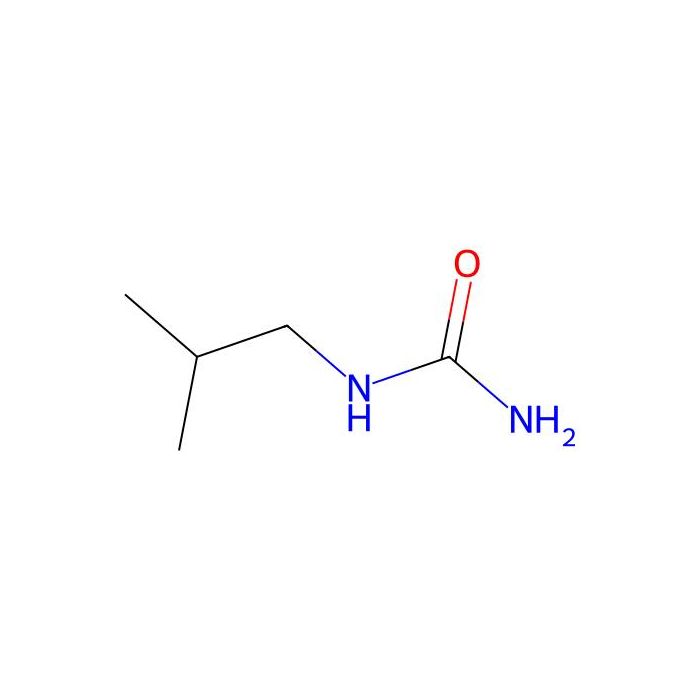
This compound belongs to the class of organic compounds known as ureas. These are compounds containing two amine groups joined by a carbonyl (C=O) functional group.
External Descriptors
Not available
1. Djoumbou Feunang Y, Eisner R, Knox C, Chepelev L, Hastings J, Owen G, Fahy E, Steinbeck C, Subramanian S, Bolton E, Greiner R, and Wishart DS. ClassyFire: Automated Chemical Classification With A Comprehensive, Computable Taxonomy. Journal of Cheminformatics, 2016, 8:61.
Certificati (CoA, COO, BSE/TSE e tabella di analisi)
C of A & Other Certificates(BSE/TSE, COO):
Analytical Chart:
Proprietà chimiche e fisiche
Peso molecolare
116.160 g/mol
XLogP3
0.300
Hydrogen Bond Donor Count
2
Hydrogen Bond Acceptor Count
1
Rotatable Bond Count
2
Exact Mass
116.095 Da
Monoisotopic Mass
116.095 Da
Topological Polar Surface Area
55.100 Ų
Heavy Atom Count
8
Formal Charge
0
Complexity
80.500
Isotope Atom Count
0
Defined Atom Stereocenter Count
0
Undefined Atom Stereocenter Count
0
Defined Bond Stereocenter Count
0
Undefined Bond Stereocenter Count
0
The total count of all stereochemical bonds
0
Covalently-Bonded Unit Count
1
Calcolatori di soluzioni
Molarity Calculator
Determine the necessary mass, volume, or concentration for preparing a solution.
Dilution Calculator
Determine the dilution needed to prepare a stock solution.
Reconstitution Calculator
Recensioni
Recensioni dei clienti
Application Protocols
Not applicable. This product is not supplied as a biological reagent for WB/IHC/IF/FC. For chemical applications, refer to the Reaction Conditions and Synthetic Utility sections for literature-guided procedures, and consult the SDS/CoA for handling specifics.
Biological Roles
No item-specific biological data are provided. The following are general, literature-based comments relevant to urea motifs (not specific to N-isobutylurea in vivo):
Urea functionality: The –NH–C(=O)–NH– unit is a common pharmacophore mimicking peptide hydrogen-bonding patterns; it engages as both H-bond donor and acceptor in protein–ligand contexts.
Memetic properties: Mono-N-alkyl ureas can serve as stable amide surrogates in chemical biology probes due to their planarity and hydrogen-bonding.
Solubility/compatibility: The urea group increases aqueous compatibility relative to hydrocarbons; the isobutyl group confers hydrophobic character, potentially aiding membrane interactions in model systems.
Research use only (as indicated in Product Data). No clinical or therapeutic claims are made or implied.
Buffer Applications
This compound is not a buffering agent and is not typically employed to control pH in biochemical assays. If used in aqueous systems, it will reside in the chosen buffer rather than define it.
Practical guidance:
Choose a conventional buffer (e.g., phosphate, HEPES, Tris) appropriate for your pH range and ionic strength, then dissolve N-isobutylurea into that medium as solubility permits (warming and co-solvents like 5–20% ethanol or DMSO can aid dissolution).
Verify that the urea does not interact adversely with buffer components (e.g., avoid strong acids/bases at elevated temperature to prevent hydrolysis).
Green Alternatives
As a solid reagent/building block, N-isobutylurea itself is not readily replaced by a “green solvent,” but its use context often allows greener choices.
Greener considerations (literature/general):
Solvent selection:
Prefer bio-based alcohols (ethanol, 2-propanol) or water when solubility allows.
For high-solubility screening, replace DMF/DMSO with safer dipolar aprotics where feasible (e.g., propylene carbonate) or use MeCN with proper recovery.
Isocyanate generation:
Replace phosgene/diphosgene with triphosgene or carbonyldiimidazole (CDI) pathways when compatible. Triphosgene is still hazardous but easier to handle; CDI avoids halogenated off-gassing, albeit sometimes lower yielding and with imidazole waste.
Workup and waste:
Design crystallization-based purifications from green solvents (EtOAc/EtOH/water) to minimize chromatography.
Illustrative comparison (qualitative):
Traditional: CH2Cl2 or toluene + triphosgene for isocyanate formation; efficient but halogenated solvent and toxic reagent.
Greener tilt: EtOAc or MeCN + CDI or polymer-supported carbonylating agents; reduced chlorinated waste, often milder conditions. Tradeoff: longer reaction times or additional activation steps.
Note: Selection must be case-specific; verify substrate solubility and stability before switching to green media or reagents.
Pharmaceutical Uses
No pharmacopeial or excipient status is provided in the Product Data.
General considerations (non-clinical, formulation/manufacturing context only):
Urea derivatives can serve as intermediates toward APIs (e.g., via conversion to isocyanates and subsequent carbamate/urea coupling). N-isobutylurea may be used as a synthetic intermediate in process routes where an isobutyl isocyanate or downstream urea/carbamate motif is required.
As a finished excipient, simple urea is commonly used; mono-N-alkyl ureas like N-isobutylurea are not typical pharmaceutical excipients. Any use would require comprehensive toxicological and quality evaluation.
For GMP or regulatory applications, obtain full specifications, residual solvent data, and impurity profiles from the CoA and validate suitability per ICH guidelines.
Physical Properties
Item-specific measured specifications are not provided in the Product Data. Consult the CoA/Spec Sheet for definitive values.
General/literature expectations for N-monoalkyl ureas (for planning only):
Physical state: typically crystalline solids due to urea H-bonding networks.
Polarity/H-bonding: strong H-bond donor (2 × NH) and acceptor (C=O); forms robust intermolecular H-bond lattices.
Solubility (qualitative, literature):
Water: moderate to good solubility at ambient temperature, increasing with heat; branching (isobutyl) reduces water solubility versus straight-chain analogs but the urea motif maintains appreciable aqueous compatibility.
Less soluble in nonpolar solvents (hexanes, toluene) unless warmed or with co-solvent.
Partitioning: the urea group lowers logP relative to hydrocarbons of similar size; the isobutyl side chain raises hydrophobicity compared to unsubstituted urea (qualitative statement).
Acid/base behavior: non-ionic under neutral conditions; urea nitrogens are weakly basic and can be protonated under strong acid; exhibits multiple H-bonding tautomeric contributors but predominates as carbonyl (not enol) form.
Thermal behavior: ureas commonly melt/decompose upon heating; avoid prolonged exposure to elevated temperatures to limit decomposition (literature-general note).
Note: Where exact BP/MP/density/refractive index/logP are required for your method, verify against primary literature or the item’s CoA.
Quality and Grades
Grade/Purity: Not specified for this item; refer to CoA/Spec Sheet.
Interpretation and guidance:
When grade/purity are unspecified, assume a research-use chemical suitable for general synthesis and method development. For analytical or trace applications, verify metal/anion residuals and UV background on the CoA.
If a stabilizer or additive is present, it will be disclosed on the CoA. None are indicated in the Product Data.
Typical quality considerations for urea derivatives:
Water content can influence crystallinity and dissolution rate. For moisture-sensitive operations (e.g., dehydration to isocyanates), dry under vacuum at mild temperature prior to use.
Residual amines or isocyanates (from partial decomposition) can affect reaction selectivity—check by NMR/LC before critical steps.
Documentation: For regulatory or QA needs, request lot-specific CoA detailing identity (1H/13C NMR, IR, MS), purity (HPLC/GC), and residuals as applicable.
Reaction and Applications
N-Isobutylurea is a versatile urea derivative whose dual H-bond donor motif and amide-like carbonyl enable several synthetic and methodological uses (literature/general):
Precursor to isobutyl isocyanate: Dehydration/chlorination of N-monoalkyl ureas with phosgene equivalents (e.g., triphosgene, diphosgene) or oxalyl chloride/POCl3 provides the corresponding isocyanate. This is a convenient route from the benign urea to a reactive isocyanate handle for downstream carbamate/urea formation.
Hydrolysis to amine: Acidic or basic hydrolysis under reflux liberates the parent isobutylamine with evolution of CO2/NH3. Useful for protected amine delivery in sequences sensitive to more labile protecting groups.
H-bond donor organocatalyst/additive: Simple diarylthioureas are more common, but monoalkyl ureas can modulate transition states via dual H-bonding. As an additive, N-alkyl ureas sometimes improve stereocontrol or rate in halogenations, Michael additions, and SN1-type solvolyses by stabilizing charged intermediates.
Carbamoylation/transcarbamoylation: Under activating conditions (e.g., CDI, carbonyldiimidazole, or dehydrative couplings), ureas can transfer the carbamoyl unit to nucleophiles (alcohols/amines) to give carbamates or unsymmetrical ureas.
Supramolecular/H-bonding studies: The well-defined donor–acceptor pattern of ureas supports host–guest binding and crystal engineering; the isobutyl group tunes hydrophobicity and packing.
Practical tips:
Dry before use for moisture-sensitive steps.
Monitor reactions by IR (isocyanate band ~2270 cm−1, literature) or NMR.
Use inert atmosphere when generating isocyanates; rigorously exclude water.
Reaction Conditions
General, literature-based guidance for common transformations of N-monoalkyl ureas (adjust to your substrate and verify experimentally):
Dehydration to isocyanate (R–NCO):
Reagents: triphosgene (0.35–0.5 equiv), Et3N or DIPEA (2–3 equiv).
Solvent: anhydrous CH2Cl2 or toluene (0.05–0.2 M).
Temperature: 0 °C to rt, then 40–70 °C as needed.
Time: 1–6 h, monitor by IR (appearance of ~2270 cm−1, literature) and TLC/LC.
Notes: rigorously exclude moisture; vent CO2/HCl safely; quench excess phosgene equivalent with nucleophile or base under hood.
Acidic hydrolysis to amine:
Reagents: 6 M HCl (aq), reflux.
Solvent: water or water/ethanol.
Time: 3–16 h, depending on scale.
Workup: basify, extract amine with organic solvent; distill or salt as needed.
Expected yields vary with substrate and conditions; consult primary literature for your specific transformation. Always run small-scale trials to optimize equivalents and temperature.
Safety and Handling
Hazard classification details are not provided in the Product Data. Always consult the SDS for authoritative information before use.
General laboratory safety guidance for urea derivatives (literature/experience-based):
Expected hazards: may cause skin/eye irritation and respiratory tract irritation as dust/aerosol. Not volatile, but avoid dust generation.
PPE: lab coat, nitrile gloves, safety glasses; use a fume hood when weighing or dissolving to control dust and any vapors from reagents/solvents used with it.
Storage (item-specific): Store at 2–8 °C, desiccated. Protect from moisture to prevent caking and from prolonged heat to avoid decomposition. Shipped on wet ice.
Incompatibilities: strong oxidizers; strong acids/bases can hydrolyze ureas upon heating or prolonged contact. Dehydrating/chlorinating agents (e.g., POCl3, triphosgene) can convert ureas to isocyanates—use only with appropriate controls.
First aid overview: If on skin/eyes, rinse with water for several minutes; remove contaminated clothing. If inhaled, move to fresh air. If swallowed, rinse mouth with water. Seek medical attention if symptoms persist. Defer to SDS for specifics.
Waste: Dispose in accordance with institutional and local regulations for non-halogenated organic solids; avoid drain disposal.
Note: No GHS pictograms, signal word, or H-statements are specified for this item in the Product Data.
Solvent Selection
This product is a solid reagent/building block, not a solvent. Solvent selection here refers to dissolving/processing N-isobutylurea and choosing media for reactions involving it.
Preferred dissolution solvents: water (warm), methanol, ethanol, isopropanol, DMSO, DMF. Aqueous-organic mixtures can balance solubility and downstream workup.
Limited solubility: nonpolar media (hexanes, heptane). Toluene/EtOAc may dissolve at elevated temperature or with co-solvent (e.g., 10–30% MeOH or DMF).
For organocatalysis/H-bond donor uses: low-to-moderate polarity solvents (toluene, CH2Cl2, EtOAc) are typical; ensure the urea remains adequately soluble at working concentration.
For dehydrations to isocyanate: commonly run in CH2Cl2, toluene, or acetonitrile with a base (e.g., Et3N) and a phosgene equivalent (e.g., triphosgene); strictly anhydrous conditions.
Quick comparison (qualitative):
DMSO/DMF: maximal solubility; harder workup. Good for screening.
Alcohols (MeOH/EtOH): green(er), easy removal; may participate in carbamoylation under activating conditions.
Water: benign, but limited by hydrophobic isobutyl group; warming improves dissolution.
Storage and Reconstitution
Storage conditions (item-specific): Store at 2–8 °C, desiccated. Shipments are on wet ice as indicated.
Container: Keep tightly closed in original container. Protect from ambient moisture to prevent caking/hygroscopic uptake.
Handling: Bring to room temperature in a desiccator before opening to avoid condensation. Reseal promptly after dispensing.
Stability: Ureas are generally stable at room temperature when dry and protected from light; avoid prolonged heating, and avoid strong acids/bases unless hydrolysis is intended.
Reconstitution/dissolution: For stock solutions, use an appropriate solvent based on application—water (warm), alcohols (MeOH/EtOH/iPrOH), DMSO, or DMF. Filter if particulate remains. Prepare fresh solutions for moisture/oxidation-sensitive downstream chemistry (e.g., isocyanate generation).
Freeze–thaw: Not typically applicable to the solid; if preparing solutions for longer-term storage, aliquot and store cold (e.g., 2–8 °C or −20 °C depending on solvent compatibility) and protect from moisture.
For shelf-life, assay, and impurity limits, refer to the lot-specific CoA/Spec Sheet. Research use only (as stated in Product Data).
Structure and Identity
N-Isobutylurea is a mono-N-alkyl urea bearing an isobutyl group on one urea nitrogen and a free urea NH on the other.
SKU: I769335
Product name: N-isobutylurea
CAS: 592-17-6
CID: 79051
InChIKey (from Product Data): 225627
SMILES: Not specified for this item; refer to CoA/Spec Sheet. (Literature example: CC(C)CNC(=O)NH2)
Molecular formula: Not specified for this item; refer to CoA/Spec Sheet. (Computed/literature: C5H12N2O)
Molecular weight: Not specified for this item; refer to CoA/Spec Sheet. (Computed/literature: 116.16 g/mol)
Structural features (general description):
Core functionality: a urea carbonyl (C=O) flanked by two nitrogens (–NH–C(=O)–NH–), with one nitrogen substituted by an isobutyl residue [(CH3)2CH–CH2–].
Functional groups: neutral urea (amide-like) carbonyl; two H-bond donor NH sites (one secondary, one primary) and one strong H-bond acceptor carbonyl oxygen.
No rings or stereocenters; the isobutyl side chain is branched aliphatic, conferring moderate hydrophobicity to an otherwise polar urea unit.
2D description in words: a central carbonyl C double-bonded to O, single-bonded to two nitrogens; one nitrogen bears an isobutyl substituent and one hydrogen, the other nitrogen bears two hydrogens.
Synthetic Utility
Key reactivity features (literature/general):
Functional group: urea (–NH–C(=O)–NH–) with one N-alkyl substituent (isobutyl). The carbonyl is strongly polarized; the NHs are good H-bond donors; the nitrogens are weak nucleophiles.
Transformations:
Dehydration to isocyanate (R–NCO) using phosgene equivalents (triphosgene, diphosgene) or POCl3/SOCl2 with base. The resulting isobutyl isocyanate enables rapid assembly of carbamates (RO–C(=O)–NHiBu) and ureas (R′NH–C(=O)–NHiBu).
Hydrolysis (acidic/basic, heat) to isobutylamine + CO2/NH3—useful for masked-amine strategies.
CDI-mediated activation to N-acylimidazolium-like intermediates for transcarbamoylation to alcohols/amines.
N,N′-disubstitution: coupling with electrophiles (e.g., chloroformates, activated esters) to generate unsymmetrical di-substituted ureas.
Strategic roles:
Protecting/holding strategy for amines where temporary attenuation of nucleophilicity is beneficial.
H-bond donor additive or organocatalyst component in polar transition-state stabilization.
Crystal engineering/supramolecular synthons via predictable R2 2(8) urea hydrogen-bond motifs.
Orthogonality and compatibility:
Stable to many neutral conditions; avoid strong acids/bases at heat and dehydrating chlorinating agents unless transformation is intended.
The isobutyl group provides lipophilicity while maintaining the polar urea handle for phase behavior tuning.
Target Specificity
Not applicable. This product is a small-molecule chemical reagent, not a biological targeting agent or antibody. No antigen/epitope/clone/isotype information applies.
We use cookies to ensure the website functions properly and, where permitted, to improve your experience. You can manage your preferences at any time in Settings. Learn more in our Cookie Policy.
Shall we send you a message when we have discounts available?
Remind me later
Thank you! Please check your email inbox to confirm.
Products are supplied to verified businesses, institutions, and qualified professionals for research and development use only. Not for use in humans, animals, diagnosis, or therapy.