N-Phenylhydroxylamine is a useful synthetic intermediate. It was used as a reagent to prepare 6-halo-2-amino-3-formylchromones as potential topoisomerase inhibitor anticancer agents. It was also used in the synthesis of N-(chlorophenyl)cycloalkyl-hydroxamic acids and N-phenyl-N-hydroxycyclohexylacetamide with anti-viral activities.
Application
N-Phenylhydroxylamine can be used as a starting material for the synthesis of:
· 2-alkylindoles by treating with aliphatic terminal alkynes using gold catalyst via sequential 3,3-rearrangements and cyclodehydrations.
· Isoxazolidines by reacting with aldehydes and α, β-unsaturated aldehydes via a three-component one-pot catalytic reaction.
· Tetrahydro-1,2-oxazines by treating with an aldehyde and cyclopropane via homo 3+2 dipolar cycloaddition reaction
This compound belongs to the class of organic compounds known as n-phenylhydroxylamines. These are hydroxylamines that are N-substituted with a phenyl group.
External Descriptors
a small molecule
1. Djoumbou Feunang Y, Eisner R, Knox C, Chepelev L, Hastings J, Owen G, Fahy E, Steinbeck C, Subramanian S, Bolton E, Greiner R, and Wishart DS. ClassyFire: Automated Chemical Classification With A Comprehensive, Computable Taxonomy. Journal of Cheminformatics, 2016, 8:61.
Determine the necessary mass, volume, or concentration for preparing a solution.
Dilution Calculator
Determine the dilution needed to prepare a stock solution.
Reconstitution Calculator
Recensioni
Recensioni dei clienti
Application Protocols
No assay protocols (e.g., WB, IHC, IF, FC) are applicable to this small-molecule reagent. For synthetic or analytical use, refer to the Reaction Conditions, Solvent Selection, and Synthetic Utility sections for practical guidance. If you require a step-by-step protocol for a specific transformation (e.g., Bamberger rearrangement or oxidation to nitrosobenzene), adapt the literature conditions provided to your scale and equipment, and consult primary references and your institutional SOPs.
Biological Roles
This compound is not a biomolecule and this product is for research use only. The following notes summarize literature context regarding related metabolic chemistry without implying clinical use.
Metabolic relevance (literature)
N-Phenylhydroxylamine is a known intermediate in the biotransformation of nitrobenzene and aniline derivatives. Enzymatic and cellular reductive/oxidative pathways can interconvert nitrobenzene ⇄ nitrosobenzene ⇄ N-phenylhydroxylamine ⇄ aniline.
It can undergo further biotransformations (e.g., conjugation, oxidation) and is associated with oxidative stress pathways in cells when generated in situ.
Protein/hemoglobin interactions (literature)
Aromatic hydroxylamines and nitrosoarenes can oxidize hemoglobin iron, contributing to methemoglobin formation in toxicology models. Such mechanisms are often invoked in risk assessments of aniline/nitrobenzene exposure.
Reactive behavior in biological matrices (literature)
Readily protonated in acidic environments and subject to acid-catalyzed rearrangement to p-aminophenol; in vivo, acidic microenvironments and enzymes can influence product distribution.
Lab biosafety perspective
Handle as a chemically hazardous research reagent. Avoid exposure to biological specimens unless your protocol specifically requires it and is approved under institutional safety review. Dispose according to chemical hazardous waste procedures; do not discharge into biological drains.
No medical, diagnostic, or therapeutic applications are claimed or supported for this catalog item.
Buffer Applications
N-Phenylhydroxylamine is not a buffering reagent and is not typically used to prepare pH buffer systems. In aqueous mineral acids it undergoes Bamberger rearrangement to p-aminophenol; thus, intentional exposure to buffer components, especially acidic ones, can change its composition.
Practical guidance
If aqueous handling is required, use neutral, oxygen-poor water briefly and at low temperature. Avoid phosphate/citrate/acetate buffers at low pH that can catalyze rearrangement.
For most workflows, employ anhydrous organic solvents (see Solvent Selection) and maintain inert atmosphere to preserve the N–O functionality.
For buffer preparation and pH control, use dedicated buffering agents (e.g., phosphate, HEPES, acetate) rather than this compound.
Green Alternatives
Selection of greener strategies depends on whether N-phenylhydroxylamine is a desired isolable intermediate or a transient in a telescoped sequence.
Consider avoiding isolation (literature best practice)
In many processes (e.g., nitrobenzene → aniline or → p-aminophenol), catalytic methods can minimize or avoid isolating N-phenylhydroxylamine, reducing exposure and waste. Examples include continuous-flow hydrogenation or one-pot nitro reduction/rearrangement with in situ processing.
Solvent choices
Replace chlorinated solvents (DCM, CHCl3) with ethyl acetate, 2-MeTHF, or MeCN where compatible. Alcohols (EtOH) are preferable to MeOH for greener metrics.
Oxidation/reduction reagents
Favor catalytic oxidations (e.g., O2 with a suitable catalyst) over stoichiometric metal oxidants when generating nitrosobenzene, acknowledging selectivity challenges.
For reductions to aniline, employ catalytic hydrogenation (H2, Pd/C or Raney Ni) in ethanol/water rather than metal-acid stoichiometric systems (Fe/HCl, Zn/HCl), which produce metal salt waste.
Comparison (literature; qualitative)
DCM workup vs EtOAc
Pros (EtOAc): renewable-ish, lower toxicity, easy removal; Cons: may require larger volumes for solubility.
Fe/HCl reduction vs H2/Pd-C
Pros (H2/Pd-C): catalytic, cleaner waste; Cons: requires pressure equipment and controls for over-reduction.
EHS considerations
Limiting storage time, aliquoting, and inert handling minimize degradation and waste. Flow chemistry can further improve process safety by reducing inventory of energetic redox-active intermediates.
Pharmaceutical Uses
This product is offered strictly for research use only. It is not an excipient or drug substance as supplied here. The points below reflect general literature context relevant to pharmaceutical process chemistry, not medical use claims.
Role in process chemistry (literature)
N-Phenylhydroxylamine is a classical intermediate in the conversion of nitrobenzene to aniline and in acid-mediated routes to p-aminophenol (a key intermediate in several analgesic APIs). In modern practice, the hydroxylamine is often generated and consumed in situ to enhance safety and throughput.
Considerations for GMP/process development
Control of residual nitrosobenzene and nitrobenzene impurities is critical due to genotoxic potential; validated analytical methods (HPLC/GC-MS) are typically required.
Not recognized as a pharmaceutical excipient; no pharmacopeial monograph is commonly assigned for this substance.
EHS/process safety
Where process routes involve this intermediate, implement appropriate containment, gas scrubbing for NOx, and minimize inventory through continuous processing or on-demand generation.
No therapeutic or clinical claims pertain to this catalog item.
Physical Properties
Item-specific specifications (water content, metals, UV cutoff, exact mp/bp, etc.) are not provided in the Product Data for this catalog entry. Values below are typical literature descriptors for N-phenylhydroxylamine and should be used as general guidance only.
State/appearance: Typically isolated as a crystalline solid (literature); sensitive to oxidation and acid-catalyzed rearrangement.
Melting point (literature): ~81–85 °C (reports vary with purity and polymorph; decomposes/reshuffles under strongly acidic conditions).
Boiling point: Not commonly distilled; compound undergoes decomposition/rearrangement before or upon attempted distillation (literature).
Density: Not commonly reported; depends on crystalline form (literature).
Solubility (literature):
Water: low to moderate; significantly more soluble in acidic aqueous media due to protonation at nitrogen.
Organic: soluble in polar organics (EtOH, MeOH, acetone), ethers, chlorinated solvents (DCM, chloroform), and ethyl acetate.
Acid-base behavior (literature): Weakly basic aniline-type nitrogen; readily protonated in strong mineral acid to give salts that undergo rearrangement. The N–OH is weakly acidic and can be deprotonated by strong base to give N-oxide anion equivalents.
Partitioning/polarity (literature): Moderately polar aromatic; logP estimated near unity (qualitative). Exhibits both H-bond donation and acceptance.
1H NMR (CDCl3): aromatic multiplet ~6.6–7.4 ppm; exchangeable N–H/O–H signals often broad and solvent-dependent.
For method development or safety-critical work, consult primary literature and the product’s CoA/SDS for definitive values.
Quality and Grades
Item-specific grade/purity and appearance: Not specified for this item; refer to CoA/Spec Sheet.
Interpreting grade (general guidance)
For redox- and acid-sensitive organics like N-phenylhydroxylamine, common grades include “purum,” “98%,” or “reagent grade.” Without an explicit grade, users should verify assay, residual solvents, and stabilizer content on the CoA.
Stabilizers: This product listing does not indicate any stabilizer. If a stabilizer is present (e.g., trace base or antioxidant), it will be disclosed on the CoA; stabilizers can influence reaction outcomes (e.g., Bamberger rearrangement kinetics or oxidation rate).
Suitability for use (how to evaluate)
Chromatography/analytical use: If using as a reference or in sensitive kinetics, verify UV impurities, peroxide/oxidation byproducts (e.g., nitrosobenzene) by HPLC/GC.
Synthetic use: Confirm assay and headspace oxygen level where available; an inert-packaged solid stored at −20 °C generally maintains quality, but re-check by NMR/IR for N–O integrity before scale-up.
Batch documentation
Always consult the item’s specific CoA/SDS for: assay method, residual solvent, trace metals (if relevant), and recommended shelf life. Any missing specifications in this catalog entry should be treated as “Not specified for this item; refer to CoA/Spec Sheet.”
Practical tip
Given the compound’s propensity to oxidize, open vials briefly, backfill with inert gas after use, and consider storing as pre-weighed aliquots to preserve grade across multiple uses.
Reaction and Applications
N-Phenylhydroxylamine serves as a versatile intermediate in aromatic amine chemistry with distinct reactivity at N and O.
Under strong acid (e.g., conc. H2SO4 or HCl), N-phenylhydroxylamine rearranges to predominantly p-aminophenol. This is a key step in synthetic routes to p-aminophenol derivatives and related fine chemicals.
Mechanistic note: N-protonation followed by N–O bond migration via a cationic intermediate directs para-selective hydroxylation on the ring.
Redox interconversions (literature)
Oxidation: mild oxidants (e.g., MnO2, ferricyanide, Fe(III) salts) convert it to nitrosobenzene; controlled conditions avoid overoxidation to nitrobenzene. Nitrosobenzene is a useful electrophile and dienophile.
Reduction: catalytic hydrogenation (H2, Pd/C) or metal/acid systems (Zn/HCl, Fe/HCl) regress to aniline. Such steps mirror nitrobenzene reduction pathways where the hydroxylamine is a transient intermediate.
Functional group derivatization (literature)
O-Acylation or O-sulfonylation furnishes O-activated hydroxylamines that act as electrophilic aminating agents (N–O cleavage to deliver –NHPh to nucleophiles).
N-Protection strategies (e.g., carbamates, sulfonamides) help tune reactivity and prevent undesired rearrangement.
Practical tips
Avoid mineral acids unless rearrangement is desired; even dilute acid can initiate conversion.
Conduct manipulations under inert gas and subdued light to limit oxidation to nitroso species.
When oxidizing to nitrosobenzene, monitor by TLC/GC; nitrosobenzene exhibits distinct color/UV profile and characteristic IR (N=O ~1500–1600 cm⁻¹).
Reaction Conditions
The following conditions are representative literature guidance for work involving N-phenylhydroxylamine. Optimize for your substrate, scale, and safety constraints.
Bamberger rearrangement to p-aminophenol (literature)
Reagents: conc. H2SO4 (or HCl) aqueous media.
Solvent: water or water/EtOH.
Temperature: 0–25 °C (cooling recommended to manage exotherm and control para selectivity).
Time: 0.5–4 h depending on acid strength and concentration.
Notes: Avoid >25–30 °C to limit side reactions; neutralize carefully and extract promptly.
Oxidation to nitrosobenzene (literature)
Oxidants: MnO2 (activated), Fe(III) salts, K3[Fe(CN)6], or TEMPO/O2 variants.
Solvent: AcOH, DCM, or MeCN.
Temperature: 0–25 °C.
Time: 0.5–3 h, monitor by TLC/UV-vis (nitrosobenzene exhibits characteristic color).
Notes: Exclude base; minimize light/air after endpoint to avoid overoxidation.
Reduction to aniline (literature)
Catalytic hydrogenation: H2 (1–5 bar), Pd/C (1–10 wt%), EtOH or EtOH/H2O, 20–40 °C, 1–6 h.
Metal/acid: Fe or Zn (3–6 equiv), HCl (aq), 0–25 °C, 1–4 h.
Notes: Filtration over celite removes catalyst/metal fines; verify absence of nitroso/nitro by GC/LC before isolation.
O-Acylation to O-acyl hydroxylamines (literature)
Reagents: acyl chloride/anhydride (1.0–1.2 equiv), base (pyridine, 2,6-lutidine), DCM or MeCN.
Temperature: 0–10 °C to start; then 20–25 °C.
Notes: Low temperature and non-nucleophilic bases favor O-selectivity; avoid strong acids post-acylation to prevent rearrangement/cleavage.
All parameters above are general literature guidance; validate on small scale and consult primary sources for your specific system.
Safety and Handling
GHS/SDS status for this item
Signal word: Not specified for this item; refer to SDS.
H-Statements: Not specified for this item; refer to SDS.
GHS classification/pictograms: Not specified for this item; refer to SDS.
General hazards (literature/experience-based)
Aromatic hydroxylamines can be harmful if inhaled, ingested, or absorbed through skin; risk of methemoglobinemia has been reported for related substances.
Strongly acid-sensitive: in mineral acids, N-phenylhydroxylamine undergoes Bamberger rearrangement; avoid unintended acid exposure.
Oxidation-sensitive: readily oxidized to nitrosobenzene; protect from air and light as practical. In the presence of metals or peroxides, further oxidation/polymerization may occur.
Work in a fume hood. Avoid aerosols and dust formation. Use an inert atmosphere for weighing and transfers when feasible.
PPE: laboratory coat, safety glasses or face shield, and appropriate chemical-resistant gloves (e.g., nitrile). Consider double-gloving for extended handling.
Incompatibilities: strong acids (rearrangement), strong oxidizers (rapid oxidation), and strong bases (possible N–O cleavage under forcing conditions). Avoid catalytic metal surfaces if oxidation is undesirable.
First aid (overview; defer to SDS)
Inhalation: move to fresh air; seek medical attention if symptoms persist.
Skin/eye contact: rinse with water for ≥15 minutes; remove contaminated clothing; obtain medical advice.
Ingestion: rinse mouth; do not induce vomiting; seek medical attention.
Storage/transport (from Product Data)
Store at −20 °C, protected from light, under an argon atmosphere. Ship on ice with ice pads. Keep tightly closed; minimize headspace oxygen.
Solvent Selection
N-Phenylhydroxylamine is a moderately polar aromatic bearing an N–OH functionality. Choice of solvent should balance solubility, redox stability, and the intended transformation (oxidation/reduction vs. rearrangement).
Limited: water at neutral pH; enhanced in acidic media due to protonation (note: acid promotes rearrangement).
Poor: aliphatic hydrocarbons (hexanes, heptane) unless co-solvent is used.
Polarity and stabilization
Hydrogen-bonding solvents (alcohols) solvate the N–OH group well but can accelerate certain acid/base-catalyzed processes.
Aprotic polar solvents (MeCN, DCM, THF) are often preferred for controlled oxidations or O-acylations where protic media are undesirable.
When to choose what (use-case guidance)
Bamberger rearrangement: aqueous mineral acids (H2SO4/HCl) with controlled temperature; start from a water-miscible organic co-solvent (e.g., EtOH) for dissolution if needed.
Oxidation to nitrosobenzene: acetic acid, DCM, or MeCN commonly used; avoid basic media.
Reductions to aniline: alcohols (EtOH) for catalytic hydrogenation; protic solvents for metal/acid reductions (Fe/HCl), or aprotic for transfer-hydrogenation protocols.
Comparison snapshot (literature)
DCM vs EtOH: DCM offers inert, aprotic conditions minimizing side reactions; EtOH provides benign handling but may participate in acid-mediated pathways.
THF vs EtOAc: THF improves solubility at low temperature; EtOAc easier to remove and greener, but may be less effective for very concentrated solutions.
Storage and Reconstitution
Storage (from Product Data)
Store at −20 °C, protected from light, under an argon atmosphere (argon charged). Ship in an ice chest with ice pads. Keep container tightly closed and minimize headspace oxygen exposure.
Stability considerations (general)
Sensitive to oxidation (to nitrosobenzene) and acid-catalyzed rearrangement (to p-aminophenol). Limit exposure to air, moisture, and light. Avoid contact with acids unless rearrangement is intended.
If supplied as a solid (appearance not specified for this item; refer to CoA/Spec Sheet), dissolve under inert gas in a dry, oxygen-poor solvent such as DCM, THF, MeCN, EtOAc, or ethanol. Typical stock concentrations: 0.05–0.5 M depending on application.
Degas solvents when feasible (sparge with argon or nitrogen) and pre-cool if preparing acid-sensitive solutions.
Filter solutions through PTFE syringe filters to remove particulates; avoid silica/alumina contact if oxidation is a concern.
Aliquoting and shelf life
Prepare small aliquots in amber vials, backfilled with inert gas, and freeze at −20 °C to reduce freeze–thaw cycles.
Clearly label preparation date and solvent. For maximum integrity, use freshly prepared solutions; discard if color changes (e.g., green/yellow indicative of nitroso species) or if analysis detects significant decomposition.
Research use
For research use only. Consult the product’s CoA/SDS for any item-specific stability data and for authoritative safety information.
Structure and Identity
N-Phenylhydroxylamine is an aniline-derived N–O functionalized aromatic amine frequently encountered as an intermediate in nitrobenzene/aniline chemistry.
Item-specific identifiers (from Product Data)
SKU: N131374
CAS: 100-65-2
CID: 7518
InChIKey (as provided): 46767
Literature/computed identifiers and composition (general reference; not item-specific specifications)
Structural features (general chemical description)
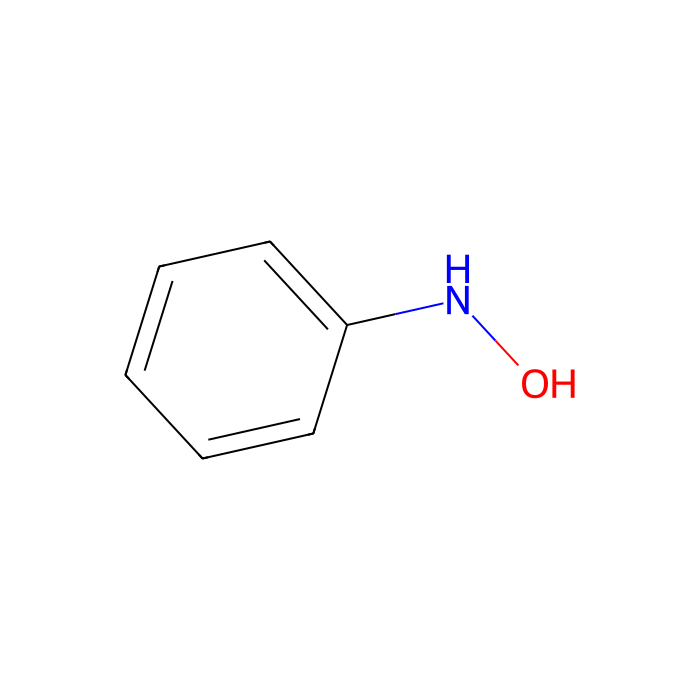
Aromatic ring: a monosubstituted benzene (phenyl) attached to an N–O unit.
Functional groups: an aniline-type nitrogen bearing an –OH substituent (N–OH, hydroxylamine functionality). Tautomerization (minor) between N–OH and O–NH is often discussed formally, but the N–OH description is conventional.
H-bonding: both H-bond donor and acceptor; capable of intra-/intermolecular H-bonding via N and O.
Redox-active: readily oxidized to nitrosobenzene and reduced to aniline; prone to acid-catalyzed rearrangement (Bamberger) to p-aminophenol.
2D structure in words
A benzene ring (positions 1–6) with an –N(–H)–OH substituent at C1. The nitrogen is directly bonded to the aromatic carbon and to a hydroxyl group (N–O single bond). No stereocenters; planar aromatic core with a pendant N–O group capable of rotation.
Synthetic Utility
The N–OH motif in N-phenylhydroxylamine confers unique reactivity at both nitrogen and oxygen, enabling redox, rearrangement, and electrophilic amination chemistry.
Key functional-group behavior (literature)
N–O bond: susceptible to acid-catalyzed rearrangement (Bamberger) yielding p-aminophenol. Under basic or thermal conditions with appropriate activation, N–O cleavage can deliver anilide/amine derivatives.
N-centered nucleophilicity: can be attenuated or directed by protection/activation (e.g., acylation, sulfonylation) to access O-activated hydroxylamines that serve as electrophilic aminating agents.
Redox handles: oxidation to nitrosobenzene (N=O) and reduction to aniline allow toggling between electrophilic and nucleophilic aryl nitrogen species.
Named/related reactions (literature)
Bamberger rearrangement → p-aminophenol (predominant para selectivity).
Oxidation to nitrosobenzene for subsequent cycloadditions or C–N bond constructions.
Electrophilic amination via O-acyl/N–O activation of hydroxylamines delivering Ar–NH fragments to carbon or heteroatom nucleophiles.
Retrosynthetic value
Provides a branch point from nitroarenes to either anilines (reduction) or aminophenols (rearrangement) under chemoselective control.
Practical notes
For O-acylation, use mild bases (e.g., pyridine, lutidine) in aprotic solvents to favor O- over N-acylation; temperature control limits rearrangement.
Monitor reactions by IR (N–O ~900–1000 cm⁻¹) and by LC to track nitroso formation; quench under inert conditions to prevent air oxidation during workup.
Target Specificity
Not applicable. This product is a small-molecule reagent, not a biological targeting reagent (e.g., antibody, ligand with defined biomolecular target). No antigen/epitope, clone, isotype, or species reactivity information applies.
Utilizziamo i cookie per garantire il corretto funzionamento del sito web e, ove consentito, per migliorare la tua esperienza. Puoi gestire le tue preferenze in qualsiasi momento nelle Impostazioni. Per saperne di più, consulta la nostra Cookie Policy.
Desidera che le inviamo un messaggio quando avremo sconti disponibili?
Ricordamelo più tardi
Grazie! Controlli la sua casella di posta per confermare.
Products are supplied to verified businesses, institutions, and qualified professionals for research and development use only. Not for use in humans, animals, diagnosis, or therapy.

 I2601603