This compound belongs to the class of organic compounds known as benzene and substituted derivatives. These are aromatic compounds containing one monocyclic ring system consisting of benzene.
External Descriptors
Not available
1. Djoumbou Feunang Y, Eisner R, Knox C, Chepelev L, Hastings J, Owen G, Fahy E, Steinbeck C, Subramanian S, Bolton E, Greiner R, and Wishart DS. ClassyFire: Automated Chemical Classification With A Comprehensive, Computable Taxonomy. Journal of Cheminformatics, 2016, 8:61.
Determine the necessary mass, volume, or concentration for preparing a solution.
Dilution Calculator
Determine the dilution needed to prepare a stock solution.
Reconstitution Calculator
Recensioni
Recensioni dei clienti
Application Protocols
No assay or kit-style protocols are specified for this reagent. It is typically employed as a substrate/intermediate in organic synthesis. For practical use, refer to Reaction Conditions and Synthetic Utility for representative procedures and adapt them to your system via small-scale optimization. Any protocol details specific to this item are Not specified for this item; refer to CoA/Spec Sheet or SDS for handling particulars.
Biological Roles
Item-specific biological data: Not specified for this item; refer to literature as needed.
General context (literature/general):
Thioamides as bioisosteres: Replacement of C=O with C=S in amides alters hydrogen-bonding geometry, polarizability, and proteolytic stability. N-aryl thioamides are commonly used probes in structure–activity relationship exploration in chemical biology (research use only).
Binding motifs: The thioamide group can serve as both H-bond donor (NH) and acceptor (thione S), often strengthening interactions in hydrophobic pockets due to increased polarizability (literature/general observation).
Spectroscopic probes: Thioamide substitution has been used in peptides to modulate IR and fluorescence quenching characteristics (not specific to this compound).
No endogenous metabolic role is known for N-Phenylthiobenzamide; any biological testing must be conducted under appropriate institutional guidelines. No medical or clinical claims are made.
Buffer Applications
Not typically applicable. N-Phenylthiobenzamide is a hydrophobic organic reagent and is not used to prepare aqueous buffer systems. For workup or analysis, non-aqueous or biphasic systems with organic solvents (e.g., EtOAc/water for extraction) are more relevant. Refer instead to Solvent Selection and Reaction & Applications for practical usage guidance.
Green Alternatives
Green chemistry context: This product is a solid reagent. Greener choices relate to the solvents and reagents employed when transforming or handling N-Phenylthiobenzamide, rather than the substance itself.
Greener solvent options (literature/general):
Prefer ethyl acetate, 2-MeTHF, CPME, or MeCN over chlorinated solvents when feasible for dissolution, extraction, and chromatography.
Replace DMF/DMSO with propylene carbonate, Cyrene, or green esters where reaction compatibility allows.
Greener oxidants for benzothiazole synthesis (literature):
I2 with air/O2 in DMSO or MeCN (metal-free) or photoredox/aerobic conditions can reduce waste vs stoichiometric halogens.
Electrochemical oxidative cyclization has been reported for N-aryl thioamides, minimizing chemical oxidants (literature).
Use nickel-catalyzed hydrogen transfer or Pd/C with hydrogen donors instead of large excesses of Raney Ni when compatible.
Trade-offs:
Greener solvents may alter solubility/kinetics; ensure comparable conversion and selectivity before scale-up.
Avoiding chlorinated media can lengthen reactions or require higher temperatures; perform DoE to optimize.
Mini comparison (general):
DCM (excellent solubility, easy removal) vs EtOAc (biodegradable, lower toxicity): EtOAc preferred where reaction/selectivity permits.
Pharmaceutical Uses
Item-specific pharmacopeial status/excipient role: Not specified for this item; refer to CoA/Spec Sheet.
General information (non-clinical; research/manufacturing context only):
Aromatic thioamides like N-Phenylthiobenzamide may be employed as synthetic intermediates en route to heteroaromatic scaffolds (e.g., benzothiazoles) that are of interest in medicinal chemistry campaigns.
As a solid, non-volatile intermediate, it is not typically used as an excipient. Its role is primarily as a building block in discovery and process development settings.
Any incorporation into pharmaceutical development workflows would require full impurity profiling and qualification per ICH guidelines; none of this is specified for this item.
Physical Properties
Item-specific specs: Not specified for this item; refer to CoA/Spec Sheet.
Literature/computed data (reference only; not product specifications):
Molecular formula: C13H11NS (literature)
Molecular weight: 213.30 g/mol (calculated from atomic weights)
Physical state/appearance: Typically a crystalline solid (literature/general)
Solubility profile:
Poorly soluble in water; soluble in common organic solvents such as dichloromethane, chloroform, THF, acetone, ethyl acetate, and hot ethanol (literature/general). Aromatic thioamides often show enhanced solubility in polar aprotic media (DMF, DMSO).
Acid–base properties: Neutral thioamide; weakly acidic NH (pKa typically ~10–14 for aryl thioamides; literature, general range). Can form strong H-bonds as donor and acceptor (via C=S) (literature/general).
Partitioning: Expected to be moderately lipophilic due to two phenyl rings and thioamide functionality; logP likely in the 2–3 range for analogous aryl thioamides (literature/general trend; exact value not verified for this compound).
Spectroscopic notes:
IR: strong C=S stretch typically 1150–1250 cm−1; N–H stretch ~3200–3300 cm−1 (literature/general for thioamides).
1H NMR: downfield NH (~9–12 ppm, solvent-dependent) plus two sets of aromatic multiplets (literature/general).
Practical handling observations (general):
May exhibit thioamide tautomerism and rotamers, potentially broadening NMR signals at ambient temperature. Gentle heating or different deuterated solvents can sharpen spectra (literature/general guidance).
Quality and Grades
Item-specific grade/purity: Not specified for this item; refer to CoA/Spec Sheet.
Guidance on grades (general):
Analytical/AR grade: Typically indicates low inorganic/organic impurities suitable for general synthesis and analytical work.
≥98–99% purity (typical research grade, literature/general): Appropriate for most synthetic applications; residual isomeric/rotameric signals in NMR are expected for thioamides and are not necessarily impurities.
HPLC grade (if applicable to solvents): Not relevant here; compound is a solid reagent, not a solvent.
Stabilizers/inhibitors: None typically required for aromatic thioamides (literature/general). If present, they would be declared on the CoA.
What to check on receipt:
Identity: 1H/13C NMR, IR (C=S band), and MS consistent with C13H11NS (literature features). Elemental analysis may support composition.
Purity: HPLC or GC (if volatile enough), and melting behavior. Any item-specific numerical limits are Not specified for this item; refer to CoA/Spec Sheet.
Reaction and Applications
Typical reaction families for aryl thioamides (literature/general):
Benzothiazole synthesis: Intramolecular cyclization of N-aryl thioamides under oxidative or halogenating conditions to give 2-arylbenzothiazoles. Common promoters: I2/DMSO (aerobic), Br2, NBS, or hypervalent iodine (PIDA/PIFA). Often metal-free.
Electrophilic S-functionalization: S-alkylation/acylation to form thioimidates and related derivatives; conditions: alkyl halides (RX) with base in polar aprotic solvent.
Directed C–H activation (DG): Thioamide acts as a bidentate directing group for ortho-C–H functionalization on the N-aryl ring under Pd(II)/Rh(III)/Ru(II) catalysis (ligand assistance) to forge C–C or C–X bonds (literature examples).
Thioimidoyl transfer/imidoyl chlorides: Conversion with oxalyl chloride or SOCl2 to thioimidoyl chlorides for subsequent coupling (literature).
Thioamide–amide interconversions: Desulfurization to corresponding amides with Raney Ni or Lawesson’s byproduct management in reverse transformations (literature).
Practical tips (general):
Drying: While moisture sensitivity is low, anhydrous conditions improve yields in S-alkylations and acylations.
Acid/base: Strong bases can deprotonate the NH, enabling N- vs S-selectivity control (temperature and base choice influence regioselectivity).
Monitoring: IR (C=S band decrease) and TLC/UPLC; benzothiazole products often show increased UV response.
Use expansion (aligned with catalog context):
As a versatile intermediate toward heteroaromatics (benzothiazoles) and as a thioamide surrogate in SAR libraries where amide-to-thioamide bioisosteric replacement is probed in discovery chemistry (research use only).
Reaction Conditions
Literature examples (general guidance; not item-specific specs):
Benzothiazole formation (I2/DMSO, aerobic): N-aryl thioamide (1.0 equiv), I2 (0.5–1.0 equiv), DMSO (0.1–0.5 M), 80–120 °C, 2–12 h, air or O2; typical isolated yields 60–90% depending on substitution.
Desulfurization to amide: Raney Ni (excess), ethanol or THF, reflux to 80 °C, several hours; often clean conversion to the corresponding amide (literature).
Practical notes:
Control moisture in S-alkylations; water can suppress rates and alter selectivity.
Excess oxidant/halogen can over-oxidize sulfur; titrate equivalents and monitor closely (TLC/UPLC).
For C–H activation, chelation assistance from the thioamide is key; additives (Cu(II), Ag(I)) can improve turnover in some systems.
These conditions are representative from the literature. Optimize for scale, safety, and environmental considerations before application.
Safety and Handling
GHS classification and hazard statements: Not specified for this item; refer to SDS.
General thioamide safety considerations (literature/general; not a substitute for SDS):
Hazards: Aromatic thioamides can cause irritation to skin, eyes, and respiratory tract. Avoid dust formation and inhalation. Some thioamide compounds can have unpleasant sulfurous odors.
Incompatibilities: Strong oxidizing agents (risk of exothermic oxidation of sulfur), strong acids/bases (may hydrolyze or decompose the thioamide), and halogenating agents (electrophilic addition at sulfur). Keep away from nitrating/sulfonating systems.
PPE: Safety glasses or splash goggles, lab coat, and appropriate chemically resistant gloves (e.g., nitrile). Use in a chemical fume hood to control vapors/dust.
First aid (overview):
Skin/eye contact: Rinse with plenty of water for ≥15 min; remove contaminated clothing. Seek medical attention if irritation persists.
Inhalation: Move to fresh air, keep at rest, obtain medical advice if symptoms occur.
Ingestion: Rinse mouth; do not induce vomiting; seek medical attention.
Spill response: Avoid dust; collect with inert absorbent; place in compatible container for disposal following local regulations.
Fire-fighting: Use dry chemical, CO2, or foam. Combustion can produce toxic fumes (SOx, NOx). Firefighters should wear self-contained breathing apparatus.
Always consult the product-specific SDS for authoritative hazard classifications, exposure limits, and disposal guidance.
Solvent Selection
Applicability: This is a solid organic reagent, not a solvent. Solvent selection here refers to dissolving/processing N-Phenylthiobenzamide in synthesis, analysis, or recrystallization.
Good solvents: DMSO, DMF, NMP, dichloromethane, chloroform, THF, acetone, ethyl acetate, hot ethanol or isopropanol.
Limited/poor: Water and aliphatic hydrocarbons (hexanes, heptane).
Polarity considerations:
The thioamide moiety provides H-bond donor/acceptor capacity; polar aprotic solvents often maximize solubility and maintain nucleophilicity at sulfur.
Use-case guidance:
Analytical sample prep: DMSO-d6 or CDCl3 for NMR; choose based on desired observation of NH (exchangeable) and rotamer resolution.
Recrystallization: Ethanol/ethyl acetate or toluene/EtOAc mixtures can afford slow crystallization; optimize empirically.
Reaction media: For oxidative cyclizations (to benzothiazoles), DMSO or acetonitrile is frequently used; for metal-catalyzed C–H functionalizations, polar aprotics (DMA, DMSO) are common (literature).
Comparison note (literature/general):
DCM vs EtOAc: DCM affords rapid dissolution and easy removal; EtOAc offers a greener profile and higher polarity but may co-elute polar byproducts in chromatography.
Store tightly closed in a dry, well-ventilated place away from strong oxidizers, acids, and bases. Protect from prolonged exposure to light and moisture to maintain quality.
For long-term archival, a desiccator or dry box is recommended; the compound is not particularly hygroscopic but dryness benefits many transformations.
Reconstitution/dissolution (general):
To prepare stock solutions, dissolve in DMSO, DMF, acetonitrile, dichloromethane, THF, or ethanol depending on downstream use. Filter if necessary to remove particulates.
Typical research stock concentrations: 10–100 mM in DMSO or MeCN for screening workflows (research use only). Clearly label and store solutions at 2–8 °C (short term) or −20 °C (long term) in amber vials to minimize degradation; equilibrate to room temperature before opening to avoid moisture condensation.
Stability limits and item-specific expiry: Not specified for this item; refer to CoA/Spec Sheet.
Structure and Identity
Item-specific identifiers (from Product Data):
Product Name: N-Phenylthiobenzamide
SKU: N140452
CAS: 636-04-4
PubChem CID: 668263
InChIKey (as provided): 30317
Storage Conditions: Room temperature
Shipping: Normal
Literature/computed structural data (for reference; not item specifications):
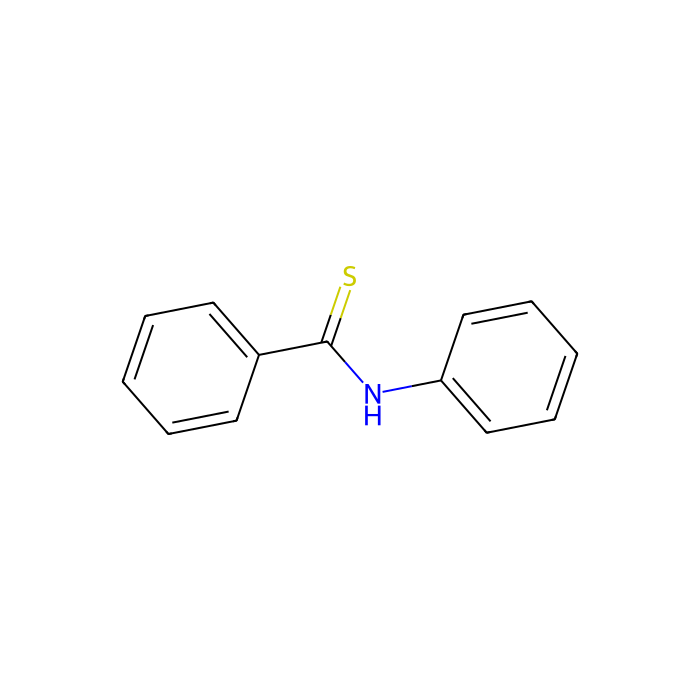
Core scaffold: Anilide of benzenecarbothioamide (benzothioanilide); planar conjugation across Ph–C(=S)–N–Ph
2D structural description (general):
A central thioamide unit C(=S)–NH connects two phenyl rings: one phenyl substituted on the carbonyl-thione carbon (benzothioyl) and the other attached to nitrogen (anilide). The thione (C=S) is conjugated with the benzoyl phenyl ring, and the N–phenyl can engage in resonance, giving partial imidothioate character. No stereocenters; expected E/Z thioamide rotamers may exist but rapidly interconvert in solution (literature).
Synthetic Utility
Functional group leverage (literature/general):
Thioamide (C(=S)–NH): Nucleophilic sulfur enables S-alkylation/acylation; nitrogen acidity enables N-derivatization and metal coordination. The C=S is a good electrophile under activation (forming thioimidates/imidoyl halides).
Bidentate directing group: Facilitates ortho-C–H activation on the N-phenyl ring for arylation, alkylation, halogenation using Pd/Rh/Ru catalysts (DG-assisted mechanisms).
Heterocycle construction: Intramolecular cyclization to 2-phenylbenzothiazoles under oxidative or halogenating conditions is a high-value transformation.
Retrosynthetic value (literature):
Accessible from benzoyl chloride (or benzaldehyde via thionation/reductive amidation routes) and aniline through thioacylation pathways (e.g., thioacyl chloride + aniline; or convert benzamide to thioamide with P4S10/Lawesson’s, then N-arylation).
Downstream diversification (examples from literature):
S-alkyl → thioimidates → amidines: Route to amidines via subsequent substitution/hydrolysis.
Electrophilic sulfur transfer: Formation of sulfenylated derivatives that can act as masked imidoyl donors.
Desulfurization: Conversion to N-phenylbenzamide using Raney Ni or metal-catalyzed hydrogenation when oxygen analog is desired.
Purification/characterization (general):
Crystallization from EtOH/EtOAc often effective; monitor with IR (loss/shift of C=S indicates reaction progress) and NMR (NH resonance diagnostic).
Target Specificity
Not applicable. This product is a small-molecule organic reagent and is not an antibody, probe, or biological targeting agent. No antigen/epitope or species reactivity data apply.
We use cookies to ensure the website functions properly and, where permitted, to improve your experience. You can manage your preferences at any time in Settings. Learn more in our Cookie Policy.
Shall we send you a message when we have discounts available?
Remind me later
Thank you! Please check your email inbox to confirm.
Products are supplied to verified businesses, institutions, and qualified professionals for research and development use only. Not for use in humans, animals, diagnosis, or therapy.

 C2211043