QUALITÀ & PUREZZAMoligand™?Moligand™ — Aladdin's line of ligands and bioactive small molecules. Use for receptor, pathway, and binding studies needing defined small-molecule tools.≥96%
Naquotinib (ASP8273) is an orally available, irreversible, mutant-selective,epidermal growth factor receptor (EGFR)inhibitor, with potential antineoplastic activity.
Targets
mutant EGFR
In vitro
ASP8273 is a small-molecule irreversible TKI inhibitor that inhibits the kinase activity of EGFR mutations including T790M, with limited activity against EGFR wild-type (WT) NSCLC. In the in vitro enzymatic and cell-based assays, ASP8273 is evaluated against EGFR mutants (L858R, exon 19 deletion, L858R/T790M, and del19/T790M) and WT EGFR. ASP8273 is found by mass spectrometry to covalently bind to a mutant EGFR (L858R/T790M) via cysteine residue 797 in the kinase domain of EGFR with long-lasting inhibition of EGFR phosphorylation for 24 h. In the NSCLC cell lines harboring the above EGFR mutations, ASP8273 has IC50 values of 8-33 nM toward EGFR mutants, more potently than that of WT EGFR (IC50 value of 230 nM). ASP8273 is further shown to suppress the signaling pathway through ERK and Akt. ASP8273 even shows activity in mutant EGFR cell line which is resistant to other EGFR TKIs including AZD9291 and CO-1686.
In vivo
In mouse xenograft studies, ASP8273 induces tumor regression in NCI-H1975 (L858R/T790M), HCC827 (del ex19) and PC-9 (del ex19) xenograft models by repeated oral dosing in a dose-dependent manner. Dosing schedules do not affect the efficacy of ASP8273. In HCC827 and NCI-H1975 xenograft models, ASP8273 induces tumor regression at 10, 30 and 100mg/kg without affecting body weight. ASP8273 also produces tumor growth inhibition from 10mg/kg in the NSCLC patient derived tumor xenograft, LU1868 which express T790M/L858R. On the other hand, ASP8273 does not produce significant tumor growth inhibition at 10 and 30mg/kg in A431 xenograft model.
Specifiche
Sinonimi
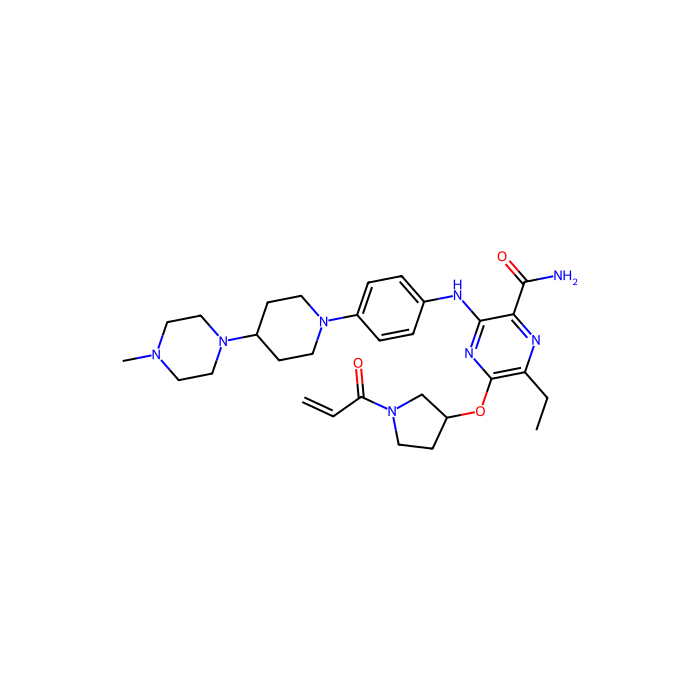
NAQUOTINIB [INN] | ASP8273 | ASP-8273 | 6-ethyl-3-[[4-[4-(4-methylpiperazin-1-yl)piperidin-1-yl]phenyl]amino]-5-[(3R)-1-prop-2-enoylpyrrolidin-3-yl]oxy-pyrazin | Naquotinib | 2-Pyrazinecarboxamide, 6-ethyl-3-((4-(4-(4-methyl-1-piperazinyl)-1-piperidinyl)phenyl)amino)-5-(((3R)-1-(1-oxo-2-propen-1-yl)-3-pyrrolidinyl)oxy)- | e-2-carboxamide Mostra altro
Specifiche e purezza
Moligand™, ≥96%
Meccanismi biochimici e fisiologici
Naquotinib (ASP8273) is an orally available, irreversible, mutant-selective, epidermal growth factor receptor (EGFR) inhibitor, with potential antineoplastic activity.
Condizioni di conservazione di stoccaggio
Store at -20°C
Spedito in
Ice chest + Ice pads
Questo prodotto richiede spedizione a catena fredda. I servizi di terra e altri servizi economici non sono disponibili.
This compound belongs to the class of organic compounds known as phenylpiperidines. These are compounds containing a phenylpiperidine skeleton, which consists of a piperidine bound to a phenyl group.
External Descriptors
Not available
1. Djoumbou Feunang Y, Eisner R, Knox C, Chepelev L, Hastings J, Owen G, Fahy E, Steinbeck C, Subramanian S, Bolton E, Greiner R, and Wishart DS. ClassyFire: Automated Chemical Classification With A Comprehensive, Computable Taxonomy. Journal of Cheminformatics, 2016, 8:61.
Determine the necessary mass, volume, or concentration for preparing a solution.
Dilution Calculator
Determine the dilution needed to prepare a stock solution.
Reconstitution Calculator
Recensioni
Recensioni dei clienti
Application Protocols
No tested applications, recommended dilutions, or control conditions are specified for this item in the Product Data. Aladdin does not provide validated protocols for this SKU.
Researchers may adapt standard protocols for small-molecule tool compounds (e.g., kinase biochemical assays, phospho-protein Western blots, viability assays), ensuring inclusion of appropriate vehicle controls and orthogonal readouts. All conditions should be optimized empirically for the specific model system.
Biological Roles
Research context (literature/general): Naquotinib (ASP8273) is described in the literature as a small-molecule tyrosine kinase inhibitor designed to target the epidermal growth factor receptor (EGFR) family, with an electrophilic warhead enabling covalent engagement of the kinase active-site cysteine. Studies emphasize mutant-selective inhibition paradigms in the EGFR pathway.
Mechanistic features (literature)
Covalent inhibition kinetics: Time-dependent potency; analysis typically involves k_inact/K_I parameters and reversible pre-complex formation before covalent bond formation with the target cysteine.
Pathway modulation: Downstream signaling nodes (e.g., phosphorylation states of EGFR, ERK1/2, AKT) are commonly monitored as pharmacodynamic readouts in cell systems.
Research applications (non-clinical)
Biochemical enzyme assays against recombinant EGFR kinase domains and kinome selectivity profiling panels.
Cellular pathway interrogation in engineered or endogenous EGFR-expressing cell lines, with attention to transporter expression and metabolic stability.
ADME/biotransformation (general considerations)
Covalent inhibitors may display distinctive metabolic stability and irreversible target residence; nonetheless, compound-specific microsomal stability, permeability, and serum protein binding must be empirically determined. No item-specific ADME data are provided here.
Cautions
No medical or therapeutic claims are made. All observations should be treated as research findings that require validation under your specific experimental conditions.
Item-specific biological data (potency, selectivity, targets, assays) are not specified for this product; consult primary literature and perform internal qualification.
Buffer Applications
This compound is not a buffering agent. However, buffers are integral to its typical research uses in biochemical and cellular assays.
Common assay buffers (general guidance)
Biochemical kinase assays: HEPES or Tris (pH 7.3–7.6), 0.01–0.05% Tween-20, 0.5–2 mM DTT or TCEP (evaluate with covalent inhibitors, as excess thiols can quench electrophiles), 5–10 mM MgCl2, 0.1–0.5 mg/mL BSA.
Cell-based assays: Complete culture media with controlled final DMSO ≤0.1–0.5% v/v; serum content can influence solubility and binding.
Practical notes
Add DMSO stocks last, with rapid mixing, to avoid local supersaturation.
For covalent inhibitor studies, assess buffer thiol content; thiol-containing buffers may reduce apparent potency by competing with target cysteines.
Filter buffers (0.22 μm) and equilibrate to temperature to ensure reproducibility.
Item-specific buffer compatibility and pH stability are not specified for this SKU; verify empirically in your assay format.
Green Alternatives
As a finished small-molecule ligand, Naquotinib itself is not readily substitutable in assays targeting its specific interaction profile. However, greener practices can be implemented in its handling and in assay design.
Solvent and process considerations
Minimize DMSO usage by preparing higher-concentration master stocks and performing microscale assays (96–1536-well formats).
Explore aqueous-compatible carriers (e.g., cyclodextrins, serum proteins) to lower organic cosolvent levels, validating for assay interference.
Prefer PBS/HEPES buffers over high-organic mobile phases during bioassays; reserve acetonitrile/methanol primarily for analytical steps.
Waste and exposure reduction
Use sealed microplates to limit VOC exposure; adopt automated low-dead-volume dispensing.
Consolidate analytical batches to reduce solvent purges and instrument rinses.
Comparative tool compounds (literature/general)
If the goal is pathway-level interrogation rather than compound-specific SAR, consider alternative EGFR-pathway tool molecules with better aqueous solubility or established green profiles. Trade-offs in selectivity, covalency, and potency should be evaluated experimentally.
Packaging/handling
Select pack sizes aligned with experiment scale to minimize leftovers and repeat freeze–thaw cycles.
Note: No change to the compound’s identity is implied; these are process-level green chemistry practices. Where a different tool ligand is considered, confirm it meets the experimental selectivity and mechanistic requirements.
Pharmaceutical Uses
No clinical or therapeutic uses are claimed or supported for this product. It is supplied strictly for research use only.
Relevant non-clinical/formulation contexts where such compounds may be utilized by R&D groups:
Reference standard: Development and qualification of analytical methods (e.g., LC–MS/MS, HPLC-UV) for discovery-stage studies. Confirm identity, purity, and exact molecular weight from the lot CoA before calibration use.
Preformulation research (in vitro): Solubility screening, stability assessments (pH/light/oxidation), and excipient compatibility studies to support early discovery research. Any data generated are research-grade and not for regulatory submissions unless supported by further qualification.
In vitro DMPK tool: Microsomal stability, plasma protein binding, and permeability assays conducted under GLP or non-GLP as appropriate to the research stage. No item-specific DMPK data are provided here.
Regulatory status
Not a pharmacopoeial-grade material; no USP/EP/JP monograph applicability is implied.
Not for human or animal administration. Handle according to institutional policies for investigational research chemicals.
Packaging/handling for pharma R&D labs
Choose pack sizes that minimize repeated freeze–thaw of DMSO stocks.
Document storage at −20°C and lot traceability (SKU N414005) for data integrity.
Physical Properties
Item-specific specifications are not provided in the Product Data for this SKU. Use the lot-specific CoA/SDS as the authoritative source when planning analytical or formulation work.
Appearance: Not specified for this item; refer to CoA/Spec Sheet.
Molecular formula: Not specified for this item; refer to CoA/Spec Sheet.
Molecular weight: Not specified for this item; refer to CoA/Spec Sheet.
Melting point, boiling point, density, refractive index: Not specified for this item; refer to CoA/Spec Sheet.
Frequently handled as DMSO stock solutions (e.g., 10–50 mM) for biochemical and cell-based assays; dilute into aqueous assay buffers immediately before use to minimize precipitation. Actual solubility limits are compound- and batch-dependent—verify experimentally.
Aqueous solubility is typically low for hydrophobic kinase ligands; co-solvents (DMSO at ≤0.1–0.5% v/v final), surfactants (e.g., 0.01–0.05% Tween-20), or serum proteins can aid dispersion (general practice).
LogP/logD, pKa, UV–Vis: Not specified for this item. For analytical method development (e.g., HPLC-UV or LC–MS), determine λmax and response empirically or consult literature.
Notes for handling stocks (general best practice):
Prepare single-use DMSO aliquots to avoid freeze–thaw cycles that can promote degradation or adsorption losses.
Filter sterilization is generally unnecessary for chemical stocks, but 0.22 μm filtration can clarify particulates before sensitive assays; confirm no adsorption to membrane materials.
Quality and Grades
Grade/purity: Moligand™
Interpretation: Moligand™ denotes a research-grade small-molecule ligand suitable for screening, target validation, and exploratory SAR in chemical biology workflows. It emphasizes fitness for in vitro biochemical, biophysical, and cell-based assays rather than compliance with pharmacopeial or clinical standards.
Typical expectations for this grade (general guidance): documented identity (e.g., by NMR/LC–MS), assay-ready format, and packaging that supports low-contamination handling. Exact purity, residual solvents, water/peroxide/metal limits, or UV cutoff are NOT specified here—consult the CoA for lot-specific data.
What is specified for this item
Storage: Store at −20°C (Product Data).
Shipping: Ice chest + ice pads (Product Data), supporting controlled temperature during transit.
Implications for experimental work
Analytical characterization: For quantitative studies (e.g., Kd/IC50 determination, LC–MS reference standard), verify purity, counterion/solvate content, and exact molecular weight from the lot CoA before use.
Stabilizers: Not specified for this item; refer to CoA/Spec Sheet. If present, note potential assay interferences.
Trace contaminants: Not specified for this item; refer to CoA/Spec Sheet. Perform appropriate blanks/controls when ultra-sensitive readouts are used.
Suitability summary
Appropriate for discovery-stage research, biochemical assays, and method development. Not intended for GMP manufacturing, diagnostic use, or human/animal administration.
Reaction and Applications
This product is supplied as a finished small-molecule research ligand rather than a building-block reagent. While not typically used as a synthetic intermediate, it has valuable applications in chemical biology and analytical workflows.
Research applications (general/non-clinical)
Biochemical target engagement: Use as a tool compound in in vitro EGFR-family kinase assays to characterize inhibition profiles, time-dependence (for covalent mechanisms), and reversibility (literature context for ASP8273 as an irreversible inhibitor).
Cell signaling studies: Probe modulation of EGFR pathway readouts (e.g., phospho-EGFR/ERK/AKT by Western blot) in engineered cell lines; optimize concentration/time to balance potency and off-target effects.
Binding/biophysics: Surface plasmon resonance (SPR), microscale thermophoresis (MST), thermal shift assays (DSF) to quantify interactions with recombinant kinase domains.
Analytical reference: Serve as a reference standard for LC–MS method development in biomarker or stability studies.
Practical tips
If covalent inhibition is under study, include time-course IC50/Ki determinations and dilution-jump controls to distinguish reversible vs covalent kinetics.
Maintain consistent DMSO percentage across assay wells. Include vehicle controls and, where relevant, alternative tool compounds for benchmarking.
For cellular work, confirm intracellular exposure (e.g., by LC–MS of cell lysates) when potency deviates from biochemical assays, accounting for efflux/uptake.
Synthetic chemistry uses
Not typically applicable. For synthetic transformations (e.g., cross-couplings), refer instead to building-block reagents in Aladdin’s catalog.
Reaction Conditions
Not typically applicable. Naquotinib (ASP8273) is supplied as a finished small-molecule research tool rather than a reagent for performing chemical transformations.
For researchers designing biological experiments instead, the following general, non-item-specific assay condition notes may be helpful (verify empirically):
Biochemical kinase assays (general)
Temperature: 25–37°C; maintain consistent temperature across plates.
Time: Preincubate inhibitor with enzyme for 15–60 min to assess time-dependent (covalent) inhibition profiles; initiate reaction with ATP/substrate.
Solvent: DMSO 0.1–1.0% v/v final; keep constant across wells.
Readouts: ADP-Glo, radiometric γ-32P, TR-FRET, or LC–MS peptide phosphorylation.
Cell-based assays (general)
Exposure: 1–24 h depending on turnover and pathway kinetics; include viability counters to normalize effects.
Concentration range: Broad titration (e.g., 0.1 nM–10 μM) to define window; tailor to literature potency.
These conditions are provided as general literature-style guidance. Item-specific reactivity or kinetic parameters are not specified for this SKU; consult the primary literature and conduct pilot optimizations.
Safety and Handling
GHS/CLP classification, signal word, hazard and precautionary statements: Not specified for this item; consult the SDS for authoritative hazard information before use.
Research use: For research use only. Not for human or veterinary use, diagnostic, or clinical applications.
General laboratory safety guidance for small-molecule kinase ligands (non-SDS, best practice):
PPE: Lab coat, safety glasses, and appropriate chemically resistant gloves (e.g., nitrile). Avoid inhalation of dust/aerosols and contact with skin or eyes.
Engineering controls: Handle powders/solid forms in a fume hood or ventilated enclosure to minimize airborne particulates. Use closed containers for solutions.
Hygiene: Wash hands thoroughly after handling. Do not eat, drink, or smoke in work areas.
Incompatibilities: Strong oxidizers and strong acids/bases may pose degradation risks for amide- and acrylamide-containing molecules; segregate accordingly. Avoid prolonged exposure to light and elevated temperatures.
Spill/accidental release: Avoid raising dust; absorb solutions with inert material (e.g., vermiculite). Clean area with suitable solvent followed by detergent/water as appropriate to the lab’s chemical hygiene plan.
Waste disposal: Dispose of in accordance with institutional and local regulations for organic chemical waste; do not discharge to drains.
First aid (overview; defer to SDS):
Skin/eye contact: Rinse with water for at least 15 minutes; remove contaminated clothing; seek medical attention if irritation persists.
Inhalation: Move to fresh air; seek medical attention if symptoms occur.
Ingestion: Rinse mouth; seek medical attention. Provide SDS to responders.
Solvent Selection
Naquotinib is typically handled as a concentrated DMSO stock for biochemical and cell-based assays.
Polarity/miscibility profile (general for kinase ligands)
DMSO: Very good solubility for many hydrophobic ligands; fully miscible with water and most polar aprotic solvents.
DMF, NMP: Alternative polar aprotics if DMSO is unsuitable; verify assay compatibility and cytotoxicity.
Aqueous buffers: Limited intrinsic solubility is common; introduce via DMSO cosolvent. Maintain final DMSO ≤0.1–0.5% v/v for sensitive cell systems (optimize per assay).
Alcohols (MeOH, EtOH): Useful for analytical sample prep; watch for protein denaturation in binding assays.
Practical recommendations
Prepare 10–50 mM stocks in anhydrous DMSO; confirm clarity. Warm gently (≤40°C) or sonicate briefly if needed, avoiding prolonged heat.
Upon dilution into buffers (e.g., HEPES, PBS), add stock last while vortexing to minimize local supersaturation/precipitation. Include 0.01–0.05% nonionic surfactant if allowed by assay.
Use low-bind plastics or pre-silanized glass to reduce adsorption at sub-micromolar concentrations.
Comparison (considerations)
DMSO vs DMF: DMSO is generally better tolerated biologically; DMF may enhance solubility for some scaffolds but can be more cytotoxic.
Neat aqueous media: Highest biological compatibility but often limited by solubility; consider cyclodextrin or protein carriers if permissible.
All solvent choices should be verified empirically for your specific assay format; consult the CoA/SDS for any solvent-related restrictions.
Storage and Reconstitution
Storage conditions (Product Data)
Store at −20°C.
Shipped in an ice chest with ice pads to maintain a controlled temperature during transit.
Stability considerations
Protect from light, heat, and moisture. Keep container tightly closed when not in use. If supplied as a solid, allow vial to equilibrate to room temperature in a desiccator before opening to minimize moisture condensation.
Reconstitution (general guidance for small-molecule ligands)
Prepare concentrated stocks in anhydrous DMSO (e.g., 10–50 mM), vortex until fully dissolved, and visually confirm clarity. If necessary, warm gently (≤40°C) or briefly sonicate.
Aliquot into single-use portions in low-bind tubes to avoid repeated freeze–thaw cycles. Label with concentration, solvent, lot, and date.
For working solutions, dilute DMSO stock into pre-warmed assay buffer or media with rapid mixing. Maintain consistent final DMSO across all samples.
In-use handling
Store DMSO stocks at −20°C or below; avoid more than 2–3 freeze–thaw cycles. For short-term use, 2–8°C storage of aliquots for up to several days may be acceptable; verify by analytical check (e.g., LC–MS or HPLC) if critical.
Expiry and specifications
No item-specific shelf life, purity, or stabilizer data are provided here. Refer to the lot-specific CoA/SDS for definitive guidance and re-test intervals.
Structure and Identity
Naquotinib (ASP8273) is supplied as a research-use small molecule in Aladdin’s Moligand™ collection.
Item-specific identifiers (Product Data)
SKU: N414005
Product name: Naquotinib (ASP8273)
CAS: 1448232-80-1
PubChem CID: 71667668
InChIKey (as provided): 299098 (note: provided value appears truncated; see literature/SDS for a complete identifier)
SMILES: Not specified for this item; refer to CoA/Spec Sheet.
Structure overview (literature/general chemistry)
Compound class: small-molecule kinase-directed ligand, reported in the literature as a covalent EGFR-family tyrosine kinase inhibitor bearing a Michael acceptor (acrylamide-type) warhead designed for irreversible binding to the catalytic cysteine (literature).
Core features typically described: substituted anilide linked to an electrophilic amide and a heteroaromatic kinase-recognition scaffold; multiple heteroatoms (N, O; halogen substitution reported in some analogs) aiding target engagement (literature).
Stereochemistry: commonly used as an achiral, single-component small molecule (literature reports do not indicate defined stereocenters).
Molecular formula and molecular weight
Not specified for this item; refer to CoA/Spec Sheet and SDS. Where required for quantitative work (e.g., LC–MS reference standard), confirm using the exact batch CoA.
2D structure description (verbal, literature)
A para-substituted anilide tethered via an amide linkage to an α,β-unsaturated carbonyl (acrylamide) electrophile, appended to a kinase-recognition heteroaromatic ring system; typical layout positions the acrylamide toward the hinge/cysteine region in EGFR-family active sites (literature).
Synthetic Utility
This SKU is a finished, target-directed small molecule intended for use as a research tool compound. It is generally not employed as a synthetic intermediate or building block.
Not typically applicable
The presence of a specialized kinase-recognition scaffold and an electrophilic warhead (literature context for ASP8273) makes downstream derivatization non-trivial and outside routine reaction-planning use. If your goal is to create analogs, begin from appropriate precursors/building blocks rather than from the final compound.
Related guidance (for chemists planning SAR)
Design synthetic routes around modular assembly of the heteroaromatic core, anilide segment, and electrophilic warhead, enabling late-stage diversification. Employ cross-coupling (e.g., Buchwald–Hartwig, Suzuki–Miyaura) and amide-bond formations as convergent steps.
Control for potential polymerization or Michael additions when handling acrylamide fragments; protect from nucleophiles and strong base during assembly.
If you require building-block reagents or protected intermediates to explore structure–activity relationships, consult Aladdin’s catalog of heteroaromatics, aryl halides/boronates, and electrophile warhead fragments. For this catalog item specifically, no synthetic derivatization guidance or reactive-handle specifications are provided.
Target Specificity
Target, selectivity, and potency data are not specified for this item in the Product Data. Do not infer biological targets or IC50 values from this listing.
General literature note: ASP8273 (Naquotinib) has been reported as a covalent inhibitor developed for EGFR-family kinases; however, for this SKU, no validated specificity profile is provided. Researchers should consult peer-reviewed sources and generate in-house confirmation (e.g., kinome panel, counterscreens) before drawing conclusions in their system.
Domande frequenti
What is the purity of this product?
This product is supplied at ≥96% purity (chemical assay). Lot-specific values are stated on the Certificate of Analysis.
What is Moligand??
Moligand? is one of Aladdin Scientific's premium product lines, formulated for high-purity applications across multiple workflows. Compared to standard grades in the same workflow, Moligand? products typically offer tighter specifications, more rigorous QC, and stronger lot-to-lot consistency.
How should this product be stored?
Store at ?20 °C. Freezer storage is required to maintain the specified shelf life.
How is this product shipped?
This product ships in an insulated container with ice pads. Unpack on arrival and transfer it to the storage condition stated above.
What are the CAS number, molecular formula and molecular weight?
The CAS Number is 1448232-80-1, the molecular formula is C30H42N8O3, and the molecular weight is 562.71 g/mol. InChIKey QKDCLUARMDUUKN-XMMPIXPASA-N.
What documentation is provided?
Available product documentation, including Certificates of Analysis (COA), Safety Data Sheets (SDS), and specification sheets, is shown in the product document area. Document availability and access follow the current site policy.
Hai bisogno di aiuto per scegliere la qualità?
La nostra guida alla selezione delle qualità copre purezza, stato dello stabilizzatore e idoneità all'applicazione per tutte le varianti del nostro catalogo.
Utilizziamo i cookie per garantire il corretto funzionamento del sito web e, ove consentito, per migliorare la tua esperienza. Puoi gestire le tue preferenze in qualsiasi momento nelle Impostazioni. Per saperne di più, consulta la nostra Cookie Policy.
Desidera che le inviamo un messaggio quando avremo sconti disponibili?
Ricordamelo più tardi
Grazie! Controlli la sua casella di posta per confermare.
Products are supplied to verified businesses, institutions, and qualified professionals for research and development use only. Not for use in humans, animals, diagnosis, or therapy.

 C2320046