Determine the necessary mass, volume, or concentration for preparing a solution.
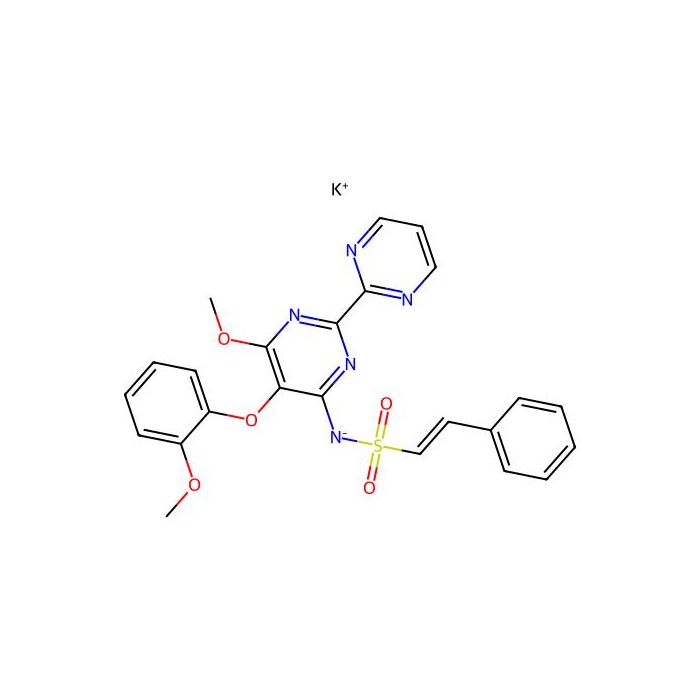
Nebentan potassium (YM598) is a potent, selective and orally active non-peptide endothelin ET A receptor antagonist through the modification of Bosentan . Nebentan potassium inhibits [ 125 I] endothelin-1 binding to cloned human endothelin ETA and ETB receptor, with K i of 0.697 nM and 569 nM, respectively YM598 can ameliorate the progression of cor pulmonale and myocardial infarction in vivo .
In Vitro
Nebentan potassium inhibits the specific binding of [ 125 I] endothelin-1 to endothelin ET A and ET B receptors in a concentration dependent manner, K i values are 0.697 nM and 1.53 nM for human and rat endothelin ETA receptors, respectively. In contrast, YM598 exhibits low affinities for human and rat endothelin ET B receptors, with K i values of 569 nM and 155 nM,respectively. In measurement of intracellular Ca 2+ concentration, Nebentan potassium concentration-dependently inhibits the increase in [Ca 2+ ]i induced by 10 nM endothelin-1 in both CHO cells and A10 cells, the IC 50 values are 26.2 nM for CHO cells and 26.7 nM for A10 cells, respectively. MCE has not independently confirmed the accuracy of these methods. They are for reference only.
In Vivo
Nebentan potassium (oral administration; 0.1-1 mg/kg; 4 weeks) significantly inhibits the progression of pulmonary hypertension and the development of right ventricular hypertrophy. Nebentan potassium (oral administration; 1 mg/kg; 30 weeks) significantly ameliorates the poor survival rate of CHF rats, it markedly reduces the hypertrophy of both ventricles as well as pulmonary congestion. MCE has not independently confirmed the accuracy of these methods. They are for reference only.
IC50& Target:ET A 0.679 nM (Ki) ET B 569 nM (Ki)
No tested applications are supplied in the product data. The following general protocols are commonly used for small-molecule library members in discovery workflows (non-item-specific):
Note: These are general procedures. Optimize concentrations and handling to your assay modality (biochemical, cell-based, biophysical).
Item-specific biological function, mechanism of action, and target engagement are not provided for Nebentan potassium in the current product record. The following guidance reflects how small-molecule salts are typically used in research contexts (not item-specific and strictly for research use only):
Important limitations:
Nebentan potassium is not a designated buffering agent, and no pKa values or buffering ranges are provided. Therefore, dedicated buffer formulation guidance is not applicable. The following notes focus on practical handling of small-molecule stocks used within buffered assay systems (general guidance, not item-specific):
Documentation note:
As a solid small-molecule reagent rather than a process solvent, “green alternatives” primarily concern solvent choices for dissolution, handling, and any upstream/downstream synthetic steps. Item-specific data are not available; the following are general, non-item-specific recommendations:
Greener dissolution/processing options (vs common high-impact solvents):
Comparison (general guidance):
Operational tips to reduce footprint:
Note: No item-specific environmental metrics (biodegradability, aquatic toxicity) are available; consult SDS for hazard and disposal guidance.
No pharmacopeial status, excipient role, or formulation specifications are provided for Nebentan potassium. This product is supplied strictly for research use only. The following are general, non-item-specific research contexts:
Important caveats:
Documentation note:
Item-specific physicochemical parameters are not listed in the current product data.
General literature guidance for potassium organic salts (not item-specific):
Actionable recommendation:
Product-specific quality attributes are not listed in the record.
Context for small-molecule library compounds (general guidance):
Recommended QC-on-receipt (practical tips):
Manufacturer application field: Not provided in the product record. The points below outline typical research uses for catalog small molecules and their salts (general guidance, not item-specific):
Practical tips:
No reaction condition data are provided for Nebentan potassium. If synthetic manipulation is planned, consider the following general (non-item-specific) conditions relevant to organic salt handling and conversion:
Yields and kinetics:
Note: Defer to the CoA/Spec Sheet to identify the ionizable functionality. Avoid strong dehydrating agents or oxidants unless the structure is known to be compatible.
Safety classifications are not provided in the current record. Always consult the SDS for authoritative guidance.
General laboratory safety for small-molecule potassium salts (not item-specific):
Storage and shipping (item-specific):
No item-specific solubility data are provided. The following guidance reflects common practice for small organic potassium salts and screening compounds (not item-specific):
Decision pointers:
Documentation note:
Item-specific storage and shipping:
General reconstitution guidance (non-item-specific):
Aliquoting and stability (general recommendations):
Documentation note:
Research use only: Not for human or veterinary use.
Brief overview: Nebentan potassium (SKU N654865) is listed as a small-molecule catalog member supplied as a potassium salt. Detailed structure data are not provided in the product record.
Structural features (general notes):
2D description (general):
Documentation note:
Item-specific functional groups and reactivity are not disclosed in the current record; therefore, detailed synthetic transformations cannot be prescribed for Nebentan potassium. General considerations for organic potassium salts (not item-specific) are provided below:
Practical tips:
Target, pathway, or receptor specificity is not provided for Nebentan potassium in the product record.
Documentation note: