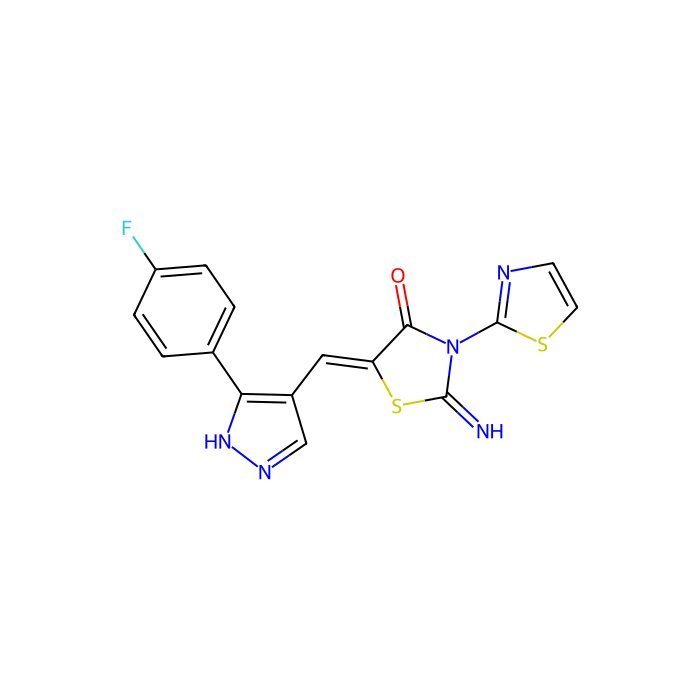
Store at -20°C. Store under desiccating conditions. The product can be stored for up to 12 months.
Specifiche
Sinonimi
(5Z)-5-[[5-(4-fluorophenyl)-1H-pyrazol-4-yl]methylidene]-2-imino-3-(1,3-thiazol-2-yl)-1,3-thiazolidin-4-one | 5-[[3-(4-Fluorophenyl)-1H-pyrazol-4-yl]methylene]-2-imino-3-(2-thiazolyl)-4-thiazolidinone | Necrostatin7 | Necrostatin-7 | Nec7 | Nec-7 | 5'-[3-(4-Fluoro-phenyl)-1H-pyrazol-4-ylmethylene]-2'-imino-[2,3']bithiazolyl-4'-one | Necro Mostra altro
Specifiche e purezza
≥98%
Meccanismi biochimici e fisiologici
Necroptosis inhibitor. Structurally distinct from other necrostatins (Nec-1, Nec-3, Nec-4 and Nec-5).
Condizioni di conservazione di stoccaggio
Store at -20°C,Desiccated
Spedito in
Ice chest + Ice pads
Questo prodotto richiede spedizione a catena fredda. I servizi di terra e altri servizi economici non sono disponibili.
Tipo di azione
INHIBITOR
Nota
Wherever possible, you should prepare and use solutions on the same day. However, if you need to make up stock solutions in advance, we recommend that you store the solution as aliquots in tightly sealed vials at -20°C. Generally, these will be useable for up to one month. Before use, and prior to opening the vial we recommend that you allow your product to equilibrate to room temperature for at least 1 hour. Need more advice on solubility, usage and handling? Please visit our frequently asked questions (FAQ) page for more details.
This compound belongs to the class of organic compounds known as phenylpyrazoles. These are compounds containing a phenylpyrazole skeleton, which consists of a pyrazole bound to a phenyl group.
External Descriptors
Not available
1. Djoumbou Feunang Y, Eisner R, Knox C, Chepelev L, Hastings J, Owen G, Fahy E, Steinbeck C, Subramanian S, Bolton E, Greiner R, and Wishart DS. ClassyFire: Automated Chemical Classification With A Comprehensive, Computable Taxonomy. Journal of Cheminformatics, 2016, 8:61.
Determine the necessary mass, volume, or concentration for preparing a solution.
Dilution Calculator
Determine the dilution needed to prepare a stock solution.
Reconstitution Calculator
Recensioni
Recensioni dei clienti
Application Protocols
Item-specific (Product Data): No tested application protocols are provided for this listing.
General cell-based assay workflow for necrostatin-class probes (not item-specific; adapt to local SOPs):
Stock preparation: Dissolve the compound in anhydrous DMSO to 10–50 mM. Vortex and, if needed, sonicate briefly. Filter through 0.22 µm PTFE for sterile applications. Aliquot and store at −20°C, desiccated.
Dosing solutions: Immediately before use, dilute the DMSO stock into pre-warmed medium to desired test concentrations, keeping final DMSO consistent across wells (e.g., 0.05–0.2% v/v).
Assay setup: Treat cells concurrently with necroptosis-inducing stimulus and serial dilutions of the probe. Include vehicle controls and, where available, an orthogonal pathway control compound.
Readouts: Assess viability (e.g., ATP content, resazurin) and membrane integrity (e.g., LDH release, PI uptake). For pathway confirmation, evaluate appropriate biomarkers by immunoblot or immunofluorescence using validated antibodies.
Data quality: Confirm absence of compound precipitation and monitor edge effects. Use at least three biological replicates with technical duplicates/triplicates.
Note: Potency ranges and exposure times are compound- and cell-line-dependent and are not specified for this item. Establish conditions empirically.
Biological Roles
Item-specific (Product Data): Research Use Note: For research use only.
Literature/general (not item-specific to this lot):
Class context: Necrostatins are widely used as chemical tools to interrogate regulated necrosis (often termed necroptosis) in cell biology. They enable temporal control over pathway modulation to study signaling, genetic dependencies, and phenotypic consequences.
Pathway landscape: Programmed necrosis involves upstream receptor signaling (e.g., death receptors), kinase cascades (notably RIPK family), and execution machinery culminating in loss of membrane integrity. Chemical probes from the necrostatin family have been used in conjunction with genetic tools to dissect these steps in various model systems.
Experimental considerations: Because readouts (e.g., cell viability, LDH release, propidium iodide uptake) can be confounded by off-pathway cytotoxicity or solvent effects, it is standard to pair necrostatins with orthogonal probes and genetic knockdowns/knockouts for robust conclusions.
Selectivity nuance: Individual necrostatin analogs differ in target engagement and selectivity spectra. For Necrostatin-7 associated with CAS 351062-08-3, consult primary literature and the technical data sheet for target annotations and potency; do not assume interchangeability with Necrostatin-1 or other series members.
No clinical or diagnostic use is intended or implied. Use in biological systems should follow institutional biosafety and chemical safety guidelines.
Buffer Applications
Necrostatin-7 is not a buffering agent and is not used to prepare defined buffer systems. Accordingly, there are no Henderson–Hasselbalch formulations or pH ranges applicable to this product.
Practical note (general for assay setup):
Working solutions are typically made by diluting a DMSO stock into pre-formulated biological buffers or culture media immediately before use. Maintain consistent final DMSO across controls and treated samples.
If precipitation occurs on dilution, gently warm the buffer/medium and increase mixing; do not alter buffer composition unless validated for your assay.
All buffer-related specifications (pH range, capacity) are not applicable to this compound.
Green Alternatives
Because Necrostatin-7 is a research probe rather than a process solvent or commodity reagent, “green alternatives” are primarily about solvent and workflow choices rather than replacing the active itself.
Greener solvent handling (general):
Prefer aqueous-compatible systems: Use minimal DMSO volumes and maximize aqueous content in working solutions while maintaining solubility.
Reduce DMF/CH2Cl2: For any analytical/sample prep steps, favor ethanol, isopropanol, acetonitrile, or ethyl acetate where compatible with the analyte and method.
Minimize waste: Prepare the smallest practical stock volumes; aliquot to reduce freeze–thaw waste. Use low-binding containers to avoid losses.
Small comparison (general effects):
DMSO vs DMF: DMSO offers broad solvency with better biocompatibility in cell-based assays; DMF is typically less desirable due to higher cytotoxicity concerns.
ACN vs MeOH for HPLC: ACN often provides lower backpressure and better peak shape; MeOH has a greener profile in some contexts but may impact resolution—optimize method conditions accordingly.
Energy/resource efficiency:
Store at −20°C as specified, but avoid unnecessary ultra-deep cold storage. Consolidate shipments to reduce cold-chain overhead where feasible.
All changes should be validated for assay performance and compound stability before implementation.
Pharmaceutical Uses
This product is supplied strictly for research use only.
Item-specific (Product Data): No pharmacopeial grade or excipient role is specified for this item.
General notes (not item-specific and without therapeutic claims):
Small-molecule research probes like Necrostatin-7 may be used in preclinical discovery research to explore pathway modulation, target validation, and structure–activity relationships. They are not formulated as drug substances or drug products.
No compendial monograph (USP/EP/JP) is indicated for Necrostatin-7. If your application requires GMP or clinical-grade materials, this catalog item is not suitable.
For any formulation-style laboratory studies (e.g., dosing vehicles in animal models in basic research settings), ensure the vehicle composition, concentration, and dosing regimen have been approved by the relevant oversight committees, and confirm compound stability/compatibility independently.
Do not use in humans or for diagnostic procedures. No therapeutic, preventive, or diagnostic claims are made for this product.
Physical Properties
Item-specific (Product Data):
Appearance: Not specified for this item; refer to CoA/Spec Sheet.
Grade/Purity: Not specified for this item; refer to CoA/Spec Sheet.
Literature/general for small-molecule research probes like Necrostatin-7 (not item-specific):
Physical state: Typically an organic solid at ambient temperature (exact form and color depend on the analog and lot).
Solubility profile: Many necrostatin-class probes are sparingly soluble in aqueous media and are commonly prepared as concentrated DMSO stocks (e.g., 10–50 mM) and diluted into buffers immediately before use. Actual solubility for this item is Not specified; confirm experimentally or via CoA.
Partitioning: Lipophilicity is often moderate to high to enable cell permeability; precise logP/logD for this CAS is Not specified for this item; refer to CoA/Spec Sheet.
Melting point, boiling point, density, refractive index, pKa: Not specified for this item; refer to CoA/Spec Sheet.
Practical considerations (general):
Hygroscopicity: Aromatic probe solids are commonly non-hygroscopic to mildly hygroscopic; storage desiccated at −20°C (as specified for this item) helps maintain integrity.
Photostability: Many heteroaromatics can be light sensitive; protect from prolonged light during storage and handling unless stability is documented on the CoA.
All definitive numerical specifications (mp, solubility, logP, etc.) for this item are Not specified; consult the CoA/SDS and perform a small-scale solubility/stability check in your intended solvent system.
Quality and Grades
Item-specific (Product Data):
Grade/Purity: Not specified for this item; refer to CoA/Spec Sheet.
Appearance: Not specified for this item; refer to CoA/Spec Sheet.
Interpreting grades for research probes (general, not item-specific):
Research grade: Typical for small-molecule probes intended for in vitro and cell-based studies. Purity is commonly reported by HPLC/UPLC area% with supplementary NMR/MS identity confirmation. Verify acceptance criteria on the CoA.
Stabilizers/Salts: Some bioactives are provided as free base/neutral form or as a salt/solvate. The presence of counterions or stabilizers can influence solubility and bioassay behavior; check the CoA for exact form.
UV profile: For bioassay readouts and chromatography, low-UV-impurity materials are preferred. If you require low-UV absorbance in the assay window, specify this at ordering and confirm on the CoA.
Residual solvents and water: Lot-specific headspace GC/Karl Fischer values may be reported on the CoA. If your application is water-sensitive or you require specific solvent limits, contact technical support for available lots.
Documentation:
Request and retain the CoA and, where available, a full Specification Sheet detailing identity methods (NMR, MS), purity determination method, and acceptance limits.
If you require a specific grade (e.g., >98% HPLC, form A polymorph), please inquire before purchase to ensure the lot meets your criteria.
Reaction and Applications
This product is intended as a research probe rather than a synthetic reagent. Accordingly, the most relevant applications are in chemical biology and cell-based assays rather than preparative organic reactions.
Item-specific (Product Data): Manufacturer Applications: Not provided for this listing.
Literature/general research use (not item-specific):
Necroptosis pathway studies: “Necrostatin” molecules have been widely used as tool compounds to interrogate regulated necrosis pathways in mammalian cells. Researchers typically evaluate phenotypic rescue of necroptotic cell death in the presence of a necrostatin vs. pro-necroptotic stimuli (e.g., TNFα plus sensitizers), using viability and pathway readouts.
Mechanistic assays: Time-course and concentration–response experiments are used to probe onset/offset kinetics, reversibility, and pathway selectivity in intact cells. Orthogonal assays (e.g., RIPK pathway biomarkers, MLKL phosphorylation/oligomerization) help confirm on-pathway effects.
Chemical biology controls: It is good practice to include negative controls (inactive analogs or vehicle) and orthogonal inhibitors to deconvolute off-target cytotoxicity.
Formulation for assays: Prepare DMSO stocks, filter if necessary through 0.22 µm PTFE, and dilute into medium immediately before dosing. Validate that solvent carryover does not confound the readout.
Note: The exact molecular target(s) and potency for Necrostatin-7 corresponding to CAS 351062-08-3 should be confirmed from primary literature or the CoA/technical data. Avoid assuming equivalence with other necrostatins (e.g., Nec-1) without verification.
Reaction Conditions
Not typically applicable. Necrostatin-7 is provided as a bioactive small-molecule probe and is not intended for use as a reagent or catalyst in synthetic organic reactions.
If derivatization or labeling is pursued in a research context (not item-specific):
Reaction media: Dry polar aprotic solvents (e.g., DMF, DMSO, NMP) are commonly used for heteroaromatic functionalization when compatible with the molecule’s stability.
Temperatures and bases/acids should be chosen based on the verified functional groups present in the exact Necrostatin-7 structure (which are Not specified here). Conduct small-scale stability screens before any transformation.
For this catalog item, no validated reaction conditions are provided. Refer to the CoA/Spec Sheet and primary literature for any chemistry involving this scaffold.
Safety and Handling
Item-specific (Product Data):
GHS Classification, Signal Word, H-Statements, Pictograms: Not specified for this item; refer to SDS.
Storage: Store at −20°C, desiccated (Product Data). Shipments are on ice with ice pads.
General laboratory safety guidance for small-molecule bioactive probes (not item-specific; defer to SDS for authoritative data):
PPE: Wear a lab coat, safety glasses, and appropriate chemically resistant gloves (e.g., nitrile). Handle powders/solids in a fume hood to minimize inhalation of dust.
Avoid: Inhalation, ingestion, and skin/eye contact. Prevent aerosol/dust generation. Use secondary containment for stock solutions.
Incompatibilities: Keep away from strong oxidizers and strong acids/bases unless compatibility is known. Avoid excessive heat and light; follow the specified −20°C, desiccated storage.
First aid (overview): In case of skin contact, wash with soap and water. For eye exposure, rinse cautiously with water for several minutes and seek medical attention. If inhaled, move to fresh air. If ingested, rinse mouth; seek medical attention. Always follow site-specific EHS procedures.
Spill response: Avoid dust; absorb solutions with inert material, collect for disposal. Decontaminate surfaces with appropriate organic solvent compatible with your lab safety plan.
Waste: Dispose of as organic laboratory chemical waste per institutional and regulatory requirements.
Always consult the item-specific SDS for GHS hazard codes, exposure limits, and detailed first-aid and firefighting information.
Practical solvent guidance for Necrostatin-class small molecules (literature/general, not item-specific):
Stock preparation: DMSO is the most common solvent for preparing concentrated stocks (e.g., 10–50 mM), owing to broad solvating power and compatibility with cell culture at low final percentages. DMF can be an alternative for initial dissolution, followed by dilution into aqueous buffers; however, DMSO is generally preferred for bioassays.
Aqueous work: Direct water solubility is often limited. For working solutions, dilute the DMSO stock into pre-warmed buffer or culture medium with vigorous mixing to a final DMSO content typically ≤0.1–0.2% v/v for sensitive cells (follow your lab’s validated limits).
Co-solvents/surfactants: If precipitation occurs on dilution, small amounts of co-solvent (DMSO maintained at the highest cell-tolerable fraction) or serum-containing medium can help maintain apparent solubility. Avoid nonionic surfactants unless validated for your assay readout.
Adsorption: Hydrophobic probes may adsorb to plastics at low nanomolar concentrations. Use low-binding polypropylene or glass, prepare fresh dilutions, and minimize hold times.
Stability: Many heteroaromatic probes are stable in anhydrous DMSO at −20°C for months when protected from light and moisture; avoid repeated freeze–thaw by aliquoting.
Comparison (general):
DMSO: Maximal solubilization, widely biocompatible at ≤0.1–0.5%.
DMF: Similar solvency but less favored in cell assays; assess cytotoxicity.
Ethanol: Sometimes workable but often lower solubility; watch volatility and assay interference.
Storage and Reconstitution
Item-specific (Product Data):
Storage Conditions: Store at −20°C, desiccated.
Shipped In: Ice chest with ice pads.
Reconstitution and handling (general best practices for small-molecule probes; not item-specific):
Initial dissolution: Prepare concentrated stocks in anhydrous DMSO under dry conditions. Typical stock concentrations are 10–50 mM, limited by solubility; exact solubility for this item is Not specified; refer to CoA/Spec Sheet.
Aliquoting: Dispense single-use aliquots (e.g., 10–50 µL) in low-binding microtubes to avoid repeated freeze–thaw cycles and adsorption losses.
Storage of solutions: Store DMSO stocks at −20°C protected from light and moisture. For extended storage, consider inert-gas headspace. Record preparation date and concentration.
Thawing/usage: Thaw quickly at room temperature, mix to homogeneity, and return unused aliquots promptly to −20°C. Avoid more than 3–4 freeze–thaw cycles.
Aqueous working solutions: Prepare immediately before use and discard after the experiment. Do not store diluted aqueous solutions unless stability has been verified.
Stability notes:
Solid-state stability is maximized by desiccation and protection from light at −20°C as specified. Degradation pathways (hydrolysis, oxidation, photolysis) are compound-specific; verify by analytical QC (e.g., HPLC) if material will be stored long-term.
Always consult the lot-specific CoA/SDS for definitive stability and handling instructions.
Structure and Identity
Brief overview: Necrostatin-7 is a small-molecule research probe commonly used in studies of regulated (programmed) necrosis pathways. Specific structural identifiers for this catalog item are not provided in the Product Data.
Item-specific (Product Data):
Product Name: Necrostatin-7 (SKU: N274719)
CAS: 351062-08-3
PubChem CID: 1239801
InChIKey (as provided): 339662
SMILES: Not specified for this item; refer to CoA/Spec Sheet.
Molecular formula: Not specified for this item; refer to CoA/Spec Sheet.
Molecular weight: Not specified for this item; refer to CoA/Spec Sheet.
Literature/general (not item-specific):
“Necrostatin” denotes a family of small molecules reported as chemical probes of necroptosis pathways in cell biology. Specific scaffold and substituents define each necrostatin analog (e.g., Nec-1, Nec-5, Nec-7, etc.). For precise structure of Necrostatin-7 corresponding to CAS 351062-08-3, consult authoritative databases or the CoA supplied with the lot.
Typical structural features across the class include heteroaromatic cores and amide/urea/aryl linkages; exact ring systems and functional groups vary by analog and should not be inferred without the CoA.
2D structure (descriptive, general to class): compact aromatic/heteroaromatic core with substituents that modulate polarity and cellular permeability. Do not assume a specific arrangement without the verified structural depiction for this CAS.
Note: Always resolve any discrepancies between third‑party listings and your lot-specific CoA/SDS before experimental use.
Synthetic Utility
Necrostatin-7 is sold as a finished small-molecule probe rather than a building block or reagent; it is not typically used as a synthon in multistep synthesis.
Item-specific (Product Data): No reactive handle or building-block role is specified for this item.
General considerations (not item-specific):
While certain necrostatin analogs may contain functional groups (e.g., amide, urea, heteroaromatic rings) amenable to further derivatization, doing so would alter the identity and bioactivity profile and is outside the intended use of a catalog research probe.
If structure–activity relationship (SAR) work is planned, obtain the exact structural information for this CAS and design derivatives accordingly; use properly characterized intermediates and document identity by NMR/MS/HRMS.
For laboratories seeking synthetic routes to necrostatins, consult primary literature for route scouting. This catalog listing does not provide precursors or a modular handle intended for downstream coupling.
Target Specificity
Item-specific (Product Data): No target, epitope, or specificity data are provided for this listing.
General note (not item-specific): Necrostatin-class molecules are used as chemical probes in regulated necrosis studies, but specific molecular targets and selectivity can differ widely among analogs. Do not assume a target profile for Necrostatin-7 without consulting primary literature and the CoA/technical data linked to CAS 351062-08-3.
This section is primarily applicable to biologics/antibodies; for small molecules like this product, target specificity must be determined from published biochemical data, which are not provided here.
Domande frequenti
What is the purity of this product?
This product is supplied at ≥98% purity (chemical assay). Lot-specific values are stated on the Certificate of Analysis.
How should this product be stored?
Store at ?20 °C, desiccated. Keep the container tightly closed with desiccant — the material is moisture-sensitive.
How is this product shipped?
This product ships in an insulated container with ice pads. Unpack on arrival and transfer it to the storage condition stated above.
What are the CAS number, molecular formula and molecular weight?
The CAS Number is 351062-08-3, the molecular formula is C16H10FN5OS2, and the molecular weight is 371.41 g/mol. InChIKey SMJGLNVGTJLIRV-KBEFMPHXSA-N.
What documentation is provided?
Available product documentation, including Certificates of Analysis (COA), Safety Data Sheets (SDS), and specification sheets, is shown in the product document area. Document availability and access follow the current site policy.
Utilizziamo i cookie per garantire il corretto funzionamento del sito web e, ove consentito, per migliorare la tua esperienza. Puoi gestire le tue preferenze in qualsiasi momento nelle Impostazioni. Per saperne di più, consulta la nostra Cookie Policy.
Desidera che le inviamo un messaggio quando avremo sconti disponibili?
Ricordamelo più tardi
Grazie! Controlli la sua casella di posta per confermare.
Products are supplied to verified businesses, institutions, and qualified professionals for research and development use only. Not for use in humans, animals, diagnosis, or therapy.