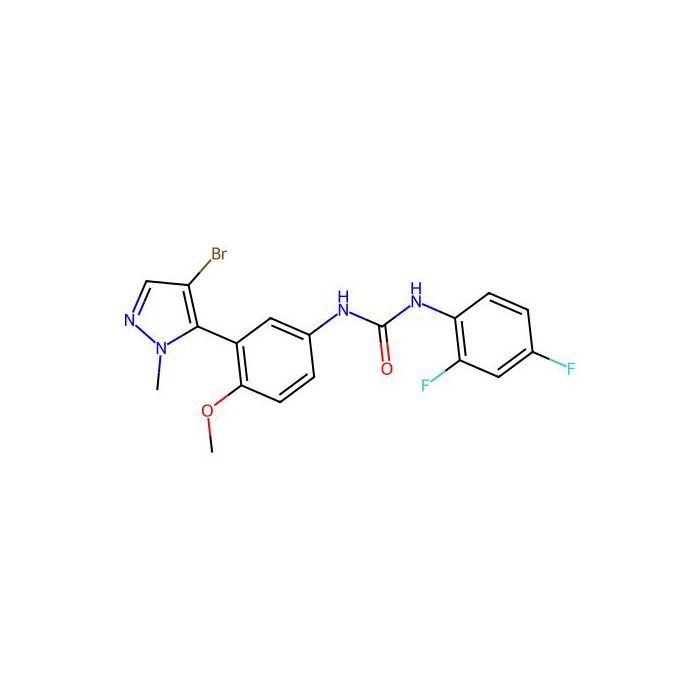
Nelotanserin is a potent 5-HT 2A inverse agonist, a moderately potent 5-HT 2C partial inverse agonist and a weak 5-HT 2B inverse agonist, with IC 50 s of 1.7, 79, 791 nM in IP accumulation assays, respectively.
In Vitro
Results from IP accumulation assays suggest that Nelotanserin is a potent 5-HT 2A full inverse agonist (IC 50 =1.7 nM), a moderately potent 5-HT 2C partial inverse agonist (IC 50 =79 nM) (maximal response was 62% of the response obtained for the reference inverse agonist clozapine), and a weak 5-HT 2B inverse agonist (IC 50 =791 nM). Nelotanserin displays high affinity for recombinant human 5-HT 2A receptors (K i =0.35 nM), moderate affinity for human 5-HT 2C receptors (K i =100 nM), and low affinity for human 5-HT 2B receptors (2000 nM) stably expressed in HEK293 cells. The results suggest that Nelotanserin has a 262-fold higher affinity for human 5-HT 2A than 5-HT 2C receptors and a 6610-fold higher affinity for human 5-HT 2A than 5-HT 2B receptors. MCE has not independently confirmed the accuracy of these methods. They are for reference only.
In Vivo
Each compound is tested in a minimum of five rats by oral gavage with administration occurring in the middle of the inactive period, 6 h after light onset. The delta power during non-REM sleep (NREMS) is significantly different between all the analogues tested and the vehicle control. Nelotanserin (Compound 39) produces significant increases in delta power that persist for the first 4 h following dosing. Significant differences are found, however, in NREMS bout length. Nelotanserin significantly increases NREMS bout length during the first hour following dosing, and 3 does so during the second hour. In conjunction with this increased NREM bout duration, the number of NREM bouts decrease during the first hour for Nelotanserin (p<0.01) as well as for compound 15 (p<0.05). MCE has not independently confirmed the accuracy of these methods. They are for reference only.
Nelotanserin is a potent 5-HT 2A inverse agonist, a moderately potent 5-HT 2C partial inverse agonist and a weak 5-HT 2B inverse agonist, with IC 50 s of 1.7, 79, 791 nM in IP accumulation assays, respectively.
Condizioni di conservazione di stoccaggio
Store at -80°C
Spedito in
Dry ice packs + Cold packs
Questo prodotto richiede spedizione a catena fredda. I servizi di terra e altri servizi economici non sono disponibili.
Certificati (CoA, COO, BSE/TSE e tabella di analisi)
C of A & Other Certificates(BSE/TSE, COO):
Analytical Chart:
Calcolatori di soluzioni
Molarity Calculator
Determine the necessary mass, volume, or concentration for preparing a solution.
Dilution Calculator
Determine the dilution needed to prepare a stock solution.
Reconstitution Calculator
Recensioni
Recensioni dei clienti
Application Protocols
Product-specific tested applications and recommended conditions: Not specified for this item.
General starting points (non-validated; optimize in-house):
Stock preparation: Dissolve in anhydrous DMSO to 10–50 mM; vortex/sonicate as needed. Store aliquots at −80 °C.
Binding assays: Prepare serial dilutions in assay buffer with constant DMSO (e.g., 0.1% v/v). Incubate with membranes/cells expressing target receptor and a suitable radioligand/fluorescent probe per established protocols; determine Ki/IC50 by nonlinear regression.
Functional assays: Measure antagonism/inverse agonism using Ca2+ flux, IP1 accumulation, or β-arrestin recruitment. Include vehicle and reference controls; preincubate compound 15–30 min before agonist challenge when appropriate.
These suggestions are literature-style starting points and are not validated for this specific lot. Always establish method suitability and robustness for your system.
Biological Roles
Context (literature; not item-specific, no medical claims):
Nelotanserin is described as a tool compound targeting serotonin 5‑HT2-family GPCRs. Such ligands are used to interrogate receptor pharmacology, including orthosteric binding, inverse agonism/antagonism, and downstream signaling modulation.
Research uses enabled by this class of compounds:
Receptor binding studies: Determine Ki values via radioligand displacement on 5‑HT2A/2C-expressing membranes or cell lines; evaluate selectivity across GPCR panels.
Functional assays: Quantify effects on second messenger pathways (e.g., PLC/IP3–Ca2+ signaling) and β-arrestin recruitment using fluorescence/bioluminescence readouts.
Systems biology: Probe cortical/neuronal signaling cascades influenced by 5‑HT2A pathway activity and map transcriptional responses using transcriptomics or phosphoproteomics.
ADME profiling: Serve as a reference in metabolic stability assays (microsomes/hepatocytes), permeability (Caco-2/MDCK), and plasma protein binding to contextualize structure–exposure relationships.
Experimental considerations:
Control for receptor reserve and expression levels; use Schild analysis or operational models to quantify functional antagonism/inverse agonism.
Account for potential off-target interactions at higher concentrations; include panel screening where target specificity is critical.
Vehicle effects (DMSO) and pH can influence apparent potency/efficacy—standardize conditions across replicates and report final solvent content.
Buffer Applications
Not a buffering reagent. Nelotanserin is a small-molecule research ligand and does not serve as an acid/base buffer component.
Practical guidance for assay buffers (general):
For receptor binding or functional assays, commonly used buffers include:
HEPES- or Tris-based buffers (pH 7.2–7.5) with physiological salts (e.g., HBSS, PBS) and 0.1% BSA to reduce nonspecific binding.
For Ca2+ flux assays: HEPES-buffered saline with probenecid (for some cell types) and dye-loading additives.
Vehicle management: Prepare compound stocks in DMSO, then dilute into buffer to a constant final DMSO fraction across all wells (e.g., 0.1% v/v) to avoid vehicle bias.
If solubility is limited, consider mild acidification of the buffer (e.g., 0.1% acetic or formic acid) or cyclodextrin inclusion; validate target compatibility and baseline effects.
Green Alternatives
Because Nelotanserin is a solid research ligand rather than a bulk solvent or reagent, “green alternatives” center on choosing greener dissolution media and minimizing hazardous waste in assay workflows.
Strategy (general guidance):
Prefer water-rich vehicles: Use aqueous buffers with minimal co-solvent (≤0.1–0.5% DMSO/EtOH) where solubility permits.
Solvent selection hierarchy:
Greener first-line: Water, ethanol.
Use-as-needed with care: DMSO (high solvency but persistent), isopropanol.
Avoid when possible for routine assays: DMF, NMP (reproductive toxicity concerns).
Comparison (general, qualitative):
Water/ethanol: Renewable, low toxicity; may limit achievable concentration and risk precipitation on dilution.
DMSO: Excellent solvency and chemical stability; consider waste stream segregation and minimize final assay %.
Surfactant-assisted aqueous systems (e.g., polysorbates): Can reduce organic solvent demand but may interfere with certain assays or targets—validate carefully.
Operational greening tips:
Prepare higher-concentration master stocks sparingly; aliquot to reduce waste from repeated freeze–thaw cycles.
Use microscale assay formats (384/1536-well) to reduce solvent volumes.
Implement LC–MS methods with short gradients and lower flow rates; use aqueous-rich mobile phases and volatile buffers (formate/acetate) to reduce solvent usage and facilitate waste handling.
Pharmaceutical Uses
No therapeutic or clinical claims are made for this product. For research use only.
Reference standard: Can be employed as a qualitative/quantitative reference in non-clinical bioanalytical methods (LC–MS/MS) after in-house qualification (purity, identity, stability).
Preformulation screening: Useful for model studies of solubility enhancement strategies for basic, aromatic small molecules (salt screening, pH–solubility profiling, co-solvents, cyclodextrins) in a research setting.
DMPK method development: Serves as a control analyte in microsomal stability, permeability, and plasma protein binding assays to benchmark laboratory systems.
Documentation needs for regulated environments:
Obtain lot-specific CoA and, if required, additional characterization (orthogonal HPLC method, HRMS, 2D NMR) to support use as a reference standard.
Establish solution stability, freeze–thaw tolerance, and adsorption to plastics/glass under your exact analytical conditions.
Note: If a specific pharmacopeial monograph or compendial status is required, verify in the appropriate compendium; none is specified for this item.
Physical Properties
Item-specific specifications: Not specified for this item; refer to CoA/Spec Sheet for any batch-certified values (e.g., appearance, purity, water content, residual solvents).
Literature/general reference values (do not treat as specifications):
Physical state: Small organic solid compounds of this class are commonly obtained as crystalline or amorphous solids.
Solubility guidance (general):
Organic solvents: Often soluble in DMSO and DMF; sparingly to moderately soluble in ethanol and methanol; limited solubility in water unless protonated (acidic media) or formulated with co-solvents/surfactants.
Aqueous handling: Stock solutions are commonly prepared in DMSO (e.g., 10–50 mM), then diluted into assay buffer to ≤0.1% DMSO v/v to minimize vehicle effects.
Acid/base behavior (general for basic amine–containing ligands):
Formation of water-soluble salts upon protonation with mineral or organic acids can enhance aqueous solubility for bioassays.
Practical notes:
When physical constants (mp, solubility, logP) are required for method development, consult primary databases (e.g., PubChem, supplier CoA) and confirm experimentally, as properties can vary with polymorph, salt form, and hydration state.
Filter sterilize assay dilutions when needed (0.22 μm PES or PTFE) and verify solution stability over the intended study period.
Quality and Grades
Grade/purity (item-specific): Not specified for this item; refer to CoA/Spec Sheet for certified purity, residual solvents, and identification (e.g., NMR, HPLC/UPLC, MS).
Appearance (item-specific): Not specified for this item; refer to CoA/Spec Sheet.
How to interpret grades (general guidance):
Research-grade small molecules are typically qualified by identity (1H NMR/MS), chromatographic purity (HPLC/UPLC, often area% at a specified wavelength), and may include water/volatile content by KF/GC as applicable.
For bioassay use, low non-volatile residue and low UV-absorbing impurities are advantageous to reduce assay background.
If chiral: Enantiomeric excess (ee) or diastereomeric ratio (dr) may be relevant. Confirm with CoA if the compound is chiral.
Recommendations:
Request the latest CoA tied to your lot number for: spectral identity, purity method/conditions (column, gradient, detection), residual solvents, and stability data.
If your application is GLP/GMP-adjacent (non-clinical), consider qualifying the lot in-house for target analytical endpoints (system suitability, linearity, carryover) and documenting solution stability under your assay conditions.
Stabilizers/salt form: If present, they will be listed on the CoA. Absence/presence can materially affect solubility, storage stability, and assay performance.
Reaction and Applications
This compound is primarily used as a research ligand/assay tool rather than as a synthetic reagent.
Pharmacology and receptor biology: Used as a reference/positive control ligand in studies interrogating serotonin 5‑HT2-family receptor signaling, binding affinity, and functional responses (e.g., inverse agonism/antagonism). Suitable for radioligand displacement assays and high-content functional readouts (Ca2+ flux, β-arrestin recruitment) when validated.
Chemical biology: Probe for pathway mapping and selectivity profiling across GPCR panels; supports structure–activity relationship (SAR) benchmarking in medicinal chemistry campaigns.
Analytical reference: Employed as a system suitability control or calibration standard in LC–UV/LC–MS method development once purity is verified.
Not typically applicable:
It is not commonly used as a reagent in stoichiometric transformations or as a catalyst/ligand in synthetic organic chemistry. For synthetic methodology development, refer instead to the Synthetic Utility section for derivative preparation considerations.
Practical notes:
Confirm compound integrity (HPLC/MS) after stock preparation and after freeze–thaw cycling.
Control vehicle concentrations (DMSO) and pre-equilibration times to ensure receptor occupancy equilibrates during functional assays.
Include orthogonal controls (an unrelated GPCR ligand and a vehicle control) to verify assay specificity.
Reaction Conditions
Not typically applicable. Nelotanserin is supplied as a finished small-molecule ligand intended for use in biological/analytical assays rather than in chemical transformations.
For researchers performing derivatization or analog synthesis (general guidance only):
Cross-coupling (if applicable to intermediates): Suzuki–Miyaura or Buchwald–Hartwig couplings are commonly conducted in polar aprotic solvents (dioxane, toluene, DMA, DMF) at 60–110 °C with Pd catalysts and suitable bases (K3PO4, Cs2CO3). Reaction times: 2–16 h depending on substrate.
N-Functionalization of basic amines: Alkylation (SN2) in acetone/MeCN with alkyl halides and carbonate base at 0–25 °C; acylation with acid chlorides/anhydrides in DCM or THF with organic base (DIPEA, TEA) at 0–25 °C.
Salt formation/crystallization: Dissolve free base in minimal organic solvent, add acid in alcohol/ether to induce precipitation; age at 0–5 °C and filter.
All conditions above are literature-general and must be optimized for the specific intermediates of the scaffold. They are not specifications for the supplied product.
Safety and Handling
Research use: For research use only. Not for human or veterinary use.
GHS/SDS status for this item:
Signal word: Not specified for this item; refer to CoA/Spec Sheet and SDS.
H-statements/Pictograms/Classification: Not specified for this item; refer to SDS for authoritative safety information.
General laboratory precautions (good practice for small organic bioactive compounds):
Personal protective equipment: Lab coat, safety glasses, and appropriate chemically resistant gloves (e.g., nitrile). Handle powders in a fume hood to minimize inhalation and dust exposure.
Avoid contact with skin, eyes, and clothing. Prevent inhalation of dust or aerosols; use local exhaust.
Hygiene: Wash hands thoroughly after handling. Do not eat, drink, or smoke in work areas.
Handling considerations:
Prepare stock solutions in a chemical fume hood. Use amber vials when light sensitivity is suspected.
Avoid prolonged exposure to elevated temperature or moisture; keep containers tightly closed.
Incompatibilities (general): Strong oxidizers and strong acids/bases may cause decomposition of organic compounds; assess compatibility before mixing.
First-aid overview (consult SDS for detailed guidance):
Inhalation: Move to fresh air; seek medical attention if symptoms persist.
Skin/eye contact: Rinse with water for several minutes; remove contaminated clothing; obtain medical advice if irritation persists.
Ingestion: Rinse mouth; seek medical attention.
Spill/cleanup: Avoid dust; collect with inert absorbent; dispose per institutional and local regulations.
Solvent Selection
Purpose: Optimize dissolution and assay compatibility for a small, hydrophobic/basic research ligand.
Primary stock solvent (typical practice, not a specification):
DMSO: Preferred for high-concentration stocks (e.g., 10–50 mM) due to strong solvating power for aromatic amine–containing ligands.
Secondary organic options (screen as needed):
DMF, NMP: Good solvency; consider toxicity and extractables in plastics.
Ethanol or methanol: Useful for lower-concentration stocks; may precipitate upon aqueous dilution if near solubility limit.
Aqueous vehicles:
Buffers with co-solvent (≤0.1–1% DMSO/EtOH) or inclusion of acid (e.g., 0.1–1% formic or acetic acid) to protonate basic centers can enhance solubility.
Surfactant-assisted media (e.g., 0.01–0.1% Tween 80) may help maintain dispersion in cellular assays; verify biological compatibility.
Small comparison (general):
DMSO: Highest solvency; potential cell toxicity at >0.1–0.5% v/v.
Ethanol: Lower solvency; broader biological tolerance to ~0.5–1% in some assays.
Aqueous + acid: Improves solubility for basic compounds; watch pH effects on targets.
Practical tips:
Warm gently (≤37 °C) and vortex/sonicate to assist dissolution; avoid prolonged heating.
Filter 0.22 μm if particulate persists and adsorption is acceptable.
Document vehicle composition rigorously for reproducibility in binding/functional assays.
Storage and Reconstitution
Storage (item-specific from Product Data):
Store at −80 °C.
Shipped on dry ice packs + cold packs.
Container handling:
Keep tightly closed in the original container. Minimize headspace and moisture ingress; allow vials to equilibrate to room temperature in a desiccator before opening to prevent condensation.
Reconstitution (general guidance for small-molecule ligands):
Prepare concentrated stocks in anhydrous DMSO (e.g., 10–50 mM). Mix thoroughly (vortex/brief sonication). If needed, sterile-filter through 0.22 μm PTFE/PES.
For aqueous use, dilute the DMSO stock into buffer to the desired working concentration, keeping final DMSO consistent across samples (commonly ≤0.1% v/v to limit vehicle effects).
Aliquoting and freeze–thaw:
Dispense single-use aliquots to avoid repeated freeze–thaw cycles. Store aliquots at −80 °C in amber vials or foil-wrapped tubes to limit light exposure.
Stability notes:
Item-specific stability/shelf-life is not specified; consult CoA/Spec Sheet and perform in-house stability checks (HPLC/LC–MS) on stored solutions.
Disposal: Dispose of unused material and solutions according to institutional chemical waste procedures and local regulations.
Always consult the SDS for detailed storage compatibility and hazard information.
Structure and Identity
Brief overview: Nelotanserin is a small-molecule research compound listed in our small-molecule/compound library category.
Item-specific registry identifiers from Product Data:
Molecular formula: Not specified for this item; refer to CoA/Spec Sheet.
Molecular weight: Not specified for this item; refer to CoA/Spec Sheet.
SMILES: Not specified for this item; refer to CoA/Spec Sheet.
InChIKey: Not specified for this item; refer to CoA/Spec Sheet.
Literature context (for reference only; verify with primary databases before use):
Nelotanserin is described in the literature as a serotonin 5‑HT2-family receptor ligand used as a tool compound in receptor pharmacology studies.
Structural description (general, literature):
Typical features reported for this class include an aryl/heteroaryl scaffold linked to a basic amine (e.g., piperidine/piperazine-like) that confers receptor-binding affinity. Exact ring systems and stereochemistry should be confirmed from authoritative databases (e.g., PubChem CID 11683556) before structure-based work.
Note: Always match your specific batch to its CoA for definitive identity fields used in method development, QC, and regulatory documentation.
Synthetic Utility
Primary role: Nelotanserin is a finished small-molecule ligand and is not typically employed as a synthetic reagent. However, in medicinal chemistry and chemical biology, related scaffolds can be derivatized for SAR or probe development.
General considerations (literature-informed for aryl/heteroaryl amine ligands):
Functional handles: Many serotonergic ligands contain basic amines and aryl/heteroaryl moieties that permit N-alkylation/acylation, Suzuki–Miyaura or Buchwald–Hartwig couplings (if aryl halides/boronates are present in intermediates), and late-stage diversification.
Probe elaboration: Installation of reporter tags (alkyne/azide for click chemistry, photoreactive diazirines, or fluorophores via short linkers) is feasible when placed distal to the pharmacophore to preserve receptor affinity—guided by published SAR.
Salt formation: Generation of defined salt forms (HCl, mesylate, fumarate) can modulate solubility and crystallinity for handling and formulation studies.
If derivatization is planned:
Start from known synthetic intermediates of the scaffold rather than the final API-like molecule to maintain step economy.
Apply late-stage C–H functionalization or cross-coupling on halogenated precursors; retain the basic center to sustain target binding.
Verify receptor binding after modification with radioligand or functional assays to ensure the tag/linker does not disrupt activity.
Target Specificity
Item-specific target/assay validation data: Not specified for this item; refer to CoA/Spec Sheet or published literature for any receptor-binding profiles.
Note:
While literature discusses receptor selectivity for compounds of this class (e.g., serotonin 5‑HT2-family GPCRs), this tab only reports product-specific, validated information. In the absence of such data, users should perform their own target engagement confirmation (binding and functional assays) under their assay conditions.
Domande frequenti
How should this product be stored?
Store at ?80 °C. Ultra-low temperature storage is required to maintain the specified shelf life.
How is this product shipped?
This product ships frozen with dry ice and cold packs. Unpack on arrival and transfer it to the storage condition stated above; handle dry ice with insulated gloves in a ventilated area.
What are the CAS number, molecular formula and molecular weight?
The CAS Number is 839713-36-9, the molecular formula is C18H15BrF2N4O2, and the molecular weight is 437.24 g/mol.
What documentation is provided?
Available product documentation, including Certificates of Analysis (COA), Safety Data Sheets (SDS), and specification sheets, is shown in the product document area. Document availability and access follow the current site policy.
Utilizziamo i cookie per garantire il corretto funzionamento del sito web e, ove consentito, per migliorare la tua esperienza. Puoi gestire le tue preferenze in qualsiasi momento nelle Impostazioni. Per saperne di più, consulta la nostra Cookie Policy.
Desidera che le inviamo un messaggio quando avremo sconti disponibili?
Ricordamelo più tardi
Grazie! Controlli la sua casella di posta per confermare.
Products are supplied to verified businesses, institutions, and qualified professionals for research and development use only. Not for use in humans, animals, diagnosis, or therapy.