QUALITÀ & PUREZZAMoligand™?Moligand™ — Aladdin's line of ligands and bioactive small molecules. Use for receptor, pathway, and binding studies needing defined small-molecule tools.≥99%
Nevadensin is a naturally occurring selective inhibitor of human carboxylesterase 1 (hCE1) with an IC 50 of 2.64 μM. Nevadensin has a variety of pharmacological effects such as anti-mycobacterium tuberculosis activities, antitussive, anti-inflammatory and anti-hypertensive
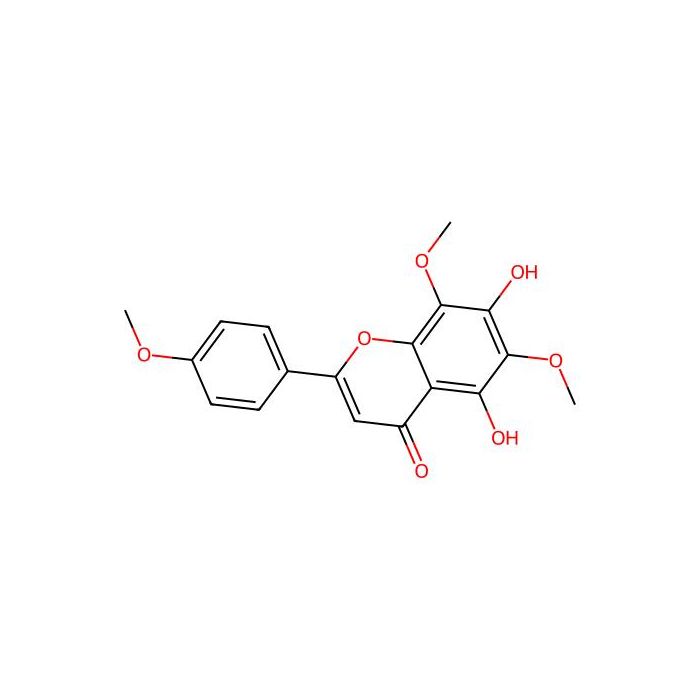
4H-1-Benzopyran-4-one, 5,7-dihydroxy-6,8-dimethoxy-2-(4-methoxyphenyl)- | Lysionatin | 5,7-Dihydroxy-6,8-dimethoxy-2-(4-methoxyphenyl)-4H-1-benzopyran-4-one | 5,7-hydroxy-4',6,8-trimethoxyflavone | 5,7-dihydroxy-6,8-dimethoxy-2-(4-methoxyphenyl)chromen-4-one | flavone, 5,7-dihydroxy-4',6,8-trimethoxy- | Ethoxychelerythrine | Nevadensin A Mostra altro
Specifiche e purezza
Moligand™, ≥99%
Meccanismi biochimici e fisiologici
Nevadensin is a naturally occurring selective inhibitor of human carboxylesterase 1 (hCE1) with an IC 50 of 2.64 μM. Nevadensin has a variety of pharmacological effects such as anti-mycobacterium tuberculosis activities, antitussive, anti-inflammatory and
Condizioni di conservazione di stoccaggio
Store at 2-8°C,Protected from light
Spedito in
Wet ice
Questo prodotto richiede spedizione a catena fredda. I servizi di terra e altri servizi economici non sono disponibili.
This compound belongs to the class of organic compounds known as 8-o-methylated flavonoids. These are flavonoids with methoxy groups attached to the C8 atom of the flavonoid backbone.
External Descriptors
Flavones and Flavonols
1. Djoumbou Feunang Y, Eisner R, Knox C, Chepelev L, Hastings J, Owen G, Fahy E, Steinbeck C, Subramanian S, Bolton E, Greiner R, and Wishart DS. ClassyFire: Automated Chemical Classification With A Comprehensive, Computable Taxonomy. Journal of Cheminformatics, 2016, 8:61.
Determine the necessary mass, volume, or concentration for preparing a solution.
Dilution Calculator
Determine the dilution needed to prepare a stock solution.
Reconstitution Calculator
Recensioni
Recensioni dei clienti
Application Protocols
These are general, non-validated laboratory protocols intended as starting points for using Nevadensin in research settings. Optimize per your assay.
Preparation of stock solutions:
Dissolve Nevadensin in anhydrous DMSO to 10–50 mM. Vortex and sonicate if needed. Filter through 0.2 µm PTFE if particulates persist. Aliquot and store protected from light.
Prepare assay buffer (e.g., 50 mM HEPES, 150 mM NaCl, pH 7.5) containing 0.01–0.5% DMSO.
Serially dilute the DMSO stock to achieve a concentration range spanning expected activity (e.g., 0.1–100 µM final), keeping DMSO constant across wells.
Include vehicle controls and, where appropriate, a positive control ligand. Monitor for precipitation/turbidity.
Analytical standard preparation (LC–UV/MS):
Prepare a 1.0 mg/mL solution in MeOH or ACN. Further dilute to a calibration series (e.g., 0.05–50 µg/mL). Store standards in amber vials at 2–8 °C, short term, or frozen for long term.
Spectrophotometry (UV–Vis):
Record spectra in MeOH to determine characteristic flavone bands; verify linearity of absorbance for quantitative work.
Note: These protocols are general guidance only and not validated for regulatory use.
Biological Roles
General background (literature; not product specifications and not medical claims):
Chemical class: Nevadensin is a plant secondary metabolite in the flavone subclass of flavonoids.
Putative roles in plants: contributes to UV protection, pigmentation, and chemical defense; participates in interactions with microbial communities and herbivores.
Biochemical behavior: polyphenolic systems can engage in hydrogen bonding, π–π stacking, and metal chelation; they often display antioxidant chemistry in model systems via radical scavenging and redox cycling.
ADME-relevant properties (conceptual): as a neutral/aromatic polyphenolic, flavones can exhibit moderate lipophilicity with low aqueous solubility, influencing permeability and nonspecific binding to proteins and plastics in vitro.
Usage in research:
Serves as a defined natural-product ligand in target deconvolution and chemical biology profiling.
Acts as a reference standard in metabolomics/natural product analytics, aiding identification of related flavone chemotypes by retention time and MS/MS patterns.
Note: Any discussion of physiological effects or therapeutic activity is outside the scope of this catalog entry and should not be inferred. For all biological testing, follow institutional guidelines and use appropriate controls.
Buffer Applications
Not typically applicable. Nevadensin is a hydrophobic small molecule and does not function as a buffering agent. For experimental work involving this compound:
Prepare concentrated stocks in DMSO or alcohol and dilute into the desired biological buffer (e.g., PBS, HEPES) with attention to final co-solvent percentage and potential precipitation.
If enhanced aqueous solubility is needed, consider cyclodextrin inclusion complexes or nonionic surfactants, verifying that additives do not interfere with the assay.
Green Alternatives
Because Nevadensin is a solid analyte/ligand rather than a process solvent, “green alternatives” pertain mainly to solvent choices for dissolution and chromatography.
Comparison of common options (general guidance):
DMSO vs Bio-based solvents:
DMSO: excellent solvency and low volatility; readily biodegradable but derived from petrochemical sources; widely accepted in screening.
2-MeTHF/CPME: greener ethers but generally poor at dissolving highly conjugated polyphenolics compared with DMSO; more applicable as reaction solvents than as assay vehicles.
Alcohols (EtOH, bioethanol): renewable, lower toxicity profile; may provide adequate solubility at moderate concentrations; volatility is advantageous for sample workup but can limit long incubations.
Aqueous solubilization aids: hydroxypropyl-β-cyclodextrin or polysorbates can reduce DMSO usage in assays; balance against potential target or assay interference.
Practical recommendations:
Prefer bioethanol or methanol for analytical standard prep when solubility allows; for HTS stocks, DMSO remains pragmatic.
Optimize LC methods to reduce organic solvent consumption (shorter columns, shallower gradients, ACN vs MeOH trade-offs) and implement solvent recycling where feasible.
Use micro-scale assay formats and pre-aliquoted plates to minimize waste and repeated solvent thaw/freeze cycles.
Pharmaceutical Uses
This product is supplied strictly for research use only.
General context (non-clinical; literature-based):
Role in analytics/QC: Nevadensin and related flavones can be used as reference standards for chromatographic profiling of botanical ingredients and natural-product preparations.
Excipients/formulation: Not used as a pharmaceutical excipient. If formulated for research dosing (e.g., in vivo exploratory studies), vehicles typically involve DMSO/PEG400/saline or ethanol/cremophor systems; ensure compliance with institutional policies.
Pharmacopeial status: No pharmacopeial monograph is indicated for this specific compound. Verify any regulatory requirements independently if using as an analytical reference in a regulated setting.
Item-specific regulatory note:
No clinical, diagnostic, or therapeutic use is intended or permitted. For research use only.
Physical Properties
Item-specific values (specs):
Appearance: Not specified for this item; refer to CoA/Spec Sheet.
Molecular weight: Not specified for this item; refer to CoA/Spec Sheet.
General/literature characteristics for flavone-type small molecules like Nevadensin (for context only; not item specifications):
Physical state: typically a crystalline solid at ambient temperature.
Solubility profile: sparingly soluble in water; soluble in organic solvents such as DMSO, DMF, acetone, methanol, and ethanol; limited solubility in aliphatic hydrocarbons.
Acid–base: predominantly neutral; phenolic OH groups (if present) are weakly acidic and can deprotonate in strong base; methoxy substituents are non-ionizable under physiological pH.
Partitioning: moderately lipophilic relative to polyhydroxylated flavonoids; actual logP/logD values depend on substitution and should be verified from primary data.
Optical properties: conjugated chromophore exhibits strong UV absorbance (typical flavone π→π* bands ca. 240–280 nm and 300–370 nm, literature). Exact λmax depends on substitution and solvent.
Practical notes:
For analytical work, prepare standards in dry DMSO or methanol and, if needed, dilute into aqueous buffers with co-solvent (≤1–2% v/v organic) while monitoring for precipitation.
Hygroscopicity is generally low for flavones, but protect from moisture and light to preserve integrity.
Quality and Grades
Grade: Moligand™
Moligand™ denotes inclusion in a curated small-molecule/compound library intended for ligand discovery, screening, and chemical biology. Emphasis is placed on identity confirmation and suitability for assay use.
What this means in practice:
Identity: typically confirmed by orthogonal methods (e.g., LC–MS/HRMS, NMR) appropriate for library-quality materials to support screening and SAR. Exact test methods and acceptance criteria are per the lot-specific CoA.
Purity: provided as part of the Moligand™ specification to support reliable bioassay and profiling; exact percentage and impurity profile are lot-specific. Item-specific purity value: Not specified for this item; refer to CoA/Spec Sheet.
Stabilizers/additives: None indicated in the product data. If present for a given lot, this will be stated explicitly on the CoA/SDS.
UV/Chromatography suitability: Library compounds are generally acceptable for LC–MS-compatible handling; however, low-UV “HPLC grade” claims do not apply to analytes. For analytical quantitation, verify extinction coefficients and detector linearity experimentally.
Documentation to request/consult:
CoA/Spec Sheet for lot-specific identity, purity, residual solvents, and analytical traces.
SDS for hazard classification and safe-use parameters.
Reaction and Applications
Manufacturer application context: Provided as part of a small-molecule/compound library (Moligand™) for research use. It is most commonly employed as a reference ligand/standard and chemical probe candidate in discovery workflows.
Research and laboratory applications (general for Nevadensin/flavones):
Ligand discovery and profiling: evaluate binding to protein targets (e.g., enzymes, transporters) in biochemical and biophysical assays (SPR, MST, DSF), observing appropriate assay controls and solvent ceilings.
Chemical biology: use as a structurally characterized natural-product scaffold in phenotypic screens to seed SAR and inform chemotype expansion.
Analytical standard: marker compound for botanicals/natural product quality control; develop LC–UV/LC–MS methods and retention time libraries.
Redox/chelation studies: the polyphenolic/flavone framework supports antioxidant chemistry and metal coordination in model systems; quantify with spectrophotometric assays (e.g., ABTS/DPPH) as needed.
Practical tips:
Stock preparation: dissolve in dry DMSO at defined concentrations; store aliquots protected from light to avoid multiple freeze–thaw cycles.
Assay implementation: minimize pre-incubation times in aqueous media to reduce precipitation; include vehicle controls and turbidity checks (A600) where relevant.
Method development: establish stability-indicating LC methods (reverse phase, C18) with gradients of water/ACN or MeOH containing formic acid or ammonium formate (for MS compatibility).
Reaction Conditions
General literature-guided conditions for common transformations on flavone scaffolds (contextual; not item specifications):
O-Alkylation/O-Acylation (phenolic positions):
Base: K2CO3 or Cs2CO3 (1–2 eq) in acetone/MeCN/DMF; RX or acyl chloride (1.1–1.5 eq).
Temperature: 25–60 °C; time: 1–12 h. Monitor for over-alkylation.
O-Demethylation (for methoxy groups):
BBr3 (1–3 eq per OMe) in dry CH2Cl2 at −78 to 0 °C, then warm to rt; quench carefully with MeOH/H2O. Alternative: AlCl3/mercaptan systems.
Metal complexation:
Dissolve flavone in EtOH/MeOH; add metal salt (e.g., Cu2+, Fe3+) in stoichiometric amounts; adjust pH mildly basic to deprotonate phenols; isolate complexes by precipitation.
Cross-coupling (if aryl halide handle is introduced):
Pd-catalyzed Suzuki–Miyaura: Pd(dppf)Cl2 (2–5 mol%), K3PO4 or Cs2CO3, dioxane/H2O, 60–100 °C.
Analytical method development:
RP-HPLC: C18 column; mobile phase water (0.1% formic acid) / ACN or MeOH gradient; detect by UV (typical flavone bands) or MS (ESI−/ESI+ depending on substituents).
Expected outcomes vary with substitution pattern; verify conditions experimentally, and confirm structure/purity by NMR and HRMS.
Safety and Handling
Authoritative safety information must be taken from the product SDS. The following summarizes general best practices for small-molecule flavonoids.
Item-specific hazard fields:
Signal word: Not specified for this item; refer to SDS.
H-statements: Not specified for this item; refer to SDS.
GHS classification/pictograms: Not specified for this item; refer to SDS.
General handling guidance (good laboratory practice):
PPE: lab coat, safety glasses, and appropriate chemical-resistant gloves (e.g., nitrile). Handle powders in a fume hood to avoid dust inhalation.
Precautions: avoid inhalation of dust/aerosols and contact with eyes/skin. Prevent light exposure (photosensitive polyphenolics may degrade). Avoid strong oxidizers.
Incompatibilities: strong bases can deprotonate phenolic OH groups (if present) and promote oxidative degradation; strong oxidants may degrade the aromatic system; protect from prolonged UV.
First-aid overview: if inhaled—move to fresh air; if on skin—wash with soap and water; if in eyes—rinse cautiously with water for several minutes; if ingested—rinse mouth. Seek medical attention as appropriate. Always consult SDS for detailed guidance.
Spill/leak: avoid dust generation; collect mechanically and place in suitable container for disposal according to institutional and local regulations.
Waste: dispose of as organic laboratory waste; follow local regulations and institutional SOPs.
Solvent Selection
Choosing a solvent for Nevadensin focuses on dissolution for screening stocks and analytical work.
Polarity class (general): moderately lipophilic polyphenolic flavone; not water-miscible as a neat solid, but dissolves well in polar aprotic organics.
Recommended primary solvents (practice-based):
DMSO: preferred for high-concentration screening stocks (e.g., 10–50 mM), good stability when protected from light and moisture.
Methanol or ethanol: suitable for analytical standards and spectroscopic work; watch for precipitation upon aqueous dilution.
DMF/Acetonitrile: useful for sample prep and LC; ensure compatibility with intended assay/column.
Aqueous vehicles: direct dissolution in water/buffer is poor; use co-solvent approaches (e.g., final DMSO 0.1–1% v/v) or solubilization aids (cyclodextrins, surfactants) as assay permits.
Small comparison (general considerations):
DMSO: highest solvating power; can affect biological assays at >1% v/v.
MeOH/EtOH: volatile and MS-friendly; lower solubility ceiling; potential enzyme inhibition at higher percentages.
ACN: good for LC; limited use in biochemical assays; lower solubility vs DMSO for polyaromatics.
Tips:
Warm gently (≤37 °C) and vortex/sonicate to speed dissolution; filter (PTFE, 0.2 µm) for particulate removal.
Record exact solvent composition for reproducibility in HTS or analytical workflows.
Storage and Reconstitution
Item-specific directions (from Product Data):
Storage conditions: Store at 2–8 °C, protected from light.
Shipping: Shipped on wet ice.
General best practices for this compound class:
Container: keep tightly closed in an amber vial to minimize light exposure. Purge headspace with inert gas for extended storage, if feasible.
Stability: avoid repeated freeze–thaw of solutions. Prepare single-use aliquots for assay stocks.
Solids: allow container to equilibrate to room temperature before opening to avoid moisture condensation. Weigh quickly and reseal.
Preparing stock solutions: dissolve in anhydrous DMSO (common) or methanol/ethanol. Document final concentration and solvent system.
Aqueous use: dilute organic stocks into buffer with vigorous mixing to the lowest effective co-solvent percentage; inspect for precipitation. If necessary, use solubilization aids compatible with the assay.
If any item-specific attributes such as appearance, exact solubility limits, or lot-specific purity are required, consult the CoA/Spec Sheet for the shipped lot.
Research Use Note: For research use only.
Structure and Identity
Brief overview: Nevadensin is a plant-derived small molecule in the flavone family (polyphenolic benzopyranone). It is provided in Aladdin’s Moligand™ screening collection for research use.
Item-specific identifiers (from Product Data):
SKU: N647433
CAS: 10176-66-6
PubChem CID: 160921
InChIKey (as provided): 187464
Molecular formula: Not specified for this item; refer to CoA/Spec Sheet.
Molecular weight: Not specified for this item; refer to CoA/Spec Sheet.
SMILES: Not specified for this item; refer to CoA/Spec Sheet.
Structural features (general chemistry/literature):
Core scaffold: flavone (2-phenyl-4H-1-benzopyran-4-one) with multiple oxygenated substituents.
Functional groups: conjugated ketone within a chromen-4-one, phenyl substituent at C-2, and a pattern of phenolic/methoxy substituents typical of O-methylated flavones.
Planarity and conjugation: highly conjugated polyaromatic system supporting UV absorbance and π–π interactions.
2D description: a bicyclic benzopyranone ring fused to a benzene ring (A/B rings) bearing oxygen substituents, with a pendant phenyl (C ring) at the 2-position.
Notes:
The exact substitution pattern, SMILES, and empirical formula for this specific lot should be confirmed from the CoA/Spec Sheet if required for regulatory filings or computational work.
Synthetic Utility
While Nevadensin is most often used as an analytical standard or screening ligand, the flavone scaffold presents several handles for derivatization and SAR exploration (general chemistry):
Functional group transformations:
O-alkylation/O-acylation of phenolic OH groups (if present) under basic conditions (e.g., K2CO3, alkyl halides) to modulate lipophilicity and stability.
O-demethylation (for methoxy-substituted positions) via boron tribromide or AlCl3/thiols to unmask phenols for subsequent diversification.
Electrophilic substitution on the pendant phenyl (ring C) is typically limited; cross-coupling requires prefunctionalization.
Metal complexation: coordination to transition metals through carbonyl and phenolic oxygens affords complexes used in materials and catalysis studies.
Late-stage diversification: C–H activation strategies on flavones have been reported (literature) enabling arylation/alkenylation at specific positions under Pd/Ir catalysis; substrate scope must be verified experimentally.
Conjugation: installation of solubilizing moieties (PEG, aminoalkyl) through carbonate/carbamate linkers improves assay compatibility and enables probe development (e.g., biotinylation for pull-downs).
Practical notes:
Maintain protection from light/oxygen during transformations to minimize oxidative degradation.
Use anhydrous, oxygen-free solvents for sensitive steps; monitor by LC–MS and 1H NMR to manage regioisomer formation common in polyoxygenated aromatics.
Target Specificity
Not applicable for this product category. Nevadensin is a small-molecule ligand and not an antibody or biological macromolecule; no clone, isotype, or species reactivity data apply.
For research involving protein targets, determine specificity empirically using orthogonal biophysical and biochemical assays (e.g., DSF, SPR, ITC, enzymatic IC50/Ki determinations), and confirm by counterscreens for off-target activity.
Domande frequenti
What is the purity of this product?
This product is supplied at ≥99% purity (chemical assay). Lot-specific values are stated on the Certificate of Analysis.
What is Moligand??
Moligand? is one of Aladdin Scientific's premium product lines, formulated for high-purity applications across multiple workflows. Compared to standard grades in the same workflow, Moligand? products typically offer tighter specifications, more rigorous QC, and stronger lot-to-lot consistency.
How should this product be stored?
Store at 2–8 °C, protected from light. The material is light-sensitive — keep it in its original opaque or amber container.
How is this product shipped?
This product ships chilled on wet ice. Unpack on arrival and transfer it to the storage condition stated above.
What are the CAS number, molecular formula and molecular weight?
The CAS Number is 10176-66-6, the molecular formula is C18H16O7, and the molecular weight is 344.32 g/mol. InChIKey KRFBMPVGAYGGJE-UHFFFAOYSA-N.
What documentation is provided?
Available product documentation, including Certificates of Analysis (COA), Safety Data Sheets (SDS), and specification sheets, is shown in the product document area. Document availability and access follow the current site policy.
Hai bisogno di aiuto per scegliere la qualità?
La nostra guida alla selezione delle qualità copre purezza, stato dello stabilizzatore e idoneità all'applicazione per tutte le varianti del nostro catalogo.
Utilizziamo i cookie per garantire il corretto funzionamento del sito web e, ove consentito, per migliorare la tua esperienza. Puoi gestire le tue preferenze in qualsiasi momento nelle Impostazioni. Per saperne di più, consulta la nostra Cookie Policy.
Desidera che le inviamo un messaggio quando avremo sconti disponibili?
Ricordamelo più tardi
Grazie! Controlli la sua casella di posta per confermare.
Products are supplied to verified businesses, institutions, and qualified professionals for research and development use only. Not for use in humans, animals, diagnosis, or therapy.

 D2614287