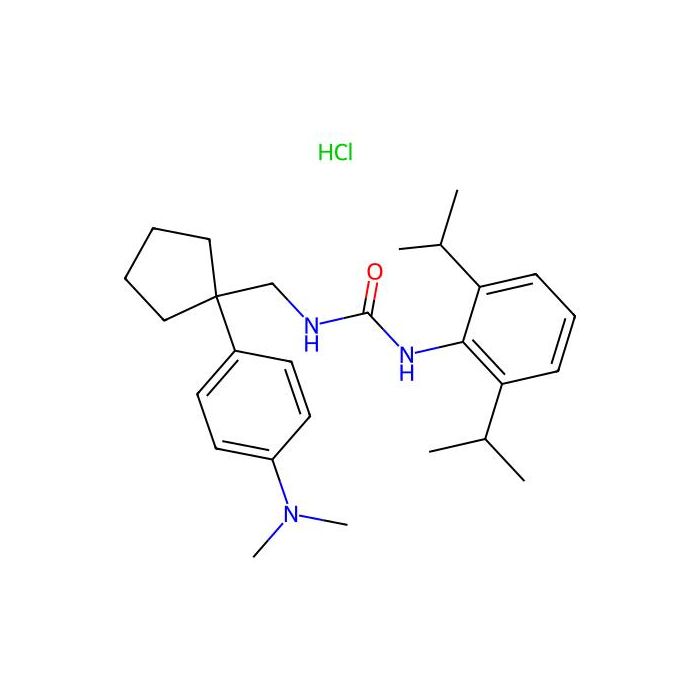
Nevanimibe hydrochloride (PD-132301 hydrochloride) is an orally active and selective acyl-coenzyme A:cholesterol O-acyltransferase 1 ( ACAT1 ) inhibitor with an EC 50 of 9 nM. Nevanimibe hydrochloride inhibits ACAT2 with an EC 50 of 368 nM. Nevanimibe hydrochloride induces cell apoptosis and has the potential for adrenocortical cancer
In Vitro
Coincubation of Nevanimibe hydrochloride (PD-132301 hydrochloride; ATR101 hydrochloride; 3 nM-30 μM) and Cholesterol markedly increases toxicity in a dose-dependent manner, where 3 nM Nevanimibe in the presence of 60 μg/mL Cholesterol reduces survival by 60% after 24 hours. All doses of Nevanimibe (3 nM-30 μM) induces cytoxicity in the presence of Cholesterol, whereas treatment with Cholesterol in the absence of Nevanimibe has no effect on cell viability. MCE has not independently confirmed the accuracy of these methods. They are for reference only. Cell Cytotoxicity AssayCell Line: The H295R and HAC clone 15 (HAC15) human ACC cell lines Concentration: 3 nM-30 μM Incubation Time: 24 hours Result: 3 nM-3 μM exhibited no toxicity, whereas 30 μM treatment reduced survival by approximately 40% within 24 hours.
Nevanimibe hydrochloride (PD-132301 hydrochloride) is an orally active and selective acyl-coenzyme A:cholesterol O-acyltransferase 1 ( ACAT1 ) inhibitor with an EC 50 of 9 nM. Nevanimibe hydrochloride inhibits ACAT2 with an EC 50 of 368 nM. Nevanimibe hyd
Condizioni di conservazione di stoccaggio
Desiccated,Store at -80°C
Spedito in
Dry ice packs + Cold packs
Questo prodotto richiede spedizione a catena fredda. I servizi di terra e altri servizi economici non sono disponibili.
Certificati (CoA, COO, BSE/TSE e tabella di analisi)
C of A & Other Certificates(BSE/TSE, COO):
Analytical Chart:
Calcolatori di soluzioni
Molarity Calculator
Determine the necessary mass, volume, or concentration for preparing a solution.
Dilution Calculator
Determine the dilution needed to prepare a stock solution.
Reconstitution Calculator
Recensioni
Recensioni dei clienti
Application Protocols
No manufacturer-validated protocols are provided for this SKU. The following general workflows are commonly used for SOAT/ACAT inhibitor evaluation; optimize for your system.
Compound handling:
Prepare 10–50 mM DMSO stocks; store in single-use aliquots at −80°C (desiccated). Warm to room temperature and vortex to ensure full dissolution before use.
Biochemical SOAT activity assay (membrane prep):
Incubate ER-enriched membrane fraction with cholesterol substrate and [14C]-oleoyl‑CoA (or LC–MS-detectable acyl‑CoA) ± inhibitor for 10–30 min at 37°C.
Quench with organic solvent; extract lipids and quantify cholesteryl esters vs. free cholesterol by scintillation counting or LC–MS.
Cell-based lipid esterification assay:
Treat cells with test concentrations (e.g., 0.03–10 µM final; vehicle ≤0.1% DMSO) for 2–24 h.
Stain neutral lipids with BODIPY 493/503 or Nile Red; analyze via high-content imaging or flow cytometry. Confirm via LC–MS lipidomics.
Data quality controls:
Include a positive-control SOAT inhibitor and vehicle control.
Monitor cytotoxicity (e.g., CellTiter-Glo) to separate on-target lipid effects from general toxicity.
Note: These are generic research protocols. Validate concentrations, incubation times, and detection methods in pilot experiments.
Biological Roles
General literature context (no clinical claims):
Target class: Reported as an inhibitor of sterol O‑acyltransferase (SOAT/ACAT), enzymes responsible for intracellular esterification of cholesterol to cholesteryl esters within the endoplasmic reticulum. Two isoforms exist in mammals: SOAT1 (ACAT1) and SOAT2 (ACAT2), with distinct tissue distributions.
Functional consequence (biochemical): Inhibition of SOAT activity reduces cholesteryl ester formation, increasing free cholesterol in membranes and potentially altering lipid droplet formation, lipoprotein assembly, and steroidogenic precursor availability.
Cellular pathways: Intersects with cholesterol trafficking (NPC1/2), SREBP-regulated lipid homeostasis, and neutral lipid storage pathways. Effects can be monitored through changes in cholesteryl ester profiles, free cholesterol pools, and compensatory regulation of lipid metabolism genes.
Selectivity: Literature sources describe differential potency toward SOAT1 vs. SOAT2 for various chemotypes. For nevanimibe analogs, reports often indicate activity on SOAT1 with varying selectivity over SOAT2; verify with primary data for your batch and assay system.
Assay readouts:
Radiometric esterification using [14C]-oleoyl-CoA incorporation into cholesteryl esters.
LC–MS quantification of cholesteryl ester species following compound treatment.
Microscopy of lipid droplets (e.g., BODIPY) to visualize neutral lipid storage changes.
Note: Exact potency, kinetics, and isoform selectivity are assay- and system-dependent; consult primary literature for detailed parameters.
Buffer Applications
As a hydrophobic amine hydrochloride used for biological assays, buffer considerations center on maintaining solubility and minimizing vehicle effects.
Stock preparation: Dissolve in anhydrous DMSO (e.g., 10–50 mM). Store aliquots at −80°C. Thaw immediately before use.
Working solutions: Dilute into assay buffer (e.g., PBS, HBSS, or culture media) to final DMSO ≤0.1–0.5% v/v. Vortex and, if needed, sonicate briefly to ensure homogeneity.
Aqueous enhancement strategies: Slightly acidic buffer (acetate/citrate, pH 4.5–6) can stabilize the protonated form and improve solubility for biochemical assays. For live-cell work, use physiological pH and consider solubilizers (e.g., 2‑HP‑β‑cyclodextrin, 0.01–0.1% Pluronic F‑127) as compatible with your model.
Filtration: If sterility is required, 0.22 µm filtration with low-binding membranes (PVDF) helps limit adsorption losses.
Adsorption mitigation: Use low-bind plates/tubes and include consistent vehicle controls across all treatments.
Not a buffering agent: The compound itself is not used to control pH; select buffers based on your biological system and analytical readouts.
Green Alternatives
While this item is a bioactive small molecule (not a solvent or bulk reagent), greener choices focus on the dissolution vehicle and assay workflow.
Greener solvent strategies (general):
Minimize DMSO carryover in biological assays (aim ≤0.1–0.2% v/v) to reduce solvent-related cytotoxicity and environmental burden.
Prefer aqueous buffers with enabling excipients:
2‑Hydroxypropyl‑β‑cyclodextrin (2‑HP‑β‑CD) complexation to enhance aqueous solubility.
Low levels of biocompatible co-solvents (≤5% ethanol) over halogenated or high-toxicity solvents.
Small comparison (general guidance):
DMSO: excellent solvency; higher environmental persistence; aim for micro-aliquoting and closed handling to minimize waste.
Ethanol/water with cyclodextrin: lower toxicity; may require larger volumes or longer dissolution times; confirm compound stability.
Operational greening:
Use pre-aliquoted, single-use vials to avoid freeze–thaw cycles and reduce material waste.
Opt for MTBE-based lipid extraction instead of chloroform where compatible, decreasing use of chlorinated solvents.
Implement microplate formats and miniaturized assays to reduce reagent consumption.
Note: No change to the compound identity is implied; recommendations address solvent systems and workflows surrounding its research use.
Pharmaceutical Uses
This product is provided strictly for research use. No medical or clinical claims are made.
Research and development contexts (non-clinical):
Reference tool compound in drug discovery programs probing SOAT/ACAT biology, lipid homeostasis, and related enzymatic pathways.
Employed as a positive control in in vitro biochemical assays quantifying cholesterol esterification.
Utilized in formulation research as a representative lipophilic amine hydrochloride to evaluate solubilization technologies (e.g., cyclodextrin inclusion, amorphous dispersions) in preformulation studies.
Analytical standardization: May serve as an internal/external reference for LC–MS method development targeting cholesteryl esters or for establishing inhibitor-response curves in screening campaigns.
Regulatory/pharmacopeial status:
Not specified for this item; refer to CoA/Spec Sheet. No pharmacopeial monograph is implied by this listing.
Note: Any use in humans, diagnostics, or as a drug substance is prohibited under this listing. For GLP/GMP contexts, verify suitability and vendor qualifications separately.
Physical Properties
Item-specific physicochemical specifications have not been provided for this catalog entry. Where relevant, consult the Certificate of Analysis (CoA) and SDS for definitive values.
Appearance: Not specified for this item; refer to CoA/Spec Sheet.
Molecular weight: Not specified for this item; refer to CoA/Spec Sheet.
Molecular formula: Not specified for this item; refer to CoA/Spec Sheet.
Melting point (salt form): Not specified for this item; refer to CoA/Spec Sheet. (Hydrochloride salts of drug-like amines often exhibit elevated, sharp melt points — literature generality.)
Boiling point: Not typically applicable for ionic organic salts; decomposition may occur before boiling (general note).
Solubility: Not specified for this item; refer to CoA/Spec Sheet. Practical guidance (general): good solubility in polar aprotic solvents (e.g., DMSO) and limited solubility in pure water unless acidified or aided by co-solvents/surfactants.
LogP/LogD, pKa, refractive index: Not specified for this item; refer to CoA/Spec Sheet.
Prepare concentrated stocks (e.g., 10–50 mM) in anhydrous DMSO, then dilute into assay buffer to a final DMSO content ≤0.1–0.5% to minimize vehicle effects.
For fully aqueous stocks, gentle acidification (e.g., dilute HCl) or use of complexation agents (cyclodextrins) can aid dissolution; verify compatibility with your assay.
Quality and Grades
Grade/Purity: Not specified for this item; refer to CoA/Spec Sheet.
Interpretation and implications (general guidance for small-molecule screening compounds):
Research use only: supplied for in vitro/in vivo laboratory studies, analytical method development, and screening. Not for diagnostic, therapeutic, or clinical use.
Typical quality controls for screening compounds may include identity confirmation by NMR/LC–MS and purity assessment by HPLC/UPLC. Exact acceptance criteria for this SKU are not specified here; consult the CoA for batch-specific details.
Stabilizer/additives: Not specified for this item; refer to CoA/Spec Sheet. The hydrochloride salt generally enhances handling stability versus the free base by reducing volatility and improving crystallinity.
What to verify upon receipt:
Confirm batch purity and identity per CoA align with your application (e.g., biochemical assays vs. cell-based screening may demand different impurity profiles).
Check water content and residual solvent only if reported on the CoA; this listing does not specify limits.
If low-UV background is required (e.g., HPLC detection), review UV chromatogram on the CoA or run a quick test injection to ensure suitability.
Reaction and Applications
This product is primarily a bioactive screening compound rather than a synthetic reagent. As such, its principal applications lie in biochemical and cell-based studies rather than as a stoichiometric building block.
Research applications (general/literature context):
Used as a tool inhibitor in studies of intracellular cholesterol esterification pathways; typically assessed in membrane enzyme assays and cellular lipid metabolism models.
Employed in high-content screening and target-validation experiments where modulation of neutral lipid storage or steroidogenic flux is monitored via analytical lipidomics (LC–MS), radiometric incorporation, or fluorescence imaging of lipid droplets.
Analytical considerations:
Prepare concentrated DMSO stocks and titrate across sub-µM to low-µM ranges depending on assay sensitivity; include matched vehicle controls.
For endpoint lipid analysis, quench reactions with organic solvent (e.g., 2:1 chloroform/methanol or MTBE-based lipid extraction) and quantify cholesteryl esters vs. free cholesterol.
Synthetic chemistry use:
Not typically used as a reagent, catalyst, or protecting group. If derivatization is needed (e.g., biotinylation for pulldown), proceed via functional handles identified from its structure (consult primary literature) and validate retained target engagement post-modification.
Reaction Conditions
Not primarily applicable: Nevanimibe hydrochloride is a finished bioactive small molecule rather than a reagent for promoting or undergoing standard organic reactions.
For users pursuing derivative or probe synthesis (general guidance):
Free-base generation: Treat a solution of the HCl salt with a slight excess of base (e.g., triethylamine) in anhydrous dichloromethane, acetonitrile, or THF to liberate the free amine; verify by TLC/LC–MS.
Couplings: If a derivatizable amine or other functional handle is present, conduct amide/urea couplings under standard peptide-coupling conditions (e.g., HATU/DIPEA or EDCI/HOBt analogs) at 0–25°C in DMF/DCM. Monitor for overacylation and preserve sensitive moieties.
Purification: Reverse-phase preparative HPLC or flash chromatography on high-loading C18 often outperforms normal-phase silica for highly lipophilic, basic compounds.
Stock solutions: 10–50 mM in anhydrous DMSO; store at −80°C in aliquots to avoid freeze–thaw.
Working range: Typical test concentrations span sub‑µM to low‑µM in biochemical or cellular assays; determine empirically for your system.
Note: No item-specific kinetic or thermodynamic data are provided here; consult primary literature for detailed synthetic or biophysical parameters.
Safety and Handling
Safety details specific to this item have not been provided. Always consult the product SDS before use.
GHS classification, signal word, pictograms, H/P statements: Not specified for this item; refer to SDS.
Likely hazards (general for lipophilic amine HCl research compounds): may cause irritation to skin, eyes, or respiratory tract; harmful if swallowed. Avoid inhalation of dust or aerosols.
PPE: lab coat, safety glasses, and appropriate chemical-resistant gloves. Handle powders in a fume hood or ventilated enclosure to avoid dust exposure.
Incompatibilities: strong oxidizers; strong bases may liberate the free base from the hydrochloride salt. Avoid contact with reactive acylating/alkylating agents.
Hygiene: wash hands thoroughly after handling; avoid contact with skin and eyes.
First aid (overview; defer to SDS):
Inhalation: move to fresh air; seek medical attention if symptoms persist.
Skin/eye contact: rinse with water for several minutes; remove contaminated clothing; obtain medical advice if irritation continues.
Ingestion: rinse mouth; do not induce vomiting; seek medical attention.
Special risks and stability:
Store as instructed (desiccated, −80°C) to minimize hydrolysis/oxidation and preserve assay-grade integrity.
Avoid repeated temperature cycling; use aliquots to prevent moisture uptake and degradation.
Solvent Selection
This compound is a basic amine supplied as a hydrochloride salt; practical dissolution mirrors other drug-like salts used in screening.
Primary stock solvent (practice):
DMSO (anhydrous) is the preferred solvent for high-concentration stocks due to strong solvating power for lipophilic salts.
Aqueous media:
Direct water solubility for hydrochloride salts can be moderate; however, hydrophobic cores may limit solubility. If needed, slightly acidic aqueous buffers (e.g., 10–50 mM acetate or citrate, pH 4.5–6) can improve dissolution of the protonated amine.
Co-solvent strategies:
Ethanol or methanol (≤10% v/v in final buffer) can assist dissolution when DMSO carryover must be minimized; evaluate assay tolerance.
Cyclodextrins (e.g., 2‑HP‑β‑CD) can enhance apparent solubility for cell assays.
Ethanol: lower solvency than DMSO; often tolerated up to ~0.5–1% v/v in cells.
Buffered saline: best for final working solutions; may require pre-dissolution in DMSO or acidified media.
Notes:
Exact solubility for this SKU is not specified; confirm experimentally.
Filter sterilize final solutions (0.22 µm) if using for cell culture; assess adsorption losses by low-binding plastics and include vehicle controls.
Storage and Reconstitution
Follow item-specific handling directives to maintain integrity for screening and biochemical work.
Storage conditions (per Product Data):
Desiccated, Store at −80°C.
Shipped on dry ice packs + cold packs to maintain low temperature during transit.
Stability: Protect from moisture and repeated freeze–thaw. Use single-use aliquots to avoid degradation and concentration drift.
Reconstitution guidance:
Solvent: Use anhydrous DMSO for initial dissolution. If aqueous solutions are required, dilute the DMSO stock into buffer with vigorous mixing; consider slight acidification or excipients to maintain solubility as compatible with the assay.
Concentration: Choose stock concentration (e.g., 10–50 mM) to minimize DMSO in the final assay (typ. ≤0.1–0.5% v/v).
Filtration: For sterile applications, filter working solutions through a 0.22 µm low-binding membrane.
In-use handling:
Keep thawed aliquots at room temperature only as long as necessary to prepare working solutions. Do not refreeze partially used aliquots.
Label aliquots with concentration, solvent, and date of preparation; track cumulative time at ambient temperature.
Research use note: For research use only. Not for human or diagnostic use.
Structure and Identity
A small-molecule hydrochloride salt supplied for research screening and biochemical studies.
Product name: Nevanimibe hydrochloride (research-grade small molecule)
CAS: 133825-81-7 (literature)
PubChem CID: 131678 (literature)
Molecular formula: Not specified for this item; refer to CoA/Spec Sheet.
Molecular weight: Not specified for this item; refer to CoA/Spec Sheet.
InChIKey: Not specified for this item; refer to CoA/Spec Sheet.
SMILES: Not specified for this item; refer to CoA/Spec Sheet.
Structural features (general, literature-based):
Drug-like, polycyclic/aromatic scaffold typical of ACAT/SOAT inhibitors; formulated as a hydrochloride salt indicating the presence of a basic amine center.
Functional groups (general): tertiary/secondary amine (protonated as HCl), multiple hydrophobic/aromatic regions that confer high lipophilicity, and heteroatoms capable of H-bonding.
Stereochemistry: Not specified for this item; refer to CoA/Spec Sheet.
2D structure description (general):
A hydrophobic core bearing an amine functionality that is protonated in the hydrochloride salt, enhancing aqueous handle for stock preparation while retaining overall lipophilicity suited to membrane-associated targets.
Synthetic Utility
This compound is not typically employed as a general synthetic reagent or building block. Nevertheless, for medicinal chemistry and chemical biology workflows, the following considerations may be relevant:
Functional handles (general): The presence of a basic amine (as hydrochloride) provides a locus for salt-metathesis, derivatization (e.g., amide/urea formation after deprotection to free base), or linker attachment for probe development.
Probe development: Analog synthesis (SAR) commonly explores substitutions on aromatic/hydrophobic regions to tune SOAT isoform potency and selectivity. Photoaffinity or biotin tags can be appended via spacers to map target engagement, with rigorous confirmation that target inhibition is retained.
Immobilization: Attaching to solid supports (e.g., NHS-activated resins) via a suitably positioned amine can enable affinity enrichment experiments from membrane preparations.
Caveats:
The complex, lipophilic scaffold may limit aqueous-phase transformations and favor anhydrous, non-protic solvents.
Retain the free base for most derivatizations; regenerate the HCl salt for improved handling/storage once modifications are complete.
If you require a synthetic intermediate rather than a finished tool compound, consider ordering core fragments or custom synthesis services tailored to your SAR plan.
Target Specificity
Item-specific biochemical characterization is not included with this listing. The following reflects general literature context for the compound class and name, provided without numerical claims:
Primary target (literature): Sterol O‑acyltransferase/Acyl‑CoA:cholesterol acyltransferase (SOAT/ACAT), enzymes catalyzing cholesterol esterification in the ER membrane.
Isoforms: SOAT1 (ACAT1) and SOAT2 (ACAT2). Reports for nevanimibe describe activity at SOAT1 with variable selectivity versus SOAT2 depending on assay system and species.
Off-targets: As with many lipophilic enzyme inhibitors acting in membranes, secondary interactions may occur; comprehensive profiling is recommended using broad enzymatic panels and cell viability counterscreens.
Species considerations: Potency can differ across human vs. rodent isoforms and across cell lines due to differential expression and membrane composition.
Only target data verified for this SKU and batch should guide critical experiments. For definitive potency and selectivity, consult peer-reviewed sources and perform internal confirmation under your assay conditions.
Domande frequenti
How should this product be stored?
Store at ?80 °C, desiccated. Keep the container tightly closed with desiccant — the material is moisture-sensitive.
How is this product shipped?
This product ships frozen with dry ice and cold packs. Unpack on arrival and transfer it to the storage condition stated above; handle dry ice with insulated gloves in a ventilated area.
What are the CAS number, molecular formula and molecular weight?
The CAS Number is 133825-81-7, the molecular formula is C27H40ClN3O, and the molecular weight is 458.08 g/mol.
What documentation is provided?
Available product documentation, including Certificates of Analysis (COA), Safety Data Sheets (SDS), and specification sheets, is shown in the product document area. Document availability and access follow the current site policy.
Utilizziamo i cookie per garantire il corretto funzionamento del sito web e, ove consentito, per migliorare la tua esperienza. Puoi gestire le tue preferenze in qualsiasi momento nelle Impostazioni. Per saperne di più, consulta la nostra Cookie Policy.
Desidera che le inviamo un messaggio quando avremo sconti disponibili?
Ricordamelo più tardi
Grazie! Controlli la sua casella di posta per confermare.
Products are supplied to verified businesses, institutions, and qualified professionals for research and development use only. Not for use in humans, animals, diagnosis, or therapy.