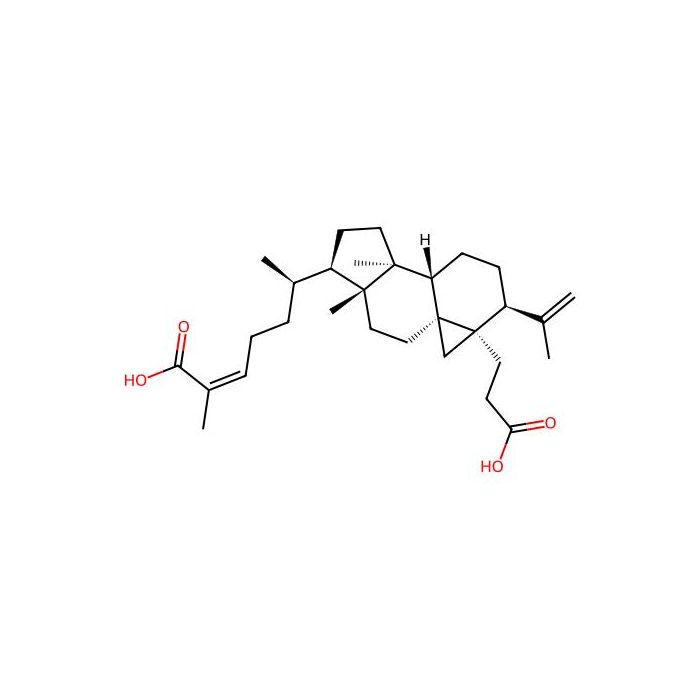
Nigranoic acid is a triterpenoid separated from Schisandra chinensis . Nigranoic acid inhibits HIV-1 reverse transcriptase . Nigranoic acid exhibits protective effects on brain through PARP/AIF signaling pathway in cerebral ischemia-reperfusion animal model
In Vivo
Nigranoic acid has a strong protective effect on rat cerebral ischemia-reperfusion injury, and acts by downregulating nerve cell apoptosis by preventing the overactivation of PARP and AIF nuclear translocation. Nigranoic acid (1 mg/kg; i.g.; 6 hours and 2 hours before brain ischemia) significantly decreases apoptosis and the expression levels of AIF protein, PARP protein, and AIF mRNA at different time-points. MCE has not independently confirmed the accuracy of these methods. They are for reference only. Animal Model: Sprague–Dawley rats (200-300 g), ischemia–reperfusion modelDosage: 1 mg/kg Administration: Intragastric; 6 hours and 2 hours before brain ischemia Result: Decreased apoptosis and the expression levels of AIF protein, PARP protein, and AIF mRNA at different time-points.
Nigranoic acid is a triterpenoid separated from Schisandra chinensis . Nigranoic acid inhibits HIV-1 reverse transcriptase . Nigranoic acid exhibits protective effects on brain through PARP/AIF signaling pathway in cerebral ischemia-reperfusion animal mod
Condizioni di conservazione di stoccaggio
Store at -20°C
Spedito in
Ice chest + Ice pads
Questo prodotto richiede spedizione a catena fredda. I servizi di terra e altri servizi economici non sono disponibili.
This compound belongs to the class of organic compounds known as triterpenoids. These are terpene molecules containing six isoprene units.
External Descriptors
dicarboxylic acid - tetracyclic triterpenoid
1. Djoumbou Feunang Y, Eisner R, Knox C, Chepelev L, Hastings J, Owen G, Fahy E, Steinbeck C, Subramanian S, Bolton E, Greiner R, and Wishart DS. ClassyFire: Automated Chemical Classification With A Comprehensive, Computable Taxonomy. Journal of Cheminformatics, 2016, 8:61.
Determine the necessary mass, volume, or concentration for preparing a solution.
Dilution Calculator
Determine the dilution needed to prepare a stock solution.
Reconstitution Calculator
Recensioni
Recensioni dei clienti
Application Protocols
No vendor-tested bioassay protocols are provided in the Product Data. The following general procedures can help initiate work with hydrophobic natural products; adapt to your laboratory’s SOPs.
Preparation of analytical standard (HPLC/LC–MS):
Accurately weigh 1–5 mg into an amber vial. Dissolve in LC–MS grade MeOH or ACN to 1.0 mg/mL; if needed, add ≤1–5% DMSO. Sonicate briefly and filter (0.22 µm PTFE). Prepare a dilution series (e.g., 1–1000 ng/mL) in 50:50 MeOH:water with 0.1% formic acid or ammonium formate depending on ionization mode.
Stock solution for bioassays (research use only):
Dissolve at 10–50 mM in anhydrous DMSO. Aliquot into amber microtubes, store at −20 °C. Thaw once, dilute into pre-warmed media with rapid mixing to a final DMSO content ≤0.1–0.5%. Include vehicle controls.
Solid-phase extraction (SPE) from matrices (method development):
Condition C18 cartridge with MeOH and water. Load sample (acidified or basified depending on form). Wash with water (±5% MeOH). Elute with MeOH or MeOH containing 0.1% formic acid. Evaporate under N2 at ≤30 °C; reconstitute in mobile phase.
Documentation:
Record lot number, preparation dates, solvent, and concentrations. Verify identity/purity by LC–MS and NMR prior to quantitative work.
Always validate these general protocols with small-scale trials.
Biological Roles
No biomedical claims are made for this product. The following provides biochemical context typical of plant-derived terpenoid/nortriterpenoid acids and is offered for research planning only.
Source and biosynthetic class (literature, general):
Nigranoic acid has been reported as a plant natural product within the broader terpenoid/nortriterpenoid space, isolated from species in the Schisandraceae/Kadsura lineage in phytochemical studies.
Biosynthetically derives from squalene/oxidosqualene cyclization followed by oxidative tailoring to introduce the carboxylic acid and other oxygen functionalities.
Putative roles in plants (general):
Specialized metabolite potentially involved in defense and signaling; accumulation in bark/fruit/roots is common for related triterpenoids.
Contributes to the chemical fingerprint of botanical extracts used in chemotaxonomy and quality control.
Analytical biology considerations:
Often monitored by LC–MS/MS using negative-ion ESI due to the carboxylate; serves as a marker compound in metabolomics workflows.
Co-occurs with structurally related terpenoids; chromatographic resolution and MS selectivity are critical to avoid isobaric interferences.
Stability in biological matrices (general):
The free acid can bind to proteins/lipids; recovery from serum/cell lysate may require protein precipitation and solid-phase extraction (C18 or polymeric sorbents).
This section summarizes general literature knowledge and should not be interpreted as an endorsement of any biological activity or therapeutic use.
Buffer Applications
Nigranoic acid is not a buffering reagent and is not typically employed to prepare buffered solutions.
Practical note:
The compound’s poor aqueous solubility as a free acid and lack of a suitable conjugate pair in the target physiological pH range make it unsuitable as a buffer component.
For biochemical assays, prepare concentrated stocks in DMSO or MeOH and dilute into an appropriate biological buffer (e.g., phosphate, HEPES) immediately before use.
If aqueous handling is required:
Transient solubilization via mild basification (e.g., NaOH to form the sodium carboxylate) may improve aqueous compatibility; re-acidify post-treatment if the free acid is needed.
For buffer preparation and pH control, choose established buffering systems (phosphate, HEPES, Tris) rather than this compound.
Green Alternatives
Greener handling of Nigranoic acid primarily concerns solvent selection and coupling reagents during derivatization.
Greener solvent swaps (general guidance):
Replace DCM with ethyl acetate or 2-MeTHF for extractions and many workups.
Substitute DMF/NMP with Cyrene, propylene carbonate, or green alcohols (EtOH, i-PrOH) where feasible.
Prefer ACN/MeOH mixtures over chlorinated solvents for analytical prep; use water-rich gradients in LC.
Coupling chemistry improvements:
Use water-compatible carbodiimide systems (EDC•HCl) with catalytic DMAP in EtOAc/EtOH, or enzyme-catalyzed esterifications in organic–aqueous media to reduce hazardous byproducts.
Minimize excess coupling reagents; choose recyclable bases (e.g., carbonate) and avoid benzene/toluene where not required.
Example comparison (literature, generalized):
DCM (traditional) vs. 2-MeTHF (alternative):
Hazard: chlorinated, higher environmental impact vs. bio-based, lower toxicity profile.
Performance: similar solvating ability for hydrophobic terpenoids; 2-MeTHF tolerates moderate water content and supports phase separations.
DMF vs. Cyrene:
Hazard: DMF is reprotoxic; Cyrene is a bio-derived dipolar aprotic solvent with favorable safety metrics.
Operational practices:
Employ microscale chemistry, solvent recycling, and in-line purification to reduce solvent use.
Favor room-temperature reactions and catalytic methods; avoid strong chlorinating/oxidizing systems unless essential.
Note: Validate solubility/reactivity of this specific scaffold in alternative media before scale-up.
Pharmaceutical Uses
No clinical or therapeutic claims are made. The information below pertains solely to research and development contexts.
Typical roles in pharma R&D (general):
Reference standard for phytochemical QC of botanical raw materials and extracts, supporting identity tests, impurity profiling, and stability studies.
Lead-like scaffold for medicinal chemistry due to its rigid, polycyclic topology and defined stereochemistry; explored in SAR by derivatization at the carboxyl function.
For in vitro testing: DMSO stock solutions diluted into compatible assay media; adsorption to plastics can occur—use low-bind consumables.
For in vivo method development (non-clinical research use only): Co-solvent systems (e.g., PEG400/EtOH/saline) or cyclodextrin inclusion may be evaluated to enhance exposure; ensure ethical approvals and institutional guidance.
Pharmacopeial status:
No pharmacopeial monograph is indicated in the Product Data. Any use as a system suitability or reference marker should be justified and documented internally.
Regulatory note:
This product is supplied strictly for research use only (Product Data). It is not intended for human or veterinary use, clinical diagnostics, or as a drug substance/excipient without further qualification.
Physical Properties
Item-specific specifications are not provided in the Product Data. Reported or computed values below are general literature guidance only and must not be treated as lot specifications.
Item-specific properties (Product Data):
Appearance: Not specified for this item; refer to CoA/Spec Sheet.
Molecular Weight: Not specified for this item; refer to CoA/Spec Sheet.
Molecular Formula: Not specified for this item; refer to CoA/Spec Sheet.
General/literature expectations for triterpenoid carboxylic acids (context, not item-specific):
Physical state: typically solid at ambient temperature (often crystalline or amorphous powder depending on polymorph and hydration).
Solubility profile: very low in water; soluble in polar aprotic organics (DMSO, DMF) and moderately soluble in alcohols (MeOH, EtOH). Increased solubility as salts (e.g., sodium carboxylate) in aqueous basic media.
Acid–base: one ionizable carboxyl group; pKa for analogous triterpenoid carboxylic acids commonly in the range ~4–5 (literature, class-level).
Partitioning: high lipophilicity (class-level); logP typically >4 for related triterpenoid acids (literature, class-level).
Thermal behavior: many polycyclic natural products exhibit decomposition or browning near melting; true boiling points are not practical under ambient pressure due to thermal decomposition (literature, class-level).
Do not treat the above as specifications. For exact mp, solubility, refractive index, UV cutoff, residual solvent, and other QC parameters for SKU N649415, consult the Certificate of Analysis (CoA) or Specification Sheet accompanying your lot.
Quality and Grades
Item-specific grade/purity (Product Data): Not specified for this item; refer to CoA/Spec Sheet.
How to interpret grades for natural-product reference standards (general guidance):
Research-grade/analytical standard: Typically supplied at high chemical purity with accompanying NMR/HRMS/HPLC data to support identity and purity. UV background and residual solvent levels are often controlled to enable analytical use (HPLC/LC–MS).
HPLC-grade designation (if provided on CoA): Indicates suitability for chromatographic applications with low non-volatile residue and minimal UV-absorbing impurities. Not specified for this item.
Stabilizers: Not commonly required for solid triterpenoid acids; if a stabilizer or counter-ion is present, it will be declared on the label/CoA. Not specified for this item.
What to check on receiving:
Verify appearance, lot number, and assay/purity (% area by HPLC), water content (KF), and identity (NMR/HRMS) on the CoA.
Confirm absence/presence of residual solvents and ash/metals, if relevant to your application.
For method validation or quantitative work, confirm characterization traceability (reference spectra, chromatographic conditions) and determine response factors in your system.
Documentation:
For regulatory or QC workflows (e.g., botanical material standardization), retain the full CoA and any spectral data supplied with SKU N649415. Contact Aladdin Scientific for additional supporting documents if needed.
Reaction and Applications
As a carboxylic-acid-bearing, polycyclic natural product, Nigranoic acid is valuable both as a reference standard and as a scaffold for semisynthetic derivatization.
Research and analytical uses (general):
Reference standard for profiling and quantifying nigranoic acid in Schisandraceae/Kadsura-derived botanical extracts by HPLC/LC–MS.
Calibration/retention-time marker for metabolomics of terpenoid fractions.
Semisynthetic transformations (typical):
Esterification: Formation of alkyl or aryl esters (Fischer, Steglich [DCC/DMAP], or EDCI/DMAP) to modulate lipophilicity and chromatographic behavior.
Amidation: Carbodiimide-mediated couplings with amines (EDCI/HOBt, HATU, or PyBOP in DMF/DCM) to generate amides for SAR exploration.
Salt formation: Sodium/potassium salts to improve aqueous handling; convert back to free acid with dilute mineral acid.
Protection strategies: Temporary protection of secondary alcohols or acids (e.g., TMS-diazomethane to form methyl ester for GC-MS analysis; exercise caution).
Purification and characterization:
Reversed-phase flash/HPLC with aqueous ACN/MeOH and 0.1% formic acid or ammonium formate for LC–MS compatibility.
Structural confirmation by 1D/2D NMR (1H, 13C, HSQC, HMBC, NOESY) and HRMS; IR for carboxyl C=O.
Practical tips:
Dry solvents and maintain anhydrous conditions for coupling reactions; add base scavengers (DIPEA) judiciously.
Monitor reactions by LC–MS to detect acyl migration or overacylation; quench carefully to avoid saponification.
Scale cautiously; polycyclic scaffolds can be sensitive to strong acid/base and prolonged heating.
Reaction Conditions
General conditions for common derivatizations of carboxylic-acid-bearing, polycyclic natural products are summarized below (literature guidance; optimize for this substrate).
Esterification (Steglich-type):
Typical: Carboxylic acid (1.0 eq), alcohol (1.5–5 eq), DCC (1.2 eq), DMAP (0.1 eq), solvent DCM or EtOAc, 0 °C to rt, 2–16 h.
Notes: Filter DCU byproduct; for greener options use EDCI in EtOAc/MeCN. Monitor by TLC/LC–MS.
Amide coupling (EDCI/HOBt or HATU):
Typical: Acid (1.0 eq), amine (1.2 eq), EDCI (1.2 eq) + HOBt (0.1–0.2 eq) or HATU (1.1 eq), base DIPEA (2 eq), solvent DMF or DCM, 0 °C to rt, 1–12 h.
Notes: Minimize epimerization at neighboring stereocenters by low temperature and short reaction times; quench with aqueous bicarbonate.
Acid chloride formation:
Typical: Oxalyl chloride (2–3 eq) or SOCl2 (3–5 eq), catalytic DMF, DCM or toluene, 0 °C to reflux, 0.5–3 h; then use in situ.
Notes: Avoid prolonged heating; sensitive scaffolds may require milder reagents (Ghosez’s reagent) or mixed anhydrides (isobutyl chloroformate).
Salt formation for solubility:
Typical: Dissolve acid in minimal MeOH; add 1.0 eq NaOMe/NaHCO3 to form sodium salt, then solvent swap to water or buffer.
Typical: H2, Pd/C (5–10 wt%), EtOAc/EtOH, rt to 40 °C, 1–24 h; or NaBH4 reductions in MeOH/THF at 0 °C to rt.
These are illustrative conditions from general literature precedent for carboxylic acid natural products and should be fine-tuned via small-scale trials for Nigranoic acid.
Safety and Handling
Safety details are limited in the Product Data; handle conservatively as a laboratory research chemical.
GHS information (Product Data):
Signal Word: Not specified for this item; refer to SDS.
H-Statements: Not specified for this item; refer to SDS.
GHS Classification/Pictograms: Not specified for this item; refer to SDS.
General laboratory precautions (good practice):
Avoid inhalation of dust and contact with skin/eyes; wear appropriate PPE (lab coat, nitrile gloves, safety glasses).
Work in a fume hood, especially during weighing, dissolution in organic solvents, or when heating.
Prevent environmental release; collect waste in designated halogen-free organic waste or as directed by your institution.
Incompatibilities and stability (general):
Strong bases convert the carboxylic acid to salts; strong mineral acids and oxidants may cause degradation.
Avoid prolonged exposure to light and elevated temperatures; protect from moisture if preparing salt forms.
First-aid (overview; defer to SDS for authoritative guidance):
Skin/eye contact: Rinse with water for at least 15 minutes; remove contaminated clothing.
Inhalation: Move to fresh air; seek medical attention if symptoms persist.
Ingestion: Rinse mouth; do not induce vomiting; seek medical advice.
Storage and shipping (Product Data):
Storage: Store at −20 °C.
Shipping: Ice chest + ice pads.
Always consult the Safety Data Sheet (SDS) for this product before use.
Solvent Selection
Nigranoic acid is a hydrophobic, polycyclic carboxylic acid. Solvent choice should balance solubility, stability, and downstream use (bioassays vs. synthesis).
Practical dissolution guidance (general, not item-specific specs):
DMSO: Typically the most effective for stock solutions (e.g., 10–50 mM). Dilute into buffers with vigorous mixing; final DMSO ≤0.1–1% v/v for many assays.
DMF or NMP: Useful for higher-concentration stocks; consider moisture sensitivity and toxicity profiles.
Alcohols (MeOH, EtOH): Moderate solubility; compatible with LC–MS sample prep and many normal-phase chromatographic workflows.
Aqueous media: Poor solubility as the free acid; dissolves as salts in basic buffers (e.g., NaOH, carbonate), but mind potential for aggregation on neutralization.
Nonpolar solvents (DCM, EtOAc, toluene): Suitable for extraction and workup; limited room-temperature solubility may require gentle warming.
Polarity/miscibility (class-level):
Practically insoluble in water; readily soluble in polar aprotic solvents. Partition strongly into organic phases during LLE.
Selection by application:
Bioassays: DMSO primary; co-solvent with aqueous media post-filtration (0.22 µm PTFE recommended).
Analytical: MeOH/ACN mobile phases with acidic modifiers for reversed-phase LC; consider ionization of carboxylate for LC–MS.
Synthesis/derivatization: Anhydrous DMF, DCM, or THF for coupling/esterification; avoid strong bases if preserving native structure.
Tip: Prepare minimal-volume, opaque, aliquoted stocks to limit freeze–thaw and photodegradation.
Storage and Reconstitution
Storage conditions (Product Data):
Store at −20 °C.
Shipped in ice chest with ice pads to maintain a cold chain.
Container and protection (general best practice):
Keep tightly closed in the original amber vial to protect from light. Purge headspace with inert gas (e.g., nitrogen/argon) after opening if long-term storage is anticipated.
Avoid repeated freeze–thaw cycles; dispense into single-use aliquots upon first opening.
Reconstitution (general guidance for hydrophobic acids):
Dissolve in anhydrous DMSO or MeOH to prepare a concentrated stock (e.g., 10–50 mM). Gentle warming (≤40 °C) and brief sonication may aid dissolution. Filter through 0.22 µm PTFE if particulate remains.
For aqueous applications, consider forming a transient salt by adding a stoichiometric base (e.g., NaOH) or using co-solvent systems; adjust pH as needed after dilution.
Stability considerations:
Minimize exposure to moisture, heat, and light. Many polycyclic natural products are stable for months at −20 °C when dry and protected; verify with periodic HPLC.
Do not store ready-to-use dilute aqueous solutions for extended periods; prepare fresh before use or freeze aliquots at −20 to −80 °C when compatible.
Documentation:
Record lot number, preparation date, solvent, and concentration on each aliquot. Consult the CoA/SDS for any lot-specific stability or incompatibility notes.
Structure and Identity
Nigranoic acid is a plant-derived small molecule (natural product) commonly classified among highly oxygenated terpenoid/nortriterpenoid-type acids used as analytical standards and semisynthetic precursors.
Item-specific identifiers (Product Data):
SKU: N649415
Product Name: Nigranoic acid
CAS: 39111-07-4
PubChem CID: 10814237
InChIKey: 239961 (as provided in Product Data)
SMILES: Not specified for this item; refer to CoA/Spec Sheet.
Molecular Formula: Not specified for this item; refer to CoA/Spec Sheet.
Molecular Weight: Not specified for this item; refer to CoA/Spec Sheet.
Structural features (general literature description, not item-specific):
Framework: polycyclic terpenoid/nortriterpenoid scaffold bearing a terminal carboxylic acid functionality.
Functional groups: one carboxylic acid (–CO2H); multiple tertiary/quaternary carbons and methyl substituents common to triterpenoid cores; additional oxygenation (e.g., hydroxyl/ketone) may be present depending on exact isomer reported in literature.
Stereochemistry: multiple contiguous stereocenters typical of plant triterpenoids; literature reports define a rigid polycyclic 3D architecture.
Fused polycyclic hydrocarbon backbone decorated with several methyl groups; a carboxylate-bearing side chain attached to the core; sparse heteroatoms localized at oxidized positions.
Notes: Exact atom connectivity, stereochemical configuration, and canonical descriptors (InChI/SMILES) should be verified against the lot-specific CoA/SDS or primary literature for Nigranoic acid (CAS 39111-07-4).
Synthetic Utility
The carboxylic acid handle on a rigid, polycyclic terpenoid core makes Nigranoic acid a versatile building block for targeted modifications.
Functional group–driven transformations:
Acyl activation: Convert to acid chlorides (e.g., oxalyl chloride, thionyl chloride with catalytic DMF) for subsequent acylation, amide formation, or Friedel–Crafts-type acylations on suitable arenes.
Direct couplings: EDCI/DMAP or HATU/DIPEA enable amide/ester formation under mild conditions, preserving stereochemistry.
Alkylation at acid: Diazomethane or TMS-diazomethane for methyl ester formation (analytical prep for GC–MS); observe stringent safety controls.
Serves as a chiral, conformationally constrained scaffold for attaching reporter groups (fluorophores, biotin) via amide/ester linkers.
Late-stage diversification at oxidized positions (if present) through selective reduction (NaBH4, catalytic hydrogenation) or oxidation (Dess–Martin, TEMPO-based), applied cautiously to avoid core rearrangements.
Purification and analysis:
Chromatograph on silica or C18 depending on polarity of derivatives; monitor by LC–MS (ESI− preferred for acids) and comprehensive NMR.
Practical considerations:
Avoid harsh strongly basic or strongly acidic conditions that can induce skeletal rearrangements in polycyclic terpenoids.
Employ anhydrous, oxygen- and moisture-controlled setups for coupling efficiency and reproducibility.
Target Specificity
Not applicable. This product is a small-molecule natural product, not an antibody, enzyme, or affinity reagent.
Item-specific target/epitope data (Product Data): Not specified for this item; refer to CoA/Spec Sheet.
For selectivity against biological targets (enzymes, receptors), consult primary literature specific to nigranoic acid and validate within your assay system. No target specificity data are provided with this catalog item.
Domande frequenti
What is the purity of this product?
This product is supplied at ≥95% purity (chemical assay). Lot-specific values are stated on the Certificate of Analysis.
How should this product be stored?
Store at ?20 °C. Freezer storage is required to maintain the specified shelf life.
How is this product shipped?
This product ships in an insulated container with ice pads. Unpack on arrival and transfer it to the storage condition stated above.
What are the CAS number, molecular formula and molecular weight?
The CAS Number is 39111-07-4, the molecular formula is C30H46O4, and the molecular weight is 470.68 g/mol. InChIKey NJFOSFIPGRXARF-BRTULJEKSA-N.
What documentation is provided?
Available product documentation, including Certificates of Analysis (COA), Safety Data Sheets (SDS), and specification sheets, is shown in the product document area. Document availability and access follow the current site policy.
Utilizziamo i cookie per garantire il corretto funzionamento del sito web e, ove consentito, per migliorare la tua esperienza. Puoi gestire le tue preferenze in qualsiasi momento nelle Impostazioni. Per saperne di più, consulta la nostra Cookie Policy.
Desidera che le inviamo un messaggio quando avremo sconti disponibili?
Ricordamelo più tardi
Grazie! Controlli la sua casella di posta per confermare.
Products are supplied to verified businesses, institutions, and qualified professionals for research and development use only. Not for use in humans, animals, diagnosis, or therapy.