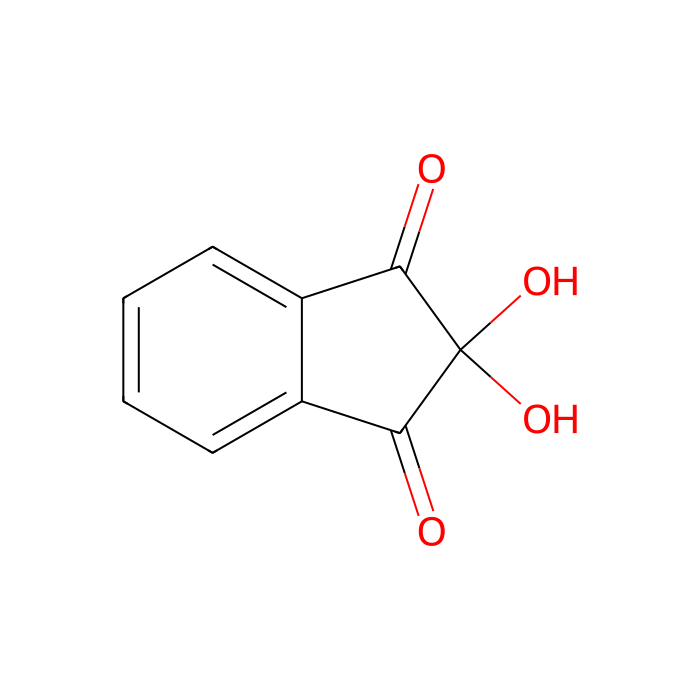
Determine the necessary mass, volume, or concentration for preparing a solution.
| Activity Type | Activity Value -log(M) | Mechanism of Action | Activity Reference | Publications (PubMed IDs) |
|---|

Utilizzato per il rilevamento e il dosaggio di peptidi, amminoacidi, ammine e amminozuccheri, produce composti ternari altamente fluorescenti con aldeidi e ammine primarie. La reazione con sarcosina o prolina dà ylidi di azometina.
Applicazione: può essere utilizzato per la rilevazione di
Può essere utilizzato per la rilevazione di peptidi, amminoacidi, amminoacidi e amminozuccheri e può produrre composti ternari fortemente fluorescenti con aldeidi e ammine primarie. Reagisce con sarcosina o prolina per formare metilimina ylide.
La ninidrina (idrato di ninidrina) può essere utilizzata come reagente per la determinazione di amminoacidi e peptidi mediante fotometria e colorimetria. Può anche essere usata per preparare reagenti di ninidrina mescolando la ninidrina con l'idronidrina (forma ridotta della ninidrina) in dimetilsolfossido. Questo reagente può essere utilizzato per il metodo manuale della ninidrina per quantificare gli amminoacidi.
Può essere utilizzato per rilevare gruppi amminici liberi in aminoacidi, peptidi e proteine.
Taxonomy Tree
| Kingdom | Organic compounds |
|---|---|
| Superclass | Benzenoids |
| Classe | Indanes |
| Subclass | Indanones |
| Intermediate Tree Nodes | Not available |
| Direct Parent | Indanediones |
| Alternative Parents | Aryl alkyl ketones Carbonyl hydrates Organic oxides Hydrocarbon derivatives |
| Molecular Framework | Aromatic homopolycyclic compounds |
| Substituents | Indanedione - Aryl alkyl ketone - Aryl ketone - Ketone - Carbonyl hydrate - Organic oxygen compound - Organic oxide - Hydrocarbon derivative - Organooxygen compound - Aromatic homopolycyclic compound |
| Descrizione | This compound belongs to the class of organic compounds known as indanediones. These are compounds containing an indane ring bearing two ketone groups. |
| External Descriptors | a small molecule |
| Activity Type | Activity Value -log(M) | Mechanism of Action | Activity Reference | Publications (PubMed IDs) |
|---|
| Activity Type | Relation | Activity value | Units | Action Type | Journal | PubMed Id | doi | Assay Aladdin ID |
|---|
| Activity Type | Relation | Activity value | Units | Action Type | Journal | PubMed Id | doi | Assay Aladdin ID |
|---|
| Activity Type | Relation | Activity value | Units | Action Type | Journal | PubMed Id | doi | Assay Aladdin ID |
|---|
| Activity Type | Relation | Activity value | Units | Action Type | Journal | PubMed Id | doi | Assay Aladdin ID |
|---|
| Activity Type | Relation | Activity value | Units | Action Type | Journal | PubMed Id | doi | Assay Aladdin ID |
|---|
| Activity Type | Relation | Activity value | Units | Action Type | Journal | PubMed Id | doi | Assay Aladdin ID |
|---|
| Activity Type | Relation | Activity value | Units | Action Type | Journal | PubMed Id | doi | Assay Aladdin ID |
|---|
| Activity Type | Relation | Activity value | Units | Action Type | Journal | PubMed Id | doi | Assay Aladdin ID |
|---|
| Activity Type | Relation | Activity value | Units | Action Type | Journal | PubMed Id | doi | Assay Aladdin ID |
|---|
| Activity Type | Relation | Activity value | Units | Action Type | Journal | PubMed Id | doi | Assay Aladdin ID |
|---|
| Activity Type | Relation | Activity value | Units | Action Type | Journal | PubMed Id | doi | Assay Aladdin ID |
|---|
| Activity Type | Relation | Activity value | Units | Action Type | Journal | PubMed Id | doi | Assay Aladdin ID |
|---|
| Activity Type | Relation | Activity value | Units | Action Type | Journal | PubMed Id | doi | Assay Aladdin ID |
|---|
| Activity Type | Relation | Activity value | Units | Action Type | Journal | PubMed Id | doi | Assay Aladdin ID |
|---|
| Activity Type | Relation | Activity value | Units | Action Type | Journal | PubMed Id | doi | Assay Aladdin ID |
|---|
| Activity Type | Relation | Activity value | Units | Action Type | Journal | PubMed Id | doi | Assay Aladdin ID |
|---|
| Activity Type | Relation | Activity value | Units | Action Type | Journal | PubMed Id | doi | Assay Aladdin ID |
|---|
| Activity Type | Relation | Activity value | Units | Action Type | Journal | PubMed Id | doi | Assay Aladdin ID |
|---|
| Activity Type | Relation | Activity value | Units | Action Type | Journal | PubMed Id | doi | Assay Aladdin ID |
|---|
| Activity Type | Relation | Activity value | Units | Action Type | Journal | PubMed Id | doi | Assay Aladdin ID |
|---|
| Activity Type | Relation | Activity value | Units | Action Type | Journal | PubMed Id | doi | Assay Aladdin ID |
|---|
| Activity Type | Relation | Activity value | Units | Action Type | Journal | PubMed Id | doi | Assay Aladdin ID |
|---|
| Activity Type | Relation | Activity value | Units | Action Type | Journal | PubMed Id | doi | Assay Aladdin ID |
|---|
| Activity Type | Relation | Activity value | Units | Action Type | Journal | PubMed Id | doi | Assay Aladdin ID |
|---|
| Activity Type | Relation | Activity value | Units | Action Type | Journal | PubMed Id | doi | Assay Aladdin ID |
|---|
Find and download the COA for your product by matching the lot number on the packaging.
| Lot Number | Certificate Type | Data | Oggetto |
|---|---|---|---|
 I2616837 | Certificate of Analysis | Sep 04, 2026 | N105630 |
| I2616902 | Certificate of Analysis | Sep 04, 2026 | N105630 |
| I2616903 | Certificate of Analysis | Sep 04, 2026 | N105630 |
| H2628068 | Certificate of Analysis | Sep 04, 2026 | N105630 |
| D2623376 | Certificate of Analysis | Apr 08, 2026 | N105630 |
| D2623384 | Certificate of Analysis | Apr 08, 2026 | N105630 |
| D2623385 | Certificate of Analysis | Apr 08, 2026 | N105630 |
| D2623392 | Certificate of Analysis | Apr 08, 2026 | N105630 |
| D2623393 | Certificate of Analysis | Apr 08, 2026 | N105630 |
| J2523607 | Certificate of Analysis | Sep 29, 2025 | N105630 |
| J2523596 | Certificate of Analysis | Sep 29, 2025 | N105630 |
| J2523597 | Certificate of Analysis | Sep 29, 2025 | N105630 |
| E2506397 | Certificate of Analysis | Apr 17, 2025 | N105630 |
| E2506398 | Certificate of Analysis | Apr 17, 2025 | N105630 |
| E2506426 | Certificate of Analysis | Apr 17, 2025 | N105630 |
| L2410630 | Certificate of Analysis | Nov 30, 2024 | N105630 |
| L2410631 | Certificate of Analysis | Nov 30, 2024 | N105630 |
| L2410632 | Certificate of Analysis | Nov 30, 2024 | N105630 |
| J2416616 | Certificate of Analysis | Sep 20, 2024 | N105630 |
| J2416614 | Certificate of Analysis | Sep 20, 2024 | N105630 |
| L2420536 | Certificate of Analysis | Jul 01, 2024 | N105630 |
| L2420537 | Certificate of Analysis | Jul 01, 2024 | N105630 |
| L2420538 | Certificate of Analysis | Jul 01, 2024 | N105630 |
| F2417282 | Certificate of Analysis | May 31, 2024 | N105630 |
| F2417303 | Certificate of Analysis | May 31, 2024 | N105630 |
| F2417304 | Certificate of Analysis | May 31, 2024 | N105630 |
| E2410322 | Certificate of Analysis | Mar 29, 2024 | N105630 |
| E2410321 | Certificate of Analysis | Mar 29, 2024 | N105630 |
| E2410323 | Certificate of Analysis | Mar 29, 2024 | N105630 |
| E2410324 | Certificate of Analysis | Mar 29, 2024 | N105630 |
| E2410325 | Certificate of Analysis | Mar 29, 2024 | N105630 |
| E2305558 | Certificate of Analysis | Apr 03, 2023 | N105630 |
| E2305519 | Certificate of Analysis | Apr 03, 2023 | N105630 |
| E2305515 | Certificate of Analysis | Apr 03, 2023 | N105630 |
| B2318076 | Certificate of Analysis | Dec 13, 2022 | N105630 |
| B2318349 | Certificate of Analysis | Dec 13, 2022 | N105630 |
| B2318154 | Certificate of Analysis | Dec 13, 2022 | N105630 |
| B2318144 | Certificate of Analysis | Dec 13, 2022 | N105630 |
| B2318132 | Certificate of Analysis | Dec 13, 2022 | N105630 |
| J22111305 | Certificate of Analysis | Sep 17, 2022 | N105630 |
| J22111304 | Certificate of Analysis | Sep 17, 2022 | N105630 |
| J22111265 | Certificate of Analysis | Sep 17, 2022 | N105630 |
| Sensibilità | light&air sensitive |
|---|---|
| Punto di fusione (°C) | 250°C |
| Peso molecolare | 178.140 g/mol |
| XLogP3 | 0.100 |
| Hydrogen Bond Donor Count | 2 |
| Hydrogen Bond Acceptor Count | 4 |
| Rotatable Bond Count | 0 |
| Exact Mass | 178.027 Da |
| Monoisotopic Mass | 178.027 Da |
| Topological Polar Surface Area | 74.600 Ų |
| Heavy Atom Count | 13 |
| Formal Charge | 0 |
| Complexity | 243.000 |
| Isotope Atom Count | 0 |
| Defined Atom Stereocenter Count | 0 |
| Undefined Atom Stereocenter Count | 0 |
| Defined Bond Stereocenter Count | 0 |
| Undefined Bond Stereocenter Count | 0 |
| The total count of all stereochemical bonds | 0 |
| Covalently-Bonded Unit Count | 1 |
No vendor-validated protocols are specified for this catalog item. The following are literature-style, general procedures (for research use only):
TLC visualization protocol (typical):
Simple colorimetric assay for free amino groups:
Fingerprint development on porous substrates (overview):
Note: Optimize parameters for your matrix and instrumentation. Always perform small-scale tests and follow institutional safety guidelines.
Ninhydrin is not a biomolecule and has no native physiological role. This section summarizes how it interfaces with biological molecules in analytical contexts.
Literature perspective:
Biochemical applications (analytical):
Limitations:
Ninhydrin is not a buffering agent and is not used to prepare biological or analytical buffers.
Consider environmental, health, and safety aspects of the derivatization system as a whole (reagent + solvent + processing).
Greener reagent or workflow options (literature):
Solvent substitutions for ninhydrin working solutions (literature):
Comparative overview (typical literature experience):
Trade-offs:
No therapeutic or clinical claims. For research and laboratory use only (per Product Data).
Item-specific (from Product Data):
Literature/typical properties (reference values; not specifications for this item):
Practical notes for use (general):
Item-specific (from Product Data):
What ACS grade implies (general explanation):
Stabilizers/additives:
Why this matters for use:
Core application: chromogenic detection and quantitation of primary amines (especially amino acids, peptides with free N-termini, and amino sugars) via formation of Ruhemann’s purple after heating.
Reaction families and mechanisms (literature):
Analytical/functional uses (literature):
Practical tips (literature):
General laboratory guidance from literature for common ninhydrin applications (not product specifications):
TLC visualization of amino acids/peptides:
Forensic fingerprint development on paper:
Colorimetric amino acid assay (batch):
Tips for reproducibility:
Item-specific (from Product Data):
Literature-based safety overview (for general guidance only; always defer to the product SDS):
Handling tips:
Ninhydrin is a solid reagent rather than a solvent. Solvent selection pertains to formulating working solutions for analytical development.
Literature guidance on vehicles (not item specifications):
Practical selection tips:
Typical comparison (literature):
Item-specific (from Product Data):
General handling guidance (literature/best practice):
Preparing working solutions (literature):
Stability notes:
Research Use Note: For research use only (per Product Data).
Brief overview: Ninhydrin is the classic chromogenic reagent for detecting primary amines (notably amino acids), forming Ruhemann’s purple upon reaction and mild heating.
Item-specific (from Product Data):
Literature/computed identifiers and structural description (for reference; not item specifications):
Notes:
While best known as an analytical reagent, ninhydrin’s electrophilic 1,3-dicarbonyl/hydrate framework enables selective reactions with amines that can be exploited synthetically.
Functional reactivity (literature):
Retrosynthetic considerations:
Limitations:
Not an antibody or affinity reagent; no antigen/epitope specificity applies.
La nostra guida alla selezione delle qualità copre purezza, stato dello stabilizzatore e idoneità all'applicazione per tutte le varianti del nostro catalogo.
Visualizza la guida alle qualità ACS →