QUALITÀ & PUREZZAMoligand™?Moligand™ — Aladdin's line of ligands and bioactive small molecules. Use for receptor, pathway, and binding studies needing defined small-molecule tools.10 mM in DMSO
Determine the necessary mass, volume, or concentration for preparing a solution.
Dilution Calculator
Determine the dilution needed to prepare a stock solution.
Reconstitution Calculator
Recensioni
Recensioni dei clienti
Application Protocols
No tested/validated application protocols are provided for this item in the Product Data.
Guidance: Consult peer-reviewed literature for protocol details relevant to your assay (e.g., electrophysiology, Ussing chamber measurements, fluorescence-based anion flux). Establish vehicle controls, concentration–response curves, and pre-incubation times empirically in your system.
Biological Roles
Note: Research use only. No medical or clinical claims.
General/literature context for NPPB
NPPB is widely referenced as a small-molecule modulator of anion transport, frequently used to probe chloride conductance in epithelial and excitable cells (literature).
Employed to interrogate roles of volume-regulated anion channels (VRAC/VSOR) and other Cl− pathways in cell physiology, transepithelial ion movement, and membrane potential regulation (literature).
Utility extends to evaluating anion-dependent processes such as regulatory volume decrease, ion-driven secretion/absorption, and certain transporter-mediated fluxes in heterologous systems (literature).
Best practices
Validate selectivity in the specific experimental system; off-target effects can be assay- and concentration-dependent (literature).
Include appropriate positive/negative controls and solvent controls to deconvolute compound- versus vehicle-driven effects.
All biological role descriptions above are general literature context and not verified performance claims for this specific catalog lot.
Buffer Applications
This compound is not a buffering agent and is not typically used to prepare biological buffers.
Practical note: When using in buffered assays, choose a buffer system (e.g., HEPES, phosphate, or bicarbonate) that maintains pH stability for your target while accommodating the compound’s solubility (often delivered from a DMSO stock). Verify that buffer ionic strength and pH do not mask or confound the intended ion channel readouts.
Green Alternatives
Context
As a specialized bioactive small molecule, NPPB is not directly substitutable without affecting biological outcomes. However, greener handling focuses on solvent choice and waste minimization.
Greener handling options (general)
Prefer aqueous buffers where feasible (adjust pH cautiously to enhance solubility) to reduce reliance on high-boiling polar aprotics.
If organic cosolvent is necessary, consider ethanol or PEG-400 as alternatives to DMF when assay-compatible; DMSO remains standard due to performance.
Scale minimization: Use microplate formats, miniaturize assays, and consolidate waste streams for compliant disposal.
DMSO: Excellent solubilizer; low volatility; persistent in waste; widely accepted in screening.
Ethanol: Renewable feedstock; higher volatility; can perturb membranes/proteins at ≥1–2%.
PEG-400: Low volatility; viscous; may interfere with certain readouts; limited compatibility in electrophysiology.
Select the least hazardous solvent system that maintains assay fidelity; document any solvent-induced effects on your biological readout.
Pharmaceutical Uses
No excipient or pharmacopeial function is specified for this item. NPPB is supplied for research use only.
Formulation context (general): In research settings, NPPB is typically formulated as DMSO stocks for in vitro assays. It is not provided with dosage form specifications, residual solvent limits, or pharmacopeial monograph status for clinical use.
Any use in pharmaceutical product development would require independent sourcing, GMP documentation, and comprehensive quality, safety, and regulatory assessments beyond the scope of this catalog item.
Physical Properties
Item-specific specifications
Appearance: Not specified for this item; refer to CoA/Spec Sheet.
Molecular weight: Not specified for this item; refer to CoA/Spec Sheet.
Common/literature information (for NPPB; not item-specific)
State: Typically an off-white to light yellow solid (literature).
Ionization: Contains a benzoic acid moiety (weak acid; expected deprotonation in basic media) and an anilino nitrogen (weak base) (literature).
Solubility profile: Frequently handled as DMSO stock solutions (e.g., 10–50 mM) due to limited aqueous solubility in neutral water; solubility can increase in basic aqueous buffers via carboxylate formation (literature).
Partitioning: Aromatic, relatively hydrophobic scaffold; expected moderate to high logP in neutral form (literature).
Melting point, boiling point, density, refractive index, pKa, logP: Not specified for this item; consult primary literature or the CoA/Spec Sheet for exact values.
Note: All numerical property values are not specified for this catalog item. Verify exact values on the item’s CoA/Spec Sheet before use in quantitative applications.
What Moligand™ typically indicates (general guidance)
Suitable for screening and exploratory research on ligand–target interactions (e.g., ion channels, receptors, enzymes) in biochemical/cellular assays.
Emphasis on identity confirmation and suitability for research use. Specific impurity limits, metal content, water content, and residual solvent limits are not provided here.
Item-specific analytical limits
Purity, water content, residual solvents, stabilizers, and UV cutoffs: Not specified for this item; refer to CoA/Spec Sheet.
Practical notes for users
For HTS or profiling, document lot number and retain CoA for traceability.
If low-UV work (e.g., HPLC detection at short wavelengths) is critical, verify background absorbance on the CoA or by in-house QC.
For structure-activity studies, consider obtaining orthogonal identity confirmation (e.g., HRMS, NMR) where necessary; Moligand™ items are intended for research only.
Reaction and Applications
This product is primarily a research tool compound rather than a synthetic reagent. Accordingly, its most relevant "applications" are in biochemical/physiological assays rather than preparative organic reactions.
Research applications (general/literature context for NPPB)
Widely used as a small-molecule modulator of anion channels and transporters in cell/patch-clamp assays (literature). Commonly explored with chloride channels and volume-regulated anion channels in electrophysiology.
Utilized to dissect contributions of anion flux in epithelial transport studies and to probe ion conductance pathways in heterologous expression systems (literature).
Practical assay tips (general)
Prepare fresh DMSO stocks and minimize freeze–thaw. Filter stocks (0.22 µm PTFE) if particulates are observed.
Confirm final solvent percentage is compatible with your target system; include vehicle controls.
Verify compound stability and potential photolability under assay illumination; protect from light if needed (general precaution for nitroaromatics).
Note: No manufacturer-validated biological application list is provided for this specific item; consult primary literature for target- and cell-type–specific conditions.
Reaction Conditions
Not typically applicable. This item is a finished small-molecule research tool and is not commonly used as a reagent or substrate in named synthetic reactions.
If derivatization is pursued in a research context, standard conditions for carboxylic acid activation (e.g., carbodiimides) or nitro reduction (e.g., catalytic hydrogenation or metal/acid systems) could be considered based on general organic chemistry literature. These are not recommendations for this product and would create derivatives distinct from the catalog item.
Safety and Handling
GHS/SDS information (item-specific)
Signal word: Not specified for this item; refer to SDS.
Hazard statements: Not specified for this item; refer to SDS.
GHS classification/pictograms: Not specified for this item; refer to SDS.
General laboratory precautions (good practice; not item-specific)
Use in a chemical fume hood; avoid inhalation of dust and contact with skin/eyes.
Avoid generating dust; handle solids with care. Wash hands thoroughly after handling.
Incompatibilities/precautions (general): Strong oxidizers and strong bases/acids may affect integrity of nitro- and carboxylic-acid–containing aromatics; segregate accordingly. Do not heat to decomposition.
First-aid overview (defer to SDS for authoritative instructions)
Eye/skin contact: Rinse with copious water for at least 15 minutes; remove contaminated clothing; seek medical attention if irritation persists.
Inhalation: Move to fresh air; seek medical attention if symptoms occur.
Ingestion: Rinse mouth; do not induce vomiting; seek medical attention.
Always consult the product’s SDS for definitive hazard, exposure limits, disposal methods, spill response, and transport information.
Solvent Selection
Solubility and polarity considerations (general/literature for NPPB-like scaffolds)
Polarity: Predominantly hydrophobic aromatic scaffold with one carboxylic acid; neutral form is poorly water-soluble, ionized form more water-compatible.
Preferred stock solvent: DMSO (common for bioactive small molecules); DMF may also be suitable. Ethanol or methanol can be secondary choices if compatible with assays.
Aqueous media: Solubility increases in basic buffers (carboxylate formation), but pH elevation may affect biological assays and target activity.
Miscibility and handling
DMSO is fully miscible with water and many organics; prepare concentrated DMSO stocks (e.g., 10–50 mM), then dilute into assay buffer to a final DMSO ≤0.1–1% v/v as tolerated by your system (general guidance).
Avoid precipitate upon dilution: Pre-warm buffer, add compound slowly with mixing, and verify clarity.
Comparison (general)
DMSO vs ethanol: DMSO offers broader solubilizing power; ethanol may reduce protein stability at higher percentages but can be preferable in some electrophysiology setups.
PBS vs HEPES buffers: Choose based on assay; buffering capacity and ionic strength may influence channel activity (consult assay-specific literature).
Storage and Reconstitution
Item-specific (from Product Data)
Storage condition: Store at -80°C.
Shipping: Dry ice packs + Cold packs.
General handling and reconstitution (not item-specific)
Protect from moisture and light. Allow vials to equilibrate to room temperature in a desiccator before opening to prevent condensation.
Prepare concentrated stock solutions in anhydrous DMSO under inert atmosphere if long-term stability is critical. Aliquot into single-use fractions to minimize freeze–thaw cycles.
Working solutions: Dilute into compatible assay buffers immediately prior to use. Typical final solvent content ≤0.1–1% DMSO depending on sensitivity of the biological system (general guidance).
Stability: Without item-specific stability data, avoid prolonged exposure to ambient temperature. For long-term storage, keep sealed at the specified -80°C and avoid repeated freeze–thaw.
For exact solubility, concentration limits, and stability for this lot, refer to the CoA/Spec Sheet and SDS.
Structure and Identity
Item-specific (from Product Data)
Product Name: NPPB (SKU: N1493266)
CAS: 107254-86-4
Grade: Moligand™
Storage: Store at -80°C
Shipped on: Dry ice packs + Cold packs
Category: 全部 / 可售 / 小分子和化合物库
Identifiers
Molecular Formula: Not specified for this item; refer to CoA/Spec Sheet.
Molecular Weight: Not specified for this item; refer to CoA/Spec Sheet.
SMILES: Not specified for this item; refer to CoA/Spec Sheet.
InChIKey: Not specified for this item; refer to CoA/Spec Sheet.
PubChem CID (from Product Data): 4549
Structural features (general/literature context for NPPB)
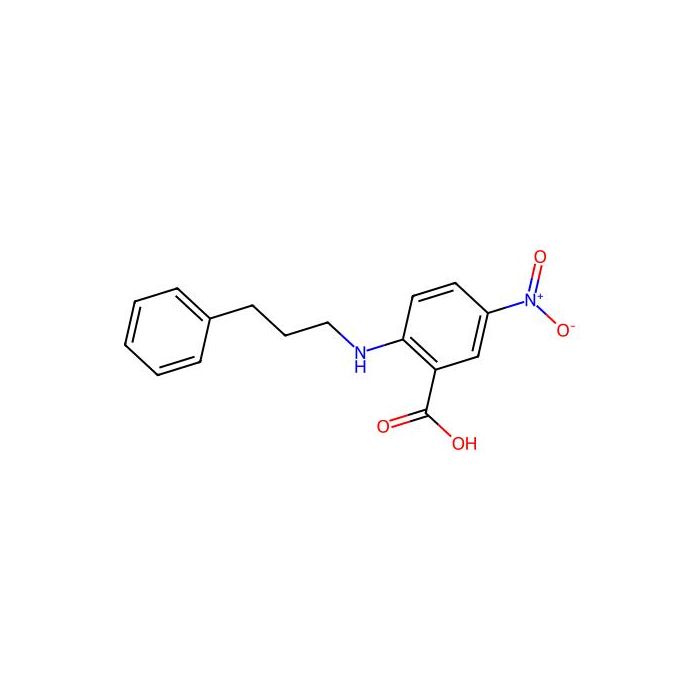
Typical chemical class: Small-molecule anion channel modulator; commonly described as a nitro-substituted benzoic acid bearing an anilino/alkyl-aryl amino substituent (literature).
2D description (literature): A substituted benzoic acid core with a nitro group para/ortho to an anilino-type linkage that extends to an aryl–alkyl chain; overall largely aromatic, weakly acidic due to the benzoic acid moiety.
Synthetic Utility
This product is offered as a bioactive small molecule rather than a building block. It is not commonly employed as a reagent or synthon in preparative organic chemistry.
Functional groups (general/literature): benzoic acid (weak acid), nitro (strongly deactivating/−M, −I), and an anilino/arylalkyl amine linkage. These groups confer limited utility for downstream diversification without significant protection/activation steps (literature).
Transformations (theoretical): The carboxylic acid could, in principle, be derivatized to esters/amides; the nitro group is reducible to an aniline under appropriate conditions. However, such transformations would change the identity relative to the catalog compound and are not typical use-cases.
For synthetic campaigns, consider using appropriately functionalized precursors rather than modifying NPPB directly.
Target Specificity
No manufacturer-validated target specificity data are provided for this item.
General literature context: NPPB is often used to probe anion channel activity (e.g., chloride channels/VRAC) but selectivity, potency, and off-target profile are system- and condition-dependent. Users should consult primary literature and perform in-house characterization for their specific target and assay.
La nostra guida alla selezione delle qualità copre purezza, stato dello stabilizzatore e idoneità all'applicazione per tutte le varianti del nostro catalogo.
Utilizziamo i cookie per garantire il corretto funzionamento del sito web e, ove consentito, per migliorare la tua esperienza. Puoi gestire le tue preferenze in qualsiasi momento nelle Impostazioni. Per saperne di più, consulta la nostra Cookie Policy.
Desidera che le inviamo un messaggio quando avremo sconti disponibili?
Ricordamelo più tardi
Grazie! Controlli la sua casella di posta per confermare.
Products are supplied to verified businesses, institutions, and qualified professionals for research and development use only. Not for use in humans, animals, diagnosis, or therapy.