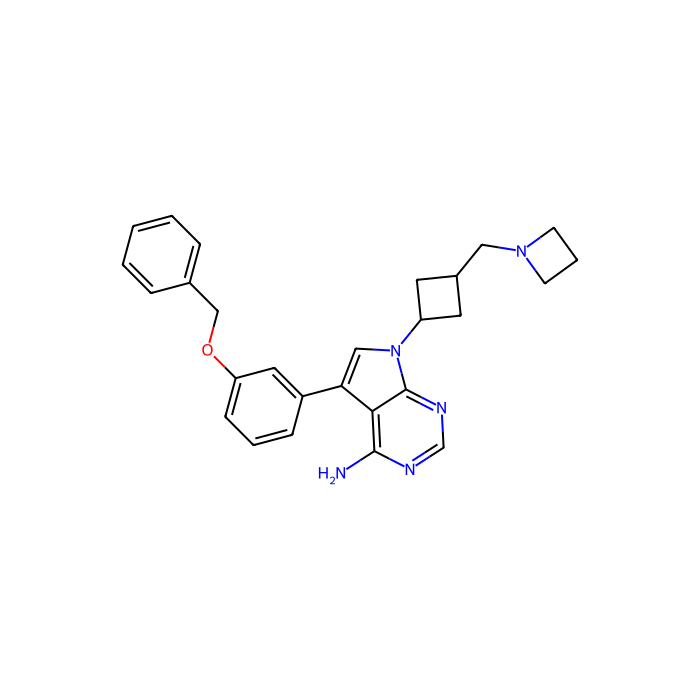
NVP-AEW541 - Moligand™, ≥98% , Inhibitor of Insulin-like growth factor I receptor, CAS No.475489-16-8, Inhibitor of Insulin-like growth factor I receptor

CAS: 475489-16-8 Cat. No.: N125538 Formula: C27H29N5O Peso molecolare: 439.55
Disponibile su ordine
QUALITÀ & PUREZZA Moligand™ ? Moligand™ — Aladdin's line of ligands and bioactive small molecules. Use for receptor, pathway, and binding studies needing defined small-molecule tools. ≥98%
Synonyms
7-[3-(azetidin-1-ylmethyl)cyclobutyl]-5-(3-phenylmethoxyphenyl)pyrrolo[2,3-d]pyrimidin-4-amine|NVP-AEW541-A|7-((1r,3r)-3-(azetidin-1-ylmethyl)cyclobutyl)-5-(3-(benzyloxy)phenyl)-7H-pyrrolo[2,3-d]pyrimidin-4-amine|cis-7-(3-azetidin-1-ylmethyl-cyclobutyl)-5-(3-benzyloxy-phenyl)-7H-pyrrolo[2,3-d]pyrimidin-4-ylamine|7-[3-(azetidin-1-ylmethyl)cyclobutyl]-5-[3-(phenylmethoxy)phenyl]pyrrolo[3,2-e]pyrimidin-4-amine|7-[trans-3-[(Azetidin-1-yl)methyl]cyclobutyl]-5-(3-benzyloxyphenyl)-7H-pyrrolo[2,3-d]pyrimidin-4-amine|methyl3-methyl-1H-pyrazole-5-carboxylate|NVP-AEW541|7-((1s,3s)-3-(azetidin-1-ylmethyl)cyclobutyl)-5-(3-(benzyloxy)phenyl)-7H-pyrrolo[2,3-d]pyrimidin-4-amine|AEW541|AEW-541|AVP-AEW541|7-[TRANS-3-(1-AZETIDINYLMETHYL)CYCLOBUTYL]-5-[3-(PHENYLMETHOXY)PHENYL]-7H-PYRROLO[2,3-D]PYRIMIDIN-4-AMINE|7H-Pyrrolo[2,3-d]pyriMidin-4-aMine,7-[trans-3-(1-azetidinylMethyl)cyclobutyl]-5-[3-(phenylMethoxy)phenyl]-|[7-[cis-3-[(Azetidin-1-yl)methyl]cyclobutyl]-5-(3-benzyloxyphenyl)-7H-pyrrolo[2,3-d]pyrimidin-4-yl]amine|AEW 541|4-formylbenzoic acid mono tert-butyl ester|7H-PYRROLO[2,3-D]PYRIMIDIN-4-AMINE, 7-[TRANS-3-(1-AZETIDINYLMETHYL)CYCLOBUTYL]-5-[3-(PHENYLMETHOXY)PHENYL]-|7-[cis-3-(Azetidin-1-Ylmethyl)cyclobutyl]-5-[3-(Benzyloxy)phenyl]-7h-Pyrrolo[2,3-D]pyrimidin-4-Amine|NVP-AEW 541|NVP AEW541
Storage
Store at -20°C
Shipped In
Ice chest + Ice pads
★
Dimensione
Germania (EU)
USA*
Prezzo
Qtà
1mg
N125538-1mg
—
3 Disponibile
61,52€
5mg
N125538-5mg
—
3 Disponibile
225,53€
25mg
N125538-25mg
—
2 Disponibile
893,68€
50mg
N125538-50mg
Su ordinazione · 8–12 settimane
1.126,24€
Enter a quantity for the sizes you want to add.

Panoramica

NVP-AEW541 is a potent inhibitor of IGF-1R/InsR with IC50 of 150 nM/140 nM in cell-free assays, greater potency and selectivity for IGF-1R in a cell-based assay.

Specifiche

Sinonimi
7-[3-(azetidin-1-ylmethyl)cyclobutyl]-5-(3-phenylmethoxyphenyl)pyrrolo[2,3-d]pyrimidin-4-amine | NVP-AEW541-A | 7-((1r,3r)-3-(azetidin-1-ylmethyl)cyclobutyl)-5-(3-(benzyloxy)phenyl)-7H-pyrrolo[2,3-d]pyrimidin-4-amine | cis-7-(3-azetidin-1-ylmethyl-cyclobutyl)-5-(3-benzyloxy-phenyl)-7H-pyrrolo[2,3-d]pyrimidin-4-ylamine | 7-[3-(azetidin-1-y Mostra altro
Specifiche e purezza
Moligand™, ≥98%
Meccanismi biochimici e fisiologici
NVP-AEW541 is a reversible, ATP-competitive, orally available insulin-like growth factor-I receptor (IGF-IR, IGF-1R) inhibitor that, despite its equipotency against recombinant kinase domains of insulin receptor (InsR) and IGF-IR in cell-free kinase assay
Condizioni di conservazione di stoccaggio
Store at -20°C
Spedito in
Ice chest + Ice pads
Questo prodotto richiede spedizione a catena fredda. I servizi di terra e altri servizi economici non sono disponibili.
Grado
Moligand™
Tipo di azione
INHIBITOR
Meccanismo d'azione
Inhibitor of Insulin-like growth factor I receptor
Purezza
≥98%
Nomi e identificatori
Pubchem Sid
Pubchem Sid Url
https://pubchem.ncbi.nlm.nih.gov/substance/504766469
Sorrisi canonici
C1CN(C1)CC2CC(C2)N3C=C(C4=C(N=CN=C43)N)C5=CC(=CC=C5)OCC6=CC=CC=C6
IUPAC Name
7-[3-(azetidin-1-ylmethyl)cyclobutyl]-5-(3-phenylmethoxyphenyl)pyrrolo[2,3-d]pyrimidin-4-amine
InChIKey
AECDBHGVIIRMOI-UHFFFAOYSA-N
INCHI
1S/C27H29N5O/c28-26-25-24(21-8-4-9-23(14-21)33-17-19-6-2-1-3-7-19)16-32(27(25)30-18-29-26)22-12-20(13-22)15-31-10-5-11-31/h1-4,6-9,14,16,18,20,22H,5,10-13,15,17H2,(H2,28,29,30)
Isomeri SMILES
C1CN(C1)CC2CC(C2)N3C=C(C4=C(N=CN=C43)N)C5=CC(=CC=C5)OCC6=CC=CC=C6
Peso molecolare
439.55
Reaxy-Rn
25733718
Reaxys-RN_link_address
https://www.reaxys.com/reaxys/secured/hopinto.do?context=S&query=IDE.XRN=25733718&ln=

Dati avanzati

Taxonomic Classification

Taxonomy Tree

KingdomOrganic compounds
SuperclassOrganoheterocyclic compounds
ClassePyrroles
SubclassSubstituted pyrroles
Intermediate Tree Nodes Not available
Direct ParentPhenylpyrroles
Alternative Parents Pyrrolo[2,3-d]pyrimidines  Phenoxy compounds  Phenol ethers  Aminopyrimidines and derivatives  Alkyl aryl ethers  Imidolactams  Heteroaromatic compounds  Trialkylamines  Azetidines  Azacyclic compounds  Primary amines  Hydrocarbon derivatives  
Molecular FrameworkAromatic heteropolycyclic compounds
Substituents 3-phenylpyrrole - Pyrrolo[2,3-d]pyrimidine - Pyrrolopyrimidine - Phenoxy compound - Phenol ether - Alkyl aryl ether - Aminopyrimidine - Monocyclic benzene moiety - Imidolactam - Benzenoid - Pyrimidine - Heteroaromatic compound - Azetidine - Tertiary aliphatic amine - Tertiary amine - Azacycle - Ether - Organonitrogen compound - Amine - Organic nitrogen compound - Hydrocarbon derivative - Organic oxygen compound - Organooxygen compound - Primary amine - Aromatic heteropolycyclic compound
DescrizioneThis compound belongs to the class of organic compounds known as phenylpyrroles. These are polycyclic aromatic compounds containing a benzene ring linked to a pyrrole ring through a CC or CN bond.
External Descriptors Not available
Struttura 3D
Modello di struttura chimica interattiva


Obiettivi associati (umani)
IGF1R Tclin Insulin-like growth factor 1 receptor (1 Activities)
Activity TypeActivity Value -log(M)Mechanism of ActionActivity ReferencePublications (PubMed IDs)
Certificati (CoA, COO, BSE/TSE e tabella di analisi)
C of A & Other Certificates(BSE/TSE, COO):
Analytical Chart:

Find and download the COA for your product by matching the lot number on the packaging.

5 results found

Lot NumberCertificate TypeDataOggetto
E2620094E2620094Certificate of AnalysisMay 28, 2026 N125538
A2219497A2219497Certificate of AnalysisAug 11, 2025 N125538
A2219546A2219546Certificate of AnalysisAug 11, 2025 N125538
A2219547A2219547Certificate of AnalysisAug 11, 2025 N125538
A2219548A2219548Certificate of AnalysisAug 11, 2025 N125538
Proprietà chimiche e fisiche
SolubilitàDMSO 88 mg/mL Water <1 mg/mL Ethanol 24 mg/mL
Peso molecolare439.600 g/mol
XLogP34.200
Hydrogen Bond Donor Count1
Hydrogen Bond Acceptor Count5
Rotatable Bond Count7
Exact Mass439.237 Da
Monoisotopic Mass439.237 Da
Topological Polar Surface Area69.200 Ų
Heavy Atom Count33
Formal Charge0
Complexity632.000
Isotope Atom Count0
Defined Atom Stereocenter Count0
Undefined Atom Stereocenter Count0
Defined Bond Stereocenter Count0
Undefined Bond Stereocenter Count0
The total count of all stereochemical bonds0
Covalently-Bonded Unit Count1
Calcolatori di soluzioni
Recensioni

Recensioni dei clienti

Application Protocols

No vendor-validated protocols (e.g., WB, IHC, IF, FC) are applicable because this product is a small-molecule research ligand, not an antibody or enzyme reagent. That said, general small-molecule dosing workflows apply.

Generic small-molecule dosing protocol (illustrative, adapt to your SOPs):

  • Prepare a concentrated DMSO stock (e.g., 10 mM) by accurately weighing the compound and dissolving with gentle warming/sonication if needed.
  • Perform serial dilutions in DMSO to create an intermediate plate, then transfer to assay plates to achieve final working concentrations with ≤0.5–1% DMSO.
  • Include vehicle controls (matching DMSO %) and positive/negative control ligands as appropriate for your assay.
  • Mix thoroughly after additions; inspect for precipitation. If turbidity occurs, extend mixing, raise temperature slightly (to 25–37°C), or adjust the dilution scheme.

Note: These steps are general best practices; verify with your institutional SOPs. For assay-specific parameters (exposure time, readout modality), consult the literature or your method development notes.

Biological Roles

Item-specific biological data are not provided in this listing; the compound is intended strictly for research use.

General, literature-level context for NVP-AEW541 (no medical/clinical claims):

  • Described in the literature as a small-molecule tool used to interrogate receptor tyrosine kinase signaling pathways in biochemical and cellular models. Such compounds are used to study upstream–downstream signaling relationships, feedback loops, and pathway crosstalk (literature).
  • In target validation workflows, reference ligands are employed to benchmark assay sensitivity, confirm on-target biochemical activity, and facilitate structure–activity relationship (SAR) discussions when compared to analog series (literature).
  • Biophysical applications may include thermal shift assays, ligand-binding displacement, surface plasmon resonance, and kinetic profiling, contingent on availability of suitable protein constructs and assay conditions.

Important notes:

  • Not for administration to humans or animals. No therapeutic or diagnostic claims are made.
  • For mechanistic studies, control for solvent effects (e.g., DMSO) and confirm engagement with orthogonal readouts to avoid pathway-level misattribution.
  • Consult primary literature and your internal SOPs for concentration ranges, exposure times, and assay-specific considerations.
Buffer Applications

This product is not a buffering agent and is not typically used to prepare or adjust pH-buffer systems.

Practical guidance:

  • When dosing into aqueous buffers for biochemical assays, dissolve first in a compatible organic solvent (commonly DMSO), then dilute into buffer with mixing to minimize precipitation.
  • Maintain low final organic solvent percentages (often ≤0.5–1% v/v) and verify compatibility with buffer components (detergents, salts, cofactors).

If your workflow requires sustained aqueous solubility, consider:

  • Stepwise dilution strategies, co-solvents, or inclusion of low-level nonionic surfactants per your validated assay protocols.
  • Using salt forms (if available for this item; not specified here) to improve aqueous handling characteristics.
Green Alternatives

While the compound itself is fixed, greener handling focuses on solvent and process choices for stock preparation, assay dilution, and cleanup.

Greener solvent considerations (general):

  • Prefer DMSO and ethanol over high-toxicity aprotics (e.g., DMF, NMP) when performance allows. DMSO has favorable environmental and safety profiles relative to many dipolar aprotics.
  • Minimize solvent volumes via high-concentration master stocks and precise liquid handling to reduce waste.
  • For cleaning and extraction, consider ethyl acetate or isopropanol as alternatives to chlorinated solvents when feasible.

Comparison snapshot (general guidance):

  • DMSO: low volatility, good EHS profile; hygroscopic; excellent solvency for heteroaromatics.
  • Ethanol/IPA: renewable sourcing possible; miscible with water; may not dissolve more lipophilic chemotypes well.
  • DMF/NMP: powerful solvents but with reproductive toxicity concerns; avoid when alternatives meet performance needs.

Operational green tips:

  • Use miniaturized assay formats (384/1536-well) to reduce solvent use.
  • Implement solvent recycling where permitted (HPLC-grade solvents) and segregate waste streams to improve reclaim potential.
  • Cold storage at -20°C (as specified) reduces degradation, extending useful life and preventing repeat synthesis/purchase, which indirectly lowers environmental footprint.
Pharmaceutical Uses

This material is supplied strictly for research use and is not manufactured to pharmacopoeial, GMP, or clinical standards.

Context (non-clinical, formulation-focused):

  • Small molecules of this class are sometimes formulated as DMSO stocks or in mixed aqueous co-solvent systems for in vitro screening and early discovery ADME profiling (literature/general practice).
  • No compendial monograph or excipient designation is indicated for this item. It is not intended for use as an API, excipient, or in any product administered to humans or animals.

Item-specific statements:

  • Regulatory status: Research-use only; not pharmacopeial.
  • Accepted residual solvent/elemental impurity limits: Not specified for this item; refer to CoA/Spec Sheet.
  • Any stabilizers, counterions, or polymorph information: Not specified for this item; refer to CoA/Spec Sheet.

For pre-formulation or developability experiments within discovery research, obtain the CoA and, if necessary, request additional characterization (salt form, polymorph, water content) to ensure reproducibility.

Physical Properties

Item-specific physicochemical specifications are not provided in this listing.

  • Appearance: Not specified for this item; refer to CoA/Spec Sheet.
  • Melting point: Not specified for this item; refer to CoA/Spec Sheet.
  • Boiling point: Not applicable for most high-MW bioactives; typically decompose before boiling (general guidance).
  • Density: Not specified for this item; refer to CoA/Spec Sheet.
  • Solubility: Not specified for this item; refer to CoA/Spec Sheet.
  • LogP/logD: Not specified for this item; refer to CoA/Spec Sheet.
  • pKa: Not specified for this item; refer to CoA/Spec Sheet.
  • Refractive index: Not applicable/Not measured for solids in routine QC.

General/literature expectations for kinase-focused small molecules (context only):

  • Often obtained as off-white to light-yellow crystalline solids or powders with moderate lipophilicity (literature).
  • Frequently soluble in polar aprotic organic solvents (e.g., DMSO, DMF, DMA) and sparingly soluble in water unless salt forms are used (literature).
  • Solid-state stability can benefit from low-temperature, desiccated storage to mitigate hydrolysis/oxidation pathways (general practice).

Note: For experimental planning (stock solution prep, formulation), consult the item’s CoA/Spec Sheet for definitive solubility and MP. Do not treat literature expectations as product specifications.

Quality and Grades
  • Grade: Moligand™ (as listed). This denotes a research-grade small-molecule suitable for screening, target validation assays, and biochemical/biophysical studies. It is not a clinical or GMP grade.

What Moligand™ generally entails (context):

  • Emphasis on identity confirmation (e.g., NMR/LC–MS) and high assay suitability. Actual acceptance criteria (purity %, residual solvents, water content) can vary by lot and are defined in the CoA/Spec Sheet.
  • Low bioburden expectations for dry solids; not sterile and not intended for cell therapy or human/animal administration.

Item-specific notes:

  • Purity (assay), water content, residual solvents, metal content, and UV cutoff: Not specified for this item; refer to CoA/Spec Sheet.
  • Stabilizers or salt form: Not specified for this item; refer to CoA/Spec Sheet.

Recommendations for quality-critical use:

  • Request lot-specific CoA, including chromatographic purity, identity spectra, and any stabilizers or counterions.
  • For analytical applications (e.g., reference standard work), verify by orthogonal methods (HPLC with dual-wavelength detection, HRMS, 1H/13C NMR).
Reaction and Applications

This product is supplied as a finished small-molecule research ligand rather than a synthetic reagent. As such, it is not typically employed as a stoichiometric reagent, catalyst, or building block in organic synthesis.

Research applications (general, literature-level):

  • Commonly used as a reference small molecule in biochemical/biophysical assays, cell-free target engagement studies, and pathway interrogation experiments. Suitable for inclusion in small-molecule and compound libraries (as indicated by the Category Path) for screening and profiling.
  • Deployed in comparative panels to benchmark assay performance, evaluate selectivity of novel entities, or validate detection methods (e.g., enzymatic readouts, thermal shift, binding kinetics).

Practical notes:

  • Prepare concentrated DMSO stocks under dry conditions; record exact concentration by weight-in/volume or use quantitative NMR when precision is critical.
  • Filter solutions through 0.2 µm PTFE for particulate removal if needed; avoid cellulose ester membranes with DMSO.
  • For plate-based work, pre-dilute to intermediate concentrations to improve pipetting accuracy and reduce DMSO carryover.

If you require this scaffold for synthetic derivatization, consult the literature for documented routes and request structural details (SMILES/InChI) from the CoA to plan compatible transformations.

Reaction Conditions

Not typically applicable. This product is not supplied as a reagent for performing named organic reactions; it is a research ligand provided for biochemical and screening applications.

For solution handling in assays (general guidance, not item specifications):

  • Stock preparation: Frequently 10–50 mM in anhydrous DMSO under inert atmosphere if sensitivity to moisture/oxygen is suspected; verify actual solubility with a small-scale test.
  • Dilution: Add stock to assay buffer with vigorous mixing to reach the desired final concentration while keeping total organic solvent low (commonly ≤0.5–1% v/v).
  • Temperature: Room temperature handling is typical; avoid prolonged exposure to elevated temperatures that may promote degradation.
  • Light and air: Protect from strong light if chromophores are present; cap tightly to limit evaporation/oxidation.

Any definitive reaction or stability parameters for this item (e.g., decomposition onset, hydrolytic stability) are Not specified for this item; refer to CoA/Spec Sheet and SDS.

Safety and Handling

GHS classification and hazard statements for this specific item are not provided here. Always consult the product SDS for authoritative safety information.

  • GHS/Signal word/H-statements/Pictograms: Not specified for this item; refer to SDS.
  • Likely hazard profile (general for bioactive heteroaromatic small molecules): May cause irritation upon contact or inhalation; avoid dust/aerosol formation. Handle as a potentially harmful organic compound (general guidance).

Core precautions (professional lab practice):

  • Engineering controls: Conduct manipulations in a chemical fume hood; use local exhaust when weighing fine powders.
  • PPE: Lab coat, safety glasses/goggles, and appropriate chemically resistant gloves (e.g., nitrile). Consider double-gloving for extended handling of DMSO stocks.
  • Hygiene: Avoid ingestion/inhalation and skin/eye contact. Wash thoroughly after handling. Prevent contamination of common surfaces.
  • Incompatibilities: Strong oxidizers and strong acids/bases may degrade heteroaromatics; avoid prolonged exposure to moisture and light (general guidance).
  • Spill/accident response: Contain solids with dampened disposable wipes/absorbent; avoid generating dust. For solutions, use inert absorbents. Dispose per institutional and local regulations.
  • First aid (summary): Remove contaminated clothing. Skin/eye contact—flush with water for ≥15 min; seek medical evaluation. Inhalation—move to fresh air. Ingestion—rinse mouth; do not induce vomiting; obtain medical attention. Defer to SDS for details.

Waste: Collect in halogenated or non-halogenated organic waste streams per your solvent matrix; label clearly with constituents.

Solvent Selection

This product is a non-volatile, heteroaromatic small molecule typically handled as a concentrated stock solution for assays.

General, literature-informed guidance (not item-specific specifications):

  • Primary solvent: DMSO is commonly used to prepare 10–50 mM stocks for screening libraries due to excellent solvating power for polar, lipophilic, and heteroaromatic scaffolds.
  • Alternative solvents: DMF, NMP, or ethanol can be employed depending on downstream compatibility; aqueous buffers often require co-solvent and/or surfactant if the compound is water-insoluble.
  • Miscibility: DMSO and DMF are fully miscible with water, enabling serial dilutions into assay buffers while minimizing precipitation; pre-warm and vortex to ensure homogeneity.

Selection considerations:

  • Avoid high final DMSO percentages in biological assays (commonly keep ≤0.5–1% v/v) to minimize solvent effects on targets/cells (general practice).
  • If precipitation occurs on dilution, consider stepwise dilution (DMSO → 50% DMSO/buffer → final buffer) or include low levels of a solubilizing excipient (e.g., 0.01–0.05% nonionic surfactant) per assay SOPs.

Comparison (general):

  • DMSO: strongest solvation, biocompatible at low %, hygroscopic.
  • DMF/NMP: strong solvency; check assay compatibility/toxicity; higher regulatory scrutiny.
  • Ethanol: greener, but lower solubility for many kinase-like chemotypes and can affect assay readouts at modest %.
Storage and Reconstitution
  • Storage conditions: Store at -20°C (as specified). Keep tightly closed in original container. Protect from moisture and prolonged light exposure. Allow container to equilibrate to room temperature before opening to minimize condensation.
  • Shipping: Shipped in ice chest with ice pads (as specified), supporting maintenance of a cool chain during transit.
  • Reconstitution: Item-specific solvent/solubility data are Not specified for this item; refer to CoA/Spec Sheet. General practice is to prepare concentrated stocks in anhydrous DMSO for assay use.
  • Aliquoting: For repeated use, prepare single-use aliquots of DMSO stock to avoid freeze–thaw cycles. Store aliquots at -20°C or colder in sealed, chemically compatible vials.
  • Stability: Definitive shelf-life and solution stability are Not specified for this item; refer to CoA/Spec Sheet. As general guidance, minimize exposure to air, moisture, and elevated temperatures. Monitor for discoloration or precipitation as indicators of potential degradation.
  • Thawing/handling: Thaw aliquots at ambient temperature, mix to homogeneity, and promptly return unused portions to cold storage. Avoid multiple freeze–thaw cycles.

Research use note: For research use only. Not for human or animal use.

Structure and Identity

Overview: NVP-AEW541 is a cataloged small-molecule research compound (Moligand grade) commonly used as a reference ligand in target- and pathway-focused studies. Item-specific structural parameters are not fully specified in this listing.

  • CAS: 475489-16-8 (provided)
  • PubChem CID: 11476171 (provided)
  • InChIKey: 3070 (provided as-is in Product Data)
  • SMILES: Not specified for this item; refer to CoA/Spec Sheet.
  • Molecular formula: Not specified for this item; refer to CoA/Spec Sheet.
  • Molecular weight: Not specified for this item; refer to CoA/Spec Sheet.

Structural features (general, literature-level, non-item-specific):

  • NVP-AEW541 is described in literature as a heteroaromatic, kinase-focused scaffold containing multiple nitrogen heterocycles and halogenated aryl groups (literature). It is typically neutral to weakly basic due to embedded heteroaromatic nitrogens (literature).
  • 2D description (literature, generic): multi-ring system with fused or pendant aza-heteroaromatics and an ancillary solubilizing tertiary amine or morpholine-type moiety are commonly reported in this chemotype; planar/aromatic cores with limited rotatable bonds (literature).

Identity and purity control (practical guidance):

  • Recommended orthogonal ID tests for small molecules: 1H/13C NMR, HRMS, and HPLC/UPLC purity profiling; optional LC–MS retention-time match to a qualified reference standard.
  • If structure-sensitive applications are planned, request the current CoA/Spec Sheet for definitive identifiers (exact SMILES/InChIKey, formula, and MW).
Synthetic Utility

This product is supplied as a finished small molecule for biological research; it is not typically used as a synthetic reagent or building block.

General considerations (if derivatization is contemplated):

  • Kinase-focused heteroaromatic scaffolds often contain multiple nitrogen heteroatoms and halogenated aryl motifs in literature precedents, enabling cross-coupling, nucleophilic substitution, or late-stage functionalization under carefully chosen conditions.
  • Without the item’s definitive structural descriptors (SMILES/InChI; not specified here), route planning must be literature-driven and contingent on verified structure from the CoA/Spec Sheet.

Practical guidance:

  • If analog synthesis or probe tagging (e.g., biotin, fluorophore) is desired, obtain the exact structure to identify vectors tolerant of modification. Protecting-group strategies may be required for basic heterocycles.
  • Characterize any derivatives rigorously (NMR, HRMS, HPLC) and confirm target engagement relative to the parent compound via orthogonal assays.
Target Specificity

Not an antibody or biologic. No antigen/epitope, clone, or isotype applies.

  • Target binding/biological specificity data for this item are not provided in the Product Data. If you require target profile or selectivity panels, consult primary literature associated with NVP-AEW541 and request any available in-house characterization from Aladdin Scientific.
  • Use only in research settings; no diagnostic or therapeutic claims are made.

Desidera che le inviamo un messaggio quando avremo sconti disponibili?

Ricordamelo più tardi

Grazie! Controlli la sua casella di posta per confermare.

Ops! Le notifiche sono disabilitate.