Certificati (CoA, COO, BSE/TSE e tabella di analisi)
C of A & Other Certificates(BSE/TSE, COO):
Analytical Chart:
Calcolatori di soluzioni
Molarity Calculator
Determine the necessary mass, volume, or concentration for preparing a solution.
Dilution Calculator
Determine the dilution needed to prepare a stock solution.
Reconstitution Calculator
Recensioni
Recensioni dei clienti
Application Protocols
No tested application protocols are provided for this product entry.
Recommended use: For research use only. Establish compound-specific protocols based on your internal target and assay format.
General small-molecule dosing guidance:
Prepare a sterile-filtered DMSO stock at 10–50 mM if soluble.
Perform serial dilutions in assay buffer maintaining ≤0.5–1% DMSO.
Include vehicle controls and, where possible, orthogonal readouts to mitigate assay artifacts.
Analytical controls: Verify identity/purity by LC–MS prior to critical experiments and after prolonged storage to confirm stability.
For protocol development assistance, contact Technical Support with assay details and any internal data you can share under NDA.
Biological Roles
No biological function, target, or pathway information is provided for Obafistat in the current product data. Therefore, specific roles, mechanisms, or on-target effects cannot be described for this item.
General considerations for small-molecule research tools (non–item-specific):
Target engagement: If Obafistat is used as a putative modulator, verify engagement via orthogonal assays (biochemical vs cellular) and counter-screens to rule out assay interference.
Selectivity profiling: Broader panel screening (e.g., kinases, proteases, GPCRs—depending on hypothesized class) can deconvolute polypharmacology.
ADME properties: Establish basic in vitro parameters (solubility, permeability, metabolic stability) if the molecule advances within your pipeline; avoid extrapolating to any clinical relevance.
Aggregation/artifacts: Screen for colloidal aggregation and redox cycling where relevant; use detergent controls and spectral interference checks.
To obtain definitive biological role information, consult the SDS/CoA or request the full technical data package for CAS 2160582-57-8 from our technical support team.
Buffer Applications
This product is a small molecule and is not a buffering reagent. No item-specific pKa or buffer capacity data are provided.
Not typically used to prepare buffer systems. If Obafistat must be dosed into buffers for assays, prepare a DMSO stock and dilute into the desired buffer (HEPES, PBS, Tris, etc.) maintaining ≤0.5–1% DMSO final.
Verify compound compatibility with buffer components (e.g., avoid reactive amines if the molecule contains activated esters—confirm based on your internal structural knowledge).
For buffer preparation details and pH control, refer instead to dedicated buffering agents.
Green Alternatives
In the absence of compound-specific synthesis or solvent-of-use details, consider general greener-chemistry practices applicable to small-molecule handling and method development.
Solvent selection: Prefer greener solvents where performance allows.
Use microscale experiments to minimize solvent and waste.
Employ closed systems and recycling for chromatographic solvents when feasible.
Favor SFC with CO2 for purifications when compatible with compound stability.
Energy efficiency: Room-temperature reactions/assays and ambient-pressure conditions reduce energy footprint. Use LED photochemistry rather than high-energy lamps where applicable to your chemistry.
Illustrative comparison (general, not item-specific):
Replacing dichloromethane with ethyl acetate for liquid–liquid extractions reduces halogenated waste.
Substituting 2-MeTHF or CPME for THF can mitigate peroxide hazards and improve lifecycle metrics.
Always balance green credentials with data quality, safety, and compound integrity.
Pharmaceutical Uses
No pharmacopeial status, excipient role, or formulation guidance is provided for this product. It is sold strictly for research use only.
Regulatory status: Not specified for this item; refer to CoA/Spec Sheet. No claim of USP/EP/JP compliance is made.
Potential roles (general, non–item-specific): Small molecules may serve as reference standards, screening hits, or internal controls in discovery workflows. Any use in human or veterinary applications is not intended and not supported by this listing.
Formulation considerations for research: If in vitro or exploratory in vivo research is undertaken within institutional approvals, establish solubility and stability in acceptable vehicles (e.g., PEG400/saline, Captisol, or lipid-based systems) based on your internal compound data.
Always adhere to “For research use only” and your organization’s governance for nonclinical materials.
Physical Properties
Item-specific physicochemical parameters are not included in the provided data.
Appearance: Not specified for this item; refer to CoA/Spec Sheet.
Melting point (literature/computed): Not specified for this item; refer to CoA/Spec Sheet.
Boiling point (literature): Not specified for this item; refer to CoA/Spec Sheet.
Density (literature): Not specified for this item; refer to CoA/Spec Sheet.
Solubility: Not specified for this item; refer to CoA/Spec Sheet. Practical guidance: for unknown small molecules, begin with DMSO to prepare a 10–50 mM stock; dilute into assay buffers with ≤1% final DMSO.
logP/logD (literature/computed): Not specified for this item; refer to CoA/Spec Sheet.
pKa (literature/computed): Not specified for this item; refer to CoA/Spec Sheet.
Refractive index/UV cutoff: Not specified for this item; refer to CoA/Spec Sheet.
General notes for handling small-molecule library members (non–item-specific):
If solid: hygroscopicity and polymorphism can affect dissolution; warm gently (25–40°C) and sonicate to aid solubilization.
If liquid/oil: verify absence of stabilizers; dryness and water content may influence activity in moisture-sensitive assays.
Conduct a small-scale solvent screen (DMSO, DMF, methanol, acetonitrile, PBS with cosolvent) to establish a robust handling protocol. Always verify chemical identity and purity by LC–MS or NMR when critical to your study.
Quality and Grades
Item-specific grade and purity are not listed in the provided product data.
Grade/purity: Not specified for this item; refer to CoA/Spec Sheet. The CoA will list assay method (e.g., HPLC area%), acceptance criteria, and related substances where applicable.
What grade implies (general):
Research-grade small molecules are typically qualified by identity (NMR/LC–MS) and purity by HPLC/UPLC. Some entries include water content (Karl Fischer), residual solvents, and mass balance.
Low-UV or LC-MS grades minimize background for analytical workflows; pharmacopoeial grades (USP/EP) are not implied unless explicitly stated.
Stabilizers/additives: Not specified for this item; refer to CoA/Spec Sheet. If present (e.g., BHT, acid salts), this affects assay design and reporting.
Batch documentation: Each lot is shipped with or linked to a CoA providing test methods, results, and release criteria. Request chromatograms if you need visibility on minor impurities for SAR or tox risk assessments.
Fit-for-purpose guidance: For bioassays and screening, ≥95% HPLC purity is commonly targeted; for in vivo exploratory studies, tighter controls on residual metals/solvents may be required. Verify against your institutional SOPs.
Reaction and Applications
The current listing does not provide a structure or reactivity profile for Obafistat. Consequently, specific reaction classes (e.g., cross-coupling, amide formation, nucleophilic substitutions) cannot be assigned with confidence.
Practical guidance for use as a research small molecule or library member:
Identity confirmation: Verify by LC–MS and, if feasible, 1H NMR prior to critical studies. Cross-check CAS 2160582-57-8 with your internal registry to ensure correct structural mapping.
Assay readiness: Establish solubility limits in your assay buffer and confirm chemical stability over the assay window (autosampler and bench-top stability, freeze–thaw robustness).
Impurity awareness: Trace impurities or counterions may confound results in biochemical assays. Review CoA for related substances and consider pre-use purification if necessary.
Control selection: Include positive/negative controls appropriate to the biological target or pathway under investigation (if known within your program).
Documentation: Record batch/lot, preparation date, and storage conditions (2–8°C, protected from light) to ensure data traceability.
If you possess structural information for Obafistat within your project, consult target-relevant literature to select reaction conditions or derivatization routes aligned with the molecule’s functional groups.
Reaction Conditions
Item-specific reaction conditions are not available because the structure and functional groups of Obafistat are not provided. Without this information, citing typical temperatures, catalysts, or yields would be speculative and is avoided per our data integrity policy.
General best practices for small-molecule method development (non–item-specific):
Condition scouting: Begin with orthogonal coupling manifolds (e.g., Pd-catalyzed cross-coupling vs SNAr for aryl–N/O/C bonds) guided by your scaffold.
Solvent/temperature: Screen a polar aprotic (DMF/DMAc/NMP), a mid-polar (MeCN/2-MeTHF), and an alcohol (EtOH/iPrOH); temperatures from 25–120°C depending on stability.
Bases/acids: Inorganic bases (Cs2CO3, K3PO4) and mild organic bases (DIPEA) are common starting points; adjust based on substrate acidity.
Catalyst loading: 0.5–5 mol% for modern cross-couplings as a scouting range; monitor by LC–MS.
Workup/purification: Favor LLE with EtOAc or greener alternatives and silica flash or SFC. Confirm purity by LC–MS and NMR.
Provide your known structure to derive precise, literature-backed conditions.
Safety and Handling
Follow general prudent practices for small-molecule research reagents. Item-specific GHS elements are not provided in the current data and should be confirmed in the SDS.
GHS classification / pictograms / H-statements / signal word: Not specified for this item; refer to SDS.
Primary hazards (general): Unknown toxicological profile; handle as a substance of unknown hazard. Avoid inhalation, ingestion, and skin/eye contact.
PPE: Lab coat, safety glasses, and nitrile gloves as minimum. Upgrade to splash goggles and face protection if handling large quantities or preparing aerosols.
Engineering controls: Work in a chemical fume hood when weighing, dissolving, or transferring powders/volatile solvents.
First aid (general):
Skin/eye contact: Rinse with water for ≥15 minutes; remove contaminated clothing; seek medical attention if irritation persists.
Inhalation: Move to fresh air; seek medical attention if symptoms occur.
Ingestion: Rinse mouth; do not induce vomiting; seek medical advice.
Storage incompatibilities: Until specific chemistry is known, segregate from strong oxidizers and acids/bases. Avoid light exposure per product instructions.
Special risks: If supplied in DMSO or other organic solvent, treat as flammable/combustible. For unknown organic compounds, consider potential dust explosivity for fine powders.
Always consult the SDS supplied with the lot for authoritative hazard and response information.
Solvent Selection
Because no structural or solubility data are provided for Obafistat, a pragmatic solvent strategy is recommended.
Starting point: Prepare a concentrated DMSO stock (10–50 mM) if the material dissolves completely; warm to 25–40°C and sonicate if needed. Filter (0.22 µm PTFE) to remove particulates.
Solvent screening:
Polar aprotic: DMSO, DMF, NMP, acetonitrile
Protic: methanol, ethanol, isopropanol
Less polar: ethyl acetate, CPME, 2-MeTHF (for workup/formulation, as applicable)
Assay dilution: Keep final DMSO ≤0.5–1% v/v in biochemical/cell assays to limit vehicle effects; include vehicle controls.
Aqueous compatibility: If aqueous solubility is poor, consider co-solvent systems (5–20% DMSO or ethanol), cyclodextrins, or pH adjustment when chemically justified (only if pKa is known from your internal data).
Chromatography/workup: Without a known logP, use a scouting gradient (water–acetonitrile with 0.1% formic/formate or ammonium bicarbonate) for LC. For flash/SFC, begin with generic methods and adjust based on retention.
Material conservation: Pilot small-scale solubility tests (1–2 mg) before committing bulk material. Record solvent history to support reproducibility.
Storage and Reconstitution
Storage conditions (item-specific): Store at 2–8°C, protected from light. Shipped on wet ice. Do not expose to direct sunlight or prolonged ambient temperatures during receipt and handling.
Container management: Keep tightly closed in the original, light-protective container. Minimize headspace to reduce oxidative/hydrolytic degradation risk.
Reconstitution (general guidance):
If solid: Equilibrate to room temperature in a desiccator before opening. Dissolve in dry DMSO to prepare a 10–50 mM stock; warm gently (25–40°C) and sonicate if needed. Sterile-filter (0.22 µm PTFE) for cell-based assays.
If supplied as solution: Mix thoroughly and aliquot upon first opening to avoid repeated freeze–thaw cycles.
Aliquoting: Prepare single-use aliquots and store at 2–8°C or per your internal stability data. Avoid unnecessary freeze–thaw; protect from light at all times.
Stability: Item-specific stability, water content, and degradation pathways are not specified; consult the lot-specific CoA/SDS. Verify integrity by LC–MS/NMR prior to critical experiments, especially after 3–6 months of storage.
Disposal: Follow institutional and local regulations for disposal of organic research chemicals and solvent residues.
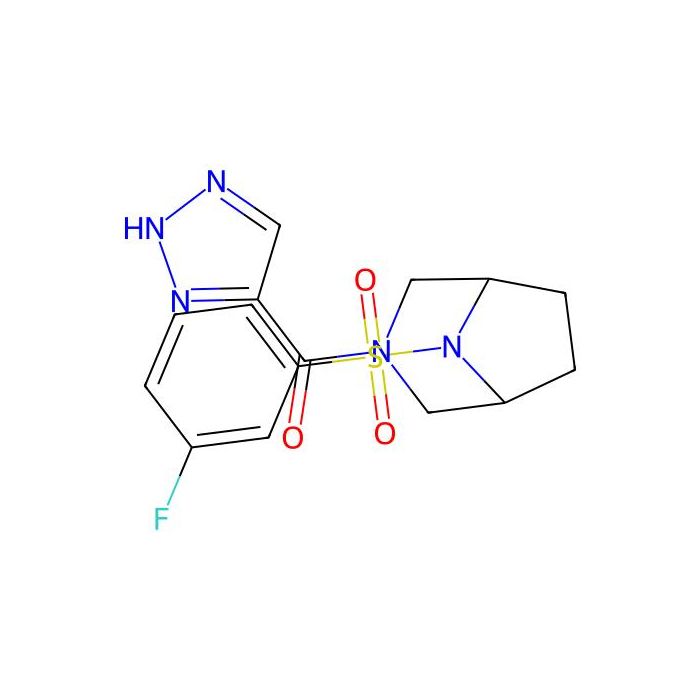
Structure and Identity
Brief identity overview for Obafistat (SKU O1438750).
Product name: Obafistat
CAS: 2160582-57-8
SMILES: Not specified for this item; refer to CoA/Spec Sheet.
InChIKey: Not specified for this item; refer to CoA/Spec Sheet.
Molecular formula: Not specified for this item; refer to CoA/Spec Sheet.
Molecular weight: Not specified for this item; refer to CoA/Spec Sheet.
Synonyms: Not specified for this item; refer to CoA/Spec Sheet.
Structural features (general guidance):
Item-specific functional groups, ring systems, and stereochemistry are not provided in the current product data. Without a structure (SMILES/InChI), specific descriptors (e.g., heteroaromatic content, chiral centers, salt form) cannot be confirmed.
If you require an exact structure depiction or 2D/3D coordinates for cheminformatics or registration, please request the CoA/SDS/Spec Sheet or contact Technical Support with the CAS number.
2D structure description (general):
Not available due to missing structure data for this specific catalog entry. If Obafistat is being used as a screening library member or reference inhibitor in your workflow, ensure your internal registry links this CAS to the correct structural record to avoid annotation drift.
Synthetic Utility
The product data do not include a structure for Obafistat; therefore, specific functional-group reactivity, named-reaction applicability, or derivatization routes cannot be asserted for this item.
General guidance if you possess structural knowledge internally:
Functional group mapping: Identify nucleophilic/electrophilic sites, protected functionalities, and potential liabilities (e.g., acid-labile acetals, base-labile sulfonates) before planning transformations.
Common transformations: Amide couplings (carbodiimides, uronium salts), cross-couplings (Suzuki, Buchwald–Hartwig), heterocycle formations, and selective oxidations/reductions—selected according to the scaffold.
Analytical control: Use LC–MS to track conversions; employ qNMR or mass balance for purity. Consider chiral SFC/HPLC if stereocenters are present.
Scalability: Screen greener solvents and catalytic conditions early to streamline scale-out while maintaining impurity profiles compatible with downstream biology.
If you require a bespoke derivative or impurity reference, contact us with your target specification and we can assess custom synthesis feasibility.
Target Specificity
No target, enzyme, receptor, or pathway specificity information is provided in the product data for Obafistat.
Target/epitope: Not specified for this item; refer to CoA/Spec Sheet.
Assay-validated selectivity: Not specified for this item; refer to CoA/Spec Sheet.
If Obafistat is part of a target-focused library in your organization, consult internal assay reports or literature linked to CAS 2160582-57-8 to define specificity and off-target profiles.
Domande frequenti
What is the purity of this product?
This product is supplied at ≥99% purity (chemical assay). Lot-specific values are stated on the Certificate of Analysis.
How should this product be stored?
Store at 2–8 °C, protected from light. The material is light-sensitive — keep it in its original opaque or amber container.
How is this product shipped?
This product ships chilled on wet ice. Unpack on arrival and transfer it to the storage condition stated above.
What are the CAS number, molecular formula and molecular weight?
The CAS Number is 2160582-57-8, the molecular formula is C15H16FN5O3S, and the molecular weight is 365.38 g/mol.
What documentation is provided?
Available product documentation, including Certificates of Analysis (COA), Safety Data Sheets (SDS), and specification sheets, is shown in the product document area. Document availability and access follow the current site policy.
Utilizziamo i cookie per garantire il corretto funzionamento del sito web e, ove consentito, per migliorare la tua esperienza. Puoi gestire le tue preferenze in qualsiasi momento nelle Impostazioni. Per saperne di più, consulta la nostra Cookie Policy.
Desidera che le inviamo un messaggio quando avremo sconti disponibili?
Ricordamelo più tardi
Grazie! Controlli la sua casella di posta per confermare.
Products are supplied to verified businesses, institutions, and qualified professionals for research and development use only. Not for use in humans, animals, diagnosis, or therapy.