Determine the necessary mass, volume, or concentration for preparing a solution.
Pd 59-60% for sensitive chromatographic and analytical workflows requiring minimal baseline interference.
Room temperature,Argon charged,Desiccated Ships Normal Check lot-specific COA for exact specifications.
SDS, COA, datasheet, and spec sheet available for download. Lot-specific COA accessible via lot number lookup.
Cited in 657 peer-reviewed publications across chromatography, organic synthesis, and cross-coupling reactions.
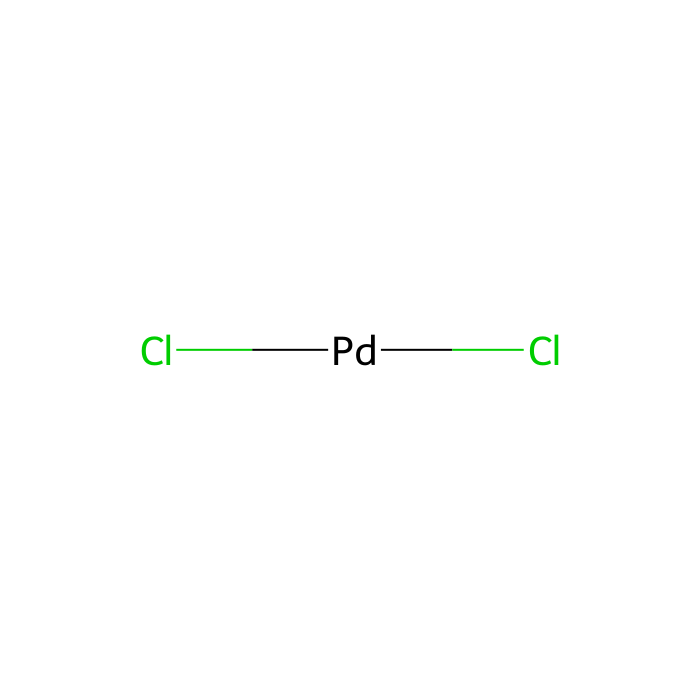
Palladium(II) chloride (PdCl2) reacts with unsubstituted or alkyl-substituted cyclic ketones in the CO atmosphere to afford acyclic diesters and acyclic chloro-substituted monoesters. PdCl2 reacts with N,N-dimethylallylamine in methanol to afford di-μ-chloro-bis(2-methoxy-3-N,N-dimethylaminopropyl)dipalladium(II). Palladium dichloride, acetate and acetylacetonate in the [bmim][BF4] or [bmim][PF6] (where[bmim]+ = 1-butyl-3-methylimidazolium cation) ionic liquids have been employed for the hydrodimerization of butadiene to form octa-2,7-dien-1-ol.
Palladium catalysts and precursor used as an oxidizing agent and as a source of Pd(0) complexes. Used in the synthesis of semiconducting metal-containing polymers in which the polypyrrole backbone has a conformational energy minimum and is nearly planar.1
Product class
PGM Solids, Chlorides
Reaction type
Cross Coupling Reactions with Arenes, CH-Activation, Carbonylation, Mizoroki Heck Coupling Reaction, Oxidation
Chemical properties
Cl2Pd
PdCl2
177.31
Pd
60
powder
red brown
Applications & references
Efficient oxidative carboxylation of benzylic C-H bonds via nondirected C(sp³)-H activation forming substituted 2-phenylacetic acid esters and derivatives starting from inexpensive, commercially available starting materials.
Reference: J. Am. Chem. Soc. 2012, 134, 9902 (DOI: 10.1021/ja3036459)
Efficient Palladium catalyzed hydroformylation of aryl and enol trifluoromethanesulfonates providing α,β-unsaturated aldehydes.
Reference: Synthesis 1996, 470 (DOI: 10.1055/s-1996-4246)
Palladium catalyzed intermolecular decarboxylative coupling in the presence of reactive C-H groups.
Reference: J. Org. Chem. 2010, 75, 1550. (DOI: 10.1021/jo9022793)
| Pubchem Sid | 508814274 |
|---|---|
| Pubchem Sid Url | https://pubchem.ncbi.nlm.nih.gov/substance/508814274 |
| Sorrisi canonici | Cl[Pd]Cl |
| IUPAC Name | dichloropalladium |
| InChIKey | PIBWKRNGBLPSSY-UHFFFAOYSA-L |
| INCHI | 1S/2ClH.Pd/h2*1H;/q;;+2/p-2 |
| Isomeri SMILES | Cl[Pd]Cl |
| Numero UN | 3290 |
| Gruppo di imballaggio | I |
| Peso molecolare | 177.33 |
| Reaxy-Rn | 3902833 |
| Reaxys-RN_link_address | https://www.reaxys.com/reaxys/secured/hopinto.do?context=S&query=IDE.XRN=3902833&ln= |
Comprehensive hazard, handling, storage, and regulatory compliance document.
Download SDS →Lot-specific quality data. Enter your lot number to retrieve the exact COA.
Look up COA →Full quality attributes and acceptance criteria for this grade.
View spec sheet →Taxonomy Tree
| Kingdom | Inorganic compounds |
|---|---|
| Superclass | Mixed metal/non-metal compounds |
| Classe | Transition metal salts |
| Subclass | Transition metal chlorides |
| Intermediate Tree Nodes | Not available |
| Direct Parent | Transition metal chlorides |
| Alternative Parents | Inorganic chloride salts |
| Molecular Framework | Not available |
| Substituents | Transition metal chloride - Inorganic chloride salt - Inorganic salt |
| Descrizione | This compound belongs to the class of inorganic compounds known as transition metal chlorides. These are inorganic compounds in which the largest halogen atom is Chlorine, and the heaviest metal atom is a transition metal. |
| External Descriptors | palladium coordination entity |
Find and download the COA for your product by matching the lot number on the packaging.
| Lot Number | Certificate Type | Data | Oggetto |
|---|---|---|---|
| Certificate of Analysis | Aug 04, 2026 | P105196 | |
| Certificate of Analysis | Mar 14, 2026 | P105196 | |
| Certificate of Analysis | Mar 14, 2026 | P105196 | |
| Certificate of Analysis | Mar 14, 2026 | P105196 | |
| Certificate of Analysis | Mar 14, 2026 | P105196 | |
| Certificate of Analysis | Mar 14, 2026 | P105196 | |
| Certificate of Analysis | Dec 10, 2025 | P105196 | |
| Certificate of Analysis | Aug 21, 2025 | P105196 | |
| Certificate of Analysis | Aug 21, 2025 | P105196 | |
| Certificate of Analysis | Aug 21, 2025 | P105196 | |
| Certificate of Analysis | Aug 21, 2025 | P105196 | |
| Certificate of Analysis | May 09, 2025 | P105196 | |
| Certificate of Analysis | Nov 13, 2024 | P105196 | |
| Certificate of Analysis | Nov 13, 2024 | P105196 | |
| Certificate of Analysis | Jan 10, 2023 | P105196 | |
| Certificate of Analysis | Jan 10, 2023 | P105196 | |
| Certificate of Analysis | Jan 10, 2023 | P105196 | |
| Certificate of Analysis | Jan 10, 2023 | P105196 | |
| Certificate of Analysis | Sep 24, 2022 | P105196 | |
| Certificate of Analysis | Sep 24, 2022 | P105196 | |
| Certificate of Analysis | Sep 22, 2022 | P105196 | |
| Certificate of Analysis | Sep 22, 2022 | P105196 | |
| Certificate of Analysis | Sep 22, 2022 | P105196 | |
| Certificate of Analysis | Sep 22, 2022 | P105196 | |
| Certificate of Analysis | Jun 05, 2022 | P105196 | |
| Certificate of Analysis | Jun 05, 2022 | P105196 | |
| Certificate of Analysis | Jun 05, 2022 | P105196 | |
| Certificate of Analysis | Jun 05, 2022 | P105196 | |
| Certificate of Analysis | Jun 05, 2022 | P105196 | |
| Certificate of Analysis | Jun 05, 2022 | P105196 | |
| Certificate of Analysis | Feb 26, 2022 | P105196 | |
| Certificate of Analysis | Feb 26, 2022 | P105196 | |
| Certificate of Analysis | Feb 26, 2022 | P105196 | |
| Certificate of Analysis | Feb 26, 2022 | P105196 |
| Solubilità | Soluble in dilute mineral acids, aqueous metal halides |
|---|---|
| Sensibilità | Hygroscopic |
| Punto di ebollizione (°C) | 2970°C |
| Punto di fusione (°C) | 678-680 °C |
| Peso molecolare | 177.320 g/mol |
| XLogP3 | |
| Hydrogen Bond Donor Count | 0 |
| Hydrogen Bond Acceptor Count | 0 |
| Rotatable Bond Count | 0 |
| Exact Mass | 175.841 Da |
| Monoisotopic Mass | 175.841 Da |
| Topological Polar Surface Area | 0.000 Ų |
| Heavy Atom Count | 3 |
| Formal Charge | 0 |
| Complexity | 2.800 |
| Isotope Atom Count | 0 |
| Defined Atom Stereocenter Count | 0 |
| Undefined Atom Stereocenter Count | 0 |
| Defined Bond Stereocenter Count | 0 |
| Undefined Bond Stereocenter Count | 0 |
| The total count of all stereochemical bonds | 0 |
| Covalently-Bonded Unit Count | 1 |