QUALITÀ & PUREZZAMoligand™?Moligand™ — Aladdin's line of ligands and bioactive small molecules. Use for receptor, pathway, and binding studies needing defined small-molecule tools.10 mM in DMSO
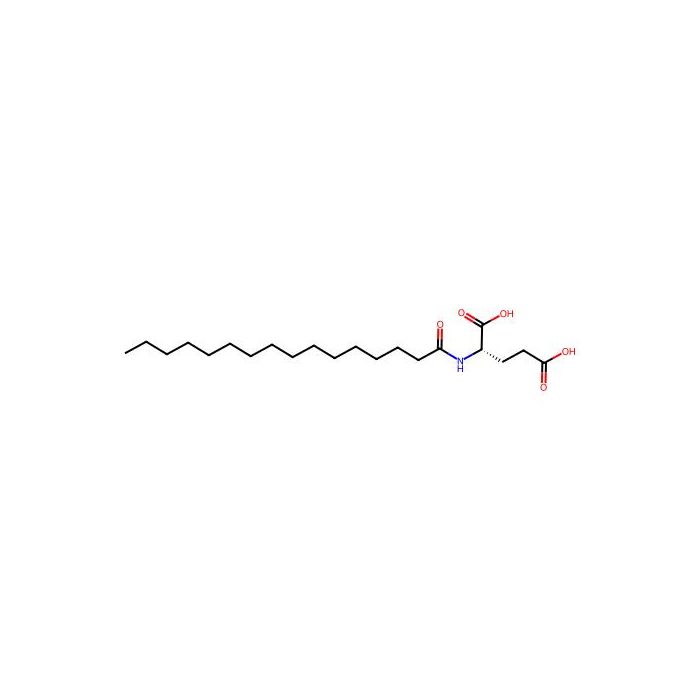
Palmitoyl glutamic acid (N-Palmitoyl-L-glutamic acid) is an acyl amino acid with neuroprotective effects. Palmitoyl glutamic acid is used as cosmetic material.
Specifiche
Specifiche e purezza
Moligand™, 10 mM in DMSO
Condizioni di conservazione di stoccaggio
Store at -80°C
Spedito in
Dry ice packs + Cold packs
Questo prodotto richiede spedizione a catena fredda. I servizi di terra e altri servizi economici non sono disponibili.
Grado
Moligand™
Nomi e identificatori
Isomeri SMILES
CCCCCCCCCCCCCCCC(=O)N[C@@H](CCC(=O)O)C(=O)O
CAS alternativo
38079-66-2
PubChem CID
161955
Termini MeSH
glutamic acid palmitamide
Dati avanzati
Certificati (CoA, COO, BSE/TSE e tabella di analisi)
C of A & Other Certificates(BSE/TSE, COO):
Analytical Chart:
Calcolatori di soluzioni
Molarity Calculator
Determine the necessary mass, volume, or concentration for preparing a solution.
Dilution Calculator
Determine the dilution needed to prepare a stock solution.
Reconstitution Calculator
Recensioni
Recensioni dei clienti
Application Protocols
No manufacturer-tested bioassay protocols are provided for this item. The following general procedures are commonly used in research with amphiphilic small molecules.
DMSO stock preparation (screening)
Warm the vial to room temperature in a desiccator before opening.
Add anhydrous DMSO to achieve 10–50 mM. Vortex and sonicate briefly. If needed, warm to 30–40°C to fully dissolve.
Filter through 0.22 µm PTFE for particulate removal if required.
Aqueous assay dilution
Add DMSO stock slowly to vigorously stirred buffer or media to a final DMSO fraction ≤1–2% v/v.
For improved dispersion, include mild surfactants compatible with your assay or adjust pH slightly basic to deprotonate carboxylates.
Conjugation (generic amide coupling)
Dissolve palmitoyl glutamic acid (protected form if regioselectivity needed) and amine partner in dry DMF.
Add HATU (1.2 equiv) and DIPEA (3 equiv); stir at RT 4–12 h.
Quench with water, extract or precipitate, and purify by RP-HPLC.
Analytical QC of solutions
Verify concentration by UV (if chromophore present in conjugate) or by quantitative NMR with an internal standard.
Note: Adjust parameters to your system; these are general research practices, not product-validated protocols.
Biological Roles
Context (general, literature): N-acyl amino acids are a class of endogenous-like molecules and synthetic analogs in which fatty acids are coupled to amino acids. While specific biological activities vary widely by acyl chain and amino acid, their amphiphilicity often imparts membrane association and self-assembly behavior relevant to research.
Relevance to palmitoyl glutamic acid (general; not a clinical claim)
Membrane interactions: The C16 palmitoyl chain promotes insertion into lipid bilayers; the diacid headgroup modulates charge state and interfacial behavior depending on pH.
Self-assembly: At suitable concentrations and pH, lipoamino acids can form micelles, vesicles, or fibers—useful in studying supramolecular organization and delivery systems.
Conjugates and probes: As a lipidation handle, the palmitoyl motif is used in research to alter subcellular localization or membrane affinity of attached cargo (peptides, dyes, probes), enabling studies of trafficking, uptake, and surface presentation.
Practical laboratory considerations
Ionization state governs interactions: Deprotonation of one or both carboxylates increases aqueous dispersibility but can decrease bilayer partitioning.
Counterion effects: Sodium/potassium/amine salts significantly influence CMC, aggregation, and compatibility with biological buffers.
Note
The above roles are general to the class. For this specific item, no bioactivity claims are made. It is designated for research use only.
Buffer Applications
This compound is not a traditional buffering agent. It contains two carboxylic acid groups but is not used to maintain precise pH ranges like established buffers (e.g., phosphate, HEPES, MES).
Practical notes for researchers
If formulated into aqueous systems, solution pH will influence ionization and solubility, but buffering capacity is limited and not well-defined.
For biological assays, use standard buffer systems appropriate for your pH range, and dissolve palmitoyl glutamic acid in a compatible cosolvent (e.g., DMSO) before dilution into the buffer.
Recommendation
Select buffers based on assay needs (e.g., HEPES pH 7.2–7.6, Tris pH 7.5–8.5, MES pH 5.5–6.7) and evaluate compound solubility and aggregation separately.
Green Alternatives
Greener choices primarily involve solvent selection and coupling methodology rather than changing the amphiphilic target itself.
Greener solvent options (general guidance)
Replace DMF/NMP with
2-MeTHF or CPME for nonpolar-to-moderately polar transformations when feasible.
Acetonitrile or propylene carbonate for certain activations; assess solubility first.
Aqueous/biobased cosolvents
Ethanol or IPA with small amounts of DMSO for delivery into aqueous buffers.
Greener coupling strategies
Water-soluble carbodiimides (EDC) in buffered aqueous/ethanol systems to avoid chlorinated solvents.
Enzymatic acylation/esterification (lipases) for selective transformations under mild conditions (applicability depends on substrate solubility).
Reduce excess reagents; employ catalytic coupling systems where validated.
Comparison snapshot (general; not product-specific specs)
DMF vs 2-MeTHF
Worker safety: DMF (reprotoxic classification in many regions); 2-MeTHF more favorable.
Waste: 2-MeTHF often easier to recover; DMF problematic in aqueous waste streams.
CH2Cl2 vs ethyl acetate
EA offers lower toxicity and better environmental profile, but may not dissolve salts/activated species as well.
Trade-offs
Amphiphiles may require polar aprotics for adequate solubility; consider making transient salts/esters to enable greener media, then deprotect under mild conditions.
Pharmaceutical Uses
No therapeutic claims are made for this item. The following are general research-oriented roles for amphiphilic lipoamino acids.
Formulation research (general)
Excipients in prototype lipid-based delivery systems: inclusion in liposomes or mixed micelles to modulate membrane packing and charge (research use only).
Pro-moieties for conjugates: transient masking of polarity (via esterification) to study absorption and distribution in preclinical models (outside the scope of this product’s intended use unless specifically validated in your lab under research approvals).
Regulatory status
No pharmacopeial monograph is indicated in the provided data. Any use in GMP settings would require independent qualification and specification setting by the user.
Developability considerations (general)
Salt selection (e.g., sodium, tromethamine) can improve aqueous handling.
Solid-state form (amorphous vs crystalline) influences processing; verify by DSC/XRPD if critical to your application.
Reminder
This product is supplied for research use only, not for human or veterinary use, clinical diagnostics, or as a drug substance without appropriate regulatory controls.
Physical Properties
Item-specific properties
Molecular formula: Not specified for this item; refer to CoA/Spec Sheet.
Molecular weight: Not specified for this item; refer to CoA/Spec Sheet.
Appearance: Not specified for this item; refer to CoA/Spec Sheet.
Literature/computed values (typical references; not product specifications)
Plausible molecular formula for N-palmitoyl-L-glutamic acid: C21H39NO5 (literature/computed)
Approximate molecular weight: ~385.5 g/mol (computed from C21H39NO5)
Acidic functionality: diacid (two CO2H groups); expected pKa values in the approximate ranges of carboxylic acids (e.g., pKa1 ~2–3; pKa2 ~4–5), modulated by neighboring groups and medium (literature)
Amphiphilicity: strong hydrophobic tail (C16) with two acidic heads; forms aggregates/micelles above certain concentrations in aqueous media with base/surfactant (literature)
Solubility behavior (qualitative, literature)
Water: poor at neutral pH; improved in basic aqueous media (deprotonated carboxylates)
Organic: soluble in DMSO, DMF; limited in alcohols; soluble in chlorinated solvents when carboxylates are esterified or as salts
Stock solutions: commonly prepared at 10–50 mM in anhydrous DMSO for screening
LogP: expected high (owing to C16 tail); experimental values vary with ionization state (literature)
Important
Do not treat the above as specifications. For exact lot-specific data (mp, residual solvents, water, metals, UV cutoff, etc.), consult the CoA/Spec Sheet.
Quality and Grades
Item-specific grade
Grade/Purity: Moligand™ (as provided). This denotes inclusion in Aladdin Scientific’s small molecule/compound library intended for discovery workflows and screening.
What Moligand™ typically implies (general description; not a specification)
Focus on structural diversity and screening readiness: Compound identity confirmed by suitable spectroscopic/analytical means (e.g., MS, 1H NMR) appropriate to library compounds.
Practical presentation: Often supplied in screening-friendly formats and quantities suitable for hit-finding, probe development, or chemical biology.
Documentation: CoA/Spec Sheet provides identity confirmation and any test limits applicable to the lot.
Clarifications
No item-specific numerical purity, water content, residual solvent, metals, or UV cutoffs are stated in the provided data. For any such details, consult the CoA/Spec Sheet. Do not infer unstated limits.
Stabilizers: None specified for this item; refer to CoA/Spec Sheet.
Fit-for-purpose guidance
For biochemical screening or cell-free assays, prepare fresh DMSO stocks and use within defined timelines to avoid hydrolysis or oxidation.
For synthetic use (e.g., conjugations), verify counterion/salt form and stereochemical assignment in the CoA to ensure compatibility with your route.
Reaction and Applications
Use-cases span lipidation research, conjugate chemistry, and surface/membrane anchoring studies.
Chemical biology and screening
Probe development: The palmitoyl chain confers membrane association; the dual carboxylates enable further derivatization to tune charge and permeability.
Library inclusion: Amphiphilic scaffolds are valuable in phenotypic screening to explore physicochemical space distinct from purely polar or hydrophobic molecules.
Conjugation chemistry
Amide coupling: Activate one carboxyl (α or γ) with EDC/HOBt, HATU, or T3P to couple with amines (peptides, small molecules), creating lipopeptides or surfactant-like conjugates.
Ester formation: Convert to activated esters (NHS, pentafluorophenyl) for downstream reactions with alcohols or hydroxylated polymers.
Salt formation: Prepare sodium/potassium salts for improved aqueous handling or layer-by-layer assembly.
Materials and formulation research
Lipid-based carriers: Incorporation into liposomes, micelles, or lipid–polymer hybrids to modulate bilayer packing and cargo release (research use only).
Surface modification: Immobilization on amine-functionalized surfaces to create hydrophobic brushes with terminal carboxyl functionality.
Practical considerations
Protect the non-target carboxyl via orthogonal protection (e.g., benzyl vs tert-butyl esters) when regioselectivity is required.
Maintain anhydrous conditions for coupling; use bases like DIPEA in DMF. Monitor reactions by LC–MS; amphiphiles can tail in HPLC—use gradient and ion-pairing if needed.
Reaction Conditions
General guidance for common transformations involving palmitoyl glutamic acid (literature practices; adjust per your system):
Notes: Protect the non-target carboxyl if regioselectivity is required; monitor by LC–MS.
Esterification (alcohol coupling)
Option A: DIC (1.2–1.5 equiv) + DMAP catalytic in CH2Cl2 or THF; 0–25°C, 2–24 h
Option B: CDI activation in DMF, followed by alcohol addition; 25–40°C
Notes: For selective monoester formation, start from a selectively protected diacid.
Activated ester formation (NHS/PFP)
Solvent: DMF/CH2Cl2
Reagents: DCC or EDC + NHS/PFP (1.1–1.5 equiv)
Temperature: 0–25°C
Salt formation for aqueous use
Dissolve in minimal DMSO, then titrate with NaOH or triethylamine in water/ethanol to pH 7.5–8.5; lyophilize to isolate the salt if desired.
Purification
Reverse-phase flash or preparative HPLC with water/acetonitrile + 0.05–0.1% formic acid; gradients from 40–95% ACN often effective.
These conditions are provided as general literature-style guidance and are not product specifications.
Safety and Handling
Authoritative safety information is provided in the SDS. The following are general best practices for lipoamino acids and long-chain fatty amide derivatives.
Item-specific safety data
Signal word / H-statements / GHS classification / pictograms: Not specified for this item; refer to SDS.
General guidance (literature/industry practice)
Expected hazards: May cause skin/eye/respiratory irritation. Low volatility; dust may form combustible mixtures in air if finely powdered.
PPE: Lab coat, safety glasses, disposable nitrile gloves. Use a certified chemical fume hood when handling powders or preparing solutions.
Handling
Minimize dust generation. Use antistatic measures if weighing fine powders.
Avoid contact with strong oxidizers. Amphiphilic molecules may foam; add slowly when diluting.
Incompatibilities: Strong oxidants; strong bases/acids can hydrolyze the amide or carboxylates under forcing conditions.
First aid (overview; defer to SDS)
Eyes: Rinse cautiously with water for several minutes; remove contacts if present.
Skin: Wash with soap and water. Remove contaminated clothing.
Inhalation: Move to fresh air; seek attention if symptoms persist.
Ingestion: Rinse mouth; do not induce vomiting; seek medical advice.
Fire safety: Use CO2, dry chemical, or foam. Thermal decomposition may produce CO/CO2 and nitrogen oxides.
Storage and transport
Store at −80°C (item-specific). Shipments on dry ice + cold packs (item-specific). Allow to equilibrate to room temperature in a desiccator before opening to mitigate condensation.
Solvent Selection
Palmitoyl glutamic acid is amphiphilic with two acidic groups and a long hydrophobic C16 tail. Solvent choice hinges on ionization state and end use.
Stock solution preparation (screening workflows)
Preferred: Anhydrous DMSO (10–50 mM). Warm gently (25–40°C) and vortex/sonicate to aid dissolution.
Alternative: Anhydrous DMF for coupling chemistry or when DMSO is incompatible.
Aqueous workups and delivery
For aqueous assays, dilute DMSO stocks into buffered media with vigorous mixing. Maintain final DMSO ≤1–2% v/v when possible.
Basic aqueous solutions (e.g., 1–10 mM NaOH or carbonate) improve solubility by carboxylate deprotonation; monitor pH to avoid amide hydrolysis over time.
Organic synthesis contexts
Nonprotic, polar: DMF, NMP for carbodiimide or uronium coupling to the γ-CO2H or α-CO2H.
Chlorinated/aromatic: CH2Cl2, CHCl3, toluene may require conversion to ester derivatives or in situ activation to enhance solubility.
Miscibility considerations (general)
DMSO and DMF are fully miscible with water and many organics, easing transfers.
Alcohols show limited solvating power unless salts/esters are formed.
Practical tips
Pre-wet vessel walls with solvent to reduce material loss by adhesion.
Use mild warming and sonication; avoid prolonged heating (>50–60°C) in basic media.
Storage and Reconstitution
Item-specific conditions
Storage: Store at −80°C.
Shipping: Dry ice packs + Cold packs.
Research use: For research use only.
General stability and handling advice (not specifications)
Protect from moisture and repeated freeze–thaw cycles. Allow the sealed container to equilibrate to room temperature in a desiccator before opening to avoid condensation.
After opening, consider storing under inert gas (argon/nitrogen) in a desiccated environment.
Reconstitution and aliquoting
For screening: Prepare concentrated stocks (e.g., 10–50 mM) in anhydrous DMSO. Divide into single-use aliquots (amber vials or low-bind tubes) and refreeze at −80°C.
For synthetic work: Use dry polar aprotic solvents (DMF, DMSO). If necessary, form a soluble salt in situ with a mild base (DIPEA, triethylamine) before coupling.
Shelf-life and stability
Not specified for this item; refer to CoA/Spec Sheet. As a general practice, use DMSO stocks within weeks to a few months, monitoring for precipitation or hydrolysis.
Disposal
Dispose of residues and solutions according to institutional and local regulations for organic chemicals.
Structure and Identity
Concise overview: Palmitoyl glutamic acid is a lipoamino acid in which glutamic acid’s α-amino group is acylated by palmitic acid, yielding an amphiphilic molecule with two free carboxylates and a long C16 alkyl chain.
Item-specific identifiers (from Product Data)
SKU: P1496366
Product name: Palmitoyl glutamic acid
CAS: 38079-66-2
Category: Small molecules and compound library (Moligand™)
InChIKey: Not specified for this item; refer to CoA/Spec Sheet.
SMILES: Not specified for this item; refer to CoA/Spec Sheet.
Literature/computed identifiers and features (for reference; not item specifications)
Common structural assignment: N-palmitoyl-L-glutamic acid (monoacylated at the α-NH2)
Stereochemistry: L-configuration at the α-carbon (as commonly reported for the CAS)
2D structural description (general)
Left: a terminal carboxylic acid (α-CO2H) attached to the α-carbon bearing an amide nitrogen.
Center: chiral α-carbon linked to a three-carbon side chain terminating in a second carboxylic acid (γ-CO2H).
Right: the amide nitrogen is acylated by a straight C16 palmitoyl chain ending in a methyl group.
Notes
Research use only (as provided). Always confirm exact structure and stereochemistry in the CoA for this specific lot.
Synthetic Utility
Palmitoyl glutamic acid is a versatile amphiphilic building block offering orthogonal handles for conjugation and materials chemistry.
Key functional elements
Two carboxylic acids (α- and γ-CO2H): amenable to selective protection and stepwise coupling to amines or alcohols.
Secondary amide (N-palmitoyl): typically inert under mild conditions; serves as the lipophilic anchor.
Representative transformations (general)
Amide couplings: EDC·HCl/HOBt or HATU/DIPEA in DMF to link peptides, dyes, or small-molecule amines, yielding lipopeptides or amphiphiles.
Esterifications: Formation of benzyl or tert-butyl esters to differentiate α vs γ acids; hydrogenolysis or acidolysis for deprotection.
Activated esters: NHS or PFP esters for downstream bioconjugations in aqueous/organic media.
Salt formation: Na+, K+, or organic amine salts to tailor solubility and assembly.
Selectivity strategies
Use orthogonal protection (e.g., γ-OBzl, α-OBu-t) to direct coupling sequence.
Exploit reactivity differences: α-CO2H often slightly more activated; verify by small-scale trials and NMR monitoring.
Analytical considerations
LC–MS with acidic mobile phases improves peak shape for amphiphiles; inclusion of 0.05–0.1% formic acid and a shallow organic gradient can reduce tailing.
Characterize by 1H/13C NMR in DMSO-d6 or CD3OD; broad signals may appear due to aggregation—dilute or add base to sharpen.
Target Specificity
Not applicable. This product is a small molecule lipoamino acid, not an antibody, enzyme, or affinity reagent with defined biological target specificity.
No antigen, epitope, clone, isotype, or species reactivity information applies.
For intended uses, refer instead to the Synthetic Utility, Reaction Conditions, and Reaction & Applications sections.
Domande frequenti
What is Moligand??
Moligand? is one of Aladdin Scientific's premium product lines, formulated for high-purity applications across multiple workflows. Compared to standard grades in the same workflow, Moligand? products typically offer tighter specifications, more rigorous QC, and stronger lot-to-lot consistency.
How should this product be stored?
Store at ?80 °C. Ultra-low temperature storage is required to maintain the specified shelf life.
How is this product shipped?
This product ships frozen with dry ice and cold packs. Unpack on arrival and transfer it to the storage condition stated above; handle dry ice with insulated gloves in a ventilated area.
What are the CAS number, molecular formula and molecular weight?
The CAS Number is 38079-66-2.
What documentation is provided?
Available product documentation, including Certificates of Analysis (COA), Safety Data Sheets (SDS), and specification sheets, is shown in the product document area. Document availability and access follow the current site policy.
Hai bisogno di aiuto per scegliere la qualità?
La nostra guida alla selezione delle qualità copre purezza, stato dello stabilizzatore e idoneità all'applicazione per tutte le varianti del nostro catalogo.
Utilizziamo i cookie per garantire il corretto funzionamento del sito web e, ove consentito, per migliorare la tua esperienza. Puoi gestire le tue preferenze in qualsiasi momento nelle Impostazioni. Per saperne di più, consulta la nostra Cookie Policy.
Desidera che le inviamo un messaggio quando avremo sconti disponibili?
Ricordamelo più tardi
Grazie! Controlli la sua casella di posta per confermare.
Products are supplied to verified businesses, institutions, and qualified professionals for research and development use only. Not for use in humans, animals, diagnosis, or therapy.