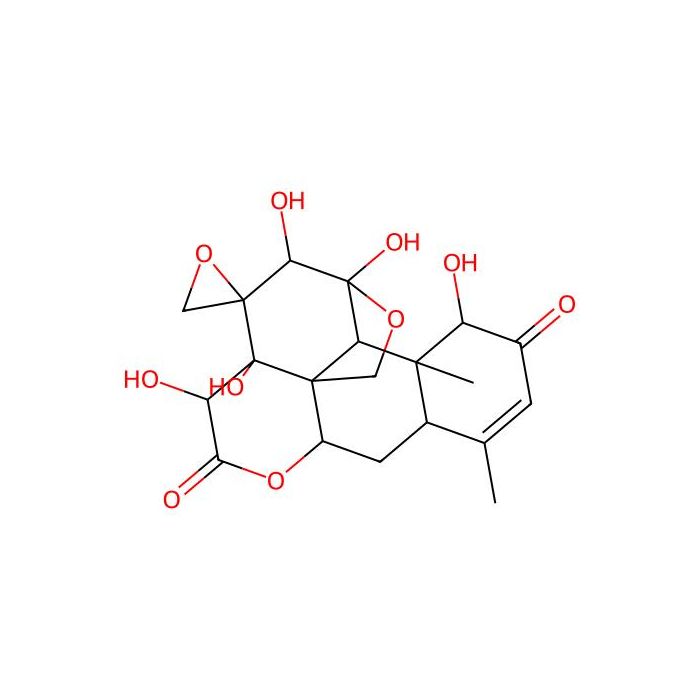
This compound belongs to the class of organic compounds known as quassinoids. These are a group of compounds chemically degraded from triterpenes. According to their basic skeleton, quassinoids are categorized into five distinct groups, C-18, C-19, C-20, C-22 and C-25 types. The C-20 quassinoids can be further classified into two types, tetracyclic and the pentacyclic. The tetracyclic variety does not have oxygenation at C-20, while the pentacyclic quassinoids possess additional oxygenation at C-20 that allows for the formation of an additional ring.
External Descriptors
Not available
1. Djoumbou Feunang Y, Eisner R, Knox C, Chepelev L, Hastings J, Owen G, Fahy E, Steinbeck C, Subramanian S, Bolton E, Greiner R, and Wishart DS. ClassyFire: Automated Chemical Classification With A Comprehensive, Computable Taxonomy. Journal of Cheminformatics, 2016, 8:61.
Certificati (CoA, COO, BSE/TSE e tabella di analisi)
C of A & Other Certificates(BSE/TSE, COO):
Analytical Chart:
Proprietà chimiche e fisiche
Solubilità
DMSO : 100 mg/mL (235.63 mM; Need ultrasonic)
Calcolatori di soluzioni
Molarity Calculator
Determine the necessary mass, volume, or concentration for preparing a solution.
Dilution Calculator
Determine the dilution needed to prepare a stock solution.
Reconstitution Calculator
Recensioni
Recensioni dei clienti
Application Protocols
No tested application protocols are specified for this item. The following general practices are commonly used for small-molecule library members in biological assays.
Stock preparation (general): Dissolve in anhydrous DMSO to prepare 10–50 mM stocks. Vortex and, if necessary, sonicate briefly. Filter only after dilution to avoid adsorption losses.
Serial dilution: Use low-bind polypropylene plates or tubes; pre-wet tips to minimize adsorption. Prepare fresh working dilutions immediately before use.
Stability checks: Confirm chemical integrity by LC-MS after typical assay exposure times and under assay lighting to assess photosensitivity.
Controls: Include vehicle controls matching the highest DMSO percentage; include positive controls for the assay modality and negative controls for background.
For analytical workflows:
HPLC methods: Start with C18 reverse-phase, water–acetonitrile with 0.1% formic acid, 5–95% gradient over 15–20 min; adjust based on observed retention. Detect by UV and MS.
Always adapt protocols to your institutional SOPs and verify compatibility with your biological system.
Biological Roles
Item-specific biological data are not provided in this listing and no medical/clinical claims are made. The following context is general and should be verified from primary literature for Pasakbumin B specifically.
Origin (literature, general): Pasakbumins are reported constituents of Eurycoma longifolia (a plant source of diverse secondary metabolites). Pasakbumin B is studied as a defined small molecule for research use.
Role in source organism: As with many plant secondary metabolites, such molecules may function in chemical defense, signaling, or ecological interactions (literature, general). Specific biosynthetic pathway assignments for Pasakbumin B should be confirmed from authoritative sources.
Research relevance: Natural products like Pasakbumin B are often included in discovery libraries to probe cellular pathways, enzyme function, and stress responses in model systems. Any observed bioactivity should be independently validated and characterized for off-target effects.
Practical guidance:
For cell-based work, define solvent carryover and confirm compound stability in culture media over the exposure period.
Include appropriate vehicle controls and, where possible, use orthogonal assays to confirm that readouts are not driven by assay interference (fluorescence quenching, redox cycling, aggregation).
Buffer Applications
Pasakbumin B is not a buffering agent and is not typically used to prepare biochemical buffers. If the compound is dosed into buffered systems for assays, select the buffer based on the biology of the assay rather than on this molecule.
Practical notes (general):
Common assay buffers: PBS, HEPES, Tris, or acetate buffers depending on pH requirements. Ensure compatibility of the buffer with the compound’s solubility (consider 0.1–1% DMSO cosolvent if needed).
Filtration: If sterile conditions are required, filter the final diluted solution through 0.22 µm PTFE or PVDF (check adsorption losses) rather than attempting to filter concentrated DMSO stocks.
Green Alternatives
As a small-molecule analyte rather than a process solvent or reagent, “green alternatives” pertain mainly to solvent choices for dissolution, purification, and analysis. No item-specific requirements are provided.
Greener solvent considerations (general):
Prefer bio-based or lower-toxicity solvents where feasible for workup and chromatography.
Comparison (general guidance):
DMSO (benchmark) vs 2-methyltetrahydrofuran (2-MeTHF): DMSO is common for assay stocks but is challenging to remove; 2-MeTHF is a greener extraction/elution solvent with lower toxicity and good safety profile, though less suitable as an assay cosolvent.
Acetonitrile vs ethanol: ACN offers strong elution power for LC and HPLC-UV transparency; ethanol is a greener alternative for prep chromatography but may reduce resolution or require longer gradients.
Supercritical CO2 (SFC): For chiral or normal-phase separations, SFC reduces organic solvent consumption relative to traditional normal phase.
Operational tips:
Minimize stock solution volumes; prepare only what is needed for near-term assays to reduce waste from limited stability.
Use aqueous-compatible reverse-phase methods to reduce chlorinated solvent use in purification where possible.
Pharmaceutical Uses
This product is supplied strictly for research use only. No medical, diagnostic, or therapeutic uses are claimed or supported.
As a reference standard or tool compound, it may be formulated into laboratory dosing vehicles for in vitro assays (e.g., DMSO stocks) or exploratory non-GLP studies where permitted by institutional policies. Any in vivo use must follow institutional approvals and local regulations; the supplier does not endorse clinical use.
Excipients for research vehicles: aqueous buffers with cosolvent (DMSO/PEG-400/ethanol) and surfactants (e.g., 0.5–1% Tween-80) may improve apparent solubility; confirm that excipients do not confound readouts.
Regulatory status: Not specified for this item; no pharmacopeial monograph is indicated. Consult the CoA/SDS for any statements on residual solvents or elemental impurities if your quality system requires them.
Physical Properties
Item-specific physicochemical properties are not supplied in this listing.
Appearance: Not specified for this item; refer to CoA/Spec Sheet.
Melting point: Not specified for this item; refer to CoA/Spec Sheet.
Boiling point: Not applicable/unknown for a complex natural product; typically decomposes before boiling (general, literature).
Density: Not specified for this item; refer to CoA/Spec Sheet.
Solubility: Not specified for this item. General guidance for similar natural products: often sparingly soluble in water; soluble in polar aprotic organics (DMSO, DMF) and alcohols (MeOH, EtOH). Confirm experimentally.
logP/logD: Not specified for this item; refer to literature or compute from a verified structure.
pKa: Not specified for this item; may possess weakly acidic/basic functions depending on structure (general).
UV-Vis: Not specified for this item. Many plant metabolites have UV chromophores enabling HPLC-UV detection; determine λmax empirically after structure confirmation.
Stability: Not specified for this item. Given the storage guidance, protect from light and heat; many natural products are photosensitive or undergo slow oxidation (general).
Practical tips (general):
Prepare small test solutions (1–5 mg/mL) in dry DMSO, MeOH, and acetonitrile to evaluate solubility; sonication and gentle warming (≤40 °C) can assist dissolution.
Assess stability by LC-MS over 24–72 h at room temperature and 4 °C in intended solvent to select handling conditions for assays or stock solutions.
Quality and Grades
Grade/Purity: Not specified for this item; refer to CoA/Spec Sheet for assay method (e.g., HPLC area %), residual solvents, and water content if measured.
Interpretation and implications (general guidance):
Research grade natural products are typically qualified by HPLC purity (UV or CAD) and identity by NMR and/or MS. Verify whether purity is UV-based (may overestimate if chromophore differs) and confirm with orthogonal detection where critical.
If an inhibitor/screening library member, low UV background and defined counter-ions are desirable; check for form (free base, salt, hydrate/solvate) on the CoA.
Stabilizers: None specified for this item. If stabilizers or antioxidants are present in other lots, they can influence bioassays and should be disclosed in methods.
Lot-to-lot variation: Plant-derived materials can exhibit subtle impurity profiles. Retain representative chromatograms and spectra for your records.
Documentation to request/consult:
CoA with purity, analytical method, and acceptance criteria.
NMR (1H/13C), HRMS, and HPLC trace where available.
Water and residual solvent content if relevant to your application.
Reaction and Applications
This product is primarily positioned as a member of a small-molecule/compound library for research screening (Product Data category). It is not typically used as a synthetic reagent per se.
Research applications (general, non-clinical):
Tool compound in phenotypic or target-based screening panels to probe biological pathways in cell or biochemical assays.
Reference standard in natural product profiling, dereplication, or LC-MS method development for plant extracts when Pasakbumin B is relevant.
SAR starting point: Derivatization of natural products can be explored to map structure–activity relationships; see Synthetic Utility for general strategies.
Analytical tips:
Establish a robust LC-MS method with dual-wavelength UV and full-scan MS to monitor stability during assay incubation.
Evaluate adsorption losses in plasticware; pre-rinse with solvent or use low-bind plates if recovery is poor.
Not typically applicable:
Named-reaction participation or reagent roles (e.g., coupling agent, catalyst) are not standard for this class; any semisynthetic transformations should be designed case-by-case once the exact functional groups are confirmed from the CoA/literature.
Reaction Conditions
No specific reaction conditions apply, as Pasakbumin B is offered as a small-molecule library member rather than as a reagent. If semisynthetic modifications are pursued after confirming the exact structure, conditions must be tailored to the functional groups present.
General condition guidelines for natural-product derivatization (non-item-specific):
Mild acylation/carbamate formation: use acyl chlorides or carbamoyl chlorides with base (e.g., DIPEA) in DCM/THF at 0–25 °C; monitor to avoid overacylation.
Etherification: Mitsunobu or Williamson conditions, chosen based on substrate stability; avoid strong base if sensitive stereocenters are present.
Selective oxidation: TEMPO/bleach for primary alcohols; Dess–Martin periodinane for secondary alcohols; protect acid/base-sensitive motifs.
Hydrogenation: Pd/C under H2 at ambient pressure for alkene/arene reductions if compatible; test on milligram scale first.
Always verify reaction outcomes by LC-MS and 1D/2D NMR. Because complex scaffolds can rearrange, run controls and consider low-temperature, anhydrous conditions to preserve stereochemistry.
Safety and Handling
Hazard classification is not provided for this item; handle as a potentially hazardous laboratory chemical.
GHS classification: Not specified for this item; refer to SDS.
Signal word/H-statements/Pictograms: Not specified for this item; refer to SDS.
General precautions (not item-specific):
Use in a chemical fume hood; avoid inhalation of powders and aerosols.
PPE: lab coat, safety glasses, and appropriate chemical-resistant gloves (e.g., nitrile). For weighing fine powders, consider a particulate mask or balance enclosure.
Incompatibilities: Avoid strong oxidizers, strong acids/bases until compatibility is known. Protect from light per Product Data.
First aid (general): If inhaled—fresh air; if on skin—wash with soap/water; if in eyes—rinse with water for several minutes; if ingested—rinse mouth. Seek medical attention in all cases. Defer to SDS for authoritative instructions.
Hygiene: Prevent environmental release; collect waste in halogen-free organic waste unless directed otherwise by SDS.
Analytical verification: Because natural products can degrade, confirm identity and purity by HPLC/LC-MS before critical experiments.
Special risks (general):
Photosensitivity/oxidation: Store and handle under low light, inert headspace if possible.
Unknown toxicology: Treat as bioactive; avoid skin contact and ingestion. For cell-based assays, prepare solutions aseptically and filter if appropriate.
Solvent Selection
No item-specific solvent data are supplied. The following is general guidance for dissolving hydrophobic natural products for screening and analytical use.
Primary stock solvent: Anhydrous DMSO is typically preferred for small-molecule screening stocks due to high solvating power and assay compatibility up to 0.1–1% v/v. Verify solubility empirically.
Alternative solvents: MeOH, EtOH, acetonitrile, and DMF can be effective. For NMR, CDCl3, DMSO-d6, CD3OD, or acetone-d6 are common choices depending on polarity.
Aqueous use: Prepare concentrated DMSO stocks (e.g., 10–50 mM) and dilute into buffered media with vigorous mixing to avoid precipitation. Keep final DMSO below assay tolerances.
Cosolvent systems: If precipitation occurs on dilution, use cosolvent mixes (e.g., 5–20% ACN or MeOH in buffer) or add solubilizing excipients (1–5% PEG-400, 0.1–1% Tween-80) where assay-compatible.
Comparison notes (general):
DMSO vs DMF: DMSO is less volatile and more biocompatible; DMF can be harder to remove and is less favored in bioassays.
MeOH/EtOH: Easier to evaporate for sample prep, but lower solvating power for highly lipophilic compounds. Consider gentle heating to assist dissolution.
Avoid chlorinated solvents for biological assays; reserve for analytical or synthetic operations if necessary.
Storage and Reconstitution
Item-specific conditions (Product Data):
Storage: Protect from light; store at −80 °C.
Shipping: Dry ice packs + cold packs.
General handling guidance:
On receipt, keep sealed and frozen at −80 °C. Allow the container to equilibrate to room temperature in a desiccator before opening to prevent condensation on the solid.
Working aliquots: If repeated use is anticipated, subdivide into single-use aliquots under dry, inert atmosphere (e.g., nitrogen glove box or with dry nitrogen backfill) to minimize freeze–thaw and moisture/light exposure.
Reconstitution: Not specified for this item. Typical practice is to dissolve in anhydrous DMSO to prepare a concentrated stock (e.g., 10–50 mM). Record the exact concentration gravimetrically or by quantitative NMR if high accuracy is required.
Short-term stability: Not specified for this item; verify by LC-MS/HPLC after 24–72 h at 4 °C and room temperature in the intended solvent.
Long-term storage of solutions: Store frozen (≤−20 °C) in amber vials with minimal headspace. Avoid multiple freeze–thaw cycles; discard if precipitation, discoloration, or new peaks by HPLC are observed.
Disposal: Follow your institution’s chemical waste procedures; collect solutions in appropriate organic waste streams.
Structure and Identity
Pasakbumin B is a small-molecule natural product commonly cataloged in screening libraries. Item-specific structural identifiers in this listing are limited.
CAS: 138809-10-6 (Product Data)
PubChem CID: 13936703 (Product Data)
InChIKey: 224167 (Product Data)
SMILES: Not specified for this item; refer to CoA/Spec Sheet.
Molecular formula: Not specified for this item; refer to CoA/Spec Sheet.
Molecular weight: Not specified for this item; refer to CoA/Spec Sheet.
Structural features (general, literature):
Pasakbumins are reported as plant-derived small molecules isolated from Eurycoma longifolia. Specific ring systems/functional groups for Pasakbumin B should be verified against primary literature or the CoA for this lot.
As with many plant secondary metabolites, stereochemistry and multiple oxygenated or heteroatom-bearing centers may be present (literature, general). Verify stereochemical descriptors before use in structure–activity or analytical work.
2D structure description (general guidance):
Without a provided SMILES or structure file, depict using a published reference or supplier-provided structure. Confirm atom numbering and stereocenters prior to NMR assignment or derivatization.
Traceability:
For publication or regulatory documentation, cite CAS 138809-10-6 and cross-check the full InChIKey and exact molecular formula from the CoA/Spec Sheet for this specific item/lot.
Synthetic Utility
Pasakbumin B, as a defined natural product, is generally used as an analyte or tool compound rather than as a reagent. Without a verified structure in this listing, specific transformations cannot be prescribed. The following is general guidance for semisynthesis once functional groups are known from the CoA/literature.
Derivatization strategies (general):
Protection/deprotection of hydroxyls (if present) to enable selective acylation, carbamation, or etherification.
Oxidation/reduction at allylic/benzylic positions to tune polarity and stability.
Formation of prodrugs (e.g., carbonate/ester masks) for solubility enhancement in research settings.
Analytical enablement:
Generate a small panel of derivatives with UV-active or MS-friendly tags to aid in bioanalytical quantitation if the parent has weak response.
Retrosynthetic perspective:
Complex natural products may be accessed by semisynthesis from abundant congeners or via fragment coupling; however, such routes are highly structure-dependent and beyond scope without confirmed functional group mapping.
Recommendation: Obtain or confirm a curated structure (SMILES/InChI) for Pasakbumin B prior to planning any chemical modifications to ensure regio- and stereochemical fidelity.
Target Specificity
No target specificity data are provided for this product. There are no item-specific claims regarding molecular targets, binding partners, or selectivity.
Guidance for users (general):
If using Pasakbumin B in screening, perform counter-screens against common assay interference mechanisms (redox activity, PAINS motifs, aggregation) and test off-target panels relevant to your pathway of interest.
Report full assay conditions and compound provenance (CAS 138809-10-6, supplier SKU P646963, lot number) to ensure reproducibility.
Domande frequenti
What is the purity of this product?
This product is supplied at ≥98% purity (chemical assay). Lot-specific values are stated on the Certificate of Analysis.
How should this product be stored?
Store at ?80 °C, protected from light. The material is light-sensitive — keep it in its original opaque or amber container.
How is this product shipped?
This product ships frozen with dry ice and cold packs. Unpack on arrival and transfer it to the storage condition stated above; handle dry ice with insulated gloves in a ventilated area.
What are the CAS number, molecular formula and molecular weight?
The CAS Number is 138809-10-6, the molecular formula is C20H24O10, and the molecular weight is 424.40 g/mol. InChIKey MOCOVNGOINOTNW-NURDAXFGSA-N.
What documentation is provided?
Available product documentation, including Certificates of Analysis (COA), Safety Data Sheets (SDS), and specification sheets, is shown in the product document area. Document availability and access follow the current site policy.
Utilizziamo i cookie per garantire il corretto funzionamento del sito web e, ove consentito, per migliorare la tua esperienza. Puoi gestire le tue preferenze in qualsiasi momento nelle Impostazioni. Per saperne di più, consulta la nostra Cookie Policy.
Desidera che le inviamo un messaggio quando avremo sconti disponibili?
Ricordamelo più tardi
Grazie! Controlli la sua casella di posta per confermare.
Products are supplied to verified businesses, institutions, and qualified professionals for research and development use only. Not for use in humans, animals, diagnosis, or therapy.