This compound belongs to the class of organic compounds known as iodobenzenes. These are aromatic compounds containing one or more iodine atoms attached to a benzene.
External Descriptors
Not available
1. Djoumbou Feunang Y, Eisner R, Knox C, Chepelev L, Hastings J, Owen G, Fahy E, Steinbeck C, Subramanian S, Bolton E, Greiner R, and Wishart DS. ClassyFire: Automated Chemical Classification With A Comprehensive, Computable Taxonomy. Journal of Cheminformatics, 2016, 8:61.
Determine the necessary mass, volume, or concentration for preparing a solution.
Dilution Calculator
Determine the dilution needed to prepare a stock solution.
Reconstitution Calculator
Recensioni
Recensioni dei clienti
Application Protocols
Not applicable. No tested bioassay protocols (WB, IHC, IF, FC) or kit-style procedures are associated with this small-molecule reagent. For practical use, refer to the Reaction & Applications and Reaction Conditions sections for synthetic protocols and setup guidance.
Biological Roles
This product is a synthetic, highly hydrophobic aryl iodide and is not a biological metabolite or buffer component.
General context (not item-specific):
Aryl iodides are occasionally used as heavy-atom probes in structural biology (e.g., to enhance X-ray scattering) and as photoaffinity or radical precursors in chemical biology tool development. Pentamethyliodobenzene’s extreme steric bulk and hydrophobicity limit aqueous compatibility but could be leveraged in membrane-mimetic or protein-binding hydrophobic pockets in method development.
The iodine substituent provides a strong anomalous scattering center; however, practical use in biological macromolecules typically relies on iodinated amino acids or nucleotides rather than bulky pentasubstituted arenes.
No endogenous role: Pentamethyliodobenzene does not participate in known metabolic pathways and has no natural biological function.
Note: For research use only, as stated in Product Data. Avoid any in vivo or clinical applications.
Buffer Applications
Not typically applicable. Pentamethyliodobenzene is a nonpolar, water-insoluble aryl iodide and is not used to prepare aqueous buffer systems or for pH control. For relevant information, see Reaction & Applications and Synthetic Utility sections for its role as an electrophile in organic synthesis.
Green Alternatives
Context: As an aryl iodide, Pentamethyliodobenzene is a high-reactivity electrophile but iodine sourcing and halogenated waste present sustainability concerns. Greener choices focus on solvent selection, alternative electrophiles, or catalytic methods that lower energy and waste.
Greener options and trade-offs (general)
Solvent substitution:
Replace chlorinated solvents with 2-MeTHF, CPME, or toluene where compatible. These offer lower toxicity and improved lifecycle metrics while supporting Pd-catalyzed couplings.
Use aqueous-organic Suzuki couplings (toluene/EtOH/H2O or PEG/H2O) to reduce organic solvent load; phase-transfer or micellar catalysis can further lower solvent usage.
Electrophile choice:
Aryl bromides or triflates may be viable and reduce iodine-specific waste; however, aryl iodides typically react under milder conditions, potentially lowering energy input. For highly hindered systems, the iodide may still be the most efficient choice.
Catalysis improvements:
Employ highly active Pd precatalysts (e.g., Buchwald-type) or Ni catalysis to cut catalyst loadings and temperatures. Consider heterogeneous Pd/C for certain transformations to facilitate catalyst recovery.
Illustrative comparison (general)
Aryl iodide in toluene (80–120°C): High reactivity; halogenated waste from iodide byproducts.
Aryl iodide in 2-MeTHF (60–90°C): Similar performance in many couplings; better solvent sustainability profile.
Aryl bromide in 2-MeTHF (90–120°C): Avoids iodine but may require higher temperature/ligand loadings, impacting energy use.
Recommendation: Prioritize greener solvents and aqueous media where feasible; balance reactivity benefits of iodide vs waste and cost.
Pharmaceutical Uses
Formulation/excipient status
Not a common excipient or pharmacopeial buffer component.
Research/manufacturing context (general)
Serves as a hindered aryl electrophile for assembling highly substituted aromatic motifs in medicinal chemistry SAR campaigns and process route scouting.
The iodine substituent enables late-stage diversification via Pd/Ni-catalyzed couplings to access libraries of pentamethylphenyl derivatives that modulate lipophilicity and metabolic stability.
The heavy atom can aid in crystallographic phasing for small-molecule structure determination during lead characterization.
Compliance note
No therapeutic or clinical claims are made. For research use only, as specified in Product Data. Any cGMP or regulatory suitability must be established with lot-specific documentation (CoA, residual solvents, elemental impurities) and internal validation.
Physical Properties
Item-specific specifications
Boiling point: Not specified for this item; refer to CoA/Spec Sheet.
Melting point: Not specified for this item; refer to CoA/Spec Sheet.
Density: Not specified for this item; refer to CoA/Spec Sheet.
Refractive index: Not specified for this item; refer to CoA/Spec Sheet.
Water, peroxide, metal content, UV cutoff: Not specified for this item; refer to CoA/Spec Sheet.
General/literature expectations for pentasubstituted aryl iodides (for context only)
Physical state: typically crystalline solids or low-melting solids (literature, qualitative).
Solubility: low solubility in water; good solubility in nonpolar and moderately polar organic solvents (e.g., toluene, chlorinated solvents, ethers, aromatics) owing to hydrophobic aryl and multiple methyl substituents (general knowledge).
Partitioning: expected high logP due to heavy halogen and multiple alkyl groups (general trend; confirm experimentally if relevant).
Thermal behavior: aryl C–I bonds are weaker than C–Br/C–Cl and may undergo homolysis at elevated temperatures or under radical conditions; avoid unnecessary overheating (general safety/handling consideration, not a product spec).
Notes
For quantitative property values required for process design or analytical method development, consult the Certificate of Analysis or request measured data for the specific lot.
Quality and Grades
Item-specific
Grade/Purity: Not specified for this item; refer to CoA/Spec Sheet.
Appearance: Not specified for this item; refer to CoA/Spec Sheet.
General notes on quality for aryl iodide electrophiles
Purity considerations: Trace iodide salts, inorganic iodine, or partially deiodinated/aromatized byproducts can inhibit cross-coupling catalysis. High purity and low metal contamination are beneficial for reproducible reactivity.
Stabilization: No stabilizer is typically required for solid aryl iodides, but protection from light (as specified) helps mitigate slow photolysis. If prolonged storage is expected, consider aliquoting under inert gas to reduce adventitious oxidation.
Chromatographic performance: If used as a reference or starting material in analytical workflows, low UV background and single-spot TLC behavior are desirable; confirm via CoA.
Documentation: The lot-specific CoA typically includes assay (%), residual solvents, and impurity profile (e.g., related aryl halides). Always use the item-specific CoA/Spec Sheet for method validation, especially for regulated environments.
Reaction and Applications
Pentamethyliodobenzene is a sterically hindered, electron-rich aryl iodide. The C–I bond undergoes rapid oxidative addition relative to aryl bromides/chlorides, but the flanking methyl groups impose substantial steric demands that influence catalyst/ligand choice.
Suzuki–Miyaura: Formation of pentamethylphenyl–C(sp2/sp3) bonds using aryl/alkenyl/benzyl boron reagents. Bulky biaryl phosphines (e.g., SPhos, XPhos, tBuXPhos) often improve rates for hindered substrates.
Sonogashira: Coupling with terminal alkynes; copper-free conditions with bulky Pd–phosphine systems mitigate side reactions and accommodate steric congestion.
Buchwald–Hartwig amination/etherification: C–N and C–O bond formation to generate hindered anilines/aryl ethers; strong bases and electron-rich bulky ligands are typically required.
Negishi/Kumada: Possible after preformation of the organozinc/magnesium reagent; sterics can limit rates—optimize catalyst system accordingly.
Halogen–metal exchange: Conversion to pentamethylphenyl lithium/magnesium reagents at low temperature (e.g., with t-BuLi or i-PrMgCl·LiCl), enabling access to aldehydes, ketones, alcohols, and boronates via trapping.
Borylation/iodine–boron exchange: Synthesis of pentamethylphenyl boronic esters via Pd-catalyzed borylation or direct halogen–boron exchange using B2pin2 under suitable catalysis.
Radical chemistry: Iodine-atom transfer or photoredox-mediated aryl radical generation; steric hindrance may bias towards selective bond formations or limit addition to crowded π-systems.
Practical tips
Use dry, deoxygenated solvents and an inert atmosphere (N2/Ar).
Favor robust, bulky ligands and higher temperatures to overcome steric encumbrance.
Monitor for protodeiodination under strongly basic or reductive conditions.
Reaction Conditions
General literature guidance for sterically hindered aryl iodides (adjust per substrate and scale)
Suzuki–Miyaura coupling:
Catalyst/ligand: Pd2(dba)3 (0.5–1 mol% Pd) with SPhos/XPhos/tBuXPhos (1–2 mol%) or precatalysts (e.g., XPhos Pd G3).
Base: K3PO4, K2CO3, Cs2CO3; aqueous-organic mixtures often beneficial.
Solvent: Toluene, dioxane, 2-MeTHF, or toluene/EtOH/H2O.
Temperature/time: 60–110°C, 2–16 h. Hindered systems may require the upper range.
Buchwald–Hartwig amination:
Catalyst/ligand: Pd(OAc)2 or Pd2(dba)3 with BrettPhos/BippyPhos/AlPhos-class ligands.
Base: NaOtBu, KOtBu, Cs2CO3.
Solvent: Toluene, tAmOH, dioxane.
Temperature: 80–120°C; extended times for highly hindered amines/phenoxides.
Sonogashira (copper-free recommended):
Catalyst: Pd(PtBu3)2 or Pd2(dba)3/PtBu3.
Base: Et3N, i-Pr2NEt, or carbonate.
Solvent: THF, toluene, DMAc.
Temperature: RT–80°C (often 40–80°C for sterically congested substrates).
Halogen–metal exchange:
Reagent: t-BuLi (−78 to −40°C) or i-PrMgCl·LiCl (−20 to 25°C, turbo-Grignard).
Solvent: Dry THF or 2-MeTHF, strictly anhydrous, inert atmosphere.
Notes
Degas solvents (freeze–pump–thaw or sparge) and maintain rigorously anhydrous conditions.
Monitor for protodehalogenation and homocoupling; adjust ligand, base, and temperature accordingly.
Reported yields vary widely with coupling partner and conditions; perform small-scale screens to optimize.
Safety and Handling
Item-specific (Product Data)
Storage conditions: Store at 2–8°C, protected from light.
Shipping: Shipped on wet ice.
GHS/Signal Word/H-statements/Pictograms: Not specified for this item; refer to SDS.
General safety guidance for aryl iodides and highly substituted aromatics (defer to SDS for authoritative data)
Hazards: Aryl iodides may cause skin/eye irritation and are harmful if swallowed or inhaled (general). Handle in a fume hood to avoid inhalation of dust/particles.
Light sensitivity: Protection from light is recommended to minimize potential photolysis of the C–I bond and maintain material integrity.
PPE: Use lab coat, safety glasses, and suitable chemically resistant gloves (e.g., nitrile). Avoid skin contact; wash thoroughly after handling.
Incompatibilities: Strong oxidizing agents (risk of exothermic reaction); strong reducing metals in the presence of activators (risk of halogen–metal exchange); radical initiators and UV can promote homolysis of C–I.
Handling: Minimize exposure to air and moisture when material will be used in metal-catalyzed couplings; store under inert atmosphere if possible for long-term stability. Avoid grinding vigorously to limit dust generation.
First aid (overview): If inhaled, move to fresh air; if on skin, wash with soap and water; if in eyes, rinse cautiously with water for several minutes; if ingested, rinse mouth—seek medical attention in all cases. Consult SDS for full instructions.
Waste: Dispose of halogenated organic waste in accordance with institutional and regulatory guidelines.
Solvent Selection
Compound class and polarity (general)
Class: Highly substituted aryl iodide; nonpolar to weakly polar, hydrophobic.
Miscibility/solubility (general): Poorly soluble in water; soluble in aromatic solvents (toluene, xylene), chlorinated solvents (DCM, chloroform), and many ethers (THF, MTBE). Solubility in acetonitrile or DMF is typically moderate; verify experimentally.
Selection guidance by application
Cross-coupling (Suzuki, Sonogashira, Buchwald–Hartwig): Toluene, dioxane, THF, CPME, or mixed toluene/EtOH/H2O systems are commonly used. The steric bulk of pentamethyl substitution may favor higher-boiling, less coordinating aromatics (toluene, mesitylene) that support elevated temperatures.
Halogen–metal exchange or lithiation: Ethers (THF, 2-MeTHF) at low temperatures under inert atmosphere; ensure rigorous dryness.
Radical transformations or photochemistry: Deaerated, nonprotic solvents (toluene, MeCN) with efficient light shielding during handling to minimize undesired side reactions.
Quick comparison (general trends)
Toluene: Good solubility, thermal stability for high-T couplings.
1,4-Dioxane/THF/2-MeTHF: Better for polar catalysts/bases; THF/2-MeTHF enable low-temperature organometallic steps.
DMF/DMSO: Maximize catalyst/ligand solubility but may over-coordinate; consider only if needed.
Note: Always confirm solubility and catalyst compatibility on small scale before process optimization.
Storage and Reconstitution
Item-specific (Product Data)
Storage: Store at 2–8°C, protected from light.
Shipping: Shipped on wet ice.
General guidance for handling solid aryl iodides
Container: Keep in tightly closed, light-resistant (amber) glass vials to minimize photodegradation of the C–I bond.
Atmosphere: For extended storage, consider inert gas blanket (N2/Ar) and desiccation to limit oxidative or moisture-related degradation, especially if frequent opening is expected.
Reconstitution/solution prep: Dissolve in suitable dry organic solvents (e.g., toluene, THF, 2-MeTHF, DCM) immediately before use. Filter if particulate matter is present. Prepare stock solutions under inert atmosphere for air/moisture-sensitive transformations and store cold, protected from light.
Freeze–thaw: If storing solutions, aliquot to avoid repeated freeze–thaw cycles; many aryl iodides are stable for days to weeks at 2–8°C in the dark, but verify by TLC/LC.
Note
Always consult the lot-specific CoA and SDS for definitive storage stability and handling recommendations.
Research use only, as stated in Product Data.
Structure and Identity
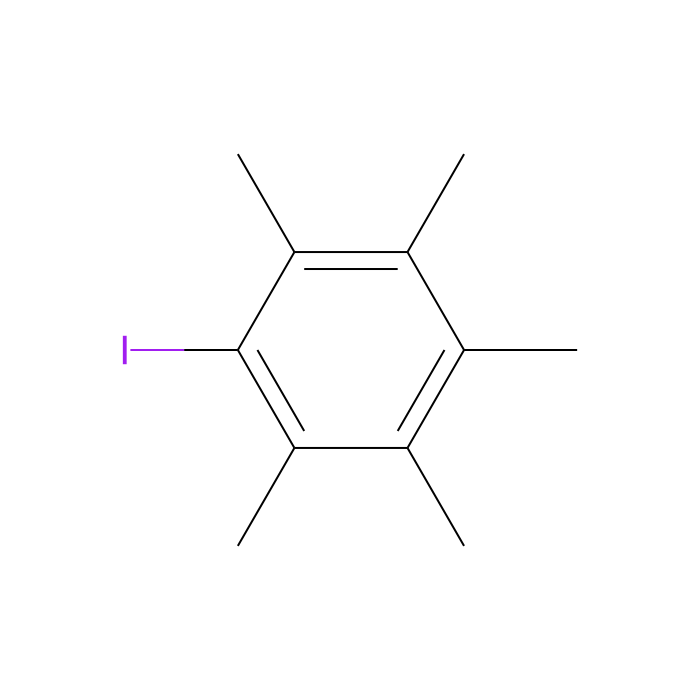
Pentamethyliodobenzene is a hexasubstituted arene bearing five methyl groups and one iodine on the benzene ring, making it a highly hindered aryl iodide electrophile.
Item-specific identifiers (Product Data)
SKU: P193126
CAS: 3853-91-6
PubChem CID: 77461
InChIKey: 371582 (as provided)
Literature/computed identifiers and descriptors
Molecular formula: C11H15I (literature/computed from structure)
SMILES: Ic1c(C)c(C)c(C)c(C)c1C (literature; one of several equivalent tautomers for ring substitution pattern)
Structural features: benzene ring fully substituted (no ring hydrogens); five electron-donating methyl groups (strong +I effect) and one iodo substituent (good leaving group in cross-coupling; heavy atom for X-ray contrast in crystallography).
2D structure described in words (general)
A planar benzene core in which all six ring positions are substituted: five positions carry methyl groups; the remaining position bears iodine. The distribution of five methyls around the ring renders the aryl iodide center extremely sterically encumbered and strongly electron-rich relative to unsubstituted iodobenzene.
Synthetic Utility
Functional group and reactivity profile (general)
Key handle: aryl iodide (excellent leaving group; low bond dissociation energy among aryl halides).
Electronic/steric properties: Five methyl substituents strongly donate electron density (+I) and create severe steric hindrance at the ipso carbon, influencing oxidative addition and favoring catalysts/ligands tailored to congested substrates.
Transformations enabled
C–C bond formation: Suzuki–Miyaura, Negishi, Kumada, and Stille couplings furnish biaryls, alkenyl- and alkyl-aryl motifs bearing the pentamethylphenyl group.
C–N/O/S bond formation: Buchwald–Hartwig amination and etherification; Ullmann-type couplings are generally disfavored due to sterics but can proceed with modern ligands or nanoparticulate catalysts.
Halogen–metal exchange: Generation of pentamethylphenyllithium or Grignard reagents for addition to carbonyls, carboxylation (to acids), and trapping with B, Si, or P electrophiles.
Radical pathways: Photoredox or ATRA-type chemistry using the C–I bond as a radical precursor for selective bond constructions.
Strategic notes
The pentamethylphenyl (PhMe5) group can serve as a bulky aryl cap to block sites, tune conformations, or protect reactive centers during multistep synthesis; its removal typically requires oxidative or reductive strategies planned in advance.
For retrosynthesis, the iodide enables convergent late-stage diversification from a common advanced intermediate.
Target Specificity
Not applicable. This product is a small-molecule aryl iodide, not a biological targeting reagent (e.g., antibody, inhibitor with defined biological target) in this catalog context. No antigen/epitope, species reactivity, clone, or isotype information applies.
We use cookies to ensure the website functions properly and, where permitted, to improve your experience. You can manage your preferences at any time in Settings. Learn more in our Cookie Policy.
Shall we send you a message when we have discounts available?
Remind me later
Thank you! Please check your email inbox to confirm.
Products are supplied to verified businesses, institutions, and qualified professionals for research and development use only. Not for use in humans, animals, diagnosis, or therapy.

 E2612369