This compound belongs to the class of organic compounds known as acyl fluorides. These are organic compounds containing the functional group -CO-F.
External Descriptors
Not available
1. Djoumbou Feunang Y, Eisner R, Knox C, Chepelev L, Hastings J, Owen G, Fahy E, Steinbeck C, Subramanian S, Bolton E, Greiner R, and Wishart DS. ClassyFire: Automated Chemical Classification With A Comprehensive, Computable Taxonomy. Journal of Cheminformatics, 2016, 8:61.
Determine the necessary mass, volume, or concentration for preparing a solution.
Dilution Calculator
Determine the dilution needed to prepare a stock solution.
Reconstitution Calculator
Recensioni
Recensioni dei clienti
Application Protocols
No manufacturer-validated bioassay protocols are provided for this reagent. Typical laboratory protocols relate to moisture-free acylation reactions:
Example outline (literature, non-validated):
Dry glassware and solvents; assemble under inert gas.
Charge nucleophile (amine/alcohol) and non-nucleophilic base in anhydrous solvent; cool if needed.
Add perfluorooctanoyl fluoride dropwise; maintain temperature and stir to completion (monitor by TLC/IR/19F NMR).
Quench cautiously; neutralize HF; isolate product by extraction/fluorous separation and purify.
For any application-specific SOPs, consult peer-reviewed procedures and adapt to your scale and safety infrastructure.
Biological Roles
This compound is a synthetic perfluoroacyl fluoride and has no known endogenous biological role.
General context (literature; not product-specific):
Perfluoroalkyl moieties confer extreme hydrophobicity/oleophobicity and chemical stability; these features are exploited in materials and surface science but do not correspond to natural metabolic functions.
Hydrolysis yields perfluorooctanoic acid (PFOA), a persistent environmental contaminant; interactions with biological systems are largely discussed in environmental toxicology rather than biochemistry.
Laboratory relevance:
Occasionally used to prepare perfluoroalkylated probes or surface modifiers for studying protein adsorption or membrane interactions in vitro; such applications are materials-focused.
No medical or clinical uses are implied; for research use only.
Buffer Applications
Not typically applicable. Perfluorooctanoyl fluoride is a moisture-sensitive acylating reagent and is incompatible with aqueous buffers due to rapid hydrolysis (releasing HF and perfluorooctanoic acid). For work in aqueous systems, prepare the desired amide/ester derivative first and then formulate that product in appropriate buffers.
Green Alternatives
Considerations for greener chemistry must account for both reagent hazard and lifecycle impacts. Perfluorinated reagents raise persistence concerns (PFAS). Where feasible, evaluate less persistent options.
Why reconsider PFO acylations?
PFAS persistence and bioaccumulation concerns; specialized waste handling often required.
HF generation upon hydrolysis/processing increases corrosion and exposure risks.
Alternative strategies (literature; trade-offs summarized):
| Goal | Alternative approach | Benefits | Trade-offs |
|---|---|---|---|
| Introduce hydrophobic chain without PFAS | Long-chain hydrocarbon acyl chlorides/anhydrides (e.g., stearoyl chloride) | Lower persistence, simpler waste profile | Reduced chemical/thermal stability vs perfluoroalkyl; different surface energy |
| Couple carboxyl without acid halides | Direct coupling of perfluorocarboxylic acids using carbodiimides (EDC/DIC) or CDI | Avoids handling acyl fluoride; milder | Still uses PFAS acid; urea byproducts; sometimes slower |
| Improved solvent profile | 2-MeTHF, CPME in place of DCM/THF | Renewable origin, safer profiles | Must validate reactivity/selectivity; water content control |
| Shorter-chain PFAS | C6 or C4 perfluoroacyl equivalents | Reduced bioaccumulation (relative) | Different performance; still PFAS |
Practical guidance:
If PFO functionality is essential to performance (e.g., fluorophilicity, chemical resistance), minimize scale, optimize atom economy, and implement closed-loop capture/neutralization of HF and fluoride.
Document and segregate PFAS-containing waste; consult local regulations.
Pharmaceutical Uses
No pharmacopeial excipient status or formulation role is specified for this item; refer to CoA/Spec Sheet.
General, non-clinical context (literature):
Perfluoroacyl fluorides may be used as synthetic intermediates to prepare fluorinated amides/esters during early-stage materials or medicinal chemistry research. Any such use remains strictly in-process and not in final dosage forms.
Due to PFAS-related environmental concerns and HF hazards, their use in GMP settings is uncommon and demands strict containment and waste management.
No therapeutic or clinical claims are made; for research and laboratory synthesis only.
Physical Properties
Item-specific specifications: Not specified for this item; refer to CoA/Spec Sheet.
Literature/typical properties (non-spec, for planning only):
Physical state/appearance: typically a colorless, fuming liquid with pungent, acid fluoride odor.
Hydrolytic behavior: hydrolyzes in the presence of moisture to perfluorooctanoic acid (PFOA) and hydrogen fluoride (HF).
Solubility: expected low solubility in water (reacts/hydrolyzes); soluble in nonpolar and moderately polar aprotic media (e.g., halogenated and fluorinated solvents; also compatible with dry ethers/esters under rigorously anhydrous conditions).
Volatility: moderate; use closed, dry systems to minimize fuming and hydrolysis.
Density/refractive index/phase-transition data: commonly reported for analogous perfluoroacyl fluorides to be high density relative to hydrocarbons and low refractive index; exact values for this item are not specified.
Notes for practitioners:
Because hydrolysis releases HF, measured properties can vary with trace moisture and containment; consult primary literature or your in-house characterization immediately prior to critical process design.
Always distinguish planning values from purchase specifications; Aladdin provides CoA values lot-by-lot where available.
Quality and Grades
Item-specific grade/purity: Not specified for this item; refer to CoA/Spec Sheet.
Context for this reagent class:
Acyl fluorides used in synthesis are commonly supplied as neat liquids with moisture control. When grades are specified (e.g., ≥95% GC), they typically indicate assay by GC/19F NMR and limits on hydrolysis products (acid/anhydride) and free fluoride.
UV-Vis background and metal content are generally not critical for this class unless the reagent is used in photochemical or catalytic screening; such limits are rarely standardized and are batch-dependent.
Stabilizers: Perfluoroacyl fluorides are usually shipped without stabilizers; quality is preserved by anhydrous handling and cool storage. If a stabilizer is present, it will be explicitly listed on the CoA.
Practical guidance:
Verify identity and assay by 19F NMR prior to moisture-sensitive couplings; characteristic signals of –COF and terminal CF3 facilitate quick QC.
For exact impurity profiles (PFOA, anhydride, inorganic fluoride), and any water/peroxide/UV-cutoff/metal limits: Not specified for this item; refer to CoA/Spec Sheet.
Reaction and Applications
Perfluorooctanoyl fluoride serves as a versatile electrophile to introduce the perfluorooctanoyl (PFO) group into organic molecules.
Key transformations (literature examples; not item-specific claims):
Amidation: Efficient conversion with primary/secondary amines to perfluorooctanamides. Typical setup uses anhydrous DCM or MeCN, 0–25°C, with Et3N/DIPEA or pyridine to neutralize HF. Catalytic DMAP can accelerate sluggish reactions; avoid excess nucleophile to limit N-acylation side products.
Esterification: Reaction with alcohols under base (Et3N) or catalyst (DMAP) provides perfluorooctanoate esters. Fluorous-tagged esters are useful in phase-switchable catalysis and separations.
Hydrolysis: Controlled quench in ice-water yields perfluorooctanoic acid (PFOA). Note environmental and disposal regulations for PFAS-derived wastes.
Acyl transfer chemistry: Conversion to activated esters (e.g., perfluorooctanoyl imidazole via CDI) can improve coupling to weak nucleophiles or sensitive substrates.
Polymer/surface modification: Grafting of the PFO group onto monomers, resins, or surfaces to impart oleophobicity/hydrophobicity; often proceeded via amide/ester linkages to polymer backbones or surface primers.
Practical tips:
Rigorous dryness is essential; pre-dry glassware and solvents. Add acyl fluoride to nucleophile/base solution to manage exotherm and HF capture.
Monitor by 19F NMR or IR; the acyl fluoride C=O stretch typically appears at higher frequency than corresponding acids/esters.
Quench/neutralize HF and fluoride safely (CaCO3/Ca(OH)2) and segregate PFAS-containing waste per institutional policy.
Reaction Conditions
General literature guidance (not item-specific specifications):
Amidation of perfluorooctanoyl fluoride:
Solvent: dry DCM or MeCN (0.05–0.5 M).
Base: Et3N or DIPEA (1.0–2.0 equiv relative to amine) to neutralize HF.
Temperature: 0–25°C; exotherm controlled by slow addition of acyl fluoride to the amine/base solution.
Catalysts: catalytic DMAP or pyridine can accelerate reactions with hindered amines.
Monitoring: 19F NMR; disappearance of –COF signal and emergence of amide CF2/CF3 pattern.
Esterification with alcohols:
Solvent: DCM, toluene, or neat alcohol with an aprotic cosolvent.
Additives: base (Et3N) and/or catalytic DMAP (5–10 mol%).
Temperature: 0–40°C; remove HF by precipitation as insoluble fluoride salts (e.g., CaF2) where appropriate and safe.
Hydrolysis to PFOA:
Medium: ice-water or aqueous base; add acyl fluoride slowly under cooling and vigorous stirring.
Caution: HF generation; use compatible materials and have neutralization agents (CaCO3/Ca(OH)2) on hand.
Workup/purification:
Quench residual acyl fluoride with nucleophile or aqueous base under controlled conditions.
Separate inorganic fluoride (e.g., as CaF2) by filtration; use fluorous phase extraction or silica (pre-neutralized) for organics.
Expected outcomes depend strongly on substrate/nucleophile; consult primary literature and perform small-scale trials to optimize equivalents and temperature profiles.
Safety and Handling
Item-specific GHS data: Not specified for this item; refer to SDS for authoritative classification, H/P statements, and pictograms.
General safety considerations for acyl fluorides and perfluorinated acyl reagents (literature; not product-specific):
Respiratory/eye irritation: fuming vapors can be irritating; use in a certified chemical fume hood.
Personal Protective Equipment (PPE):
Chemical-resistant gloves with HF awareness (e.g., laminate gloves; avoid simple nitrile for HF exposure), splash goggles or face shield, lab coat; consider HF-calcium gluconate gel availability in HF-using labs.
Handling:
Work strictly under dry, inert atmosphere; use dried glassware and anhydrous solvents. Employ PTFE-lined caps/septa. Minimize headspace and exposure time.
Avoid contact with bases, strong nucleophiles, alcohols, amines, and water unless controlled synthetically.
Storage incompatibilities and materials of construction:
Keep tightly sealed at 2–8°C per Product Data; protect from moisture. Store away from acids/bases that could catalyze decomposition.
HF formed upon accidental hydrolysis can etch glass and attack many materials; secondary containment and compatible elastomers (PTFE, perfluoroelastomers) are advisable.
First aid overview (defer to SDS):
Skin/eye contact: immediate decontamination with copious water. For suspected HF exposure, apply calcium gluconate gel and seek urgent medical attention.
Inhalation: move to fresh air and obtain medical attention. Provide SDS to responders.
Solvent Selection
This product is a moisture-sensitive acylating reagent rather than a process solvent. Selection of reaction medium should balance nucleophile solubility, moisture exclusion, and control of HF formed in situ.
Compatible, anhydrous aprotic media: dichloromethane (DCM), chloroform, acetonitrile, toluene, ethyl acetate, MTBE, CPME; perfluorinated solvents (e.g., perfluorohexane) can also be used when phase-separation is advantageous.
Avoid protic solvents (alcohols, water) unless they are intentional nucleophiles for ester formation.
Selection tips:
Amidations: DCM or MeCN often provide good rates and manageable HF handling; add a non-nucleophilic base (e.g., Et3N, DIPEA, pyridine) to scavenge HF.
Esterifications: Use the target alcohol as co-solvent with an aprotic diluent; include base or catalytic DMAP to accelerate acyl transfer.
Phase-transfer or biphasic setups can help isolate perfluoroalkyl-containing products using a fluorous phase, aiding workup and separation from inorganic fluoride.
Comparison notes:
Versus acid chlorides: acyl fluorides are generally less reactive and more selective; they can reduce side reactions in polar solvents.
Versus anhydrides: fewer byproducts but may require catalyst/base for sluggish nucleophiles.
Storage and Reconstitution
Item-specific instructions (from Product Data):
Storage: Store at 2–8°C.
Shipping: Shipped on wet ice.
General handling guidance for acyl fluorides (literature; not product-specific):
Moisture sensitive; store tightly sealed under dry inert gas (argon or nitrogen). Use PTFE-lined caps; avoid prolonged headspace.
If dispensing repeatedly, consider aliquoting into dry, sealed ampoules/vials to minimize moisture ingress.
Do not freeze aqueous solutions; the product is typically handled neat or in anhydrous aprotic solvents. No reconstitution is normally required; if dilution is needed, use dry, compatible solvents (e.g., DCM, MeCN, toluene) in a dry box or using Schlenk techniques.
Inspect periodically by 19F NMR for hydrolysis (appearance of PFOA signals) if long-term storage is anticipated.
Waste and residues should be neutralized/segregated per institutional PFAS and HF waste policies.
Structure and Identity
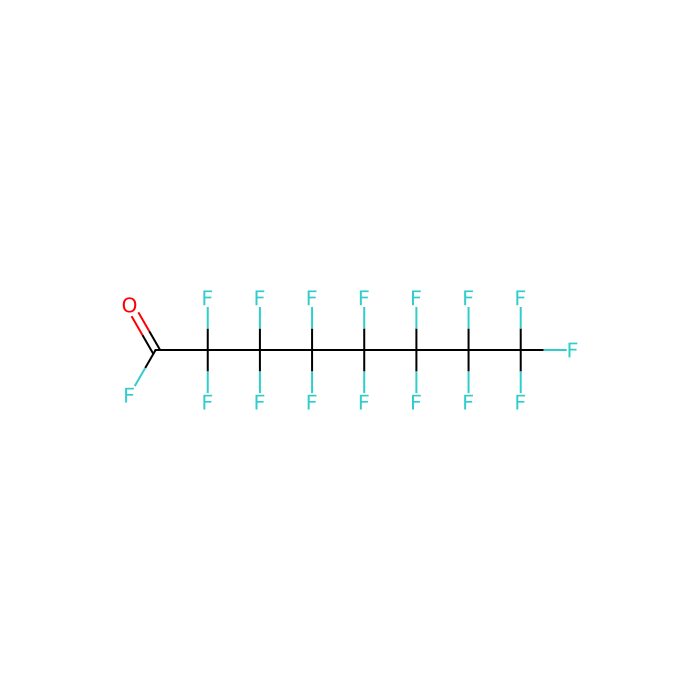
Perfluorooctanoyl fluoride is a perfluoroacyl fluoride (R–COF) corresponding to the acid fluoride of perfluorooctanoic acid.
Item-specific (from Product Data):
SKU: P331775
CAS: 335-66-0
InChIKey: 457908 (as provided)
Storage: Store at 2–8°C; shipped on wet ice
Research Use: For research use only
Literature/computed identifiers and features (for reference; not specifications):
Functional group: acyl fluoride (carbonyl carbon bonded to fluorine: –COF)
Backbone: a fully fluorinated C8 perfluoroalkyl chain (CF3–(CF2)6–), terminating at a carbonyl fluoride.
2D features: linear, saturated perfluoroalkyl chain; electron-withdrawing fluorines render the carbonyl highly electrophilic yet less nucleophilically reactive than an acid chloride; no stereocenters or rings; no hydrogens on the carbon skeleton.
Synthetic Utility
Functional group profile and retrosynthetic value (literature):
Electrophilicity: The –COF group is strongly activated by the inductively withdrawing perfluoroalkyl chain; it reacts with nucleophiles (amines, alcohols) to form amides/esters with predictable chemoselectivity.
Chemoselectivity vs acid chlorides: Acyl fluorides are generally less prone to side reactions (e.g., overacylation, rearrangements) and can offer cleaner profiles in the presence of sensitive functionalities. They are also less susceptible to solvolysis in aprotic media.
Activation chemistry: Formation of activated esters (e.g., imidazolides, nitrophenyl esters) provides orthogonal handles for stepwise acyl transfer, useful in complex molecule assembly and polymer modification.
Fluorous tagging: The perfluorooctanoyl group functions as a removable “fluorous tag” for phase-vanishing or fluorous SPE, enabling streamlined purification.
Transformability: Hydrolysis to PFOA supplies a convergent path to other PFO derivatives (acid chlorides, anhydrides) if needed, though starting from the fluoride often minimizes side-generated HCl.
Workflow tips:
Couple under anhydrous, mildly basic conditions; titrate base to the nucleophile equivalents to sequester HF without promoting elimination or side reactions.
Track conversions by 19F NMR and IR (νC=O of acyl fluorides typically higher than acids/esters).
Target Specificity
Not applicable. This product is a small-molecule acylating reagent and not a biological targeting agent, antibody, or probe. No antigen/epitope or isotype information applies.
We use cookies to ensure the website functions properly and, where permitted, to improve your experience. You can manage your preferences at any time in Settings. Learn more in our Cookie Policy.
Shall we send you a message when we have discounts available?
Remind me later
Thank you! Please check your email inbox to confirm.
Products are supplied to verified businesses, institutions, and qualified professionals for research and development use only. Not for use in humans, animals, diagnosis, or therapy.

 H2613445